
Sweet Potato
Ipomoea batatas
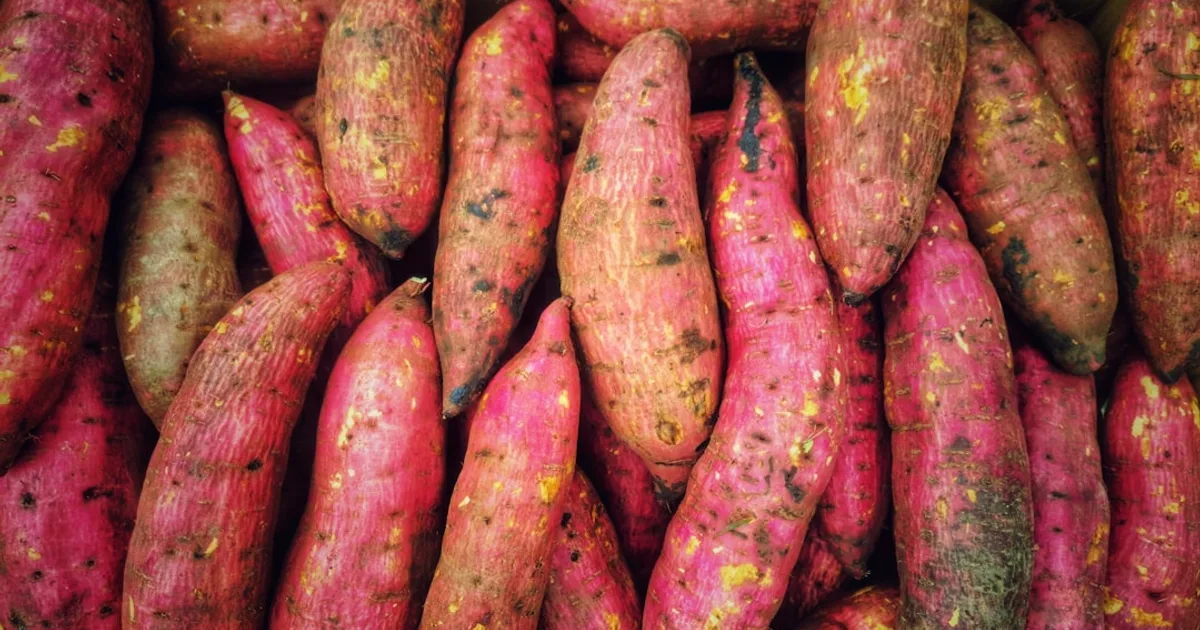
Sweet potatoes (Ipomoea batatas) are not related to potatoes. They’re a member of the morning glory family (Convolvulaceae), and the biology of propagating them reflects that - you don’t plant tubers or seeds, you plant slips, which are rooted stem cuttings grown from a stored sweet potato. Once you understand how slips work, the year-over-year economics of growing sweet potatoes become much better than almost any other vegetable crop.
Year one: you buy slips at $3–$6 per bunch of 5–12 slips, or you buy one sweet potato from the grocery store and grow your own. Year two: you save a few roots, grow slips from them in early spring, and plant for near-zero input cost. The crop is perennial in zones 9–11; in cooler zones it’s an annual, but the slip propagation cycle means your seed cost in subsequent years is the cost of a little heat mat time and some water.
Slips: how the propagation actually works
A sweet potato slip is a stem cutting taken from a sprouting root. Six to eight weeks before your last frost date, take a sweet potato root and suspend it half-submerged in a jar of water in a warm (75–80°F) location. Shoots will emerge from the root. When shoots are 4–6 inches long with developing root nodes, twist them off and place them in water until roots are 1–2 inches long, then transplant. One sweet potato root can produce 10–20 slips (University of Georgia Extension, Sweet Potato Production, Bulletin 1338, 2020).
Commercially produced slips are available from seed companies and are certified disease-free. For first-year growers unfamiliar with the crop, purchased slips are reliable. After year one, save a few good-looking roots and grow your own.
Variety selection
Beauregard is the commercial standard - disease-resistant, produces in 90–100 days, orange flesh, widely available as slips. Consistent and predictable.
Covington is the dominant commercial variety in North Carolina production. Better skin appearance and longer storage life than Beauregard.
Jewel and Garnet are common storage types with good flavor and 4–5 month storage life.
Japanese/Korean white-flesh types (Murasaki, O’Henry) command $3–$5/lb at Asian specialty markets and farm stands (USDA AMS Specialty Crop Market News, 2023). If you have access to those markets, white-flesh varieties shift the ROI math.
Vardaman is a compact bush type that works for small spaces and containers - most sweet potato vines spread 4–6 feet in every direction.
The ROI case
Slips from a retailer run $0.50–$0.75 each. At 4 lb average yield per slip (under good conditions) and $1.75/lb retail (USDA ERS, Vegetables and Pulses Yearbook, 2023), each slip returns $7. The seed cost per slip is $0.50–$0.75. That’s a 9:1 to 14:1 return by value in year one.
In year two, if you grew your own slips from saved roots, your input cost drops to electricity for the heat mat and the cost of the jar on your windowsill. The return per square foot over a multi-year planting cycle is hard to beat.
Variety ROI: The Specialty Market Gap
Not all sweet potatoes return the same per-pound value. The difference between standard and specialty types is large enough to factor into variety selection if you have access to specialty buyers or Asian grocery markets.
| Variety | Days to maturity | Flesh type | Typical retail price | Yield per slip (4 lbs typical) | Per-slip value |
|---|---|---|---|---|---|
| Beauregard | 90-100 days | Orange | $1.50-2.00/lb (conventional) | 4 lb | $6-8 |
| Covington | 90-100 days | Orange | $1.75-2.25/lb (conventional) | 4 lb | $7-9 |
| Jewel | 100-110 days | Orange | $1.75-2.00/lb (conventional) | 3.5-4.5 lb | $6-9 |
| O’Henry | 100-110 days | White | $3.00-4.50/lb (specialty) | 3-4 lb | $9-18 |
| Murasaki (Japanese purple skin) | 110-120 days | White | $3.50-5.00/lb (specialty) | 3-4 lb | $10-20 |
| Purple (Stokes, Okinawan) | 120-130 days | Purple | $4.00-6.00/lb (specialty) | 2.5-3.5 lb | $10-21 |
Sources: USDA AMS Specialty Crop Market News (2023); University of Georgia Extension, Sweet Potato Production, Bulletin 1338 (2020); NC State Extension variety trials.
The caveat is market access. Beauregard is what conventional grocery stores sell; you’ll find buyers easily. Murasaki and O’Henry require a local Asian grocery or a farmers market with buyers who know what they are. If neither is available in your area, the specialty price premium exists in theory but not in practice. Plant what you can actually sell or use. For households who cook Japanese or Korean food regularly, growing Murasaki for home use at $4/lb versus $5/lb at the Asian market still makes the math favorable.
Spacing, Bed Management, and Expected Yield
Sweet potato vines spread aggressively - 4 to 6 feet per plant in every direction under good conditions. Most home gardeners underestimate this and plant too densely, which competes for light and reduces root development.
Recommended spacing: 12 to 18 inches between slips in rows 3 to 4 feet apart. This is wide compared to other vegetables. In a standard 4x8 bed, this means 6 to 8 slips per bed if rows run the length, or 4 to 6 slips per bed if vines need to spill over the sides.
A 4x8 bed with 6 slips at 12-inch in-row spacing, allowing vines to trail beyond the bed edges:
- 6 slips × 4 lb average yield = 24 lb total
- At $1.75/lb (Beauregard conventional): $42
- At $4.00/lb (Murasaki specialty): $96
- Seed cost (purchased slips): 6 × $0.65 = $3.90
The vine management consideration: after vines reach 18 to 24 inches, redirect them back toward the bed to prevent rooting at nodes, which produces small, misshapen secondary roots. Every two weeks through August, walk the bed and tuck vine tips back to the soil area over your main root zone (NC State Extension, Sweetpotato Production, Bulletin AG-09, 2019). It takes 5 minutes and keeps root development concentrated under the original slip planting area.
Growing requirements
Sweet potatoes are serious heat lovers. They’re native to tropical South America and perform accordingly. Soil temperature must be above 60°F before transplanting - below that, vines stall and root development is poor. Most gardeners in zones 5–7 transplant slips 3–4 weeks after last frost when soil has had time to warm (Clemson Extension, Sweet Potatoes, HGIC 1322, 2021).
In cool-summer climates (Pacific Northwest, upper Midwest), short-season varieties like ‘Vardaman’ (90 days) and the use of black plastic mulch to preheat soil can make the difference between a harvest and a failure. Without soil warming, vines grow but don’t produce roots before frost.
Soil pH of 5.5–6.5. Sweet potatoes prefer slightly acidic, loose, well-drained soil. Sandy loam is ideal. Heavy clay prevents root expansion and produces misshapen, cracked tubers. If your soil is heavy, growing in raised beds or mounded rows improves the outcome.
Once established (2–3 weeks after transplanting), sweet potato vines are drought-tolerant - more so than almost any other common vegetable crop. They evolved in a seasonally dry environment. Overwatering established plants is a more common mistake than underwatering; wet soil encourages root rot. Water once per week during the main growing season; reduce further once vines are dense and covering the soil.
Nitrogen is counterproductive in sweet potatoes. Excess nitrogen produces lush vine growth and tiny roots. If you’ve amended with heavy compost or added nitrogen fertilizer, you may end up with beautiful vines and a poor harvest. Apply compost sparingly and skip nitrogen-heavy fertilizers entirely after transplanting.
What goes wrong
Sweet potato weevil (Cylas formicarius) is the most serious pest where it’s established (primarily in the Gulf States). The adult is a small blue-black and red weevil; larvae bore through vines and into storage roots, making them inedible. There is no effective chemical control for established infestations. Prevention: use certified slip stock from disease-free sources, rotate crops, destroy all crop debris at season end, and don’t move soil or plant material between sites.
Fusarium wilt (Fusarium oxysporum f. sp. batatas) causes yellowing, wilting, and death of vines. Infected roots show internal brown discoloration. Resistant varieties (Beauregard, Covington) are the primary management tool. Don’t replant in an infected bed for several years.
Scurf (Monilochaetes infuscans) is a soilborne fungus that causes dark, scurfy patches on root skin. It’s cosmetic but reduces marketability. Certified slip stock and crop rotation prevent it from building up.
Wireworms (click beetle larvae, family Elateridae) bore into roots. Same management as with potatoes: avoid beds recently converted from lawn, rotate away from problem areas.
Harvest and storage
Harvest before the first killing frost. Frost-damaged sweet potato roots rot quickly in storage. The standard timing: 90–120 days after transplanting. Check root size by gently digging alongside a plant with a fork to expose a root without pulling the vine.
Harvest carefully - sweet potato roots bruise easily, and any damage creates an entry point for storage rot. Dig with a broad fork, not a spade. Work slowly.
Cure immediately after harvest: 85–90°F with 85–90% relative humidity for 4–7 days. This critical step heals wounds, sets the skin, and converts starches to sugars - it’s what makes a freshly dug sweet potato sweet rather than starchy (North Carolina State Extension, Sweetpotato Storage, AG-09, 2019). Without proper curing, the roots store poorly and don’t develop full flavor.
After curing, store at 55–60°F in moderate humidity. Do not refrigerate - temperatures below 50°F cause chilling injury and produce an off-flavor. Properly cured Beauregard and Covington types store 4–6 months. Specialty types vary.
Related crops: Arugula, Winter Squash
Related reading: Beginner Homestead Crops - where sweet potatoes fit in a first-year homestead growing plan; Root Cellaring for the Modern Home - how sweet potatoes cure and store for months, changing the seasonal harvest economics; Sweet Potato ROI Analysis - slip cost versus yield and the per-pound grocery savings comparison
Frequently Asked Questions
What are sweet potato slips?
Slips are rooted stem cuttings grown from a stored sweet potato - you plant slips, not tubers or seeds. Each stored root produces 5 to 20 slips over 4 to 6 weeks in warm, moist conditions. In year 2, save roots from your own harvest and grow slips at no cost.
How do I cure sweet potatoes after harvest?
Cure freshly dug sweet potatoes at 85 to 90 degrees with high humidity (85 to 90%) for 4 to 7 days. Curing converts starches to sugars (improving flavor), heals skin wounds, and prevents rot. Improperly cured roots are starchy and bland.
How long do cured sweet potatoes keep?
Properly cured sweet potatoes store 6 to 10 months at 55 to 60 degrees with moderate humidity. Do not refrigerate - temperatures below 50 degrees cause chilling injury that produces a hard center and off-flavor.
Growing Sweet Potato? Track your harvest value and break-even date in the Garden ROI app.
Get the App