
Chayote
Sechium edule
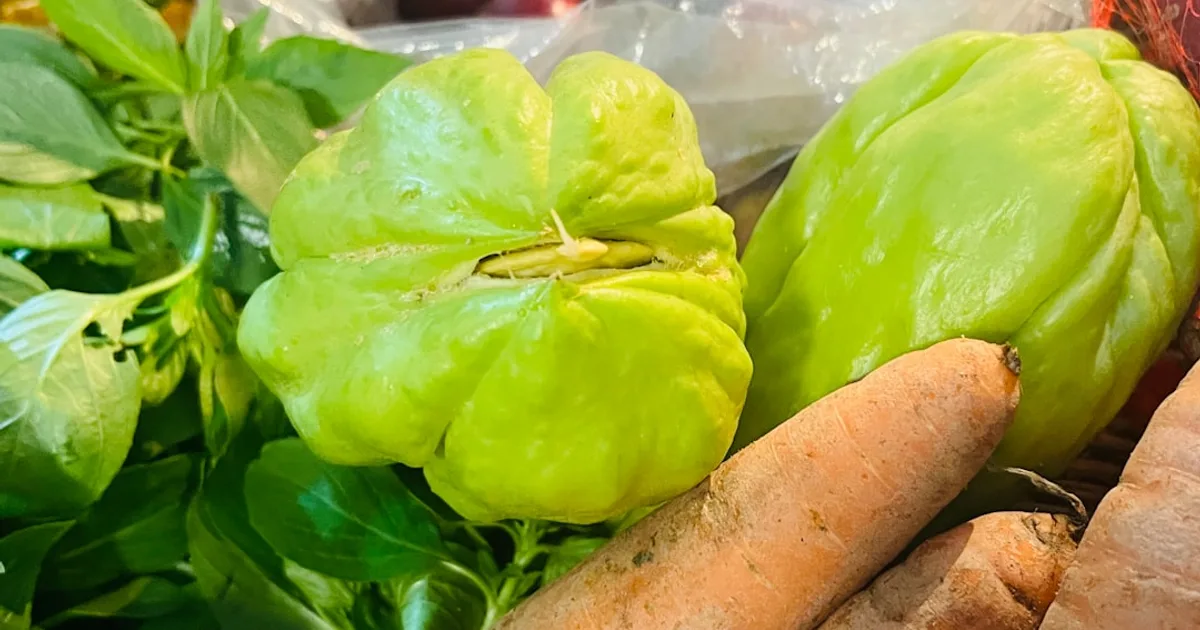
Chayote is the most productive food plant most American gardeners have never tried. A single vine in its second or third year in a warm climate will produce 50-100 fruits per season. In ideal conditions - zone 9-10, long warm season, established root system - that number climbs to 200. At $1-2 per fruit retail at Latin American markets, the math is straightforward.
The fruit itself is mild - crisp, slightly sweet, somewhere between a cucumber and a potato - which makes it one of those vegetables that takes on the flavor of whatever you cook it with rather than asserting itself. That’s an asset, not a flaw. In Latin American cooking it goes into everything: soups, stews, salads, gratins, and pickles. In Southeast Asian cooking it’s stir-fried with garlic and oyster sauce. The shoots and young leaves are eaten as greens. The large starchy root of established plants is cooked like a potato.
What it actually is
Sechium edule is in the gourd family (Cucurbitaceae), native to Mesoamerica. It’s the only species in its genus. The plant is a vigorous perennial vine in frost-free climates that grows 30-50 feet, and an annual elsewhere. It climbs by tendrils and produces lobed leaves 4-8 inches across.
The fruit is botanically unusual: it contains a single seed that is not separated from the flesh by a hard barrier. The entire fruit - skin, flesh, and seed together - is the propagating unit. You plant the whole fruit.
Fruit color varies by variety from pale green to white to dark green; shape varies from deeply ridged to smooth. The primary distinction in cooking:
| Type | Skin | Flesh | Flavor | Best use |
|---|---|---|---|---|
| Smooth green | Thin, smooth | Crisp, mild | Mild, slightly sweet | Raw, stir-fried, soups |
| Spiny green | Spiny, thicker | Firmer, more starchy | More pronounced | Roasting, gratins |
| White | White, thin | Very mild, crisp | Most delicate | Fresh eating, pickling |
All three types are interchangeable in most recipes. Smooth green is the most widely available in US markets.
The root (tayota or chayotextle) is a large, starchy tuber that develops on established perennial plants in zones 9-11. It’s cooked like a potato - boiled, baked, or fried - and is a staple food in parts of Mexico and Central America.
The ROI case
Chayote’s economics depend heavily on whether you’re in a zone where it’s perennial (years 2+ are exponentially more productive) or growing it as an annual.
As a perennial (zones 9-11):
| Year | Fruits | Value @$1.50/fruit | ”Seed” cost | Cumulative net |
|---|---|---|---|---|
| 1 | 15-30 | $22.50-45 | -$2.00 | $20.50-43 |
| 2 | 50-100 | $75-150 | - | $95.50-193 |
| 3 | 100-200 | $150-300 | - | $245.50-493 |
| 5 | 150-250 | $225-375 | - | $695.50-1,243 |
As an annual (zones 5-8):
| Planting | Fruits | Value @$1.50/fruit | Cost | Net |
|---|---|---|---|---|
| 1 vine | 20-40 | $30-60 | $2.00 | $28-58 |
The annual production is still positive but lower than the perennial case. In zone 8, a perennial root system that survives mild winters gives a real production boost in year 2+.
The seed cost advantage: the “seed” is a grocery store chayote, available for $1-2. You don’t need a special seed packet. Next year’s seed comes from this year’s harvest.
Growing requirements
Starting: plant the whole fruit. Place it at an angle in a large container or directly in the ground, with the wide stem-end down and the narrow tip pointing up and barely exposed or covered by 1 inch of soil. The fruit will sprout from the pointed end. In zones 5-7, start indoors in a large container (at least 3 gallons) 4-6 weeks before last frost. In zones 8+, direct plant outdoors after last frost when soil is warm.
Support: chayote is a vigorous climber that needs substantial support - a 15-20 foot run of trellis, fence, or arbor. It can cover an entire pergola by midsummer. Without support, the vine sprawls unmanageably and yields drop. The support investment pays off over years in zones where the plant is perennial.
Pollination: chayote produces separate male and female flowers on the same vine. A single vine will fruit (self-fertile). Multiple vines improve fruit set. The flowers are small and inconspicuous; bee and insect activity is required for pollination.
Soil: well-drained soil with generous organic matter. Chayote is a heavy feeder - side-dress with compost or balanced fertilizer monthly during the growing season. Consistent moisture, especially during fruit development, prevents blossom drop and small fruit.
Season length: chayote needs a long growing season to produce well as an annual - 120+ frost-free days. In zones 5-6, an indoor start is essential and a 4-foot row cover tunnel in fall adds 2-3 weeks of production.
Overwintering in zone 8: plants often die back to the ground in zone 8 winters but regrow from the root. Mulch heavily after the first frost to protect the crown.
What goes wrong
Vine growth without fruit: happens when the plant has insufficient warmth during flowering, or when male and female flowers aren’t open simultaneously (unusual but occurs). Also happens with excess nitrogen fertilization, which drives vegetative growth at the expense of fruiting.
Powdery mildew: universal in cucurbits by late summer. Keep plants well-watered; improve airflow. Doesn’t reduce production much on established plants if it arrives in August when fruits are already developing.
Angular leaf spot (Pseudomonas spp.): water-soaked angular spots on leaves. Avoid overhead irrigation; the bacterial disease spreads in water splash.
Short season failure: in zone 5-6, chayote planted without an indoor start or from an undersized transplant may not produce before frost. The indoor start must be in a large container (the whole fruit takes significant space) - don’t start in a small cell.
Harvest and use
Harvest fruits when they’re full-sized but before they start to wrinkle or the skin loses its sheen. At that point they’re past peak tenderness. Smaller fruits (tennis ball to fist size) are more tender; larger fruits have slightly firmer, more starchy flesh. Check the vine every 2-3 days during peak production.
Store at cool room temperature for 2-3 weeks or refrigerated for 4-6 weeks. Cut chayote browns slightly on exposure to air; use promptly after cutting.
Preparation: peel (optional - the skin is edible when young and tender), remove the central seed (soft and edible; can be cooked with the flesh), and slice, dice, or grate. No acidulation needed.
Core preparations:
-
Stir-fried chayote with garlic (Latin American): julienned chayote, stir-fried 3-4 minutes over high heat with garlic, salt, and lime juice. One of the simplest preparations. The texture holds its crunch; the lime brightens the mild flavor.
-
Chayote soup: diced chayote in a chicken or vegetable broth with onion, garlic, and tomato. A staple in Mexican and Central American cooking. Chayote holds its shape in the broth and absorbs the flavors of the base.
-
Stuffed chayote (chayote relleno): halved and partially cooked chayote, flesh scooped out and mixed with ground pork or beef, tomato, onion, and spices, then baked in the shell. Common in Mexican and Caribbean cooking.
-
Chayote gratin: sliced chayote layered with cream, Gruyère, and herbs, baked until tender. The mild flavor is a good foil for rich dairy preparations; it doesn’t compete with the cheese the way stronger vegetables would.
-
Raw chayote slaw: shredded raw chayote dressed with lime juice, cilantro, salt, and a small amount of chili. The raw texture is like jicama - crunchy and refreshing. A natural substitute in any jicama application.
Related reading: Jicama - fellow mild, crisp tropical root; Luffa - another productive tropical climbing cucurbit; Vegetable Value Per Square Foot - maximizing ROI in limited garden space
Growing Chayote? Track your harvest value and break-even date in the Garden ROI app.
Get the App