
Turnip
Brassica rapa subsp. rapa
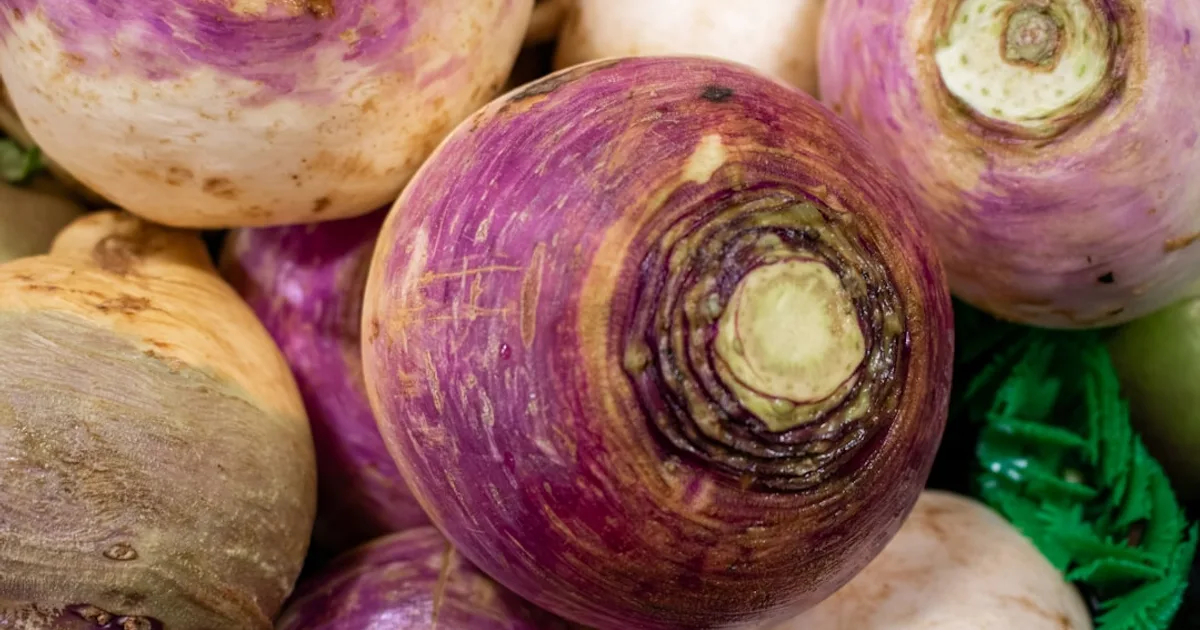
Most people who grow turnips treat the greens like packaging material - something you strip off and compost before you get to the actual vegetable. That’s leaving money on the table. A $1.99 packet planted in late summer can return $14 worth of produce before the first hard freeze, if you manage it right. That number requires harvesting both crops, which takes maybe five minutes of attention per week starting at day 30.
Here is the math. A standard turnip planting produces roughly 4 lb of roots at market value of $1.75-2.50/lb - call it $8 at $2/lb. The same planting produces around 2 lb of harvestable greens across the growing period. Fresh turnip greens at farmers markets sell for $2-4/lb (USDA Agricultural Marketing Service Specialty Crop Market News). At $3/lb, that’s another $6. Total from a $1.99 packet: $14. You are not going to beat that return per dollar invested anywhere in the cool-season garden.
The catch is that you have to actually harvest the greens - selectively, at the right time, without stripping the plant bare. More on that below.
What it actually is
Turnip (Brassica rapa subsp. rapa) sits in the same species as napa cabbage, bok choy, and mizuna. The different subspecies just emphasize different parts of the plant. In turnip, breeders have selected for the swollen hypocotyl - the stem tissue just above and below the soil line - rather than the leaves or a heading structure. The root you eat is not technically a root in the botanical sense. That distinction matters less in practice than knowing that both the tops and the hypocotyl are fully edible and nutritionally worthwhile.
There are three practical groups:
Baby/salad turnips - Hakurei types and Tokyo Market - are harvested at golf-ball size, around 30-38 days. Thin-skinned, crisp, no bitterness. They don’t need peeling and hold up raw in salads. Hakurei in particular changed American farmers market perception of turnips starting in the early 2000s, when growers discovered they could sell Japanese salad turnips to people who had never voluntarily bought a turnip before. A customer who wouldn’t touch a Purple Top will pay $4/lb for a bunch of Hakurei. Same species, different customer.
Standard storage turnips - Purple Top White Globe, Golden Ball - grow to 3-4 inches across at 55-60 days. The skin toughens. These are cooking turnips. They hold in a cold root cellar or refrigerator for 2-3 months, which is the argument for planting them in volume if you’re putting food by.
Greens-focused types - Seven Top is the main one - are grown primarily for the tops. The root is present and edible but secondary. The plant directs energy into dense, productive leaf growth rather than root swelling. If you want greens and don’t care much about the root, Seven Top is the right tool.
The dual-crop case
The ROI numbers above assume a specific management approach: you harvest outer leaves beginning at day 30, while letting the roots continue developing to full size at day 45-60. This is not complicated, but it requires restraint. You want 3-4 outer leaves per harvest per plant, and you leave the inner growth alone. The plant needs photosynthetic capacity to push energy into root development. If you strip it, the root suffers.
The timing works because leaf and root development happen on different schedules. By day 30, the outer leaves are large enough to be useful in the kitchen and the plant has enough inner leaf mass to sustain root growth. You make a selective harvest - outer leaves only, cut at the base - and the plant keeps growing. Repeat every 10-14 days until you pull the root.
For a 10-foot row at 6-inch spacing (20 plants), rough numbers look like this:
| Harvest | Timing | What You’re Taking | Approx. Weight |
|---|---|---|---|
| Greens harvest 1 | Day 30 | 3-4 outer leaves per plant | 0.75 lb |
| Greens harvest 2 | Day 42 | 3-4 outer leaves per plant | 0.75 lb |
| Root harvest | Day 50-60 | Pull entire plant | 3-4 lb |
| Total | ~5.5 lb |
At $2/lb roots and $3/lb greens: (4 lb × $2) + (1.5 lb × $3) = $12.50 from one 10-foot row, planted for $1.99. If you’re selling at a farmers market, the margins are better because fresh turnip greens are an easier sell than you might expect - particularly alongside the roots.
Variety selection
Not all turnips are the same crop in practice. Variety choice affects days to maturity, root character, greens quality, and what the plant is actually good for. The table below covers the main options worth knowing.
| Variety | Days to Maturity | Root Character | Greens Quality | Best Use |
|---|---|---|---|---|
| Purple Top White Globe | 55 days | 3-4 inch, white flesh, purple shoulder | Good, slightly coarse at maturity | Standard cooking turnip; good for storage |
| Hakurei | 38 days | 2-3 inch, white, very smooth skin | Excellent, tender | Raw in salads; farmers market; quickest ROI |
| Seven Top | 45 days | Small, fibrous, edible but not the point | Very good; productive, large leaves | Greens-focused; cut-and-come-again harvest |
| Scarlet Queen | 45 days | Red-skinned, white flesh, 2-3 inch | Good | Visual appeal at market; early harvest |
| Golden Ball | 60 days | Yellow flesh, dense, sweet | Good | Sweetest flavor; longest maturity; storage |
Hakurei is worth growing even if you’ve written off turnips. It is mild enough that people eat it like an apple at the farmers market stand, which no one does with a Purple Top. The trade-off is that it has a smaller root and shorter storage life. Eat it fresh within a week.
Golden Ball takes the longest - 60 days - but the yellow flesh has a different flavor from standard white types. The extra starch-to-sugar conversion that happens in cool fall soil hits Golden Ball particularly hard. A Golden Ball pulled in October after a few nights in the 30s is not the same vegetable as a spring-planted Purple Top that matured in June heat.
The fall timing argument
If you plant turnips in spring and harvest them in June or July, you’re getting a different vegetable than if you plant in July and harvest in September and October. Fall turnips are consistently better. This is not preference - it’s physiology.
When soil temperatures drop, the plant converts stored starch to sugars - the same process that makes parsnips and Brussels sprouts sweeter after frost. A fall turnip pulled after the first light frost has a mild, slightly sweet flavor. The same variety planted in spring and harvested in heat can be sharp, pithy, and pungent. The sulfur compounds in Brassica vegetables are more pronounced when the plant matures under stress.
For Zone 5-6, the target planting window for fall turnips is late July to early August - 45-60 days before your average first frost (mid-October in most Zone 5 locations, late October in Zone 6). This puts the root development phase in September, when nights are cool but days are still warm enough for steady growth. You get the best of both.
The other advantage to fall planting: flea beetle pressure drops as temperatures cool. Spring brassicas in most of the country take a beating from flea beetles (Phyllotreta species) in April and May. A late July planting misses the heaviest pressure window.
If you’re reading this in April, plant Hakurei now for a spring harvest - it’s fast enough (38 days) that it matures before summer heat sets in. But for Purple Top or Golden Ball, wait for fall. Spring-planted slow-maturing turnips are likely to disappoint.
Growing requirements
Turnips are direct-seeded only. The root development is disrupted by transplanting; you’ll get forked, fanged, or stunted roots if you try to start them in trays. Broadcast in rows 6-8 inches apart or scatter across a bed, cover with no more than 1/4 inch of soil, and firm the seedbed with the back of your hand or a board. Turnip seeds are small and need good soil contact. They’ll germinate in 3-7 days at soil temperatures of 50-70°F (Cornell Cooperative Extension).
Thin to 4-6 inches for baby types, 6-8 inches for full-size roots. The thinnings are edible. Don’t compost them - the small leaves and tiny roots from thinning are usable in salads or stir-fries. This is the first greens harvest, free of charge, that comes before you’ve even started the dual-crop management plan.
Soil pH 6.0-7.0. Turnips are light feeders by brassica standards. Incorporate compost before planting, but don’t push heavy nitrogen fertilization. Excess nitrogen drives leaf growth at the expense of root development, which is the opposite of what you want in a standard root turnip. (For Seven Top, grown for greens, additional nitrogen actually makes sense.)
Consistent moisture matters more than total moisture. The goal is 1-1.5 inches of water per week, steady. Irregular watering - dry spells interrupted by heavy water - produces pithy, cracked roots. If you’re getting less than an inch of rain per week, supplement with drip or soaker hose irrigation rather than overhead watering, which increases foliar disease pressure.
What goes wrong
Flea beetles (Phyllotreta species) are the main spring pest. Adults chew small round holes in young leaves; a heavy infestation can devastate a planting before the seedlings establish. Row cover over newly seeded beds prevents adult feeding. Remove the cover once plants are 3-4 inches tall and growing fast. Fall plantings largely avoid this - flea beetle populations drop as temperatures cool in August and September.
Root maggots (Delia floralis - the turnip root maggot) are the other serious problem. The adult fly resembles a small housefly and lays eggs at the soil line; larvae tunnel through roots, creating brown scarring and entry points for rot. Row cover through the first four weeks of growth prevents egg-laying. Crop rotation - no brassicas in the same bed for three or more years - reduces soil population. If you see tunneling damage, pull the crop early and don’t leave the damaged roots in the ground.
Pithy roots are almost always caused by one of three things: heat at maturity, drought stress during root development, or harvesting too late. Roots left in warm soil past their peak swell too large and become spongy inside. Harvest when the shoulder is 2.5-3 inches across. Bigger is not better.
Downy mildew (Peronospora parasitica) shows as yellow patches on upper leaf surfaces with gray sporulation on the undersides. Thin plantings improve air circulation; avoid evening overhead irrigation. More common in wet fall weather. Not usually fatal to the crop, but it reduces greens quality.
Harvest and dual-crop management in practice
For the greens harvest: cut outer leaves at the base, leaving the growing point and inner leaves untouched. The cut should be clean - use scissors or a knife rather than tearing. Three to four leaves per plant per harvest is the working guideline. The plant grows back from the center. You can do this every 10-14 days from day 30 until you pull the root.
Do not harvest greens from plants that are under moisture stress. If the soil is dry and the plant looks wilted in the afternoon, water first and wait a few days before taking leaves. A stressed plant that’s also losing leaves is going to give you a poor root.
For the root harvest: pull when the shoulder of the root is the target size for the variety. Baby types (Hakurei, Scarlet Queen): pull at 2-3 inches across. Standard types (Purple Top, Golden Ball): 2.5-3 inches. Pull by grasping the tops at the base and pulling straight up. If the soil is hard, loosen it with a trowel or fork first rather than snapping the top off by force.
For storage: remove the tops immediately after harvest. Tops left on pull moisture from the root and the root softens within days. Washed, topped roots in a plastic bag in the refrigerator stay firm for 2-3 weeks. In a cool root cellar at 32-40°F and high humidity, they’ll hold for 2-3 months (University of Minnesota Extension).
Turnip greens are best used within 3-4 days of harvest - they wilt and yellow faster than kale or collards. Wash in cold water, spin dry, store in a damp towel in the refrigerator.
In the kitchen
The standard American treatment of turnips - boiled, possibly buttered, served as a side dish - does not do the vegetable any favors. Boiling leaches out the sugars and concentrates the sulfur compounds. There are better methods.
Glazed turnips are the gateway recipe for people who think they dislike turnips. Peel and cube a fall-harvested Purple Top or Golden Ball, cook in butter over medium heat until they start to soften, add a tablespoon of honey and a few sprigs of thyme, and let the liquid reduce to a glaze. The honey amplifies the existing sweetness; the thyme cuts through the richness. A turnip that tasted harsh raw becomes a different vegetable here.
Navarin d’agneau - the classic French braised lamb and vegetable stew - uses turnips as a primary vegetable alongside carrots and potatoes. The long braise in lamb stock transforms the texture and integrates the flavor into the dish completely. It’s not a recipe where you taste the turnip as a separate thing; it becomes part of the broth and the whole dish is richer for it.
Raw Hakurei in salads needs no transformation. Slice thin, dress with rice wine vinegar, a little sesame oil, and salt. That’s it. Hakurei is mild enough that the sharp-turnip problem doesn’t apply.
For greens: turnip greens are traditional in Southern cooking, cooked long with pot liquor (the cooking liquid, which is where a lot of the nutrition goes). For a faster approach, saute with garlic in olive oil for 5-7 minutes until wilted. The flavor is more assertive than spinach but less bitter than mature kale. Young greens harvested at the first cutting are the mildest.
Related crops: Radish, Arugula
Related reading: Succession Planting Calendar - how to stagger fast-maturing crops like turnips and radishes for continuous harvest through spring and fall
Growing Turnip? Track your harvest value and break-even date in the Garden ROI app.
Get the App