
Beet
Beta vulgaris subsp. vulgaris
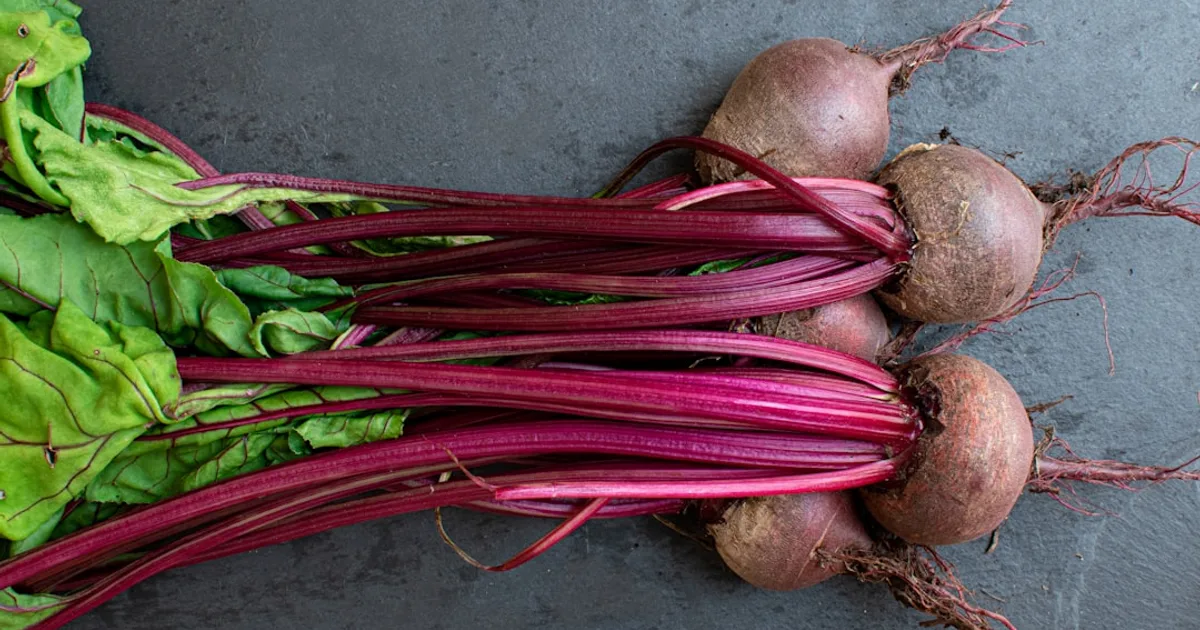
Beets (Beta vulgaris subsp. vulgaris) are the only common garden crop where you harvest the same plant twice. The roots are the main event, but the greens are essentially a free second crop. Beet greens at the farmers market run $3–$4/lb and are nutritionally comparable to Swiss chard - they’re the same species. When you thin your beet seedlings, you’re pulling young plants that would otherwise be composted. Those thinnings are fully edible greens. The math for a $2.49 seed packet becomes noticeably better once you account for both harvests.
What you’re actually growing
Beets divide into four main types in home garden catalogs:
Red/crimson types - the Detroit Dark Red lineage dominates home gardens. Reliable, uniform, good flavor at baby or full size.
Golden/yellow types - milder flavor than red, don’t bleed when cut, excellent roasted. Slower to germinate than red types in some trials.
Chioggia (candy cane) - Italian heirloom with concentric red-and-white rings when sliced. Striking raw in salads; rings fade when cooked. These sell for $4–$6/lb at specialty markets and farmers markets (USDA AMS Specialty Crop Market News, 2023).
Cylindra/Formanova - elongated, carrot-shaped roots that slice uniformly. Good for pickling because you get consistent rounds.
The “seed” in beet packets is actually a dried fruit containing 1–4 seeds clustered together. When that cluster germinates, multiple seedlings emerge from one spot. Thin to one plant per cluster promptly or roots crowd each other and stay small.
The ROI case
A $2.49 packet contains roughly 200–250 seeds (most beet packets are generous). At standard spacing of 3–4 inches in-row (Cornell Cooperative Extension, Beet Production, 2020), a 4-foot row holds 12–16 plants. Mature beets at typical garden conditions yield 0.25–0.50 lb each. A full 4x8 bed dedicated to beets realistically produces 20–30 lbs of roots.
At $2.50/lb (USDA ERS retail price data, conventional beets, 2023), that’s $50–$75 in root value. The specialty math is better: Chioggia at $5/lb from the same bed is $100–$150. Add the greens from thinning and from harvesting outer leaves during the season, and a single bed earns its inputs.
The break-even on the seed cost is trivially fast. The real costs are bed space and your time - beets are harvested once (or twice with succession planting), not continuously.
Double-Harvest Value: Roots and Greens
The financial case for beets improves when you account for both harvests - the roots you planned for and the greens you’d otherwise compost.
Thinning greens. When beet clusters germinate and produce multiple seedlings, you thin to one plant per spot. Those thinnings, pulled at 3 to 5 inches tall, are fully edible greens. For a 4x8 bed with approximately 50 plants at final spacing, early thinning might remove 50 to 100 small plants - roughly 0.5 to 1 lb of baby greens. At the farmers market, baby beet greens sell for $3 to $4 per bunch and command the same prices as microgreens at specialty retailers.
Outer leaf harvest during the season. Once beet plants are established and the roots are sizing up, you can harvest 1 to 2 outer leaves per plant every 2 weeks without affecting root development. Penn State Extension notes that leaf removal up to 30% of the plant’s leaf area doesn’t reduce root yield. For a 50-plant 4x8 bed harvested at 1 outer leaf per plant every 2 weeks over 6 weeks before main root harvest: approximately 1 to 2 lb of beet greens per season.
Full harvest-time greens. At main root harvest, each plant produces a substantial bunch of greens attached. These greens are often discarded, but they’re the same crop as store-bought beet greens or Swiss chard. A 4x8 bed at final harvest yields 2 to 3 lb of greens in addition to the root harvest.
Here’s the total double-harvest math for one 4x8 bed, succession-planted twice (spring and fall), running Zone 6:
| Harvest component | Spring sowing | Fall sowing | Value ($2.50/lb roots; $3.50/lb greens) |
|---|---|---|---|
| Roots (4x8 bed, 50 plants) | 20-30 lb | 20-30 lb | $100-150 roots per sowing |
| Thinning greens | 0.5-1 lb | 0.5-1 lb | $1.75-3.50 per sowing |
| Mid-season outer leaf harvest | 1-2 lb | 1-2 lb | $3.50-7.00 per sowing |
| Harvest-time greens | 2-3 lb | 2-3 lb | $7.00-10.50 per sowing |
| Per sowing total | ~$112-171 | ||
| Two-sowing season total | ~$224-342 |
Source: yield data from Penn State Extension, Beet Production for Pennsylvania (2019); OSU Extension, Beets and Chard, HYG-1606; greens pricing from USDA AMS Specialty Crop Market News (2023).
Against a $2.49 seed packet that covers both sowings, the bed-level return is clear. The greens component adds $12 to $21 per sowing - not the main event, but real value that would otherwise go into the compost pile.
Succession Planting: Two Crops from One Bed
Beets produce well in both spring and fall, making them one of the few root vegetables that support two full crops per season from the same bed space. The key is timing each sowing around temperature constraints.
Spring succession: Sow 4 to 6 weeks before last frost, when soil temperature is above 45°F. In Zone 6, that’s late March to mid-April. The crop matures in late May to early June - before heat stress becomes a factor. Beet quality declines when roots mature in sustained temperatures above 80°F, producing pithy, less flavorful roots. Time the spring sowing so roots finish before late June heat (Penn State Extension, Beet Production for Pennsylvania, 2019).
Fall succession: Sow 8 to 10 weeks before first fall frost. In Zone 6, that’s late July to mid-August. This is the more reliable sowing in most years because cooling fall temperatures are in beet’s favor - roots maturing in September and October in cool soil develop better flavor and hold in the ground longer than spring roots. Fall beets that don’t get harvested before frost can actually be mulched and pulled through early winter in Zones 6 and warmer.
Two sowings from one 4x8 bed: at 20 to 30 lb of roots per sowing, the annual total from one bed is 40 to 60 lb of beets. At $2.50/lb conventional, that’s $100 to $150 in root value. At $5/lb for Chioggia specialty, $200 to $300. The seed packet containing both sowings costs $2.49.
Growing requirements
Beets are cool-season crops. The ideal soil temperature for germination is 50–85°F; they bolt (flower and turn bitter) when exposed to temperatures below 45°F for extended periods after germination (Penn State Extension, Beet Production for Pennsylvania, 2019). This makes spring planting timing specific - sow 4–6 weeks before last frost, and expect the crop to mature and be harvested before summer heat arrives. A fall planting seeded 8–10 weeks before first frost is often more reliable in zones 6 and warmer.
Soil pH of 6.5–7.0. Beets are sensitive to low pH and will develop brown heart (internal tissue discoloration) in acidic soils below 6.0 due to boron deficiency, which is exacerbated by low pH. If your soil is acidic, lime to at least 6.5 before planting (OSU Extension, Beets and Chard, HYG-1606).
Phosphorus matters at establishment - it supports root development. Work in compost or a balanced starter fertilizer at planting. Unlike heavy feeders like corn or tomato, beets don’t need aggressive nitrogen supplementation; excess nitrogen produces lush foliage at the expense of root development.
Consistent soil moisture is critical. Irregular watering - dry then wet - produces roots that crack, develop pithy cores, or become fibrous and woody. Aim for 1 inch per week applied evenly. Mulching after seedlings are a few inches tall helps buffer moisture swings.
Beets tolerate partial shade better than most root crops - 4 hours of direct sun will still produce a harvest, though roots will be smaller than in full sun. This makes them useful for partially shaded bed corners.
What goes wrong
Cercospora leaf spot (Cercospora beticola) is the primary foliar disease. It produces circular brown spots with reddish-purple margins on older leaves. It’s a fungus that spreads through irrigation splash and wind and overwinters in plant debris. In mild infections it reduces yield without killing plants. In severe infections it defoliates the plant and stunts roots. Prevention: space plants for airflow, use drip irrigation rather than overhead watering, and remove infected foliage promptly. Crop rotation for 3 years prevents soilborne inoculum buildup.
Leaf miners (primarily Pegomya betae, the beet leafminer) lay eggs on leaf undersides; larvae tunnel through leaf tissue leaving pale, papery blotch mines. Severely mined leaves are inedible as greens and reduce photosynthetic capacity. Inspect the undersides of leaves and crush egg masses. Row cover early in the season physically excludes adult flies. Spinosad controls larvae in active mines.
Aphids - particularly the black bean aphid (Aphis fabae) - colonize beet foliage. Knock back with a water blast or insecticidal soap. Aphid pressure on beets is rarely severe enough to damage roots.
Bolting - when the plant sends up a flower stalk - happens when seedlings are exposed to extended cold (below 45°F for 1–2 weeks) early in their development or as day length exceeds 12–14 hours in spring. Bolted beets develop woody, pithy roots with poor flavor. Timing your planting for soil temperatures consistently above 50°F reduces bolt risk.
Harvest and storage
Roots are best harvested at 1.5–3 inches in diameter. Below that size, you have baby beets with excellent flavor but less volume. Above 3 inches, texture coarsens and flavor can become earthy-bitter, particularly in older varieties. Chioggia and golden types tend to hold quality at larger sizes than red types.
Harvest by loosening soil alongside the root with a trowel or fork and pulling. Don’t yank - the greens separate from the root under direct force.
Cut greens off the roots immediately after harvest, leaving 1 inch of stem attached. Leaving greens on draws moisture out of the root and accelerates wilting. Beets store in the refrigerator for 2–4 weeks as-is, or 4–6 months in a root cellar or garage at 32–40°F in high humidity (Penn State Extension, Vegetable Storage, 2021).
Greens wilt within a day or two. Use them immediately or blanch and freeze.
For pickling - which is how most home gardeners preserve large harvests - beets’ natural acidity makes them good candidates for quick-pickling with vinegar. Follow USDA-tested canning guidelines for water-bath canning shelf-stable pickled beets.
Related reading: Succession Planting Calendar - how to time spring and fall beet plantings to avoid heat and cold stress; Root Cellaring for the Modern Home - how beets store over winter in a cold cellar or refrigerator
Frequently Asked Questions
How do I prevent woody or pithy beet roots?
Thin seedlings to 3 to 4 inches apart after germination - overcrowded roots compete for space and produce woody texture. Harvest roots at 2 to 3 inches diameter before they overmature, especially in warm weather where large roots go pithy quickly.
Are beet greens edible?
Yes. Beet greens are nutritionally comparable to Swiss chard (same species) and retail at $3 to $4/lb at farmers markets. Thinnings and outer leaves harvested throughout the season are a free second crop - saute, blanch, or add to soups.
How do I store beet roots?
Remove greens leaving 1 inch of stem to reduce bleeding, then store unwashed beets in a sealed container with damp sand at 32 to 40 degrees. Properly stored beets keep 3 to 5 months without quality loss.
Growing Beet? Track your harvest value and break-even date in the Garden ROI app.
Get the App