
Bok Choy
Brassica rapa subsp. chinensis
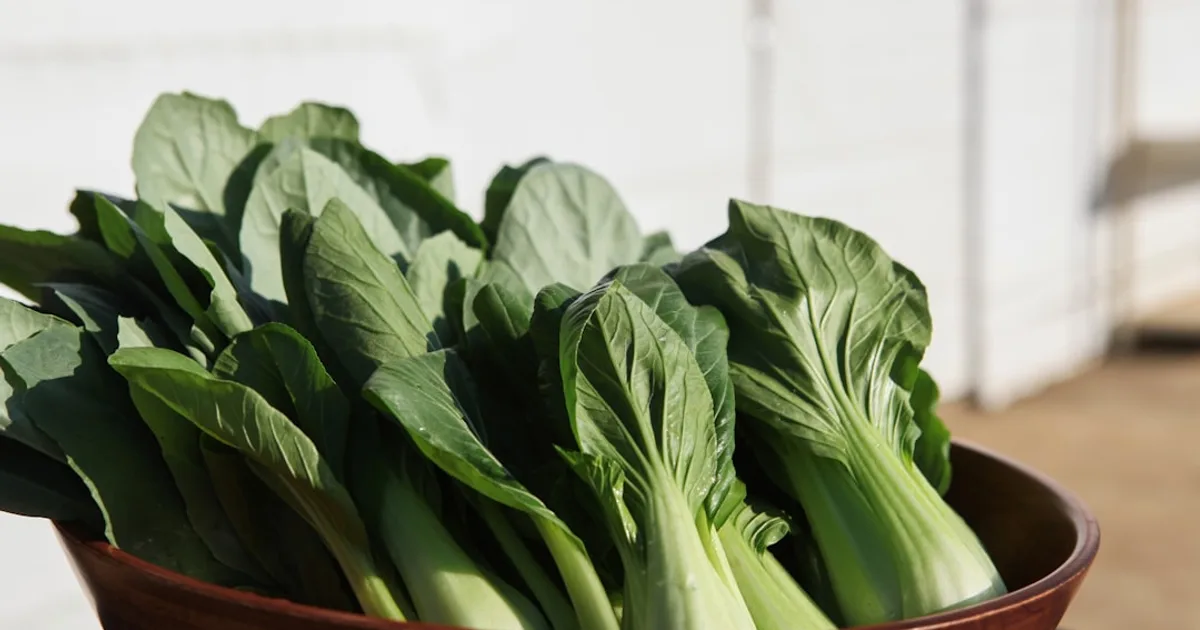
Bok choy (Brassica rapa subsp. chinensis) is one of the most undervalued crops in a home garden. Not because it’s rare or difficult - it’s neither - but because most people grow it as a full-size vegetable when the real money is in baby heads harvested thirty days after transplant. The price difference between full-size and baby bok choy at specialty grocers is not subtle. It’s the difference between a crop that barely justifies the bed space and one that returns four to five dollars per pound in a season you weren’t using that bed for anything else.
What you’re actually growing
Brassica rapa subsp. chinensis is in the same species as turnip (B. rapa subsp. rapa) and napa cabbage (B. rapa subsp. pekinensis). It forms a loose rosette of thick petioles - white or green depending on variety - and broad, dark green leaves. Unlike heading brassicas, it never forms a tight ball. You harvest the whole rosette by cutting at the soil line.
The white-stem types are what most people picture: glossy white petioles, dark green leaves, the classic Asian market look. The Shanghai or green-stem types (B. rapa subsp. chinensis var. communis) have green petioles throughout and a slightly more delicate texture. Both types exist as full-size and baby variants, though some cultivars are specifically bred to stay compact.
Baby bok choy is not a separate species or a fundamentally different plant. It’s bok choy harvested at 4-6 inches tall, typically 30 days after transplanting, before the plant has reached full size. The distinction matters mostly for pricing and cooking use.
The four varieties worth knowing
Most seed catalogs carry a dozen or more bok choy varieties. These four cover the practical range:
| Variety | Type | Days to Maturity | Petiole Color | Best Use |
|---|---|---|---|---|
| Shanghai Green | Baby / compact | 30 days | Green | Stir-fry, halved and seared |
| White Stem / Joi Choi | Full-size | 45 days | White | Braising, soups, high-volume harvest |
| Toy Choi | Miniature | 25 days | Green | Baby salad mix, quick-turn market production |
| Ching-Chiang | Full-size | 50 days | Green | Heat-tolerant; extends the fall window |
Shanghai Green is the workhorse for baby production. It’s what you see halved and caramelized in restaurant stir-fries. Joi Choi is the standard full-size market variety - thick white petioles, good shelf life, productive. Toy Choi stays small at maturity, not just an early harvest of a larger variety, which makes it useful if you’re growing for salad mix or very small portions. Ching-Chiang’s heat tolerance isn’t magic - it will still bolt in a heat wave - but it buys you another week or two at the end of the fall window compared to standard varieties.
The ROI case: baby vs. full-size
A $2.49 packet contains roughly 200-300 seeds, enough to plant a 10-square-foot bed two to three times over. That seed cost is effectively a rounding error.
The real calculation is price per pound against what you can actually grow.
Baby bok choy path (10 sq ft, Shanghai Green):
Space plants 6 inches apart in a 10-square-foot bed. That gives you approximately 24 plants. Baby bok choy harvested at 4-6 inches runs 2-3 oz per head. At 2.5 oz average, 24 plants yields roughly 3.75 lbs. Baby bok choy at specialty grocers runs $4-7 per pound - the $4 end at well-stocked Asian markets, $6-7 at natural food stores and farmers markets. At $5/lb average, that 10-square-foot bed returns about $18.75 in produce. At $6/lb it’s $22.50.
Seed cost allocated to that planting: under $0.25 (a fraction of the $2.49 packet). Soil amendment, water, maybe $0.50-$1.00 in inputs. Net return on that 30-day planting: $17-22.
Do that twice in spring (two succession plantings) and twice in fall and you’ve run four cycles through the same bed. Total seed packet cost: $2.49 for all four plantings combined.
Full-size path (same 10 sq ft, Joi Choi):
Space full-size plants 10-12 inches apart. That gives you 9-12 plants in 10 square feet. Full-size heads at 45 days weigh 0.5-0.75 lbs each. At 10 plants and 0.6 lbs average, you’re at 6 lbs from the bed. Full-size bok choy retails at $1.50-3/lb - lower-end at supermarkets, higher at farmers markets and specialty stores. At $2.50/lb average, that’s $15. At $3/lb it’s $18.
The full-size path takes 45 days instead of 30, gives you more volume per harvest, but lower price per pound. For most home cooks who want bok choy for stir-fry, the full-size yield is more than enough for a household. For anyone selling at farmers market, the baby path is more efficient - higher price per pound, faster turnover, easier to display.
Which path to choose:
If you cook primarily stir-fry and sauteed dishes, baby bok choy is the better choice. The smaller heads cook faster, portion more naturally for 2-4 servings, and command the premium price at market. If you braise, make soup, or cook for a larger household, full-size gives more usable volume per harvest and more flexibility in the kitchen.
The honest answer for most home gardeners: grow baby bok choy in spring when your window is short and you need a fast harvest before the bed turns over to warm-season crops. Grow full-size in fall when the season is longer and you have more time.
Succession planting and the useful windows
Bok choy bolts in heat and long days. It is not a summer crop. The useful growing windows in Zone 5-6 are March to May and August to October. Outside those windows you’re fighting the plant’s biology and you will lose.
Within those windows, succession sow every 10-14 days. A single sowing gives you a one-week harvest window before the plants start sizing out or bolting. Three staggered sowings gives you four to five weeks of continuous harvest from the same bed.
Spring timing: start your first sowing as soon as the soil can be worked, 6-8 weeks before your last frost date. Bok choy seed germinates in 4-7 days at soil temperatures of 45-85°F. Transplant or thin to final spacing after the seedlings have their first true leaves. Get the crop in the ground early - by the time consistent 70°F+ days arrive, you want the plants already harvested.
Fall timing is more forgiving. Start seeds in late July to early August for transplanting in mid-August to early September. Fall days are shortening, which reduces bolt risk, and the plants will grow slowly through September and October as temperatures drop. In Zone 6 you can often harvest into November if you use row cover for frost protection. Fall bok choy is frequently better quality than spring - slower growth produces denser, crisper petioles.
Flea beetles: deal with them on day one
Flea beetles (Phyllotreta spp.) are the primary pest on bok choy and all Asian brassicas. They are small, black or striped, jump when disturbed, and chew dozens of tiny round holes in leaves. On established full-size plants, the damage is cosmetic and doesn’t affect yield much. On seedlings under 4 inches tall, a heavy infestation can kill the plant outright or stunt it badly enough that it bolts early.
The timing problem: if flea beetles are established in your garden from previous years, they will find new seedlings within 48 hours of emergence. By the time you notice the damage, the beetles have been feeding for days.
Row cover from germination to 4 inches tall prevents most damage. Install it before the seeds germinate - not after you see the holes. Floating row cover (Agribon-15 or similar) laid directly on the soil and secured at the edges is enough. Once plants are 4-5 inches tall and past the most vulnerable stage, you can remove the cover.
If you’re growing in a bed that had flea beetle problems the previous year, cover from day one without exception. They overwinter in the soil as adults and emerge in spring looking for exactly the kind of tender brassica seedlings you’re about to grow.
Diatomaceous earth (food-grade, applied dry to the soil surface around plants) reduces adult beetles on the soil surface. It needs to be reapplied after rain. It’s a partial measure - row cover is more reliable.
Spinosad (an OMRI-listed organic insecticide derived from soil bacteria) is effective on flea beetles if you’re dealing with an established population and can’t use row cover. Follow label rates. It breaks down in sunlight within 1-7 days, so repeated applications may be necessary during peak beetle pressure.
Growing requirements
Soil pH 6.0-7.5. Bok choy is a moderate feeder. Incorporate compost before planting. A balanced fertilizer (10-10-10 or similar) at transplanting is usually sufficient for the 30-45 day growth cycle - the crop doesn’t stay in the ground long enough to exhaust soil nutrients under most conditions.
Consistent moisture is more critical than fertility. Drought stress increases bitterness, accelerates bolting, and makes the petioles fibrous. You want 1 to 1.5 inches of water per week, evenly distributed. Drip irrigation or soaker hose is better than overhead watering - wet leaves in cool weather invite fungal problems and make row cover management more complicated.
Light: full sun to partial shade. In spring, full sun is fine. In fall, as days shorten and temperatures drop, full sun helps maintain growth. In hot spells, afternoon shade delays bolting by a few days - not a permanent fix, but useful at the edges of the season.
Spacing: 6 inches apart for baby bok choy, 10-12 inches for full-size. Crowded plants bolt faster than properly spaced ones - this is consistent across brassicas. Don’t try to squeeze extra plants in to get more yield; you’ll get earlier bolting and smaller heads.
Other things that go wrong
Bolting is the most common problem. The plant sends up a flower stalk, leaves turn bitter and tough, and the harvest window closes. Prevention is timing. Varieties marketed as “slow bolt” delay the response by a week or two - worth paying attention to if you’re pushing the edges of the season. Once the central stalk elongates, the plant is done. You can eat the flowering shoots - they’re similar to broccoli raab and good stir-fried - but the main harvest is over.
Cabbage aphid (Brevicoryne brassicae) colonizes the inner leaves of the rosette. A hard water spray directed into the center of the plant dislodges most colonies. Insecticidal soap for persistent infestations. Check inside the rosette when harvesting - a colony can establish in the tight inner leaves without being visible from outside.
Clubroot (Plasmodiophora brassicae) is a soilborne pathogen that causes distorted, swollen roots and stunted above-ground growth. It persists in soil for up to 20 years and has no effective chemical treatment once established (University of Wisconsin Extension, Clubroot of Crucifers, 2019). Rotate brassicas out of any bed where clubroot appears for at least 3-4 years. Raising soil pH to 7.0-7.2 reduces pathogen activity. If you’re in a new bed without brassica history, clubroot is not something to worry about.
How to actually cook it
Bok choy is best cooked fast over very high heat. The window from raw to perfectly wilted is narrow - get it right and you have crisp-tender petioles with caramelized edges and barely-wilted leaves. Overcook it by two minutes and you have a watery, sulfurous mess.
The technique for baby bok choy halved lengthwise:
Get your pan - cast iron or wok - ripping hot before anything goes in. Add oil with a high smoke point (avocado, refined coconut, or peanut oil). Lay the bok choy cut side down. Leave it alone for 45 seconds. Don’t move it. You want actual color on that cut face. Flip each half and cook 30-45 more seconds. The leaves should be just wilted; the petioles still have some snap. Pull them off the heat. Total cook time: 75-90 seconds. Total prep-to-plate time from a washed, halved head: under 5 minutes.
The mistake most people make is using medium heat because they’re worried about burning it. Medium heat steams the vegetable in its own moisture. You get pale, soft, waterlogged bok choy that smells faintly of sulfur. High heat evaporates surface moisture fast and creates the Maillard reaction on the cut face. Those are two completely different dishes.
For full-size bok choy in soups or braises, the timing is different - add it to the broth in the last 3-4 minutes of simmering. It doesn’t need the sear, and the petioles hold up to moist heat better than the leaves, which get silky quickly.
Harvest and storage
For baby bok choy, cut at the soil line when plants reach 4-6 inches. Use a sharp knife - a dull blade crushes the petiole base and accelerates decay in storage. For full-size, cut at the soil line when heads are compact and outer leaves are still dark green without yellowing.
You can harvest individual outer leaves from full-size plants and let them continue growing - this extends the harvest by 1-2 weeks. Stop this approach at the first sign of a central stalk elongating.
Fresh bok choy keeps 3-5 days in the refrigerator in a loosely closed bag. Don’t wash before refrigerating - moisture accelerates decay. The petioles wilt quickly at room temperature, so move from garden to refrigerator without delay.
For longer storage: blanch for 2 minutes, cool in ice water, drain thoroughly, and freeze in zip bags. Frozen bok choy is soft when thawed and only suitable for cooked applications - soups, stir-fry, braised dishes. It won’t work as a salad green after freezing.
Related reading: Spring Garden Planning - how to time cool-season crops to avoid the common spring bolt problem
Growing Bok Choy? Track your harvest value and break-even date in the Garden ROI app.
Get the App