
Luffa
Luffa aegyptiaca
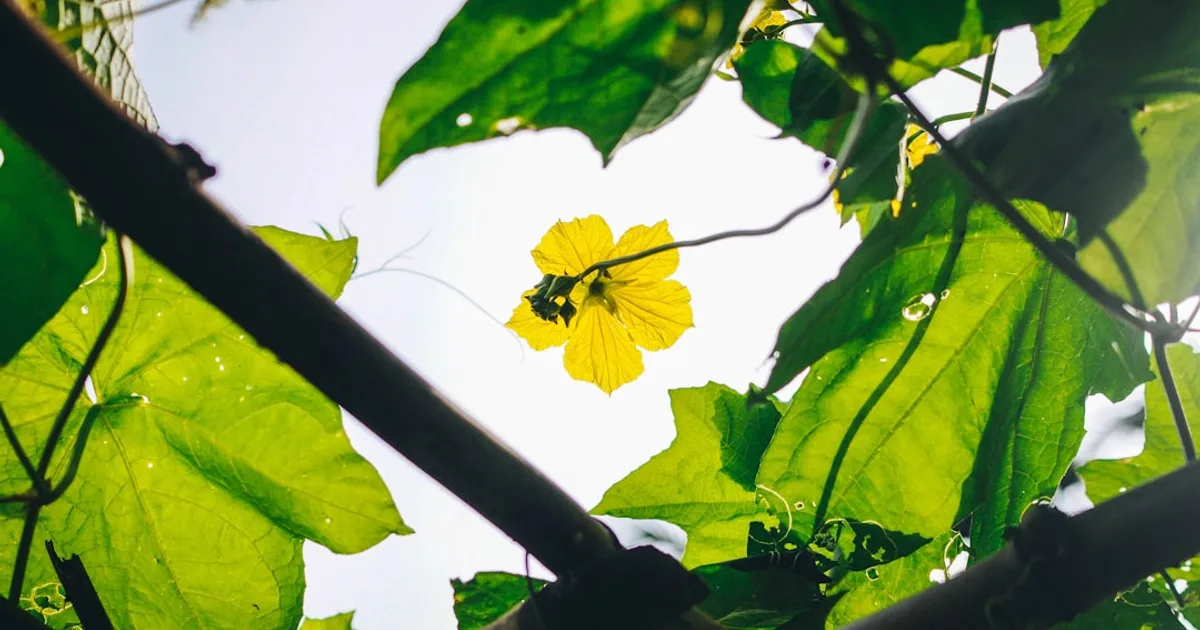
Luffa produces two completely different products from the same plant: a fresh vegetable when harvested young, and a fibrous bath sponge when left to fully mature and dry. Most Americans know it as a loofah sponge and have no idea it’s a food crop, but throughout South Asia, East Asia, and Africa, young luffa is a routine vegetable - stir-fried, curried, and added to soups at the same stage a zucchini would be harvested.
Fresh young luffa ($2-4/lb at Asian markets where available) has a mild flavor with a slightly slippery texture when cooked, similar to okra but less mucilaginous. Dried mature luffa sponges sell for $4-8 each at natural food stores. A single plant over a full season produces 10-20 fruits - either food, sponges, or a combination of both depending on when you harvest.
What it actually is
Luffa aegyptiaca (smooth luffa, Egyptian luffa) and Luffa acutangula (ridged/angled luffa) are the two cultivated species in the gourd family (Cucurbitaceae). L. aegyptiaca is the species sold as loofah sponge commercially. L. acutangula (ridged luffa) has pronounced ridges running down the fruit and is the type more commonly eaten as a vegetable in South Asia (turai or torai in Hindi/Urdu; patola in Tagalog).
Both are tropical vines that grow aggressively on a trellis. In frost-free climates they’re perennial; grown as annuals in zones 5-10.
| Type | Species | Primary use | Texture when young | Season |
|---|---|---|---|---|
| Smooth luffa | L. aegyptiaca | Sponge + food | Very mild, slightly spongy | 90-120 days |
| Ridged/angled luffa | L. acutangula | Food (South Asian) | More tender, less spongy | 80-100 days |
The fiber structure: when luffa is allowed to fully mature (fruit turns yellow-brown, papery), the flesh dries into a fibrous network. This network is the “loofah sponge.” Peeling the dry outer skin and shaking out the seeds reveals the sponge. The fiber is xylem - the vascular tissue of the plant - which is why it’s naturally soft but structurally strong.
The ROI case
Luffa’s value calculation depends on your harvest strategy. Fresh vegetable has the lower per-pound value but is the faster harvest. Sponges have the higher unit value but require a full season.
| Strategy | Fruits per plant | Yield | Value | Seed cost | Net |
|---|---|---|---|---|---|
| Fresh vegetable (all young) | 10-15 | 4-6 lb | $12-24 | $1.25* | $10.75-22.75 |
| Sponge (all mature) | 8-12 sponges | 8-12 units | $40-96 | $1.25* | $38.75-94.75 |
| Mixed (young + sponge) | mixed | 2-3 lb + 5-7 sponges | $6-12 + $25-56 | $1.25* | $29.75-66.75 |
*Estimated from $2.49 packet; 2 plants per row section assumed.
The mixed strategy is usually most practical: harvest a few young fruits as vegetables through summer, then leave the last fruits to mature as sponges. One season’s plants can easily produce $40-60 of sponges plus fresh vegetable value.
A productive, well-managed luffa vine in zones 8-11 can produce 20-30 fruits over a full season. In zones 5-7 with a 4-6 week indoor start and a stretched season, expect 10-15 fruits. The high-end yield figure requires consistent water and fertility, a very long trellis, and no serious disease or pest pressure. Most gardeners in good conditions land between these numbers.
Growing requirements
Season requirement: luffa needs a long, warm season. The 90-120 day maturity figure is from transplant; including a 4-week indoor start, you’re planning for a 5-6 month growing season from seed to mature sponge. In zones 7-11, this is reliable. In zone 6, it’s tight; zone 5 and colder requires row cover extension to get a sponge crop.
Starting indoors: 4 weeks before last frost. Soak seeds 24 hours before planting - the hard seed coat benefits from soaking. Plant 1/2 inch deep in individual 4-inch pots. Germination at 75-85°F in 7-14 days. Transplant after last frost when nights are above 55°F.
Trellis: essential, substantial, and vertical. Luffa vines reach 15-30 feet in a full season and become heavy once fruiting begins - a lightweight trellis collapses. A cattle panel anchored to T-posts, or a sturdy fence at least 6 feet tall, is the minimum appropriate support. Space plants 2-3 feet apart at the base.
The vertical element is critical for fruit quality, not just convenience. Luffa fruits that develop horizontally or rest on the ground develop misshapen, curved, or flattened fibrous tissue. For sponge production especially, a fruit that hangs freely and grows straight produces a uniform cylindrical sponge; a fruit that rests on something grows asymmetrically. For culinary harvest, straightness matters less, but ground contact invites rot and mold. Plan the trellis so fruits hang freely below the vine with no contact with the trellis itself - the stem holds the weight while the fruit hangs below.
Pollination: separate male and female flowers on the same plant. Bee activity handles pollination in most gardens. Female flowers have a tiny immature luffa at the base; male flowers are on a slender stem without a basal ovary.
Fertilizing: moderate feeder. Compost amendment at planting; balanced fertilizer side-dress when vines reach 3-4 feet; potassium-heavy fertilizer once fruiting begins to support fruit development.
Watering: consistent moisture during fruit development prevents bitterness. Bitter luffa results from water stress, exactly as with cucumbers - the plant produces cucurbitacins in the fruit as a stress response. Drip irrigation at the base, or deep watering 2-3 times weekly, is better than shallow daily watering.
What goes wrong
Short season is the primary issue in northern zones. Even with a 4-week indoor start, zone 5-6 gardeners often can’t get fully dried sponges before frost. Row cover extends the season at both ends; leaving a few fruits on the vine as long as possible maximizes sponge maturity. Partially matured luffa can be harvested green and dried indoors, though the sponge quality is lower.
Bitter fruit from water stress or heat stress. Consistent irrigation prevents most bitterness. Harvest at 6-8 inches for best flavor - overmatured young luffa gets bitter and the texture turns pithy.
Powdery mildew appears on older leaves in late summer - same as all cucurbits. Manageable; rarely fatal to the plant at that stage.
Fruit too mature to eat: luffa transitions from tender edible to tough and fibrous quickly (within a few days of the harvest window). A fruit left on the vine a week too long will be inedible as food but fine for sponge production. Check developing fruits every 2-3 days.
Mold on drying sponges: if fruits are harvested before fully dried and dried in humid conditions, the fiber molds before the moisture clears. Harvest in dry weather if possible; dry in a warm, well-ventilated location (not a damp basement).
Harvest and use
For eating (young luffa): harvest when fruits are 4-8 inches long and still tender - the younger end (4-6 inches) gives the most delicate texture, closer to zucchini. At 6-8 inches the flesh is still edible but begins to show more texture variation. The test is skin resistance: the skin should yield easily when pressed with a thumbnail. If it resists firmly, the fruit is transitioning toward sponge-suitable maturity. Harvest every 2-3 days during peak season - luffa develops quickly and the edible window is short.
For sponges (mature luffa): leave fruits on the vine until the skin turns yellow to brown and papery. The fruit feels lighter than expected for its size - the flesh has dried. After harvest, soak in water for 30 minutes to soften the outer skin, then peel. Shake out the seeds (save for next year). Wash the sponge in diluted bleach (1 tablespoon per gallon of water) to remove remaining flesh and whiten. Rinse thoroughly, squeeze dry, and allow to dry completely before storing.
Preparing for eating: peel the skin with a vegetable peeler - the skin is tough regardless of fruit size. Cut into rounds, half-moons, or cubes.
Core preparations:
-
Stir-fried luffa with egg: the most common preparation in East Asian cooking. Peel, slice into half-moons, stir-fry with beaten egg and a splash of soy sauce and sesame oil. The luffa absorbs the egg flavor; texture is soft but not mushy.
-
Luffa in dal (turai dal): South Indian preparation. Ridged luffa (turai) cut into small pieces, cooked in split lentil dal with turmeric and curry leaves. The luffa dissolves partially into the dal, adding body.
-
Luffa soup: Chinese winter melon soup style. Luffa cut in large chunks, simmered with pork ribs, ginger, and dried scallop or shrimp. The flesh becomes silky.
-
Luffa curry: standard in South Asian home cooking. Peeled, cubed luffa cooked in a light tomato-onion curry with cumin, coriander, and turmeric.
Seed Saving
Luffa is one of the simplest crops to save seed from because the sponge harvest and seed saving are the same process. When you harvest a mature sponge and shake out the seeds, you’ve already done the seed-saving work. Let the seeds dry completely on a paper plate or towel before storing. Seeds are large, flat, and dark-colored; easy to clean and handle.
Store dry seeds in a paper envelope in a cool, dry location. Viability: 3-5 years. A single mature luffa contains 50-150 seeds - enough to plant 25-75 plants. You’ll produce more than you need after the first season, which makes luffa an easy seed-swap crop.
Market Value: Sponges Beyond Home Use
Handmade natural luffa sponges sell at farmers markets, craft fairs, and on Etsy in the $4-8 range per individual sponge, and $12-20 for sets of three. The market for natural alternatives to synthetic bath sponges is real and consistent. A 2-plant luffa planting yielding 20-30 mature sponges per season represents $80-240 at direct retail prices - from a $2.49 seed packet.
Differentiation approaches that command premium pricing: sponges packaged with goat milk soap bars as bath gift sets, sponges cut into specific shapes (rounds for facial use at $6-10 each), sponges marketed as kitchen scrubbers (distinct market from bath sponges, different buyer demographics). Natural kitchen scrubbers from luffa are legitimately useful and biodegradable - a positioning that resonates with a specific buyer who pays $4-6 per sponge.
Related reading: Bitter Melon - fellow tropical cucurbit for vertical trellis; Cucumber - cucurbit with similar succession and vertical growing approach
Growing Luffa? Track your harvest value and break-even date in the Garden ROI app.
Get the App