
Elderberry
Sambucus nigra
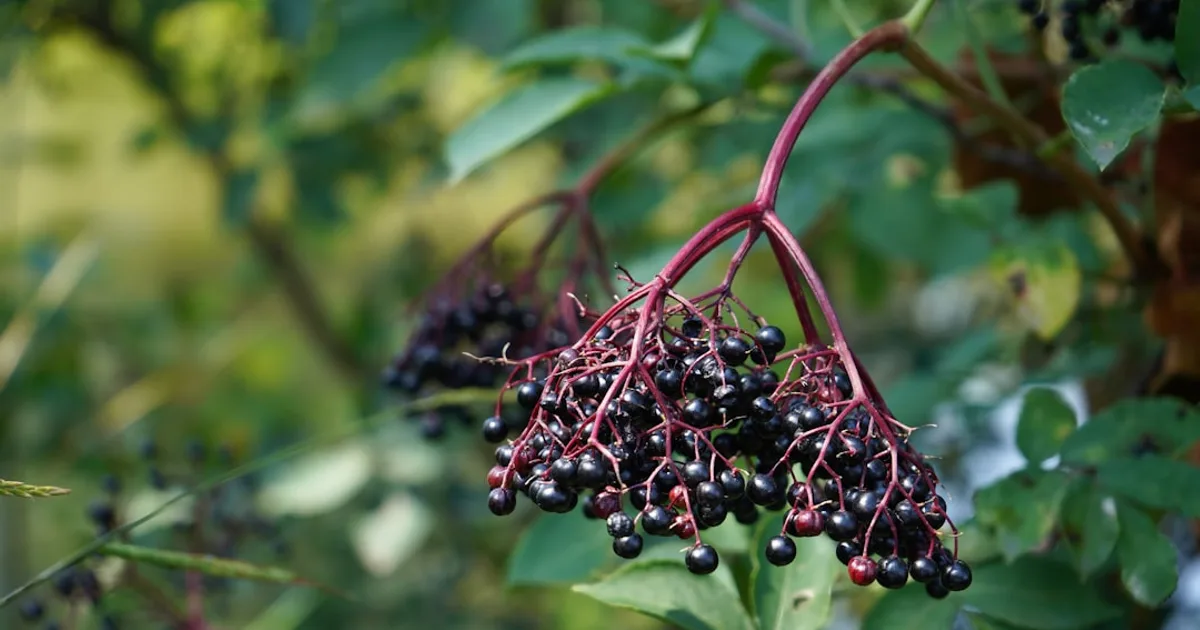
Elderberry (Sambucus nigra) is a perennial shrub that will produce berries for 15-20 years from a single $19.99 bare-root plant. By year four, that plant is putting out 12-20 lb of berries per season. At the low end of fresh retail pricing - $8/lb - that is $96 to $160 per plant per year from something you planted once and mostly leave alone. Before we get into the numbers, though, there is one non-negotiable fact about growing elderberries.
Food Safety - Read This First
Raw elderberries contain sambunigrin, a cyanogenic glycoside that causes nausea and vomiting. The seeds, stems, leaves, and bark contain it in higher concentrations than the ripe berries, but the berries themselves are not safe to eat raw in quantity. This is not a footnote. It is the central operating fact of this plant.
Cooking destroys sambunigrin. Ripe berries that have been simmered, baked, or processed into syrup are safe to eat. Elderflowers - the flat-topped white flower clusters that appear in June - are safe to eat raw and are commonly used in cordials, fritters, and teas. Unripe green berries are more toxic than ripe dark ones and should never be consumed.
Cornell Cooperative Extension documents this clearly: “The ripe black berries are edible when cooked, but the unripe berries, bark, leaves, and roots contain sambunigrin, a cyanogenic glycoside that can cause nausea, vomiting, and diarrhea.” (Cornell Cooperative Extension, Sambucus nigra.)
Strip berries from their stems before cooking. Do not juice the stems into your product. Do not eat raw berries while harvesting, even to taste for ripeness - you have eyes and a color chart for that.
With that established, here is why people grow this plant.
The ROI Case
A bare-root elderberry shrub costs $15-25 at most nurseries. The University of Missouri Extension, which runs one of the most serious elderberry research programs in the country, uses $19.99 as a representative retail price for bare-root plants in their production budgets (Growing Elderberries: A Production Guide for the Midwest, University of Missouri Extension, 2018). That is the number used here.
The plant produces minimal fruit in year one while it establishes. Year two, you get a real but modest crop. Year three and beyond, a well-managed shrub in full production delivers 10-20 lb of fresh berries per season depending on the variety and growing conditions.
Multi-Year Yield and Value Table
| Year | Expected Yield | Fresh Value at $10/lb | Cumulative Value |
|---|---|---|---|
| 1 | Trace - establishment | $0 | $0 |
| 2 | 3-5 lb | $30-50 | $30-50 |
| 3 | 8-12 lb | $80-120 | $110-170 |
| 4 | 12-18 lb | $120-180 | $230-350 |
| 5 | 12-20 lb | $120-200 | $350-550 |
Yields based on University of Missouri Extension production data for named cultivars under midwestern conditions. Price of $10/lb is the midpoint of the $8-15/lb fresh retail range documented by USDA AMS Specialty Crop Market News (2023).
The $19.99 plant cost pays back somewhere in year two at the low end of the yield range, or by mid-year two at the high end. By the end of year five, the cumulative value from a single shrub is $350-550 from a one-time investment of $19.99. There are no replanting costs. Pruning takes 20-30 minutes per year. Fertilization is a bag of compost spread around the base in spring.
One important caveat: elderberries produce more fruit when two different cultivars are planted together. The shrub is partially self-fertile, but cross-pollination from a second variety drives a measurable yield increase. Plant in pairs. The cost becomes $39.98 for two plants, and the cumulative five-year value from both is $700-1,100.
Syrup Value
The more compelling math is in elderberry syrup, which is where most home growers put their harvest.
A standard batch of elderberry syrup runs like this: 1 lb fresh or frozen berries, 3 cups water, 1/2 cup raw honey, cinnamon, cloves, ginger. Simmer the berries and spices for 45 minutes, mash, strain through cheesecloth, cool below 100°F, stir in the honey. This produces roughly 16 oz - two cups - of finished syrup. Commercial elderberry syrup retails for $15-20 per 8 oz bottle in natural food stores. A single batch made from 1 lb of berries yields the equivalent of two $15-20 retail bottles, call it $17 average per bottle, so $34 in retail syrup value from one pound of fruit.
Scale that to a mature plant’s full harvest:
- 10 lb harvest from one plant in year three
- 10 batches of syrup
- Each batch: 16 oz finished syrup (two 8 oz portions)
- Retail value per 8 oz bottle: $17 average
- 10 batches x 2 bottles per batch x $17 = $340 in retail syrup value
That is from a $19.99 plant. The honey and spices cost maybe $3-4 per batch, so the input cost for 10 batches is roughly $35-40. Net value of the syrup produced: $300.
At full production in year four and beyond, a single plant yielding 15 lb of berries produces 15 batches of syrup with a retail value of $510. Two plants at peak production: over $1,000 in annual syrup value from a two-plant investment that cost $39.98.
These are not pie-in-the-sky numbers. They are the math behind why elderberry syrup is one of the most active categories in the natural wellness retail market. You are not growing a novelty - you are growing the raw material for a $10-per-ounce consumer product.
Varieties
Not all elderberries perform equally. The named cultivars developed through university programs produce higher and more consistent yields than wild-type plants or unnamed seedlings. Here are the four you will actually see in nursery catalogs.
| Variety | Origin | Expected Yield | Notes |
|---|---|---|---|
| Bob Gordon | University of Missouri | 12-18 lb/plant | Highest commercial yield in MU trials; upright habit, large berry clusters; best choice for maximum production |
| Adams | Heirloom, NY origin | 10-12 lb/plant | Reliable, widely available, good flavor; more open habit than Bob Gordon; pairs well with Nova |
| Nova | Agriculture Canada | 8-12 lb/plant | Cold-hardy to zone 3; excellent flavor, slightly smaller berries; good choice for northern growers |
| Ranch | Western US origin | 8-10 lb/plant | Drought-tolerant once established; adapted to lower rainfall zones; better choice west of the 100th meridian |
Yield data from University of Missouri Extension elderberry cultivar trials and Agriculture Canada variety descriptions.
Bob Gordon is the commercial grower’s choice in the Midwest for a reason - the MU trial data on it is thorough and it consistently outperforms the field. For a home garden, Adams paired with Nova gives you two reliable producers with compatible bloom times that ensure good cross-pollination and a range of cold hardiness.
Growing Requirements
Elderberries are adaptable. They are native to woodland edges and stream banks across eastern North America, which tells you something about what they can tolerate. Heavy clay, periodic flooding, part shade - they handle conditions that would kill most fruit crops.
That said, full sun (6+ hours of direct sun) drives maximum berry production. Four to six hours produces a crop, but you leave yield on the table. If you have a choice of planting location, put them where they get morning and midday sun, which also helps leaves dry quickly after rain and reduces fungal pressure.
Soil pH 5.5-6.5. Test before planting if you are unsure - this range covers most garden soils but it matters. Organic matter improves both fertility and moisture retention; work in 2-3 inches of compost at planting and mulch the root zone every spring.
Cold hardiness: American elderberry (Sambucus nigra subsp. canadensis) is reliable to zone 3. European strains tend toward zones 5-6 minimum. The Nova variety, developed in Canada, extends the cold-hardy range for growers in the northern Plains and upper Midwest.
Spacing: 6-8 feet between plants within a row, 10 feet between rows for managed production. For a two-plant home garden pairing, 8 feet apart is sufficient.
Water: 1 to 1.5 inches per week during the growing season. Elderberries tolerate wet feet better than most shrubs but do not thrive in standing water through the winter.
Pruning
This is the management practice most growers get wrong, and it costs them yield.
Elderberry canes have a three-year productive life. New canes emerge from the crown each spring, fruit modestly in year two of their life, and produce at full capacity in year three. By year four, a cane’s productivity drops off and it is taking up space and light that younger canes could use.
The correct pruning approach: each late winter, cut all canes older than three years to the ground. Keep three to five of the youngest, strongest canes per plant. The plant will regenerate new canes from the crown each spring. This rotation keeps the shrub in a constant state of high production.
If you skip pruning for two or three years, the shrub does not die. It becomes an impenetrable thicket of old canes with declining production and poor airflow that invites disease. Catch up by cutting the whole shrub to the ground in late winter. It will regrow fully in one season.
What Goes Wrong
Elderberry borer (Desmocerus palliatus) is the primary pest that actually threatens the plant. This metallic blue-green beetle lays eggs near the base of canes in early summer. The larvae tunnel through the pith, and by midsummer you see wilting, dying canes from the inside out. Cut affected canes below the damage - well below it - and dispose of them in the trash, not the compost pile. There is no effective spray once the larvae are inside the cane.
Aphids - primarily the elder aphid (Aphis sambuci) - colonize new growth heavily in spring. Heavy infestations curl leaves and look alarming. They rarely threaten a mature shrub’s survival. Parasitic wasps and ladybugs typically bring colonies under control by midsummer. Insecticidal soap handles severe infestations in spring if natural predator populations are slow to respond.
Powdery mildew (Podosphaera spp.) appears on leaves in dry summers with warm days and cool nights. It disfigures the foliage but rarely causes serious harm to an established plant. Improve airflow through pruning and avoid overhead irrigation. Removing heavily infected leaves and disposing of them reduces spore load.
Birds. Robins, cedar waxwings, and starlings will clean out a cluster of ripe berries in an afternoon. Net the clusters as they approach full ripeness (the entire cluster turns dark, berries feel soft) or harvest slightly early and let clusters finish ripening in a cool garage. Slightly underripe berries that have been cut still ripen. Fully ripe berries do not keep well off the shrub.
Harvest and Processing
Harvest entire corymbs - the flat-topped berry clusters - when the majority of berries are dark purple-black and soft to the touch. Cut the whole cluster with shears into a bucket. Do not harvest clusters with many green berries still present; let those finish on the shrub or move to the next cluster.
Strip berries from the stems with a fork over a bowl. This takes some time. A large harvest benefits from a stripping fork or a berry stripper tool. The goal is to get berries separated from as much stem material as possible - the stems contain higher concentrations of sambunigrin than the ripe berries and do not belong in your final product.
Fresh berries keep 3-5 days refrigerated. Freeze in a single layer on sheet pans, then transfer to zip-lock bags once frozen solid. Frozen berries keep well for a year and make syrup-making easier because you can process in batches through the winter rather than all at once during the harvest window.
Drying: spread stripped berries on dehydrator trays at 135°F for 18-24 hours until fully dry. Store in airtight glass jars. Properly dried elderberries keep 12-18 months and fetch $10-20 per pound in the specialty wellness market.
Syrup: simmer 1 lb fresh berries (or 1/2 lb dried) with 3 cups water and spices - a cinnamon stick, 6-8 whole cloves, 1 tablespoon fresh grated ginger - for 45 minutes. The liquid will reduce by roughly a third. Mash the berries, strain through cheesecloth, press to extract all the liquid, and let the strained liquid cool below 100°F. Stir in 1 cup raw honey. Do not add honey to hot liquid - the heat destroys the antimicrobial enzymes that most buyers specifically want in the product.
The finished syrup keeps 2-3 months refrigerated in glass jars. For longer storage, freeze it.
Elderflower: harvest flower clusters in June when flowers are open but before pollen has dropped. Use immediately - elderflowers deteriorate quickly once cut. Elderflower cordial, fritters, and infused vinegars are the primary uses. Harvesting flower clusters eliminates berry production on those branches for the season, so a dedicated elderflower harvest means a reduced berry crop. Most growers pick 20-30% of flowers for fresh use and leave the rest to set fruit.
Related crops: Arugula, Garlic
Related reading: First Three Years ROI - how to account for perennial production ramp-up in your break-even math; Dehydrator ROI - dried elderberries at $15/lb, syrup math
Growing Elderberry? Track your harvest value and break-even date in the Garden ROI app.
Get the App