
Passionfruit
Passiflora edulis
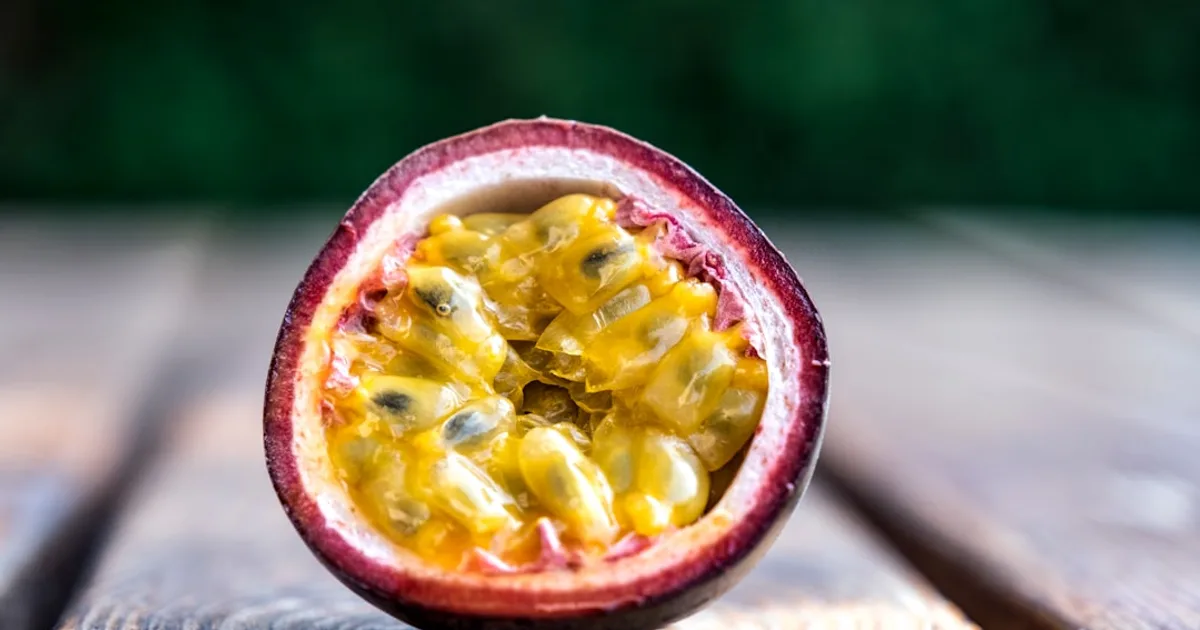
Passionfruit has the most dramatic flowers of any edible plant commonly grown in American gardens. The 3-inch blooms - with their intricate corona of purple and white filaments, five petals, and prominent central stamen structure - are so ornate they look artificial. They bloom continuously from late spring through summer on a vine that climbs 15-30 feet with minimal encouragement. The fruit that follows - golf ball to egg-sized, purple or yellow depending on variety - contains a handful of seeds surrounded by intensely flavored, aromatic pulp.
That flavor is what makes passionfruit worth growing. It’s tropical, floral, sweet-tart, and distinctive in a way that doesn’t translate to substitute ingredients. A single fruit produces enough pulp for a cocktail, a sauce, or a vinaigrette. At $2-4 per fruit at specialty grocers, growing your own in a suitable climate makes immediate financial sense.
What it actually is
Passiflora edulis is in the passionflower family (Passifloraceae), native to South America. The genus has over 500 species; P. edulis is the primary culinary species, though P. ligularis (sweet granadilla) and P. quadrangularis (giant granadilla) are also grown for food.
Two varieties of P. edulis dominate commercial production:
| Variety | Color | Size | Flavor | Cold tolerance | Notes |
|---|---|---|---|---|---|
| Purple (f. edulis) | Dark purple-black | 2-3” | Intense, aromatic, tart | Slightly hardier; to 28°F | Higher quality pulp; preferred for culinary use |
| Yellow (f. flavicarpa) | Bright yellow | Slightly larger | Milder, sweeter, less complex | Less cold-tolerant | More vigorous; commercial in tropics |
The purple form is the better culinary choice for most home growers - more intense flavor, slightly more cold tolerance, and better performance in subtropical climates. The yellow form dominates commercial production in the tropics because of vigorous growth and higher yield, but the flavor is noticeably less complex.
Maypop (P. incarnata) deserves more than a footnote for any gardener north of zone 9. It’s native to the eastern United States, grows wild from Florida to Pennsylvania to Kansas, and is cold-hardy to zone 5 or even zone 4 with some protection. The roots survive hard winters and the vine re-emerges from the ground each spring. It’s the passionflower species that colonial Americans knew, that Cherokee people used medicinally, and that grows along roadsides in the South where it’s treated as a weed.
The fruit is smaller than commercial passionfruit - typically 1.5 to 2 inches, egg-shaped, turning yellow-green when ripe. Flavor is passionfruit-adjacent, sweet and tropical, though less intense than P. edulis. You won’t be making restaurant-quality passionfruit curd from maypop, but you can make a passable syrup, add pulp to drinks, and get the ornamental flower show anywhere from Nebraska to Vermont. For zone 5-8 growers who want something productive and edible on an arbor or pergola, maypop is the honest answer.
One key difference from P. edulis: maypop is deciduous and will die to the ground completely each winter in zones 5-7. What looks like a dead plant in March will re-emerge vigorously in late spring. Don’t dig it up out of impatience.
| Species | Common name | Cold hardiness | Fruit size | Flavor | Best for |
|---|---|---|---|---|---|
| P. edulis f. edulis | Purple passionfruit | Zone 9-11 (to ~28°F) | 2-3 inches | Intense, aromatic | Culinary use, tropics to subtropics |
| P. edulis f. flavicarpa | Yellow passionfruit | Zone 10-11 | 2-4 inches | Milder, sweeter | Commercial tropical production |
| P. incarnata | Maypop | Zone 5-9 | 1.5-2 inches | Tropical, less intense | Cold-climate ornamental + edible |
The ROI case
Passionfruit in zone 9-11 as a perennial vine reaches peak production in year 2-3 and maintains it for 5-7 years.
| Year | Fruits | Value @$3/fruit | Seed cost | Cumulative net |
|---|---|---|---|---|
| 1 (from seed) | 5-15 | $15-45 | -$3.99 | $11.01-41.01 |
| 2 | 40-80 | $120-240 | - | $131.01-281.01 |
| 3 | 80-150 | $240-450 | - | $371.01-731.01 |
| 5 | 100-200 | $300-600 | - | $1,071.01-1,731.01 |
*Figures for zone 9-11 perennial production. In zones 7-8 as an annual or overwintered container plant, year-one production of 5-15 fruits is typical.
Container and zone 7-8 production: passionfruit grown in large containers (15+ gallons) and overwintered indoors in bright light produces a fraction of tropical output but still yields fruit. Expect 5-20 fruits per season from a container-grown vine in its second or third year.
Growing requirements
Climate: P. edulis is perennial in zones 9-11. In zone 8, it dies back to the ground in most winters but regrows from the root; mulch the crown heavily. In zones 6-7, grow in large containers and overwinter in a greenhouse or bright indoor space at 50°F+.
From seed: fresh seed germinates readily in 2-3 weeks at 75-85°F soil temperature. Use seed from a ripe fruit - dried commercial seed has lower germination rates. Scarification (nick the seed coat with a nail file) improves germination rate. Start indoors 8-10 weeks before last frost for annual culture.
From cuttings: passionfruit roots easily from stem cuttings (4-6 inch tips, rooted in water or moist potting mix in 3-4 weeks). This is faster than seed and maintains variety characteristics.
Support: a strong trellis, fence, or arbor is required. The vine climbs by tendrils and reaches 15-30 feet. In containers, a 6-foot trellis provides enough structure for reasonable fruit production.
Pollination: P. edulis can be self-fertile but sets fruit more reliably with two plants or hand pollination. The flower’s structure - with anthers positioned below the stigmas - makes self-pollination mechanically difficult. Transfer pollen between flowers with a small brush or simply plant two seedlings. Carpenter bees are the most effective natural pollinators.
Pruning: after the vine’s second year, prune back to 2-3 main laterals in late winter/early spring to encourage new growth on which fruit develops. Old wood produces less fruit; the annual pruning renewal keeps production high.
What goes wrong
No fruit set: the most common complaint. Causes: (1) insufficient pollination - hand-pollinate with a brush if bee activity is low; (2) temperatures above 95°F during bloom cause flower drop; (3) single plant without cross-pollination. Plant two vines or hand-pollinate.
Fusarium wilt (Fusarium oxysporum f.sp. passiflorae): causes sudden wilting and vine death. No treatment; remove affected plants. Buy certified disease-free plants from reputable nurseries; don’t replant in the same location.
Woodiness virus (PWV): causes yellow mottling on leaves, distorted fruit, and reduced pulp yield. Transmitted by aphids. No treatment; remove infected plants. Control aphid populations to limit spread.
Frost damage: even light frost damages foliage and kills growing tips. In borderline zones, a row of patio lights strung on the vine can provide enough warmth to prevent frost damage on cold nights. Bring container plants in before first frost.
Fruit dropping before ripe: normal if it happens after the fruit colors up - ripe fruit drops naturally. If green fruit drops, it’s heat stress, drought stress, or poor pollination. Consistent watering during fruit development prevents most premature drop.
Harvest and use
Ripe passionfruit drops from the vine - this is how you know it’s ready. Don’t wait for it to look ripe on the vine and then pick it; the fruit falls when the chemistry is right. In a productive season, that means checking under the vine every day. A simple approach: run a strip of bird netting or fine mesh along the ground below the trellis to catch falling fruit before it bruises on hardscape. Fruit that lands on stone or concrete splits and molds quickly. Caught in netting, it stays perfect for several days.
The skin wrinkles slightly as the dropped fruit sits at room temperature - smooth-skinned purple fruits a day or two after dropping aren’t at peak flavor. Give them 3-5 days after falling to develop full aroma. Then cut in half and scoop.
Scoop out the pulp and seeds together - the gelatinous pulp surrounding the edible seeds is the product. Strain through a sieve to separate juice from seeds (seeds are edible but the texture in drinks and sauces is better without them). A single fruit yields 1-2 tablespoons of strained juice. That sounds small, but the flavor is concentrated. One tablespoon in a drink, a sauce, or a dressing is enough to define the whole thing.
Storage: whole fruits keep 2-3 weeks refrigerated; pulp keeps 1 week refrigerated or 3-6 months frozen. Freeze pulp in ice cube trays for single-serving portions - each cube is roughly one fruit’s worth of flavor.
Core preparations:
-
Passionfruit sauce/curd: fresh pulp strained, simmered with sugar, butter, and egg yolks until thickened. The bright tropical flavor holds remarkably well in a cooked curd. Spooned over pavlova, cream-filled pastries, or yogurt.
-
Passionfruit cocktail base: strained fresh juice, 1 tablespoon per drink, combined with rum or vodka, lime juice, and simple syrup. The intensity is high enough that a single tablespoon flavors an entire cocktail. The basis for the Brazilian Batida de Maracujá.
-
Vinaigrette: strained juice with olive oil, a small amount of honey, salt, and Dijon mustard. Used over spinach salads with goat cheese and stone fruit. The floral tartness is unexpected and effective.
-
Mousse: whipped cream folded with strained passionfruit pulp and a small amount of gelatin. Sets to a light, intensely flavored dessert. One of the better applications because the cold temperature amplifies the floral quality.
-
Tropical fruit glaze: reduced passionfruit juice with sugar forms a glaze that works over grilled fish, duck breast, or roasted carrots. The caramelization of the sugars with the tartness of the fruit produces a complex finish.
Market Value
Fresh passionfruit at specialty grocers, upscale natural food stores, and well-stocked Asian markets runs $2-4 per fruit in season. Out of season, $4-6 per fruit is common when they appear at all. Frozen passionfruit pulp in the Latin food section or online (primarily Brazilian brands) runs $8-15/lb equivalent. Fresh, ripe passionfruit from your own vine is worth noticeably more in flavor than commercial frozen pulp - the volatile compounds that create the floral, aromatic quality degrade in processing.
At farmers markets, passionfruit commands attention. Most buyers have never seen the fresh fruit. Price at $3-4 each ($12-20/lb edible yield equivalent) and most customers will try one on the spot. Given the ornamental flower value, the unique tropical flavor, and the absolute rarity of fresh passionfruit in most US markets, this is a crop that markets well even in quantities that would be small for a vegetable.
For zone 9-10 growers with an established vine at year 3-4, a conservative estimate of 100 fruits per season at $3 each is $300 in farm-stand value from a single vine that costs nothing to maintain beyond occasional pruning. The perennial character means this calculation compounds year over year with no replanting cost.
Related reading: Hardy Kiwi - fellow productive tropical-flavored vine; Loquat - subtropical fruit with similar limited commercial availability; Food Forest Basics - establishing productive perennial systems
Growing Passionfruit? Track your harvest value and break-even date in the Garden ROI app.
Get the App