
Mulberry
Morus rubra
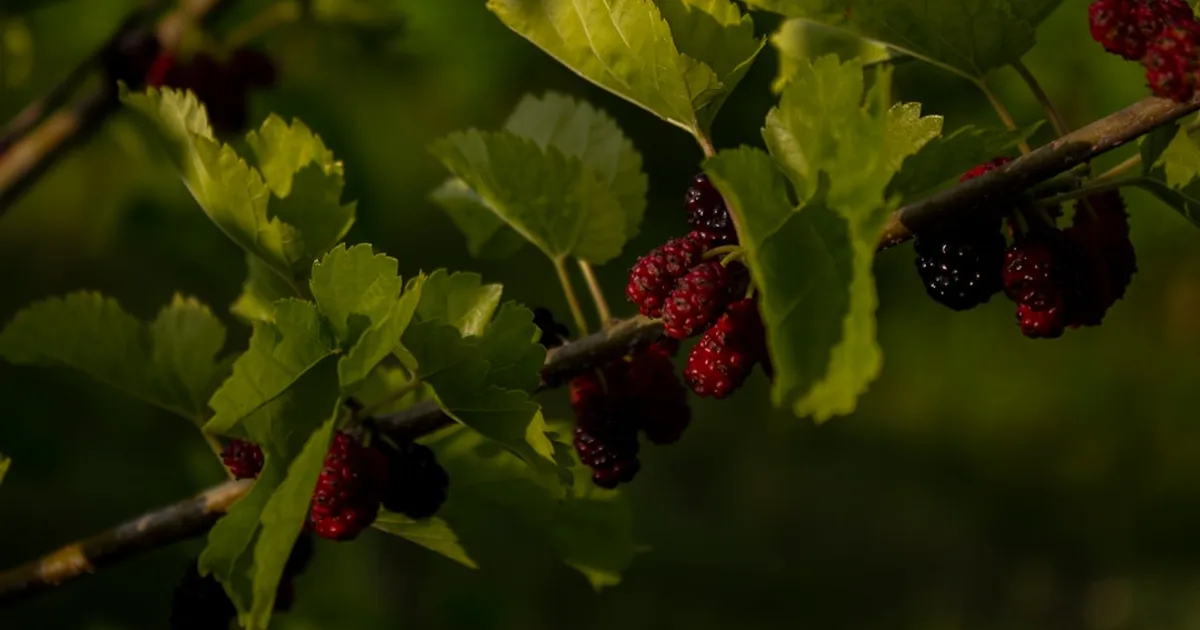
Mulberries don’t appear in grocery stores because they’re too fragile to ship. The fruit deteriorates within 24-48 hours of picking - stains everything it touches, ferments rapidly in warm weather, and simply cannot survive the handling and transit that commercial produce requires. This is precisely why growing your own is the only reliable way to have them. Fresh mulberries at farmers markets, when you can find them, run $8-12/lb. People who have mulberry trees give them away in quantity because a mature tree produces far more than a household can consume.
A mature red mulberry in a good year yields 30-100 lb of fruit. That’s $300-1,000 in market value from a tree that requires almost no annual maintenance, tolerates most soils, and grows vigorously without irrigation once established. The investment case is straightforward.
What it actually is
The genus Morus includes three species commonly grown in North America:
Red mulberry (Morus rubra): native to eastern North America, hardy to zone 4. Fruit is dark red to almost black when fully ripe, with rich, complex flavor that balances sweet and tart. The native species supports a wide range of wildlife, including songbirds, turkey, and deer. Resistant to most of the diseases that affect white mulberry in humid climates.
White mulberry (Morus alba): originally from China, introduced to North America in colonial times for silkworm cultivation. White, pink, or red fruit; flavor is generally sweeter and blander than red mulberry. Extremely vigorous; often considered invasive in parts of the eastern US. Hardy to zone 4-5.
Black mulberry (Morus nigra): from western Asia, considered by many to have the best flavor - intensely sweet-tart, complex, very dark. Less cold-hardy (zone 6-9). Slower growing; takes longer to begin fruiting.
For most of the eastern US, red mulberry or a red x white hybrid (‘Illinois Everbearing’ being the most widely planted) makes the most sense. ‘Illinois Everbearing’ is a popular choice for home gardens: it combines red mulberry flavor quality with the productivity of white mulberry, starts bearing in year 2-3 (faster than standard red mulberry), and fruits over an extended period rather than in a single concentrated flush.
| Species | Hardy to | Flavor | Fruit color | Notes |
|---|---|---|---|---|
| Red mulberry (M. rubra) | Zone 4 | Rich, sweet-tart, complex | Dark red to near-black | Native; best flavor of the group |
| White mulberry (M. alba) | Zone 4-5 | Sweet, mild, less complex | White, pink, or red | Vigorous; potentially invasive |
| Black mulberry (M. nigra) | Zone 6 | Exceptional; intensely sweet-tart | Very dark red-black | Slower, more tender; best for zones 6-8 |
| Illinois Everbearing (hybrid) | Zone 4-5 | Good; red mulberry character | Dark red-black | Early bearing, extended season, most productive |
The ROI case
Mulberry’s economics are exceptional over any time horizon longer than 5 years. The initial tree cost is the only significant input; maintenance costs are minimal.
A standard mulberry tree reaches real production in year 3-4 and full production (30-60 lb/year for a medium tree) by year 5-6. Large, old trees produce 80-100 lb in a good year.
| Year | Input | Yield (lb) | Value @$10/lb | Cumulative net |
|---|---|---|---|---|
| 1 | $19.99 tree | 0 | $0 | -$19.99 |
| 2 | $3 mulch/care | 3-5 lb | $30-50 | $7.01-27.01 |
| 3 | $3 mulch/care | 10-15 lb | $100-150 | $104.02-171.02 |
| 4 | $3 mulch/care | 20-30 lb | $200-300 | $301.02-465.02 |
| 5-10 (avg/year) | $3/year | 40-60 lb | $400-600/year | - |
| 10-year cumulative | ~$38 | ~250 lb | ~$2,500 | ~$2,462 |
The $10/lb figure reflects farmers market pricing where mulberries are sold fresh and premium. Actual household value depends on what you do with the fruit - fresh eating, freezing, jam, wine, or simply what you’d have paid at market.
The comparison to other perennial fruits: plums and apples return $2-3/lb. Mulberries at $8-12/lb represent 3-5x the per-pound value with comparable or lower maintenance requirements after establishment.
The preservation angle: mulberries freeze exceptionally well. Spread on a sheet pan, freeze until solid, transfer to bags - they keep 12 months with minimal quality loss. A productive mulberry season (60 lb of fruit) processed into jam and frozen stock represents $500-600+ in equivalent retail value and a year’s worth of exceptional fruit for baking, smoothies, and eating.
Growing requirements
Mulberry is one of the most adaptable fruit trees in North American horticulture. It grows in a wide range of soils, tolerates brief flooding and drought, and requires minimal inputs after establishment.
Soil: tolerant of clay, loam, and sandy soils. Prefers deep, fertile, well-drained soil but produces in conditions that would stress most fruit trees. Soil pH 5.5-7.0. Avoid only permanently waterlogged sites.
Site: full sun preferred for maximum fruit production. Partial shade (4-6 hours sun) is workable but reduces yield. Consider the tree’s ultimate size - red mulberry and Illinois Everbearing reach 25-35 feet without pruning. Dwarf and semi-dwarf forms exist (‘Dwarf Everbearing’, ‘Contorted’) and are better for smaller spaces or container culture.
Planting: plant container-grown or bare-root trees in spring. Mulberry is tap-rooted and does not transplant as easily as some fruit trees; the younger the tree at planting, the better establishment. Plant at the same depth as grown in the nursery.
Training and pruning: mulberry doesn’t require the same careful annual pruning as stone fruits. Train to a central leader or modified central leader in the first 2-3 years to establish scaffold branches. After that, remove dead, diseased, or crossing wood annually. Drastic pruning stimulates excessive vegetative growth; light annual pruning is sufficient.
Spacing: 20-25 feet between trees for standard forms; 8-12 feet for dwarf types. Mulberry roots are aggressive - keep 15+ feet from foundations, septic systems, and underground utilities.
Siting consideration: the fruit stains. Dark purple-red juice marks concrete, fabric, cars, and anything else it contacts. Don’t site the tree over a patio, driveway, or lawn you care about. A mulberry tree over a lawn creates a mess for 3-6 weeks annually. Practical siting: over a garden bed where the dropped fruit feeds the soil, against a fence where fruit falls on ground rather than surfaces, or anywhere the 3-6 week fruiting season doesn’t create a maintenance problem.
What goes wrong
Birds are the primary competition. Robins, cedar waxwings, and dozens of other species eat mulberries as fast as they ripen. Full-tree netting is effective but difficult with a large tree. The realistic approach: accept that birds take 20-30% of the crop and harvest aggressively during ripening. There’s usually enough fruit for both.
Mulberry borer (Dorcaschema wildii): a longhorn beetle whose larvae tunnel in woody branches. Entry holes filled with sawdust-like frass are the sign. Prune out and destroy affected branches. Stress (drought, poor nutrition) increases susceptibility.
Bacterial blight (Pseudomonas syringae): causes dark lesions on young shoots and leaves in cool, wet spring conditions. Usually self-limiting as weather warms. Prune out severely affected wood; copper spray at bud swell in susceptible areas.
Popcorn disease (caused by Ciborinia carunculoides): a fungal disease specific to mulberry that turns fruits into grossly enlarged, hollow, inedible structures. Remove and destroy affected fruit. Not common in all regions; more prevalent in the Southeast.
Root knot nematode (Meloidogyne spp.): affects mulberries in sandy soils in the South. Choose nematode-resistant rootstocks where available; improve soil organic matter.
Harvest and use
Mulberries don’t all ripen at once - the season runs 3-6 weeks depending on variety and climate. Red mulberry ripens in June-July in most of its range; Illinois Everbearing ripens over a longer period, true to its name.
The standard harvest method: spread a tarp or old sheet under the tree and shake the branches. Ripe fruit falls; unripe fruit stays. Collect, sort, use immediately or freeze. Repeat every few days through the season. This is far more efficient than picking individual berries.
Using fresh: mulberries are sweet enough to eat straight, and the flavor is best within 24 hours of picking. They work well on cereal, yogurt, and in any application where you’d use blackberries. The flavor is distinctly its own - sweeter than blackberry, less aromatic than raspberry, more complex than blueberry.
Freezing: the best preservation method for large volumes. Sheet-freeze on trays, then bag. Frozen mulberries work in smoothies, baked goods, and cooked applications without texture degradation from thawing being a concern.
Jam: mulberries are low-pectin and need added pectin or high-pectin fruit (like apple or green plum) to set properly. A 50/50 mulberry-apple blend with added pectin produces excellent jam. Pure mulberry jam with commercial pectin works but requires exact measurement.
Mulberry wine and vinegar: the juice ferments readily; mulberry wine is made throughout the Middle East and Central Asia and is straightforward to produce at home. Mulberry vinegar (ferment the wine further to acetic acid, or simply steep berries in white wine vinegar) is a useful condiment.
Drying: mulberries dry well in a dehydrator at 135°F for 12-16 hours into a raisin-like product with concentrated flavor. Dried mulberries retail at $10-15/lb; a productive season’s surplus processed into dried form is valuable.
Related reading: Plum - another high-yield perennial fruit; Elderberry - fellow prolific fruit shrub for zones 3-9; Herb Preservation Guide - preserving berry surplus
Growing Mulberry? Track your harvest value and break-even date in the Garden ROI app.
Get the App