
Endive
Cichorium endivia
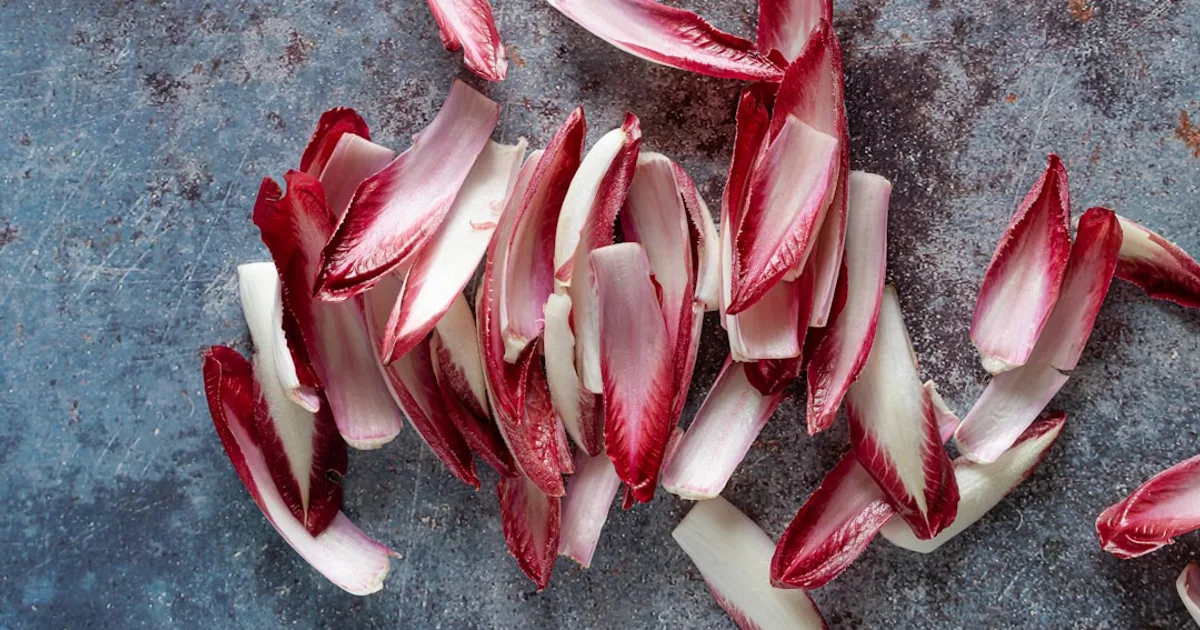
Endive (Cichorium endivia) is a bitter green that most American home gardeners have never grown despite it being a regular item at upscale restaurants and European-style grocery stores. It’s related to radicchio and chicory, shares their characteristic bitterness, and like them it’s most useful to a cook who knows what to do with that bitterness - which is mostly: balance it with fat, acid, or heat.
The blanching technique - covering the developing head to exclude light for 1-2 weeks before harvest - mellows the bitterness, turns the interior leaves pale yellow, and is what separates grocery store endive from the sharper field-grown version. You can skip blanching and eat it at full bitterness, or blanch it and have something closer to what you’d pay $4-5/lb for at the store.
What you’re actually growing
Two distinct types fall under the C. endivia name. Curly endive (also called frisée) has narrow, deeply cut, lacy leaves with curled edges and a frilly appearance. The outer leaves are dark green and quite bitter; the pale inner leaves, if naturally or artificially blanched, are milder and more delicate. This is what high-end salad mixes include when the package says “frisée.” Broad-leaved endive (escarole) has wide, flat, slightly crinkled leaves and a heartier texture. It’s used in both salads and cooked dishes - braised escarole is a classic Italian application. The flavor of escarole is less sharp than frisée.
Then there’s a third thing entirely: Belgian endive (witloof chicory, Cichorium intybus), which is actually a different species. It’s grown as a two-stage crop - roots in the field all summer, then forced in darkness over winter to produce the pale, compact chicons you see in produce sections for $6-8/lb. The process requires more patience and a cool storage space, but the yield per dollar of seed investment is hard to match.
The chicory family
Endive, escarole, radicchio, and Belgian endive are all members of the genus Cichorium. The characteristic bitterness comes from two compounds: lactucopicrin and lactucin. These are the same sesquiterpene lactones responsible for the bitter edge in chicory root - which has been roasted as a coffee substitute and coffee extender for centuries. The connection is not incidental; coffee itself has bitter compounds in the same chemical family.
Blanching reduces bitterness through two mechanisms: it blocks chlorophyll production (which accounts for some of the sharpness), and it slows the accumulation of lactucopicrin and lactucin in the leaves. This is why the inner leaves of a head are always milder than the outer ones even without deliberate blanching - the outer leaves receive full light and accumulate more of these compounds. When you manually blanch by covering the head, you’re accelerating that gradient across the whole plant.
Varieties
| Variety | Type | Days to Maturity | Notes |
|---|---|---|---|
| Très Fine Maraîchère | Curly frisée | 85 days | Fine-cut French market type; classic salade lyonnaise variety |
| Rhodos | Curly endive | 90 days | Slow-bolt; good fall crop; compact habit |
| Neos | Broad-leaf escarole | 90 days | Mild flavor; batavian type; holds well in cool weather |
| Full Heart Batavian | Broad-leaf escarole | 90 days | Self-blanching tendency; widely available |
| Witloof Zoom | Belgian endive (forcing) | 110 days | Standard forcing variety; produces uniform chicons |
Witloof Zoom and other witloof types are for the forcing process only - you do not harvest them as a standard leafy head. If you want Belgian endive chicons, grow a witloof variety. If you want frisée for salads, grow Très Fine Maraîchère or Rhodos. They are not interchangeable.
The ROI case
Endive retails at $3.00-$5.00/lb at specialty grocers and farmers markets (USDA AMS Specialty Crop Market News, 2023). A $2.99 seed packet plants a 25-foot row. At 12-inch spacing, you get roughly 25 plants per row; each head weighs 0.25-0.5 lbs at harvest. That’s 6-12 lbs per row per season.
The availability argument applies here. Fresh frisée and escarole are not common in conventional grocery stores. If you want them for cooking or salads, you’re either growing them or making a specialty grocery trip. That’s the practical case for inclusion in a kitchen garden focused on variety rather than calorie replacement.
Standard harvest vs. Belgian endive forcing: two scenarios from one packet
| Scenario | Planting | Output | Value |
|---|---|---|---|
| Standard harvest (frisée/escarole) | $2.99 seed packet, 25-ft row | 6-12 lb leafy heads | $24-60 at $4/lb retail |
| Belgian endive forcing | $2.99 witloof seed packet, 10 sq ft | 20-25 roots forced to chicons | $40-60 at $8-10/lb retail |
The forcing scenario is worth unpacking. A 10 sq ft planting of witloof produces 20-25 roots by fall. Each root forces one chicon averaging 0.25 lb. That’s 5-6 lb of Belgian endive chicons. Belgian endive retails at $8.00-$10.00/lb at specialty grocers (USDA AMS, 2023) - roughly double the price of standard endive. From a $2.99 seed packet, you’re looking at $40-60 in retail-equivalent production if you do the forcing correctly. The trade-off is time, storage space, and the multi-month process described below.
Fall timing: plant this crop for fall
Endive is almost always better as a fall crop. Heat causes premature bolting and drives up bitterness from the field - the plant produces lactucopicrin more rapidly under heat stress. A fall-grown head is noticeably milder than one harvested in June heat.
Plant 10-12 weeks before your expected first frost date. For Zone 6 (first frost around October 15), that’s transplants in the ground by late July or direct-seeded in early July. For Zone 7, you can push that back two to three weeks. The plant will size up through September and October, when temperatures are dropping - ideal conditions for mild flavor and firm heads.
Spring planting is possible but you’re fighting against day length and summer heat. Most spring-planted endive bolts before you can blanch and harvest it cleanly.
Growing requirements
Transplant-start recommended: sow seeds 6 weeks before transplanting into the garden. Direct sowing works but transplants allow better timing control. Space transplants 12 inches apart in rows 18 inches apart.
Soil pH 6.0-7.0. Endive is not particularly demanding on soil type. A basic amendment with 2 inches of compost before transplanting is sufficient. It’s a light feeder compared to heavy-nitrogen crops like corn or celery.
Water 1 inch per week. Dry stress causes very bitter, small heads. Consistent moisture through head development is important.
Blanching technique
Two weeks before planned harvest, gather the outer leaves loosely over the center of the head and secure with a rubber band or twine. Alternatively, place a plate, container, or inverted pot over the plant to exclude light completely. Keep the covering in place for 10-14 days. The interior leaves turn cream to pale yellow and become noticeably milder.
Blanching only works on heads that are nearly full-sized and only in dry conditions - moisture trapped under covering causes rot. Do not blanch during wet weather.
You can also select self-blanching varieties like ‘Natacha’ (curly) which develop compact heads where outer leaves naturally shade the center, reducing bitterness without manual blanching.
Belgian endive forcing: step by step
This is not a difficult process, but it is a long one. University of Minnesota Extension documents this as a reliable home garden technique requiring no specialized equipment beyond a cool, dark space.
Step 1 - Grow roots to full size (80-100 days). Sow witloof chicory seeds in spring or early summer, same as you would any root vegetable. Give them 12 inches of spacing. Do not harvest them as greens. You want a fully developed taproot by fall - roughly the size of a large carrot, 12-18 inches long and 1-2 inches in diameter at the crown.
Step 2 - Dig roots before hard freeze. After light frosts have knocked back the tops but before the ground freezes hard, dig the roots carefully with a fork. Trim the tops to within 1 inch of the crown. Do not cut the root tip. Inspect roots and discard any that are split, rotted, or undersized (less than 1 inch diameter).
Step 3 - Cold storage for 4-6 weeks. Pack roots loosely in slightly moist sand or sawdust in a box or crate. Store at 35-40°F in a root cellar, unheated garage, or refrigerator. This cold period is required - it breaks dormancy and primes the roots for forcing. Do not skip it. Roots stored at room temperature will produce weak, deformed chicons.
Step 4 - Force chicons in darkness. After the cold period, stand roots upright in a container with 4-6 inches of moist sand or potting mix. The crown should sit just above the medium surface. Place in a dark location - a covered box, a dark closet, a basement corner - at 50-65°F. The darkness is not optional; any light reaching the developing chicon causes it to open, spread, and turn bitter. The goal is a tight, blanched, pale cylinder.
Step 5 - Harvest chicons. In 3-4 weeks, chicons will push up from the crown reaching 4-6 inches tall. Cut them at the base when they’re tight and firm. Each root produces one primary chicon weighing 0.2-0.3 lb. After removing the first chicon, some roots will produce a second smaller chicon if left in the forcing medium for another 2-3 weeks - smaller and less uniform, but usable.
Force roots in batches of 5-6 every two weeks through winter for a continuous supply rather than a single large harvest.
Belgian endive in the kitchen
Belgian endive chicons are bitter, crisp, and slightly sweet at the core. Braised in butter with a small amount of sugar, they caramelize and the bitterness softens into something complex - this is a classic Belgian preparation. Halve them lengthwise, brown cut-side down in butter over medium heat, add a pinch of sugar and a splash of water, cover and cook through. The bitterness becomes a feature instead of a problem.
Belgian endive boats - the individual leaves used as scoops - are a natural application. Fill with blue cheese and toasted walnuts, or with a mixture of apple, celery, and walnuts. The bitterness of the leaf works against the richness of the cheese the same way it works in a composed salad.
Frisée in the kitchen
The classic application for curly endive is salade lyonnaise: frisée with lardons (thick-cut bacon or pork belly, rendered and hot), a warm sherry vinegar pan sauce poured over the greens, and a poached egg on top. The bitterness of frisée balances the fat of the bacon; the warm dressing and egg yolk soften it further. This is not a salad where you substitute romaine - the bitterness is the point.
Frisée also holds up to grilling in a way that tender lettuces don’t. Halved, dressed with olive oil and salt, and grilled until lightly charred, the outer leaves crisp and the interior softens. Finish with lemon and shaved Parmesan.
What goes wrong
Tipburn - brown, papery margins on interior leaves - is a calcium deficiency caused by rapid growth and insufficient calcium translocation. It’s common in over-fertilized plants or during humid weather. Reduce nitrogen fertilization and maintain consistent watering. It’s cosmetic damage, not a rot; trim affected leaves.
Botrytis (Botrytis cinerea) causes gray fuzzy rot on leaves in wet, cool conditions - particularly under blanching covers. Only blanch in dry weather, and check heads daily during the blanching period.
Aphids cluster in the center of developing heads. Check inside outer leaves during routine inspection. Insecticidal soap is effective; getting the spray into the head requires direct aim.
Bolting converts the head to a seed stalk in heat or long days. Fall plantings avoid most bolting pressure. If a plant bolts, it’s not recoverable as a head.
Forcing failure (for Belgian endive) - chicons that open up, turn green, or fail to form are almost always caused by light exposure or temperatures above 65°F during forcing. Check your covering for gaps. If the space is too warm, move the forcing container to a cooler location. Roots that sat in warm storage rather than cold storage before forcing will also underperform.
Harvest and storage
Cut at the base with a sharp knife when heads feel firm and dense. If blanched, cut immediately when blanching is complete - don’t leave blanched heads in the ground or they deteriorate.
Store whole heads in the refrigerator, unwashed, for 1-2 weeks. Once cut, endive oxidizes and browns at cut edges quickly. Use cut endive within a day.
Belgian endive chicons store wrapped in a damp paper towel in the refrigerator for up to two weeks. Keep them away from light even in storage - exposure causes greening and increased bitterness.
Related crops: Arugula, Radicchio
Related reading: Companion Planting Basics - what science supports and what’s folk wisdom in the most common pairings
Growing Endive? Track your harvest value and break-even date in the Garden ROI app.
Get the App