
Grape
Vitis vinifera
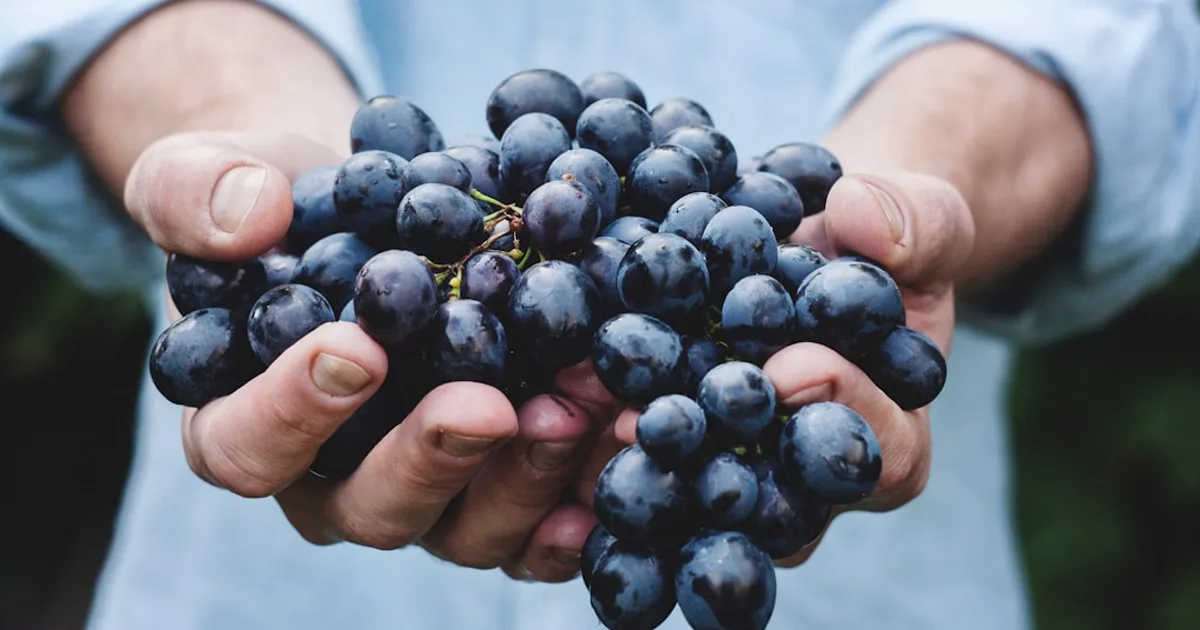
A grape vine is a 30-year investment that pays nothing for the first two years and then pays for decades. That math works only if you understand one thing up front: grapes require hard annual pruning, and that pruning is not optional, not a nice-to-have, not something you can skip one winter because it’s cold. It is the central skill of growing grapes. Everything else - variety selection, trellis design, disease management - is secondary to getting the pruning right.
A mature vine at years five through seven produces 10-20 lb of table grapes annually. At $2-4/lb retail (USDA AMS Specialty Crop Market News, 2023), that’s $20-80 in fruit value per plant, per year, for the next two decades on a $7-15 bare-root investment. Wine-quality fruit from premium hybrid varieties commands $3-8/lb at farm stands and u-pick operations. The math is not complicated. The patience is the hard part.
Variety: The Decision That Determines Everything Else
The first question is not which trellis system or what fertilizer. It’s which species group, because that choice sets your disease management burden, your climate envelope, and your realistic yield.
American grapes (Vitis labrusca and V. labrusca hybrids - ‘Concord,’ ‘Niagara,’ ‘Catawba’) are cold-hardy to Zone 4-7, disease-resistant enough to grow in humid eastern climates without a heavy spray program, and productive under home-garden management. The slip-skin texture - where the pulp slides out of the skin - is unfamiliar to people who grew up on supermarket table grapes, but for juice, jelly, and jam, Concord-type grapes are the benchmark. A gallon of fresh-pressed Concord juice sells for $8-15 at farmers markets. The intense, foxy flavor is not subtle. You either love it or you don’t.
European vinifera (Vitis vinifera - ‘Cabernet Sauvignon,’ ‘Chardonnay,’ ‘Pinot Gris’) are what most of the wine world grows. They are also the most disease-susceptible group, thin-skinned, and require dry summers to perform without a serious fungicide program. Zone 6-9, and even within that range, humid eastern climates make them difficult without near-constant management. Grow European vinifera if you’re in the Pacific Northwest, California, or a dry interior climate. In the Mid-Atlantic, Southeast, or Midwest, you are setting yourself up for frustration.
French-American hybrids (‘Marquette,’ ‘Frontenac,’ ‘Frontenac Gris,’ ‘Chambourcin,’ ‘Seyval Blanc’) were bred specifically to bridge this gap - wine-quality fruit on cold-hardy, disease-resistant vines. Zone 4-7, productive in humid climates, and the right choice for most home gardeners east of the Rockies who want wine-quality grapes without the spray burden of pure vinifera. Marquette, developed by the University of Minnesota, regularly produces wine that competes with vinifera-based reds (Teff et al., American Journal of Enology and Viticulture, 2015). It is not a consolation prize.
For most home gardeners in humid eastern climates, the practical answer is American or hybrid varieties. The disease pressure in a wet summer in Pennsylvania or Missouri will destroy an unsprayed Chardonnay. It will not destroy a Marquette or a Concord.
Variety Quick Reference
| Variety | Type | Zones | Days to Harvest | Best Use |
|---|---|---|---|---|
| Concord | American (V. labrusca) | 4-8 | 150 | Juice, jam, fresh |
| Niagara | American (V. labrusca) | 5-8 | 145 | Fresh, white juice |
| Reliance | American hybrid | 5-9 | 135 | Seedless table grape |
| Himrod | American hybrid | 5-8 | 130 | Seedless, fresh eating |
| Marquette | French-American hybrid | 4-7 | 145 | Red wine |
| Frontenac Gris | French-American hybrid | 4-7 | 145 | White/rosé wine |
| Chambourcin | French-American hybrid | 5-9 | 160 | Red wine |
| Cabernet Sauvignon | European vinifera | 6-9 | 170 | Red wine (dry climate) |
Annual Pruning: The Non-Negotiable
Grapes fruit on current-season shoots that grow from one-year-old wood. Not two-year-old wood. Not the main trunk. One-year-old canes - the growth that developed last summer. This is the biological fact that drives everything about grape pruning, and it means that every winter you must remove most of what the vine grew the previous season while leaving just enough one-year-old wood to carry next year’s crop.
The standard recommendation is to remove 70-80% of the previous year’s growth each winter (Penn State Extension, Grape Production for the Home Garden, 2022). That sounds severe. It is severe. A vine that put on 40 feet of new canes last season should have 30-35 feet of that removed before spring.
Skip one winter and the vine uses its energy pushing growth on two-year-old and older wood, which produces weak shoots and minimal fruit. The vine looks fine. It leafs out, grows vigorously, looks healthy. The harvest tells you what happened - smaller clusters, lower yield, fruit lower on the shoot. Skip two winters and you have a tangled mass of old wood with shoots coming from the wrong places and yield cut by half or more. Recovery takes two to three seasons of corrective pruning and patience.
The two main pruning systems achieve the same biological goal through different structural approaches.
Spur pruning maintains a permanent trunk and horizontal cordons (arms) trained along trellis wires. Each winter, all lateral growth on the cordons is cut back to short spurs of two to three buds. The spurs produce shoots each season, you pick the two strongest to become next year’s fruiting wood, and you cut everything else. It is simple to learn and easy to maintain year to year. Spur pruning works well with varieties that have fruitful buds near the base of the cane, including most American and hybrid varieties.
Cane pruning removes the cordons themselves each year and replaces them entirely with long canes - typically one to two canes per side, 8-15 buds each - selected from last year’s growth. It is more labor-intensive and requires more skill in selecting the right canes, but it works better with varieties (like Riesling and some hybrids) where basal buds are less fruitful. Many commercial vineyards use cane pruning for this reason.
For most home gardeners, spur pruning is the right starting point. The timing is late winter - February through early March in most zones - after the worst cold has passed but before buds break. Prune in the rain or cold if you have to. Do not let a bad week push you into April.
The Three-Year Establishment Timeline
Do not expect fruit in year one. Do not let the vine carry a full crop in year two. This is not caution - it is how you build a vine that produces for 30 years instead of burning out in five.
| Year | Goal | Pruning Action | Fruit |
|---|---|---|---|
| Year 1 | Establish root system; train single trunk to top wire | Remove all flower clusters. Pinch off any fruit development. Select one strong shoot as the trunk. | None. Remove any fruit that sets. |
| Year 2 | Develop main canes or cordons | Select and establish cordon or cane structure. Remove all but 1-3 clusters per vine if any fruit sets - no more. | Minimal - 1-3 clusters maximum. Do not push yield. |
| Year 3 | First real harvest | Full pruning to your chosen system. | 3-5 lb per vine is realistic. |
| Year 4+ | Building to full production | Maintain chosen system; annual dormant pruning is the routine. | 7-15 lb, increasing through year 7. |
Letting a year-two vine carry a full crop is a common mistake. The vine looks capable. The clusters form, they size up, it seems fine. What you can’t see is the root system that didn’t develop the way it should have because the vine was diverting energy to fruit. You pay for it in years three through five with slower growth, smaller yields, and a vine that lags behind one that was managed correctly from the start (Bordelon, Establishing a Vineyard, Purdue Extension, 2019).
Site, Soil, and Trellis
Site selection matters more with grapes than with almost any other crop. Full sun is 8 or more hours of direct sun - not “mostly sunny” with afternoon shade. South or southwest-facing slopes are ideal. Good air circulation reduces the humidity at the leaf surface that fungal diseases need to germinate. Planting in a low spot, against a fence that blocks air movement, or under trees will cost you more in disease management than any spray program can recover.
Soil pH 5.5-6.5. Grapes prefer well-drained loam or sandy loam and tolerate low fertility better than most crops. They do not tolerate waterlogged roots. Heavy clay without serious amendment or raised planting will cause chronic root problems. A simple raised bed or mounded planting row solves this if your soil drains poorly.
Install the trellis before you plant. Grapes will produce for 30 years and need a structure built to last. A two-wire system with 4x4 treated wood or steel posts set 2-3 feet deep, spaced 8 feet apart, handles most home production. First wire at 3 feet, second wire at 5-6 feet. Corner and end posts need bracing or diagonal wire support - the tension from trained vines and fruit load is substantial. A trellis that wobbles in year two will fail in year eight.
Plant bare-root vines in early spring as soon as soil can be worked. Spacing 6-8 feet in-row. Dig the hole wide enough to spread roots without bending them. No fertilizer in the planting hole - let the vine establish before pushing it.
Disease: What Will Actually Kill Your Crop
In humid US climates, the two diseases that destroy grape crops are black rot and downy mildew. Understanding them is not optional if you’re growing susceptible varieties.
Black rot (Guignardia bidwellii) is the most destructive fungal disease of grapes in humid eastern North America (Wilcox et al., Compendium of Grape Diseases, APS Press, 2015). It infects developing berries during a narrow window around bloom and shortly after, causing them to shrivel into hard, black, wrinkled mummies that hang in the cluster or drop to the ground. An infected cluster is a total loss. The mummies overwinter in the vineyard and provide next year’s inoculum - remove and destroy every mummified berry you find, in the vine and on the ground, during dormant pruning.
Protective fungicide applications starting before bloom are essential on susceptible varieties. Captan and myclobutanil both provide control; copper-based products (copper hydroxide, Bordeaux mixture) work at pre-bloom timing and are acceptable in organic programs. The critical window is from when shoots are 6 inches long through 3-4 weeks after bloom. Miss that window and no amount of later spraying recovers the cluster.
Downy mildew (Plasmopara viticola) produces oily yellow spots on the upper leaf surface and white sporulating growth on the undersides. Severe infections defoliate the vine. It is an oomycete - a water mold - not a true fungus, which means sulfur-based fungicides have no effect on it. Copper-based products work. Time applications to shoot growth of 4-6 inches and repeat every 10-14 days in wet weather (Bordelon, Purdue Extension, Grape Diseases, 2018).
Disease-resistant hybrid varieties - Marquette, Frontenac, Chambourcin, and others - reduce but do not eliminate spray requirements. In a wet year, even resistant varieties benefit from a copper spray at the key timing windows. American varieties like Concord and Niagara carry real field resistance to both diseases and can often get through a season in the East with minimal intervention.
If you grow European vinifera in a humid climate without a preventive spray program, plan for crop losses most years. That is not a pessimistic statement - it is the documented experience of growers across the eastern US.
The ROI Math
A bare-root vine costs $7-15. Add $30-80 for trellis materials for a two-vine setup. Call it $50-175 total first-year cost including vine, posts, wire, and hardware.
From year three forward, a well-managed vine yields 5-10 lb. By years five through seven, 10-20 lb is realistic on an established vine in good conditions. Table grapes at $2-4/lb retail return $20-80 annually per vine. Wine-quality hybrid grapes at $3-8/lb return $30-160. At the conservative end - $25/year on a $100 investment - you break even in four years post-establishment (year six or seven from planting). At the higher end, you break even in two years of production (year four or five from planting).
The juice math is better. One pound of grapes yields roughly 0.6 lb of juice (about 9-10 oz). At $8-12/quart for fresh-pressed Concord juice, 15 lb of grapes produces 9 lb of juice - call it about 4 quarts. That’s $32-48 in farm-stand juice value from a single vine. A pair of Concord vines at peak production, processed rather than fresh-sold, can return $60-90 annually in juice value. That is a 30-50 year revenue stream on a $100-150 capital investment.
None of this math works if you skip the pruning.
Harvest and Post-Harvest
Grapes do not ripen after picking. The sugar is fixed at harvest. You cannot pick green, set them on the counter, and expect them to sweeten - that is not how grape biochemistry works. Taste is the most reliable harvest indicator, and you should start tasting a week or two before you expect the clusters to be ready.
For a number: table grapes at peak eating quality hit 16-22 Brix (percent sugar by weight) as measured by a handheld refractometer (UC Davis ANR, Table Grape Production, 2019). A $15 refractometer is a useful tool if you’re growing multiple varieties at different maturity windows.
Cut clusters with pruning shears - don’t pull. Refrigerate immediately in vented containers at high humidity. Most table varieties hold 2-4 weeks refrigerated. Concord-type grapes for juice should be processed within 24-48 hours of harvest for best flavor and color. Freeze juice in quart containers; it keeps a year at 0°F.
For wine: whole-cluster fermentation, pressed juice, skin-contact white - the processing options are extensive and beyond a single section here. What matters at harvest is getting accurate Brix and pH readings (target pH 3.2-3.4 for most red wines, slightly higher for whites), and processing quickly. Grapes left in buckets at 70°F will begin fermenting on their own within 24-48 hours from wild yeast on the skins.
Related crops: Arugula, Oregano
Related reading: First Three Years ROI - perennial investment math for crops that don’t produce until year three
Growing Grape? Track your harvest value and break-even date in the Garden ROI app.
Get the App