
Hops
Humulus lupulus
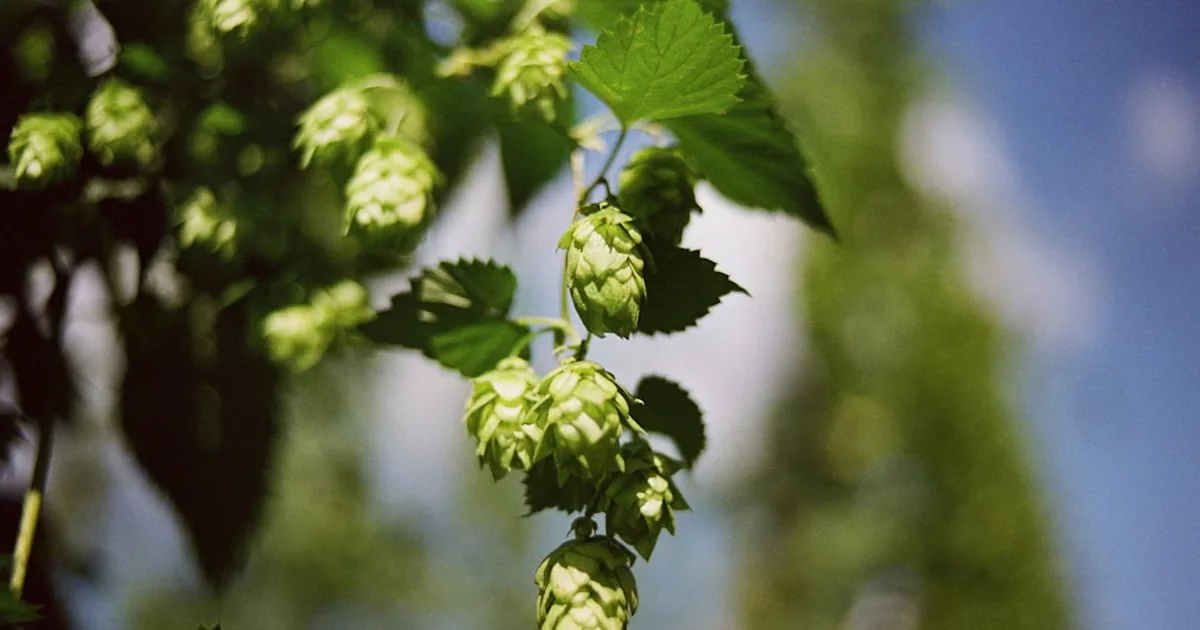
If you brew beer at home, hops are one of the clearest ROI crops in the garden. Dried hops at homebrew shops run $2-4 per ounce ($32-64/lb) for commodity varieties like Cascade and Centennial, and more for specialty or experimental varieties. A single established hop rhizome produces 1-2 lbs of dried hops per year starting in year two. The vine costs $10-15 to start and nothing to maintain beyond watering and annual pruning.
Even if you don’t brew, hops is one of the fastest-growing and most dramatic perennial vines available to a temperate gardener. It puts on 15-25 feet of growth per season, dies back to the crown each fall, and returns with the same vigor the following spring. As a screen, arbor cover, or trellis vine, it earns its space on ornamental grounds alone.
What it actually is
Humulus lupulus is in the hemp family (Cannabaceae) - a close relative of cannabis, though the relationship is about chemistry and botany, not effects. The plant is a perennial climbing vine, native to Europe, western Asia, and North America. Female plants produce the cones (strobiles) used in brewing; male plants are unwanted in a hop yard because they trigger seed production, which reduces resin content and bittering quality. Commercial rhizomes and nursery plants are always female clones.
The plant grows from a permanent underground crown (rhizome) that spreads laterally over time, sending up new bines (not vines - hops wind clockwise around supports using stiff hairs, not tendrils) each spring. The bines grow 3-6 inches per day at peak summer growth rate.
Hop varieties differ in alpha acid content (bittering), essential oil profile (aroma), and agronomic characteristics. The main categories:
| Category | Examples | Alpha acids | Aroma character | Primary use |
|---|---|---|---|---|
| Bittering | Magnum, Nugget, Chinook | 12-14% | Neutral, clean | Bittering additions early in boil |
| Aroma/dual | Cascade, Centennial, Willamette | 4-7% (Cascade) to 9-11% (Centennial) | Floral, citrus, pine | Late boil, dry hop |
| Noble (European) | Hallertau, Saaz, Tettnanger | 3-5% | Earthy, spicy, floral | Lager, pilsner, European ale styles |
| Specialty/experimental | Citra, Mosaic, Galaxy | 10-14% | Tropical, stone fruit | Modern IPA, craft brewing |
For homebrewing: Cascade is the starter hop - versatile, grows well across most of the US, and is the defining aroma hop in American pale ale and IPA. For culinary use (hop shoots as a vegetable), any variety works.
The ROI case
Year one produces little. Year two is where production begins. An established plant by year three is producing at full capacity.
| Year | Plants | Dried yield | Value @$18/lb | Rhizome cost | Cumulative net |
|---|---|---|---|---|---|
| 1 | 1 | 0.1-0.2 lb | $1.80-3.60 | -$12.99 | -$11.19 |
| 2 | 1 | 0.5-1.0 lb | $9-18 | - | -$2.19 to $6.81 |
| 3 | 1 | 1.0-2.0 lb | $18-36 | - | $15.81-$42.81 |
| 5 | 1 + divisions | 2.0-3.0 lb | $36-54 | - | $87.81-$150.81 |
Specialty variety premium: Citra and Mosaic rhizomes that cost $15 produce cones that homebrew shops charge $4-6 per ounce. If you dry-hop with whole-cone specialty hops, the per-ounce replacement value can run $48-72/lb at retail. The specialty variety case is stronger than commodity varieties.
Hop shoots: the emerging bines in early spring, before they reach 12 inches tall, are a luxury vegetable. Belgian markets sell fresh hop shoots for $15-20 per quarter pound ($60-80/lb) in spring. This is not hypothetical - the Flemish dish jets de houblon (hop shoots with egg) is a traditional spring delicacy. Pull the lateral shoots when they’re 4-6 inches, steam briefly, serve with butter or in an omelette. A productive established plant produces dozens of removable lateral shoots without affecting the main vine crop.
Growing requirements
Site: full sun, warm location, with very strong support. Hops need something to climb 15-25 feet. A post with wire running to anchor points, a tall trellis, or a rope system suspended from a building or pergola. The support must handle the weight of mature vines loaded with cones - not insignificant. Many growers train hops up twine attached to an overhead wire, then cut the twine at harvest to bring the cones down to hand level.
Soil: well-drained, deep loam with pH 6.0-8.0. Hops are tolerant of a wide range of soils but produces best in deep, well-drained conditions. They do not tolerate waterlogged soil - crown and root rot in wet conditions.
Planting: plant rhizomes in spring when soil temperature reaches 50°F. Horizontal placement 2-4 inches deep, with buds pointing up. Space plants 3-5 feet apart. Water consistently the first growing season while roots establish.
Training: when bines emerge in spring (they look like asparagus spears at first), select 3-5 of the strongest bines per plant to train up. Remove all others. Train the selected bines clockwise around their supports as they grow. Untrained bines grow laterally and reduce the plant’s vertical climbing efficiency.
Fertilizing: moderate to heavy feeder. Side-dress with a balanced fertilizer in spring when bines emerge. Nitrogen promotes vegetative growth; phosphorus and potassium support cone development. Apply balanced fertilizer (10-10-10) in early spring, then switch to a lower-nitrogen formula (5-10-10) when cones begin forming.
Zones: H. lupulus is hardy in zones 3-8. The plant requires a distinct winter dormancy - it doesn’t perform in zones 9-10 without the cold period. Most varieties require 120-150 frost-free days from emergence to harvest (late August-September). Some varieties bred for the Pacific Northwest (shorter seasons) work in zone 3-4.
What goes wrong
Downy mildew (Pseudoperonospora humuli): the most destructive disease of hops. Gray, downy growth on undersides of leaves; affected shoots turn black and die. Spreads in cool, wet spring conditions. Management: improve air circulation, avoid overhead irrigation, apply copper-based fungicides preventively. Resistant varieties are available (‘Nugget’, ‘Tahoma’).
Powdery mildew (Podosphaera macularis): white powdery coating on leaves and cones. Less damaging than downy mildew but reduces cone quality. Common in humid summers. Sulfur or potassium bicarbonate applications slow spread. Resistant varieties: ‘Cascade’, ‘Centennial’.
Hop aphids (Phorodon humuli): infestations on growing tips and undersides of leaves. They excrete honeydew that leads to sooty mold on cones, ruining them for brewing. Insecticidal soap, spinosad, or pyrethrin applications. Natural predators (ladybugs, lacewings) provide significant control.
Spider mites: hot, dry summers drive mite populations. Leaves show stippled, bronzed appearance. Miticide applications or predatory mite releases.
Verticillium wilt (Verticillium albo-atrum): soilborne fungus causes sudden wilting and dieback. No reliable treatment; remove and destroy infected plants. Do not replant hops in the same location.
Harvest and drying
Harvest when cones feel dry and papery to the touch, spring back when compressed rather than staying compressed, and the lupulin (yellow powder inside the cone) is bright yellow and fragrant - not green or brown. In most zones this is late August through September. Don’t wait for all cones to be ready; harvest by variety as each vine peaks.
Cut the entire bine down (or lower it from overhead support) to harvest at ground level. Strip cones from the bine by hand or by pulling the bine through a stripping frame.
Drying: spread cones in a single layer on window screens or mesh drying racks. Dry at 120-140°F (food dehydrator or low oven with door cracked) until the central stem of the cone is dry and snaps rather than bending - typically 8-12 hours. Over-drying damages essential oils. Moisture content target: 8-10%.
Storage: vacuum-sealed bags in the freezer. Hops oxidize rapidly at room temperature - flavor compounds degrade within weeks of drying without refrigeration. Frozen hops keep 2+ years with minimal quality loss.
Amounts for brewing: typical all-grain beer recipes call for 2-4 oz of hops total. A 1-lb dried yield from one plant equals 4-8 batches of homebrew, or 20-40 gallons of finished beer.
Related reading: Borage - fellow companion plant; Lavender - fellow perennial herb with high per-ounce value; Hops ROI Analysis - rhizome cost, expected yield in years 1-3, and the home-brewing cost case
Growing Hops? Track your harvest value and break-even date in the Garden ROI app.
Get the App