
Ashwagandha
Withania somnifera
Here’s what most herb guides get wrong about ashwagandha: they tell you to amend your soil before planting. Don’t. This plant produces its best root - denser, more resinous, higher in active compounds - in poor, dry, well-drained ground that you have done essentially nothing to. The moment you load the bed with compost and balanced fertilizer, the plant shifts its energy into leaves. You get a nice-looking shrub and a scraggly, underdeveloped taproot. The inversion of the usual advice is the single most important thing to understand before you put a seed in the ground.
The ROI case is worth understanding before the growing details, because the economics here are unusual. A 50-seed packet runs $2.99. Each seed costs roughly $0.06. A single plant, grown properly to full maturity, produces 0.25-0.75 lb of fresh root. That root dries down to approximately 0.1-0.3 lb after the 75-80% water loss that happens in the dehydrator. At $40/lb for dried root - the retail equivalent when you back-calculate from capsule products (Mountain Rose Herbs, 2024, lists bulk dried ashwagandha root powder at $26-36/lb) - one plant produces $4-12 in equivalent value from a seed that cost a dime. Worked example: 0.2 lb dried yield × $40/lb = $8.00 gross value minus $0.06 seed cost = $7.94 net per plant. That’s a 130x return per seed in a single season.
One clear disclaimer before going further: home-grown ashwagandha root is for personal use. Selling it as a supplement, in any form, requires FDA Good Manufacturing Practice (GMP) compliance under 21 CFR Part 111. This is not a gray area. Grow it, dry it, use it yourself.
What it actually is
Withania somnifera belongs to the Solanaceae - the nightshade family. The same family as tomatoes, peppers, eggplant, and potatoes. The family resemblance is visible in the small tubular flowers, which are pale green-yellow and unremarkable. The berries that follow are the more distinctive feature: small, papery-husked orange-red fruits that look exactly like miniature tomatillos. The botanical term is “berry surrounded by an inflated persistent calyx” - the same structure as a tomatillo or cape gooseberry. The USDA NRCS PLANTS database classifies it as Withania somnifera (L.) Dunal, in the nightshade family, with native range across India, the Mediterranean, and North Africa (USDA NRCS, PLANTS Database, 2024).
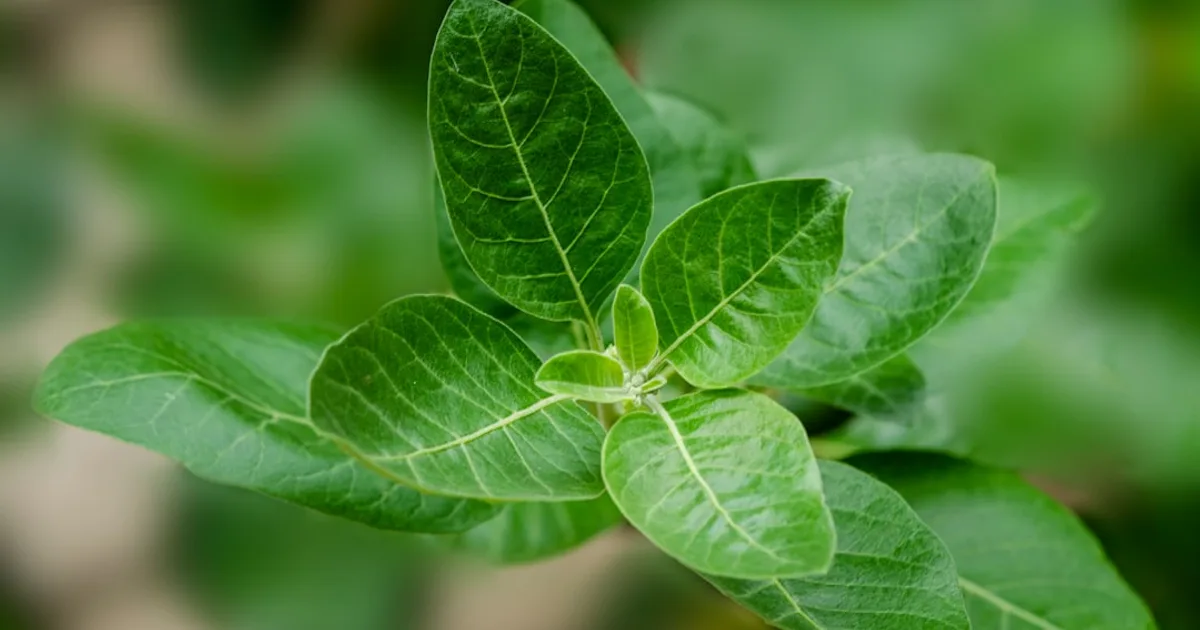
In its native habitat, ashwagandha is a woody perennial shrub that grows 2-4 feet tall with grayish-green, soft-hairy leaves. It’s zone 8-11 hardy. North of that, it’s grown as a long-season annual. Mature plants look like a small, slightly disheveled shrub - the leaves are velvety to the touch, ovate, and have a distinctive smell when crushed. That smell is earthy and strong, and it gives the plant its Sanskrit name: “ashwagandha” translates roughly as “smell of horse.” This isn’t a marketing name. The root, when you first slice into it, smells exactly like that.
The medicinal part is the dried taproot. The root contains a class of steroidal lactones called withanolides - compounds unique to Withania species. These are the bioactive constituents cited in clinical research and the basis for standardized extracts. The National Center for Complementary and Integrative Health (NIH NCCIH) maintains a monograph on ashwagandha covering its uses, safety profile, and the state of clinical evidence (NIH NCCIH, Ashwagandha, 2023). That’s the appropriate reference for anyone who wants to understand the evidence base - it covers what’s well-supported, what’s preliminary, and what’s unknown.
Why poor soil produces better roots
Ashwagandha evolved on the Deccan Plateau and in similar semi-arid, low-fertility terrain across the Indian subcontinent and Mediterranean basin. The soils there are typically thin, rocky, alkaline, and bone dry for months at a time. The plant adapted to those conditions over a very long time. When you put it in rich garden soil with generous moisture, it responds the same way any plant does when resources are suddenly abundant: it grows leaves and stems. The root’s job, in poor soil under stress, is to anchor the plant, store water, and store carbohydrates. Under those conditions, root mass development is prioritized.
Commercial ashwagandha production in India, documented in agronomic research from the Central Institute of Medicinal and Aromatic Plants (CIMAP), specifically recommends against heavy organic amendments, noting that high nitrogen promotes vegetative growth at the expense of root yield and withanolide concentration (Mishra et al., CIMAP Research Publications, 2018). The same dynamic plays out with other root crops grown for medicinal value - valerian, elecampane, and yellow dock all produce lower-quality roots in highly amended soils. You’re asking the plant to do something specific. High fertility points it in a different direction.
Practical soil preparation: till to 12-18 inches (the taproot can run deep), break up hardpan if present, and correct drainage problems. That’s it. If your soil has had years of heavy organic amendment, grow ashwagandha in a different bed or in containers with a lean mix. Target pH 7.5-8.0 - slightly alkaline, matching the plant’s native range. Slightly acidic garden soils can be corrected with garden lime. Well-drained, sandy loam is ideal. The worst possible scenario is heavy clay that holds water.
The ROI calculation in detail
This crop occupies bed space for 5-6 months and produces a modest yield per plant. The economics work because the price per pound of the dried product is high.
| Input | Value |
|---|---|
| Seed cost per plant | $0.06 (50-seed packet at $2.99) |
| Fresh root yield per plant (realistic range) | 0.25-0.75 lb |
| Drying loss (water content) | 75-80% |
| Dried root yield per plant | 0.05-0.19 lb (call it 0.1-0.2 lb realistic) |
| Bulk dried root price | $26-36/lb (Mountain Rose Herbs, 2024) |
| Retail equivalent (capsule back-calculation) | $40-80/lb |
| Gross value per plant at $40/lb | $4.00-8.00 |
| Net value per plant | $3.94-7.94 |
At 10 plants per 4×4 bed section - realistic at 12-inch spacing - that’s $40-80 in dried root equivalent from $0.60 in seed investment and a modest amount of growing season. The main cost is time (150-180 days) and water, though water costs are low given the plant’s drought tolerance.
The caveat worth repeating: these are personal-use equivalency numbers. The value is realized when you use the root yourself rather than buying it.
Growing by zone
Zones 8-11: Ashwagandha is perennial in these zones and will survive winter outdoors. Roots are still harvested in the fall of the first growing year - root quality and withanolide concentration decline in year two and beyond as the root becomes woody. Treat it as an annual even where it’s perennial. Let the berries ripen and self-sow if you want a self-sustaining population.
Zones 5-7: The standard approach. Start seeds indoors 6 weeks before your last frost date. Transplant after soil temperature reaches 70°F and nighttime temps are reliably above 50°F. This is typically late May to early June in zone 5, mid-May in zones 6-7. The plant needs 150-180 days from germination to root harvest - count backward from your first frost date to confirm you have enough season. In zone 5 (first frost mid-October), transplanting by June 1 gives you 135-140 days. That’s tight. Push the transplant date as early as you can while protecting against late frosts.
Zones 3-4: Marginal. A full 150-day season from transplant is nearly impossible in zone 3 without season extension. Cold frames or row covers to protect early transplants, then harvest before the first hard frost in September. Root development will be incomplete but not zero - you’ll harvest smaller roots. If you’re in zone 3 and want to try it, start seeds indoors in late February (10 weeks before last frost), transplant with protection as early as mid-May, and harvest by mid-September. You may get 120 days from transplant. The roots will be smaller but usable.
Direct sow vs. transplant: Direct sow is possible in zones 7+ where the season is long enough. In zones 5-6, starting indoors and transplanting is necessary to fit the season. Germination temperature for seeds is 70-85°F - seeds sown in cold soil germinate slowly or not at all. If direct sowing, wait until soil temperature is consistently above 70°F.
Germination and transplanting
Seeds germinate in 7-14 days at 70-85°F. Surface sow or cover lightly - seeds need light for germination. Soaking seeds in warm water for 4-8 hours before sowing improves germination rates; some growers lightly sand the seed coat (scarification) for better water uptake.
Start indoors in cell trays or small pots with a lean seed-starting mix. Thin to one seedling per cell once the first true leaves appear. Don’t overwater at this stage - the seedlings have no tolerance for wet feet and will damp off quickly in saturated media.
At transplant time (6 true leaves, 4-6 inches tall), harden off for 7-10 days before setting out. Transplant into your prepared lean soil at 12-inch spacing. Water in once, then let the plant establish. After the first week, pull back irrigation. The plant will look stressed and may wilt slightly during establishment - this is normal. Don’t water it back to health. Give it time to develop its root system in dry conditions.
Harvest and processing
Harvest in late fall, after the plant flowers, sets berries, and begins to die back. The berries will have turned orange-red. In zones 5-7, this lines up with October - you’re watching the plant, not the calendar, but the timing is roughly 150-180 days after germination. Don’t rush the harvest - root mass and withanolide concentration continue building through the fruiting period.
Dig carefully. The taproot runs 12-18 inches deep in well-drained soil. Use a garden fork, not a spade. Start 6 inches from the plant base and work inward, loosening the soil in stages before trying to lift. Cutting the taproot kills the plant and reduces your yield. Get the whole root if you can.
Wash the roots under running water, scrubbing off soil with a vegetable brush. Trim the fibrous side roots - the taproot and the large lateral roots are what you want. The fibrous hair roots add volume but lower concentration and are typically discarded in commercial processing.
Slice the root into 1/4-inch rounds or lengthwise slabs. The root is woody - use a sturdy knife. Arrange in a single layer on dehydrator trays. Dry at 100-110°F for 12-18 hours until the slices are completely brittle and snap cleanly with no flex at all. Any remaining moisture will cause mold in storage.
Store dried root in airtight glass jars away from light. Properly dried root keeps 1-2 years without significant loss of quality. The roots can be used whole (for tea), ground in a spice grinder or high-power blender into powder, or tinctured in alcohol.
The name and the smell
“Ashwagandha” comes from Sanskrit: ashwa (horse) and gandha (smell). The traditional explanation is twofold - the root smells distinctly horse-like, and the plant was believed in Ayurvedic practice to confer the strength of a horse. The first part is accurate. When you slice fresh ashwagandha root, the smell is unmistakable - earthy, musky, with a specific livestock quality that’s not unpleasant but is distinctive. The smell mellows during drying. Ground dried root has a faintly bitter, earthy aroma that doesn’t suggest anything equine.
Active compounds
Withanolides are the primary bioactive compounds - steroidal lactones structurally unique to Withania species. The withanolide content in commercial root and root extract is the primary quality marker for standardized products. Growing conditions, soil type, and cultivar all affect withanolide concentration.
The variety ‘Poshita’ is a documented high-withanolide cultivar developed by CIMAP in India, showing 0.3-0.5% total withanolide content in root dry weight compared to 0.13-0.31% in unselected populations (Singh et al., Industrial Crops and Products, 2017). If you’re growing specifically for medicinal use, sourcing ‘Poshita’ seed is worth the effort - it’s available from specialty herb seed suppliers.
The NIH NCCIH monograph covers the clinical research on ashwagandha in detail, including the trials on stress, anxiety, and sleep quality where the most consistent positive findings have emerged (NIH NCCIH, Ashwagandha, 2023). The evidence base is stronger than for many commonly grown medicinal herbs and more limited than enthusiastic product marketing implies. The monograph is the right place to understand what the research actually shows.
Safety
This is a medicinal plant with real pharmacological activity. That means it has real contraindications.
Pregnancy: Ashwagandha has documented uterine stimulant properties in Ayurvedic literature and some clinical pharmacology research. It is contraindicated in pregnancy. This is not a precautionary hedge - it’s a clear contraindication cited in the NIH NCCIH monograph.
Autoimmune conditions: Ashwagandha may stimulate immune activity. People with autoimmune diseases (rheumatoid arthritis, lupus, Hashimoto’s, multiple sclerosis) should consult with a physician before using it, as it could theoretically exacerbate immune activity.
Thyroid disorders: Case reports in the literature describe ashwagandha influencing thyroid hormone levels. People taking thyroid medication should monitor thyroid levels if using this plant regularly.
Sedative medications: Ashwagandha has documented sedative properties. Combined use with benzodiazepines, sleep medications, or other CNS depressants may increase sedative effects.
The NIH NCCIH monograph covers these interactions with citations to the clinical literature - that’s the reference to read, not supplement marketing copy.
What goes wrong
Root rot in wet soil is the primary crop failure. The plant evolved in semi-arid conditions. Heavy clay that holds water, beds with poor drainage, or overwatering - any of these will rot the root, usually before you notice a problem above ground. The above-ground plant may look fine for weeks while the root is decomposing. By the time the foliage yellows and collapses, the root is already gone. Prevention is drainage and restraint with irrigation. There is no recovery once root rot is established.
Aphids colonize new spring growth and tips. They’re not usually serious enough to kill the plant, but heavy infestations weaken growth. Knock them off with a hard spray of water, or use insecticidal soap if populations are high. Aphids tend to be worse in cool, wet spring conditions - the same conditions that slow the plant down anyway.
Whitefly (Trialeurodes vaporariorum and related species) can infest plants in hot, humid conditions, particularly in zones 7-9 in summer. They feed on the undersides of leaves. Yellow sticky traps help monitor populations. Neem oil or insecticidal soap applied to leaf undersides is the standard intervention.
Starting too late in zones 5-6 is the most common reason for disappointing harvests. A plant transplanted in late June in zone 5 doesn’t have enough time to develop a proper root before October frost. Do the math when you’re ordering seeds. Count 150-180 days back from your first frost date, subtract 6 weeks for indoor starting time, and that’s when to start seeds. In zone 5, that’s starting seeds in late February to early March for a mid-May transplant.
Dried root use
Ground dried ashwagandha root has a faintly bitter, earthy flavor. Traditional use in Ayurveda is 1/4-1/2 teaspoon of dried root powder in warm milk (with honey and sometimes cardamom), once or twice daily. The warm fat in milk may aid absorption of the fat-soluble withanolides. It can also be made into a basic decoction: simmer 1 teaspoon of dried sliced root in 2 cups of water for 15-20 minutes, strain, and drink.
The flavor doesn’t lend itself to most Western cooking applications. Some people incorporate it into smoothies where other flavors mask the bitterness. Others use it in savory preparations - it’s used in small quantities in some traditional Indian rice and lentil dishes. The most common approach for home growers is simply the warm milk preparation, which has the longest documented use history.
To grind: a dedicated spice grinder or high-speed blender works well. Dried root is hard and will damage a standard coffee grinder over time. Grind in short pulses and let the motor rest. Sift through a fine-mesh strainer after grinding; coarser pieces can be re-ground. Store ground powder in a sealed glass jar - it oxidizes faster than dried whole root.
Related reading: Herb Garden ROI - the 8 highest-value culinary herbs compared
Growing Ashwagandha? Track your harvest value and break-even date in the Garden ROI app.
Get the App