
Borage
Borago officinalis
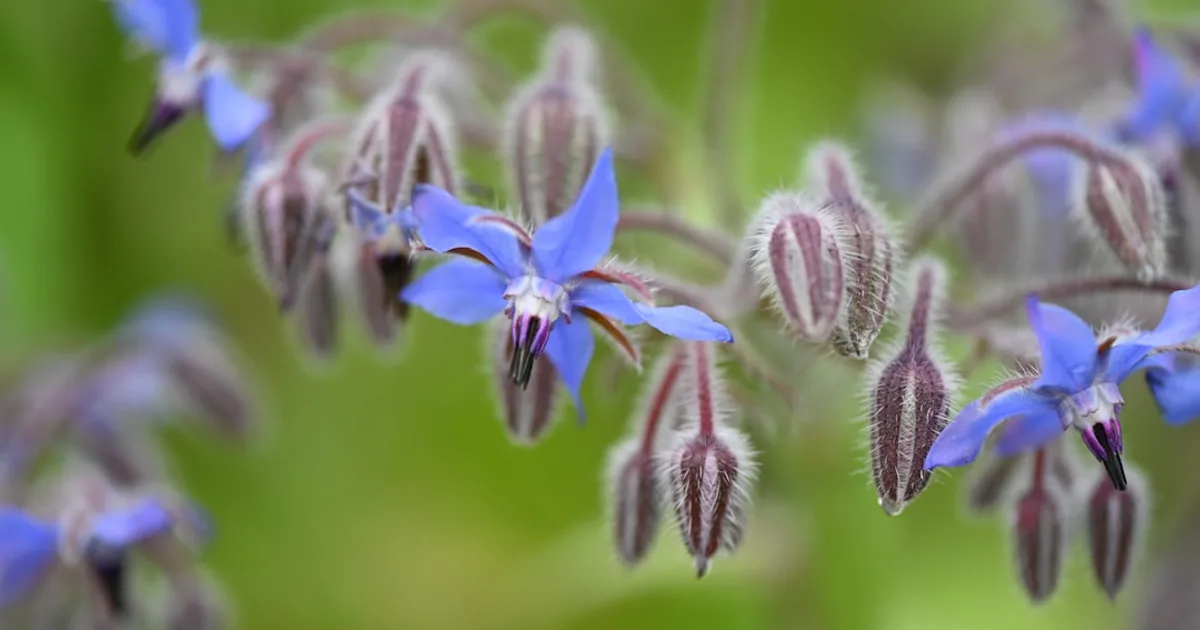
Borage (Borago officinalis) is worth growing for two practical reasons: the star-shaped blue flowers are edible and command $6-10/lb at specialty retailers and farmers markets (USDA AMS Specialty Crop Market News, 2023), and the plant self-sows so aggressively that you buy seed once and essentially never again. The third reason - it attracts pollinators and beneficial predatory insects near your tomatoes and cucumbers - is a bonus backed by documented mechanism rather than garden mythology.
What it actually is
Borage is a hardy annual in the borage family (Boraginaceae), native to the Mediterranean region. It grows quickly to 18-36 inches tall with a sprawling, branching habit. The leaves and stems are covered with stiff white hairs that are mildly irritating to sensitive skin - wear gloves when harvesting large quantities. The flowers are five-petaled, star-shaped, and an intense cobalt blue (occasionally white or pink) with a distinctive black center cone. Both flowers and young leaves taste distinctly of cucumber with a faint sweetness.
The plant produces two distinct edible products: flowers (the high-value item) and young leaves (the supporting ingredient). They serve different purposes in the kitchen and have different market values. Understanding the split matters when you’re thinking about how much the plant is actually worth.
The ROI case
Fresh edible borage flowers at retail run $6-10/lb at specialty grocers (USDA AMS Specialty Crop Market News, 2023). Farmers market pricing ranges $10-18/lb depending on region and presentation. Direct restaurant sales can reach $8-15 per small clamshell flat - and restaurants use them in quantities that make a regular supply worthwhile.
A standard restaurant portion of borage flowers is roughly 0.25 oz (about 15-20 flowers) used as a garnish on 4-6 plates. At that unit weight, a pound of flowers represents 64 portions. One vigorous borage plant in peak production generates 20-30 flowers per day over a 6-8 week productive window - call it 800-1,400 flowers per plant across the season. At 0.005 oz per flower (a reasonable average), that’s 0.25-0.44 lb of flowers per plant.
Flower value per plant, full season:
| Sales channel | Price per lb | Yield (0.35 lb avg) | Gross value |
|---|---|---|---|
| Specialty grocer | $8/lb | 0.35 lb | $2.80 |
| Farmers market | $14/lb | 0.35 lb | $4.90 |
| Direct to restaurant | $12/flat, 0.25 oz | 22 flats | $26.40 |
The restaurant channel math changes the picture. If you’re growing for market, borage is worth 5-8x more sold directly to restaurants by the flat than by the pound through a retailer.
Home growers aren’t selling to restaurants, but the math still tells you something: a $1.99 packet of borage seed, producing 4-6 plants, generates $10-18 in grocery-replacement value from the flowers alone across a season - and that’s before counting the leaf harvests. Net return on a $1.99 investment is comfortably positive in year one.
The self-seeding economics
The year-one ROI is good. The year-two ROI is better. Borage drops seed prolifically in late summer - the nutlets (four dark seeds per flower) fall to the soil before most gardeners notice, and the following spring those seeds germinate without any action on your part.
What this means practically:
- Year 1: $1.99 for seed. Plants establish, produce flowers, drop seed.
- Year 2: $0. Volunteer plants emerge in spring, often before you’ve seeded anything else.
- Year 3-10: $0. The population is self-sustaining unless you actively remove all plants before they set seed.
After the first season, borage becomes a permanent feature of the garden bed at no cost. The only management decision is how much of it you want - deadhead to limit spread, or let it run and thin as needed.
This self-seeding dynamic is worth building into any long-term garden ROI calculation. Most annual herbs and greens require seed purchase every year. Borage doesn’t. Amortize the $1.99 seed cost over 10 years and the per-year cost is $0.20 - a rounding error in any garden budget.
Growing requirements
Borage prefers well-drained soil at pH 6.0-7.0 and tolerates poor, sandy soils that would stress other herbs. Overly rich soil produces abundant foliage at the expense of flowers. Skip the heavy nitrogen amendments if flower production is your goal - lean soil keeps the plant in the business of flowering rather than growing leaves.
Direct sow after last frost. Borage has a long taproot and resents transplanting. Plant seeds 0.5 inch deep, spacing 12 inches to start (thin to 18-24 inches for best branching). Germination in 7-14 days at soil temperatures of 60-70°F.
Water at 1 inch per week during establishment. Once the taproot is down (3-4 weeks from germination), borage handles dry spells without stress. This drought tolerance makes it useful as a filler in beds where irrigation is inconsistent or limited.
Successive sowings 3-4 weeks apart extend the harvest window across the season. A first sowing at last frost, a second 3 weeks later, and a third in early June gives you staggered production that avoids all plants peaking and declining simultaneously.
Companion planting: the mechanism
Borage is frequently listed as a companion plant for tomatoes and cucumbers. The mechanism is worth understanding before deciding how much weight to put on it.
The documented benefit is pollinator and beneficial insect recruitment. Borage flowers produce nectar accessible to a wide range of beneficial insects because the open, flat flower structure requires no specialized mouthpart to reach the nectary. This is in contrast to tubular flowers that only long-tongued insects can access. UC Davis ANR’s beneficial insect habitat guidelines identify borage specifically as a plant that supports predatory wasps, hoverflies, and ground beetles - all of which prey on common garden pests (UC Davis ANR, Floral Resources for Beneficials in Agroecosystems, 2019).
The practical result: borage planted near tomatoes and cucumbers increases the population of beneficial insects in that bed, which reduces pressure from aphids, caterpillar eggs, and other soft-bodied pests. This is not “companion planting magic” - it’s habitat provision for predators, which is a documented IPM practice.
The aphid deterrence claim (that borage repels aphids directly) is less well-supported. The more accurate framing is that borage attracts insects that eat aphids. The outcome is similar but the mechanism is indirect.
What goes wrong
Borage has minimal pest problems. The hairy, coarse texture of leaves deters most soft-bodied insects from feeding directly on foliage.
Aphids (Myzus persicae and related species) occasionally colonize new growth in cool weather, usually early in spring before beneficial insect populations are established. A hard blast of water removes most colonies. Once the season warms and natural predators arrive, aphid pressure typically resolves on its own.
Powdery mildew (Erysiphe boraginacearum) appears on older leaves in late summer, particularly in humid conditions with poor airflow. It’s almost universal on mature borage plants by August and is primarily cosmetic. Remove the most affected leaves, don’t worry about the rest. The flowers are unaffected. By the time mildew is serious, the plant has been producing for months anyway.
Cucumber mosaic virus, transmitted by aphids, causes mosaic leaf discoloration and reduced vigor. Remove infected plants promptly. Controlling aphid populations early in the season prevents most transmission.
The main management challenge with borage is self-seeding into places you don’t want it. If you need to contain spread, deadhead before seed pods ripen and drop. The hollow stems pull out easily when volunteers appear.
Culinary use
Borage flowers are most commonly used as edible garnishes - they’re visually striking on a plate and the cucumber-honey flavor pairs well with seafood, cold soups, cocktails, and summer salads. The color holds for several hours after picking but fades by the following day, which is why they don’t ship well and why grocery stores rarely carry them.
Frozen in ice cubes, borage flowers become a presentation element for drinks - the blue color stays vivid when frozen, and the cube melts to reveal the flower. The technique is simple: place a single flower face-down in an ice cube tray, cover with water, freeze. Use in gin and tonics, lemonade, or any cocktail where visual presentation matters.
Young borage leaves, harvested when the plant is under 8 inches tall, taste of cucumber and add interest to salads and cold soups. Older leaves are coarser and hairier; they’re edible but the texture is off-putting raw. Cooking mellows the hairiness - chopped borage leaves can be added to soups and stews as you would spinach, though the cucumber flavor largely disappears with heat. The leaves’ flavor compounds (alkylamides) are volatile and heat-sensitive.
One application that gets overlooked: borage leaf as a wrap for soft cheese. Press a young borage leaf against fresh chèvre or ricotta as a garnish - the cucumber note complements the dairy acidity cleanly.
For the flowers, harvest in the morning when newly opened. Use scissors to snip at the base of the flower, leaving the calyx on the stem. Refrigerate in a single layer between damp paper towels for up to 24 hours. They don’t dry well - the color turns purple-gray and the texture becomes papery.
Managing the plant for production
Regular harvest extends the productive window. Every flower you pick is a signal to the plant to produce more. Left unharvested, flowers set seed and the plant’s energy shifts toward maturation rather than continued bloom.
A well-harvested borage plant in a reasonable climate produces flowers for 6-10 weeks. One that’s not harvested regularly runs out of production faster, sets seed, and declines. The practical protocol: harvest every other day at peak production, removing flowers that have fully opened. This keeps the plant in constant production mode.
By late August, even well-managed plants begin declining as the season advances and seed-setting instinct strengthens. At this point, either let the best plants go to seed for next year’s volunteers (stop deadheading entirely) or pull and compost.
Related crops: Tomato, Cucumber
Related reading: Companion Planting Basics - what the evidence actually says about common pairings including edible flowers and pollinators
Growing Borage? Track your harvest value and break-even date in the Garden ROI app.
Get the App