
Hyacinth Bean
Lablab purpureus
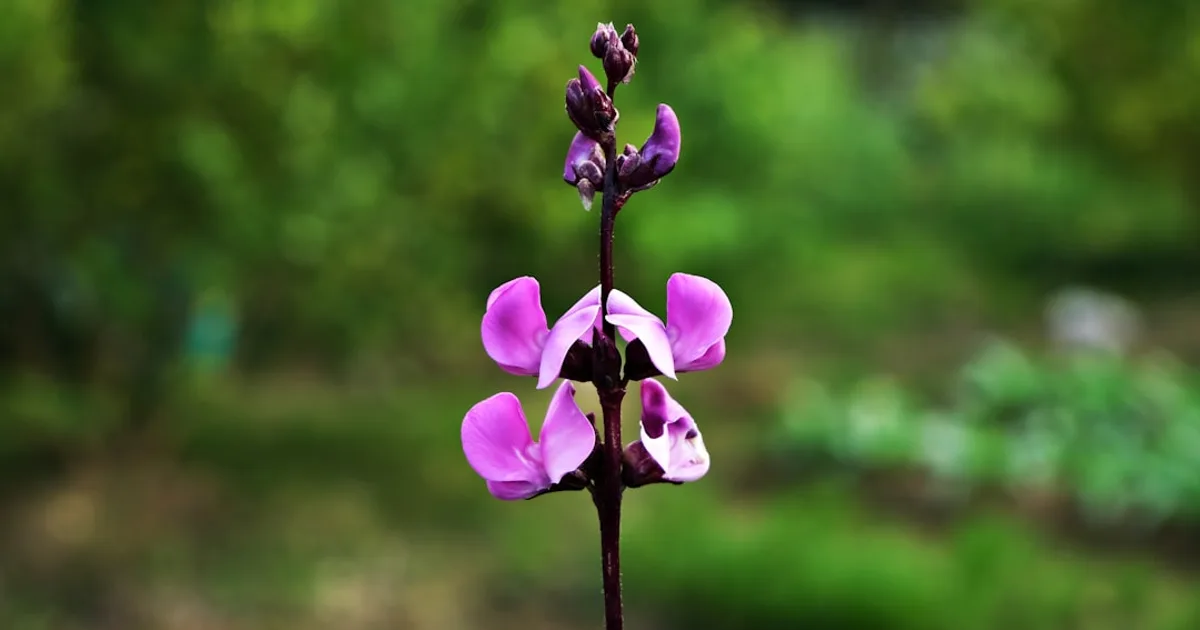
Hyacinth bean earns its place in a garden twice over. It’s one of the most ornamental climbing plants you can grow - purple-veined leaves, clusters of lavender-purple flowers that bloom continuously from midsummer to frost, and glossy deep-purple pods that persist on the vine. It’s also an edible legume, grown for centuries across South Asia and Africa for its young pods, leaves, seeds, and roots. In Indian cooking it’s called val or sem; in East Africa it’s a staple food crop. In American gardens it’s mostly treated as an ornamental, which means the edible value is overlooked almost entirely.
The caveat worth knowing upfront: mature seeds contain cyanogenic glucosides at levels that cause illness if eaten raw. Young pods are safe raw or cooked; mature seeds require prolonged boiling to detoxify. Most cooking traditions address this automatically, but it’s worth stating clearly.
What it actually is
Lablab purpureus is the only species in its genus, in the legume family (Fabaceae). It originated in Africa and has been cultivated in South Asia, East Africa, and Egypt for at least 3,000 years. Thomas Jefferson grew it at Monticello in 1812 - he called it “hyacinth bean” and grew it as an ornamental.
The plant is a vigorous twining climber that reaches 10-15 feet in a single growing season. Leaves are large, trifoliate, and often show purple veining. Flowers are pea-shaped, lavender-purple, in upright racemes that bloom continuously. Pods are flat, 2-3 inches long, deep purple fading to green with age, with a pale suture edge. The overall visual effect is dramatic - it covers fences, arbors, and trellises with color from mid-July to frost.
Genetic diversity within the species is considerable. Commercial seed sold in North America is usually a purple-flowered ornamental type selected for appearance rather than yield. Varieties grown in South Asia and Africa for food production have been selected for larger pods, higher yield, and specific seed characteristics. For serious food production, sourcing through seed companies specializing in heirloom or international varieties improves results.
Important food safety note: mature hyacinth bean seeds contain cyanogenic glucosides (primarily vicine and convicine, plus the compound linamarin). Raw mature seeds are toxic. The traditional preparation - prolonged boiling in multiple changes of water - detoxifies them completely. Young immature pods (the primary vegetable crop) have much lower concentrations and are safe cooked; many sources say young pods are safe raw, though cooking is the standard.
The ROI case
Hyacinth bean is a continuous producer once it starts flowering. A single vine on a 6-foot fence section yields pods for 10-12 weeks.
| Planting | Vines | Seasonal yield | Value @$4/lb | Seed cost | Net |
|---|---|---|---|---|---|
| 3 vines (fence/arbor) | 3 | 5-9 lb | $20-36 | $1.50* | $18.50-34.50 |
| 6 vines | 6 | 10-18 lb | $40-72 | $2.99 | $37.01-69.01 |
*Estimated from $2.99 packet.
The financial ROI is modest. The real calculation includes three things the table doesn’t capture: ornamental value on a fence or arbor that would otherwise need another climbing plant, continuous production without replanting, and culinary access to a vegetable that doesn’t exist in American supermarkets.
Seed saving: hyacinth bean produces abundantly if mature pods are allowed to dry on the vine. The seeds are large and conspicuous; one vine yields hundreds of seeds for the following season. Year-two seed cost is zero.
Growing requirements
Season: tropical annual in most US zones. Requires warm soil (above 65°F) to germinate reliably; plant after last frost. In zones 9-11, grows as a perennial; roots may overwinter and resprout. In zones 5-8, treat as an annual.
Direct sowing: sow seeds 1 inch deep, 4-6 inches apart, after last frost when soil is warm. Scarify seeds (nick with a nail file or soak overnight) to improve germination, which otherwise can be uneven. Germination at 65-80°F in 7-14 days.
Starting indoors: for zones 5-6, start indoors 4-6 weeks before last frost. Hyacinth bean has a somewhat delicate taproot - use deep cells or biodegradable pots to minimize root disturbance at transplant. Sow 2-3 seeds per cell; thin to one.
Support: this is a vigorous climber that needs substantial support. A 6-foot fence, trellis, or arbor is appropriate; it will reach the top of a 6-foot structure by late summer. Provide something for it to twine around from the start - it grabs with tendrils and climbs quickly once established.
Soil: tolerant of a wide range of soils; fixes atmospheric nitrogen through root nodules, so it thrives in lean soils where other vegetables would struggle. Avoid waterlogged conditions. No supplemental nitrogen needed.
Heat and drought: heat-tolerant. Once established, it tolerates drought better than most vegetables. In deep summer heat, it continues flowering and producing when cool-season crops have failed.
Harvest timing for pods: harvest young pods when they’re 2-3 inches long and the seeds inside are barely visible as bumps. At this stage the whole pod is tender and the cyanogenic glucoside content is low. Don’t let pods mature on the plant unless you’re saving seed - overmature pods turn the remaining pods bitter and reduce continued production.
What goes wrong
Slow establishment: the first 3-4 weeks after germination, hyacinth bean grows slowly. This is normal. The plant is developing its root system before putting energy into above-ground growth. It accelerates once roots are established.
Bean beetles and aphids: Mexican bean beetle (Epilachna varivestis) and various aphid species attack hyacinth bean as they do other legumes. Hand-pick beetle adults and egg masses from leaf undersides; knock aphids off with water; insecticidal soap for heavy infestations.
Pod set failure in cool weather: hyacinth bean is triggered to flower by shortening days in late summer. If you’re in zone 5 and the plant has barely started climbing by the time days shorten, you may get late, limited production before frost. In these zones, the indoor start is important.
Waiting too long to harvest: pods that are allowed to develop visible mature seeds inside turn tough and stringy. Once the suture edge starts bulging with seed outlines, those pods are past their eating prime for vegetable use. Either leave them to dry completely for seed saving or compost them; there’s no in-between.
Harvest and use
Harvest young pods at 2-3 inches long. Check the vine every 2-3 days during peak production - the pods go from harvest-ready to overmature in about a week. After picking, the vine flowers and sets new pods continuously until frost.
Young leaves are also edible - the tender growing tips can be harvested like other leafy greens, cooked briefly.
For mature seeds (if drying for food): shell fully dried pods; boil seeds in abundant water for at least 20 minutes, discard the water, add fresh water and boil again for 30-40 minutes until completely tender. This standard preparation used in South Asian and African cooking detoxifies the seeds and makes them fully safe.
Core preparations:
-
Val papdi chi bhaji (Indian young pod stir-fry): young pods with garlic, mustard seeds, turmeric, and grated coconut - the basic Maharashtrian preparation for fresh hyacinth bean pods. The pods hold their shape after brief cooking and absorb the spiced oil.
-
Ethiopian niter kibbeh sauce with lablab: dried and boiled lablab seeds cooked with caramelized onion, berbere spice blend, and niter kibbeh (Ethiopian spiced clarified butter). Rich, earthy, satisfying - the seed has a flavor that’s earthier than common beans.
-
Hyacinth bean dal: dried seeds soaked overnight, boiled until tender (two changes of water), finished with a tarka of onion, garlic, cumin, and tomato. Served over rice. The beans have a slightly richer, more bitter-edged flavor than lentils - more interesting than a standard dal.
-
Young leaf greens: tender growing tips cooked briefly in oil with garlic, identically to the way you’d cook sweet potato leaves or moringa. Mild flavor; slightly mucilaginous when cooked.
-
Ornamental use: it’s worth saying plainly that hyacinth bean is one of the best annual climbing plants for covering a fence or arbor with color and it does this all the way to frost. The ornamental value doesn’t require cooking anything.
Related reading: Yard-Long Bean - tropical climbing legume with similar heat tolerance; Pigeon Pea - fellow legume with South Asian culinary roots
Growing Hyacinth Bean? Track your harvest value and break-even date in the Garden ROI app.
Get the App