
Parsnip
Pastinaca sativa
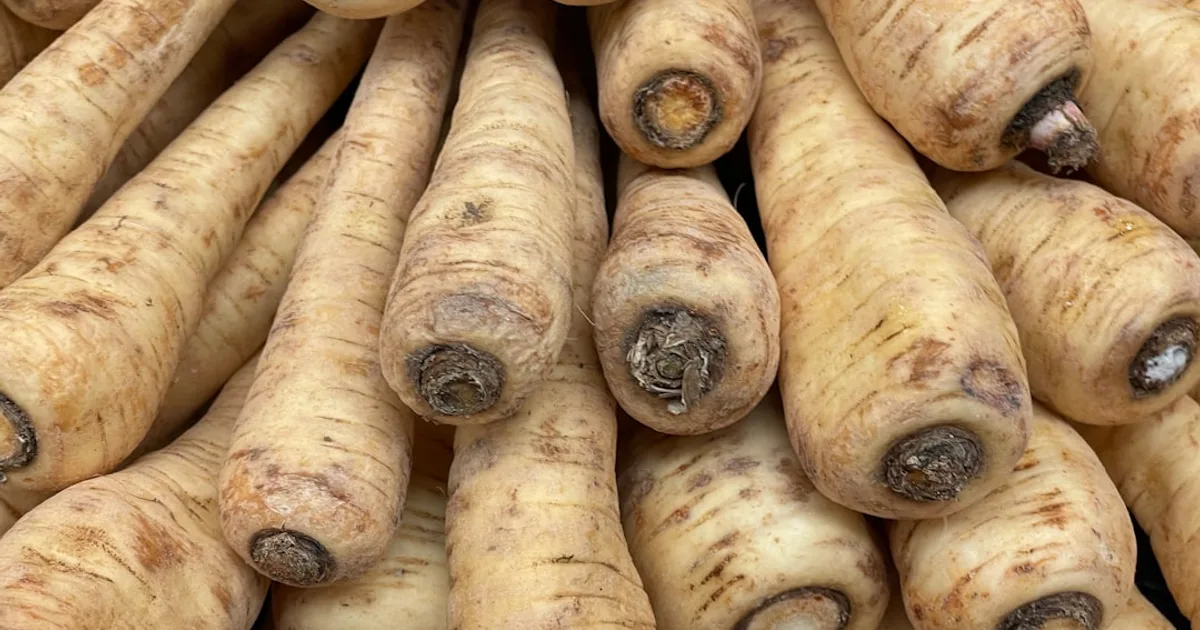
Parsnip (Pastinaca sativa) is one of the few vegetables that is objectively better after a hard freeze than before it. Plant it in spring, ignore it through summer, leave it in the ground past the first hard frost, and harvest into January. What comes out of the ground in midwinter is noticeably sweeter than what was there in October. This isn’t a marginal difference or a matter of preference. Cold biochemistry is doing something measurable inside the root, and the vegetable is better for it.
That alone makes parsnips worth growing. The fact that they also fill a practical gap - fresh root vegetables in January, when grocery stores charge accordingly - makes the ROI case stronger than the per-pound price suggests.
What you’re actually growing
P. sativa belongs to Apiaceae, the same family as carrot, celery, parsley, and fennel. The edible part is the taproot, which under good conditions grows 10 to 16 inches long and 2 to 3 inches across at the shoulder. Raw parsnips taste starchy and faintly bitter. Frost-converted parsnips taste sweet, nutty, and distinctly different from carrot. Comparing a September-harvested parsnip to a January-harvested one from the same row, same variety, feels like comparing different vegetables. It is not.
One safety note worth stating plainly: parsnip foliage and green root material contain furanocoumarins, compounds that cause phototoxic contact dermatitis - blistering and inflammation - when they contact skin in sunlight. Wear gloves when working with parsnip, particularly at harvest. This applies to the whole plant top and to broken green tissue. Cooked parsnip root presents no issue.
The ROI case
A $2.49 packet covers a generous row. Four pounds of harvested roots is a realistic yield for a 10-foot row in prepared soil - that’s a conservative figure from a planting that goes reasonably well.
Fresh parsnips at retail run $2.00 to $3.00 per pound through the fall (USDA AMS Specialty Crop Market News). At that price, 4 pounds equals $8 to $12 gross value against $2.49 seed cost. The math isn’t spectacular, but it’s fine.
The winter harvest calculation is the more interesting one. In January and February, when domestic field production is done and retail sources are drawing from storage or import, prices for fresh root vegetables climb. Parsnips in particular are not a commodity crop - they’re a specialty item in most U.S. markets. January retail prices of $3.00 to $4.00 per pound are typical in the northern states. At $3.50/lb on a 4-pound yield, gross value reaches $14, with the same $2.49 seed cost. Your cost of production is time and bed space, not inputs.
More to the point: a parsnip you dig in January from your garden costs you nothing beyond what you already spent in May. The root has been sitting in the ground for seven months, getting better. There is no equivalent in a grocery store produce section - a parsnip that’s been in cold-storage since October is a different product than one that wintered in the ground and converted its starches over multiple freeze-thaw cycles.
| Harvest timing | Yield (lb) | Price/lb | Gross value | Seed cost | Net value |
|---|---|---|---|---|---|
| September (pre-frost) | 4 | $2.00 | $8.00 | $2.49 | $5.51 |
| November (post-frost) | 4 | $2.50 | $10.00 | $2.49 | $7.51 |
| January (winter harvest) | 4 | $3.50 | $14.00 | $2.49 | $11.51 |
The January harvest more than doubles the net value of the September harvest from the same planting. That’s the actual argument for parsnips.
Seed viability - non-negotiable
Buy fresh parsnip seed every year. This is not optional and not a matter of thrift versus performance. Parsnip seed loses viability faster than almost any other common vegetable. Fresh seed from a reputable supplier germinates at 80% or better. Seed that’s two years old often germinates below 30%. At that rate, you’ll plant a full row and get scattered, thin stands - too sparse to thin properly, too gapped to produce a real yield.
The practical consequence: if you have a half-used packet from last year, throw it away. The few dollars you save by reusing it is not worth a failed stand in a crop that takes 100 to 130 days to mature. You won’t know the germination was poor until the stand comes in thin, and by then it’s too late to replant and still make a fall harvest.
Parsnip seed is not universally available at big-box garden centers. Buy from a seed company with high turnover and a stated pack date. Check that the packet is dated for the current season.
Varieties
Four varieties cover most practical situations. The differences between them matter - canker resistance in particular is not a cosmetic feature.
| Variety | Type | Days to maturity | Canker resistance | Notes |
|---|---|---|---|---|
| Hollow Crown | Heirloom | 95 | Low | Classic long tapered root; widely available; flavor is excellent post-frost; skin is rougher |
| Javelin | Hybrid | 100 | High | Smooth-skinned, uniform; practical choice for wet or clay-heavy soils where canker pressure is higher |
| Harris Model | Heirloom | 120 | Low | Fine-grained, very sweet; longer season works in favor of flavor; requires full season to size up |
| Gladiator | Hybrid | 95 | High | Fast to mature; canker-resistant; good choice when spring planting is delayed and you need to compress the season |
If you’ve had canker problems before, or if your soil stays wet through fall, grow Javelin or Gladiator. If you’re in a well-drained bed with no history of canker, Hollow Crown and Harris Model deliver excellent flavor and are easy to source.
Growing requirements
Direct sow in spring once soil reaches 50°F. Parsnips need a long season - 95 to 130 days depending on variety - and they don’t transplant. The taproot begins forming immediately, and any disruption to it causes forked or stunted roots. Seed goes in the ground and stays there.
Sow 1/2 inch deep. Plant 3 to 4 seeds per inch in the row, then thin to 3 to 4 inches apart once seedlings reach 2 inches tall. Rows 18 inches apart. Deeper spacing produces larger individual roots; tighter spacing produces more roots at smaller size. Either is fine.
Soil preparation is where most parsnip failures begin. The taproot needs 12 or more inches of loose, stone-free, well-drained soil to grow straight and long. Rocks or hard subsoil cause forking. Compaction causes stunting. If your native soil is heavy clay, rocky, or hard-packed below 8 inches, parsnips will disappoint you every season until you address the underlying problem. Raised beds with amended soil - 12 to 15 inches of loose material - solve this reliably.
Work the bed to 12 to 15 inches. Remove stones. Add 2 to 3 inches of finished compost. Do not add fresh manure or high-nitrogen amendments at planting. Excess nitrogen pushes top growth and produces hairy, multi-branched roots. Phosphorus matters more than nitrogen for root crops at establishment.
Soil pH 6.0 to 7.0. Parsnips are tolerant of slightly alkaline conditions.
Water 1 inch per week. Consistent moisture during the growing season produces straight, properly formed roots. Irregular watering - a long dry stretch followed by heavy rain or irrigation - causes roots to split or develop internal cracks. Mulch the row once seedlings are 3 to 4 inches tall to buffer moisture and suppress weeds.
Germination and row marking
Parsnip germinates slowly. Under ideal conditions - soil temperature 50 to 60°F, consistent moisture, fresh seed - expect 14 to 21 days before seedlings appear. In cooler soil or with slightly older seed, 28 days is not unusual. This creates a real problem: the row looks bare for three to four weeks, and it’s easy to disturb it by accident, or to assume nothing is coming and sow something else there.
The solution is radishes. At the same time you sow parsnip, sow a few radish seeds in the same row, mixed in or at the row ends as markers. Radishes germinate in 5 days. They’ll be up and visible before you’ve stopped checking for parsnips. They mark the row clearly, and they’re harvested before the parsnips need the space. It’s the oldest row-marking trick in kitchen gardening, and it works better than any stake or label you’ll use instead.
Don’t let the soil crust over during the germination period. A light crust can prevent emergence even when germination below the surface is proceeding normally. If you’re in a dry spell, water gently to keep the top inch moist and break any crust that forms.
The frost sweetening mechanism
Parsnips accumulate starch through the growing season. That starch serves as the plant’s energy reserve. When temperatures drop below freezing, the plant responds by converting starch to sugars - primarily sucrose, glucose, and fructose - which lower the freezing point of cell fluids and act as a form of cryoprotection. The same mechanism operates in carrots and salsify, and it’s why all three are better after frost than before it.
The conversion is not instantaneous. A single light frost makes a modest difference. Several nights at 28°F or below, over a period of weeks, produce the full effect. A parsnip harvested after a week of freezing nights tastes materially different from one harvested in early October after one frost. Patience here is directly rewarded.
You can measure this roughly: a parsnip fresh from the ground in November, eaten raw, tastes noticeably sweet compared to the same variety in September. The texture also changes - the flesh becomes slightly denser and the raw flavor loses most of its bitterness. Cooked, the difference is pronounced. Roasted frost-converted parsnips caramelize more readily and develop a flavor that September parsnips simply don’t have.
The conversion is ongoing through the winter as long as the roots remain in the ground. A January harvest in Zone 5 or 6, from roots that have experienced repeated freeze-thaw cycles, represents the full expression of the flavor the variety can produce.
What goes wrong
Parsnip canker (Itersonilia perplexans, sometimes with associated Phoma spp.) is the most damaging disease. It appears as orange-brown rot at the shoulder of the root, usually starting at cracks or lenticel openings and expanding into the flesh. It’s most common in wet autumns and in soil with poor drainage. Canker-resistant varieties - Javelin and Gladiator - are the practical solution. Rotation out of infected soil helps, but resistant varieties help more. Improving drainage is the long-term fix.
Carrot fly (Psila rosae) larvae tunnel into roots, leaving orange-brown channels and entry points for secondary rot. Row covers from germination through mid-July prevent adults from laying eggs. Resistant varieties have some tolerance but are not reliably immune.
Forked roots are a soil preparation failure, not a pest or disease. Rocks, hard subsoil, or compacted layers below the seed furrow cause roots to branch around the obstruction. The correction is thorough soil preparation before sowing. Nothing applied after planting fixes this.
Powdery mildew on foliage in late summer is common and largely irrelevant to root quality. If it appears after midsummer, ignore it. If it appears in June or July, address it - early season mildew can reduce the photosynthetic capacity the plant needs to build root mass.
Poor germination is almost always a seed viability problem. Fresh seed in soil at 50 to 60°F should show emergence in two to three weeks. If nothing has come up in four weeks, the seed was old. This is why fresh seed is non-negotiable.
Harvest and in-ground storage
Wait for hard frost - 28°F or colder, sustained over several nights. Parsnips are edible before frost. They’re better after it.
Dig with a fork. Parsnips in well-prepared soil reach 10 to 16 inches deep, and pulling from the top breaks roots. Work the fork in from the side, 6 to 8 inches out from the plant, and lever upward. Large roots in loose soil come out intact this way.
In Zones 5 and 6, you can leave parsnips in the ground and harvest through the winter on demand. After the first hard frost, mulch the bed with 6 inches of straw. This slows the freeze depth and allows you to push the straw aside and dig even in December and January when the surface soil would otherwise be frozen solid. The roots continue to sweeten through the winter as long as they’re in the ground. Harvest only what you need; leave the rest.
In Zone 4 and colder, the ground eventually freezes too deep for practical winter digging. Harvest the entire crop after the first several hard frosts - you’ll still have the post-frost flavor improvement - and store roots packed in damp sand or sawdust at 32 to 40°F. Storage life under these conditions is 2 to 4 months.
If you’re digging a winter harvest in January in Zone 5 or 6, you’re pulling produce from a garden that looks dead and dormant. The roots are better than anything in the grocery store that week, they cost you $2.49 in seed money, and the ground has been doing the work since May. That’s the actual case for parsnips.
Related crops: Carrot, Celeriac
Related reading: Beginner Homestead Crops - which roots and storage crops earn space in a practical homestead garden
Growing Parsnip? Track your harvest value and break-even date in the Garden ROI app.
Get the App