
Pawpaw
Asimina triloba
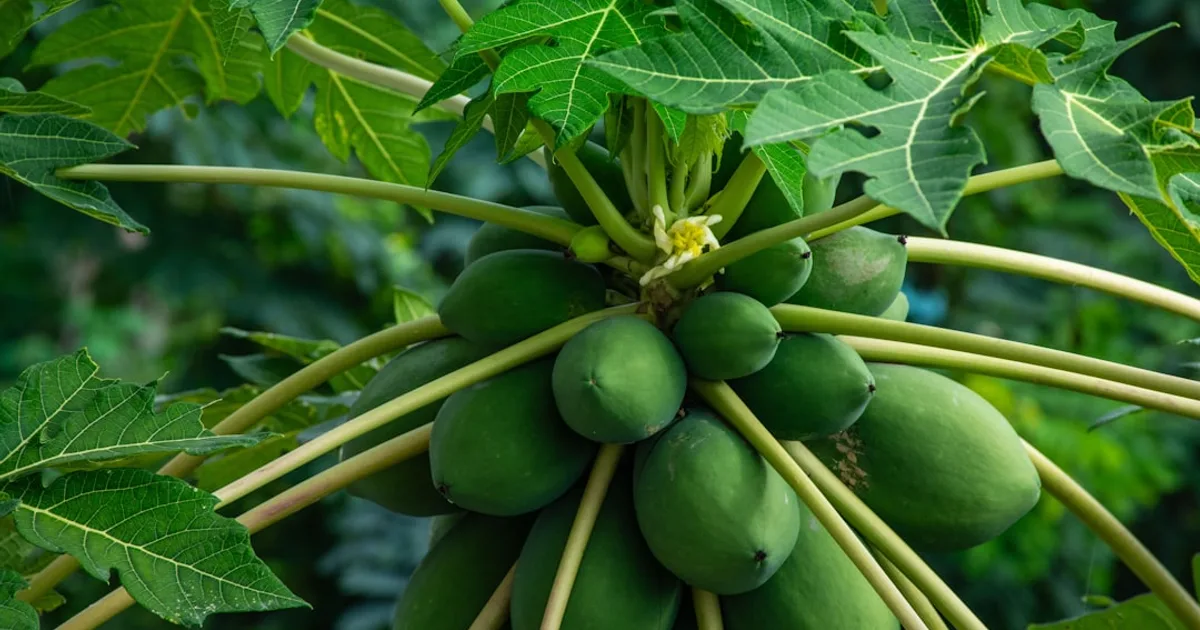
The pawpaw is probably the most unusual fruit you can grow in a temperate garden. It belongs to the custard apple family - a tropical plant family - and it tastes like it: creamy, rich, a blend of banana, mango, and vanilla with a custard-like texture. It grows wild from New York to Nebraska to Florida and is as cold-hardy as most apple varieties. It just never made it into commercial production, because the fruit doesn’t ship.
That’s the gardener’s advantage. A ripe pawpaw has a 2-3 day window before it goes from perfect to overripe. Commercial distribution can’t handle that. But a backyard tree 20 feet from your kitchen can. At the rare farmers market that carries them in September, they sell for $8-15/lb. A mature pawpaw tree produces 20-40 lb per year.
What it actually is
Asimina triloba is the only temperate member of the family Annonaceae, which otherwise includes tropical fruits like soursop, cherimoya, and atemoya. It’s native to 26 US states and Ontario - growing in forest understories and riverbanks throughout eastern North America. Native Americans used the fruit extensively as food (Moerman, Native American Ethnobotany, Timber Press, 1998).
The fruit is 3-6 inches long, green ripening to yellow-green or yellowish, 0.5-1.5 lb each, with creamy yellow flesh and two rows of dark brown seeds. The flavor profile is more tropical than any other cold-hardy fruit.
The genetic diversity in pawpaws is enormous. Wild pawpaws vary tremendously in fruit quality - some are excellent, many are merely acceptable. Named improved cultivars, developed through selection programs at Kentucky State University and commercial nurseries, produce consistently superior fruit. Growing from seed produces variable results; for reliable quality, buy a grafted tree from a reputable nursery.
Key improved cultivars:
| Variety | Flavor notes | Fruit size | Notes |
|---|---|---|---|
| Shenandoah | Vanilla-sweet, mild | Large | Best-known commercial variety; low seed content |
| Susquehanna | Rich, complex | Very large | High-quality flavor; more sensitive to cold |
| Sunflower | Sweet, mild | Large | Self-fruitful; good for single-tree planting |
| Allegheny | Excellent flavor | Medium-large | Kentucky State University selection |
| Wabash | Custard-rich | Large | Late ripening; long harvest season |
The ROI case
Pawpaws are a long-term investment. First-year trees are small; most grafted trees begin producing at year 3-4 and reach significant output at year 5-7. The fruit value is high ($8-15/lb at market), but the primary value is access - these fruits are rarely available for purchase.
| Year | Yield estimate | Value @$10/lb | Cumulative value | Tree cost (2 trees) | Cumulative net |
|---|---|---|---|---|---|
| 1-2 | 0 | $0 | $0 | -$39.98 | -$39.98 |
| 3 | 3 lb | $30 | $30 | - | -$9.98 |
| 4 | 10 lb | $100 | $130 | - | $90.02 |
| 5 | 20 lb | $200 | $330 | - | $290.02 |
| 7 | 30 lb | $300 | $830 (est.) | - | $790.02 |
| 10 | 35 lb | $350 | $1,430 (est.) | - | $1,390.02 |
Two trees required for cross-pollination in most cultivars; some (Sunflower) can produce with one.
Note: two trees at ~$20 each used in calculation. Prices at farmers markets when pawpaws are available often exceed $10/lb; $8/lb used as conservative estimate.
Growing requirements
Cross-pollination: most pawpaw cultivars require a different variety for cross-pollination. The flies and beetles that pollinate pawpaw flowers aren’t efficient pollinators, and the flowers are imperfect self-pollinators. Plant at least two different named varieties within 50 feet of each other. Some growers hang roadkill or raw meat near the trees during bloom to attract flies - this is effective but socially complicated.
Shade tolerance when young: young pawpaw trees prefer partial shade during their first 1-2 years in the ground - they evolved as understory plants. After establishment, they perform better with more sun. A practical approach: plant on the east side of a taller planting where they get morning sun and afternoon shade, then remove the shade source after year 2.
Soil: deep, rich, well-drained, slightly acidic (pH 5.5-7.0). Pawpaws grow naturally along stream banks and forest bottoms - fertile, moist, well-drained soil. They don’t tolerate standing water or shallow, rocky soil.
Watering: consistent moisture during the first 2-3 years until establishment is critical. Established trees are more drought-tolerant but produce better fruit with consistent irrigation during fruit development (late summer). Deep, infrequent watering is better than frequent shallow watering.
Fertilizing: light feeder once established. Compost mulch around the drip line provides most of what the tree needs. Avoid high-nitrogen fertilizer, which produces excessive vegetative growth at the expense of fruit.
Suckers: pawpaw trees sucker aggressively from the roots. Left unmanaged, a single tree becomes a dense thicket - the natural growth form. For a clean garden tree, remove suckers as they appear at the base. Alternatively, allow controlled suckering to create a managed clump, which also improves cross-pollination.
What goes wrong
Failure to establish: pawpaws have a thick taproot that develops quickly; they resent root disturbance. Buy container-grown trees from reputable nurseries and handle roots carefully. Don’t let roots dry out between purchase and planting. The first year, newly planted pawpaws may show minimal top growth while the root system establishes - this is normal.
No fruit set despite flowers: poor pollination is the most common reason for flower-set failure. Ensure two different varieties are within pollination range, and consider hand-pollinating by transferring pollen between flowers with a small paintbrush. Pollinate when the stigma (central female part) is receptive - it appears slightly sticky and cream-colored.
Zebra swallowtail caterpillar (Eurytides marcellus): the only significant pest specific to pawpaw. The caterpillars feed on leaves but rarely cause serious damage to established trees. They’re also extraordinarily beautiful - blue, yellow, and black striped. Most gardeners tolerate them.
Fruit dropping before ripeness: July and August heat stress or irregular watering can cause premature fruit drop. Consistent watering during fruit development reduces this.
Sunscald on young trees: the smooth, thin bark of young pawpaws is susceptible to sunscald (southwest injury) in winter. Wrap trunks during the first 2-3 winters.
Harvest and use
Pawpaws ripen in late August through October depending on variety and location. They signal ripeness clearly: skin turns from green to yellowish-green, fruit yields to gentle thumb pressure (similar to a ripe avocado), and the stem releases with slight pressure. The aroma at peak ripeness is unmistakable - distinctly tropical, slightly floral.
Ripening tip: a pawpaw picked at “firm ripe” (slightly yielding but not soft) can ripen at room temperature in 2-3 days. This is the practical way to manage the narrow window - pick at firm ripe, eat over the next few days. Don’t refrigerate before ripening; cold storage of unripe pawpaw slows ripening unevenly. Ripe pawpaws refrigerate for 3-5 days.
The seed: pawpaw seeds are large (3/4 inch), dark brown, and indigestible. Remove them. The flesh clings to the seeds somewhat; work around them. A rough field method: bite directly and work the flesh off the seeds.
Core preparations:
-
Eaten fresh from the tree: the primary use. Ripe pawpaw eaten at peak requires no preparation. Scoop the flesh with a spoon or eat directly; discard the skin and seeds.
-
Pawpaw ice cream: the natural preparation. The flesh is already custard-textured. Blend ripe pawpaw pulp with cream, sugar, and a little vanilla; freeze in an ice cream maker. Superior to banana ice cream in flavor complexity.
-
Pawpaw smoothie: pulp blended with yogurt and honey. The flavor holds well blended; works with or without dairy.
-
Pawpaw bread (quick bread): same structure as banana bread. Ripe pawpaw pulp used in place of banana. Moister result, more complex flavor. Add cardamom or ginger.
-
Pawpaw chutney: the tartness of underripe pawpaw combined with the sweetness of ripe pawpaw, ginger, vinegar, and sugar. Works well with pork and poultry.
-
Frozen pawpaw pulp: scoop ripe pulp, seed and all into a colander; press through to separate pulp from seeds. Freeze in ice cube trays, then transfer to bags. Frozen pawpaw pulp keeps 6-12 months and retains most of the fresh flavor.
Related reading: Persimmon - another native tree fruit with similar late-season harvest timing; Mulberry - low-maintenance native fruit tree; Fruit Tree Payback Timeline - when tree fruits break even on investment
Growing Pawpaw? Track your harvest value and break-even date in the Garden ROI app.
Get the App