
Peach
Prunus persica
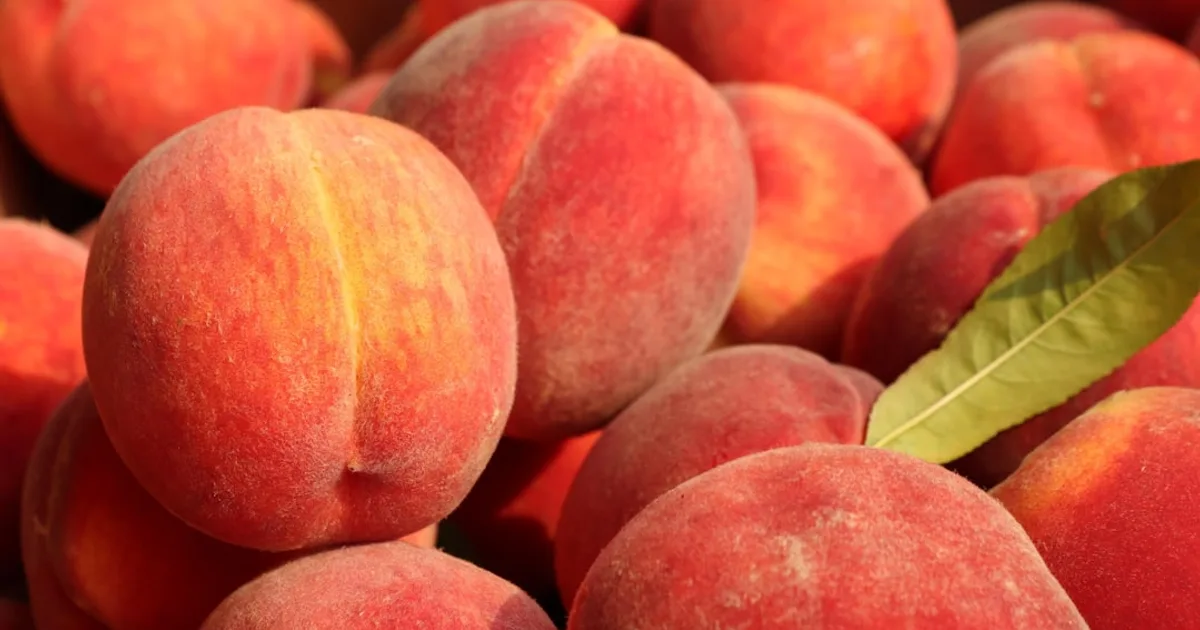
Fresh peaches at the farmers market run $2-4/lb for freestone varieties in season. A mature peach tree in its fifth year produces 50-100 lb of fruit. That’s $125-400 in retail-equivalent value from a single tree per year. The tree cost $25-40 at the nursery. The math looks good. The problem is that most home peach trees never get to year five in productive form, because brown rot destroys the harvest in a wet August and the owner stops trying.
This page covers both sides: the real ROI case and the real disease risk. You need both numbers before you plant.
What you’re actually buying
Peach trees sold at nurseries and garden centers are grafted trees, not seedlings. Two parts make up the plant: the rootstock (the underground root system and lower trunk) and the scion (the fruiting variety budded onto the rootstock above the graft union).
This matters more than most nursery tags communicate. The scion - the named variety like ‘Reliance’ or ‘Redhaven’ - determines flavor, fruit size, harvest timing, and disease resistance in the fruit itself. The rootstock determines tree size, soil adaptation, and the tree’s tolerance of wet feet or compacted ground. Common rootstocks include Lovell (good general performance), Nemaguard (nematode resistance in the South), and Guardian (replant disease tolerance). Standard nursery stock rarely labels the rootstock. If you’re planting in an area with known root knot nematode pressure - sandy soils in the Southeast particularly - ask specifically for Nemaguard rootstock, or you’ll lose the tree in 3-5 years.
The graft union is the visible bulge near the base of the trunk. Keep it above soil level when planting. Burying the graft union invites crown rot and rootstock suckering.
One more thing: a peach tree you buy at a box store in spring is typically a one-year-old whip, sometimes called a maiden. It will need 2-3 years of establishment before real fruit production. Year one, you’re building the tree’s structure. Year two, you’re seeing the first light crop. Year three, it starts to look like what you paid for.
Chilling hours - the variable that decides whether you can grow peaches at all
Chilling hours are the single most important variable in selecting a peach variety, and they’re the first thing most backyard growers get wrong. A chilling hour is one hour of temperature between 32°F and 45°F, accumulated between November and February. Peaches use this cold accumulation to break dormancy properly in spring. Without enough chill, the tree either doesn’t flower, flowers erratically, or sets fruit that drops before maturity.
Most of the country east of the Rockies in zones 5-8 accumulates 900-1,200 chilling hours per winter without difficulty. The Gulf Coast, South Florida, coastal Southern California, and the desert Southwest accumulate far fewer - sometimes as low as 100-300 hours per year. If you plant a high-chill variety like ‘Redhaven’ (950-1,050 hours required) in zone 9, you get a tree that leafs out and dies back repeatedly and never produces fruit. If you plant a low-chill variety like ‘Flordaprince’ (150-200 hours) in zone 6, it breaks dormancy in January during the first warm spell and loses its blossoms to the next hard freeze.
Match variety chill requirement to your location’s actual accumulated chill hours. Your state’s cooperative extension service publishes chill accumulation maps.
| Variety | Chill Hours Needed | Zones | Harvest Season | Notes |
|---|---|---|---|---|
| Reliance | 900-1,100 | 4-8 | Mid-August | Extremely winter-hardy; survives -25°F; good quality for a northern variety (Michigan State Extension) |
| Redhaven | 950-1,050 | 5-8 | Late July | Benchmark freestone; excellent flavor and texture; widely recommended by Penn State Extension |
| Contender | 1,050 | 4-8 | August | Moderate brown rot resistance; one of the few varieties with documented disease tolerance |
| Winblo | 850 | 6-9 | September | Later harvest extends season; freestone; adapted to mid-Atlantic and upper South |
| Flordaprince | 150-200 | 8-9 | Very early (May-June) | Low-chill standard for Gulf Coast; developed by University of Florida IFAS |
| UFSharp | 100-150 | 9-10 | April-May | Extremely low-chill; developed by UF IFAS for South Florida conditions |
Sources: USDA ARS stone fruit research program; University of Georgia Extension low-chill variety evaluations; Michigan State University Extension variety guides for northern regions.
One thing the table doesn’t capture: chill hours vary by year. A mild winter in zone 6 might deliver only 700 hours. A cold zone 8 winter might deliver 900. Plant a variety with 200 hours of buffer above your average accumulation. If your area averages 1,000 hours, plant varieties requiring 800 or fewer. ‘Reliance’ and ‘Contender’ at 900-1,050 hours are good choices for zone 5-6 where 1,100+ hours is common.
Clingstone vs. freestone - what it means for your use case
The pit attachment of the flesh is a practical characteristic that affects how you use the fruit.
Freestone peaches: the flesh separates cleanly from the pit when ripe. You can halve the fruit, twist, and lift out the pit cleanly. ‘Redhaven’ and ‘Reliance’ are freestone. This makes slicing for fresh eating easy, and canning or freezing straightforward - you can pack halves into jars without fighting the pit. Retail price for fresh freestone at farmers markets: $2-4/lb (USDA AMS Specialty Crop Market News, 2023 season data).
Clingstone peaches: the flesh clings tightly to the pit. You can’t halve and twist cleanly - you cut the fruit off the pit with a knife. Clingstones often ripen earlier than freestones, and many are considered sweeter. They represent the majority of commercial canning production because the firm texture holds through thermal processing. Retail equivalent for canned clingstone peaches: $1.50-2.50/lb by can weight (USDA ERS food price data).
Semifreestone varieties: a middle category that separates cleanly when fully ripe but clings when picked slightly early.
For home use, freestone is nearly always the better choice. The easier processing makes a difference when you’re handling 50+ lb from a mature tree in a two-week harvest window. Clingstone makes sense only if your primary plan is canning and you want the flavor characteristics of early-ripening varieties.
10-year ROI
These numbers come from USDA ARS peach production research and Penn State Extension orchard economics publications. The inputs assume a single standard-sized tree purchased as a bare-root whip, planted in a site with adequate sun and drainage, and receiving standard maintenance including annual pruning and a basic spray program.
| Year | Cost | Yield | Fruit Value | Net |
|---|---|---|---|---|
| Year 1 | $25-40 (tree) + $10-15 (planting supplies) | 0 | $0 | -$35-55 |
| Year 2 | $15-20 (spray materials, fertilizer) | 0-2 lb | $0-5 | -$15-20 |
| Year 3 | $15-20 | 10-20 lb | $25-50 | +$5-35 |
| Year 4 | $15-20 | 25-40 lb | $62-100 | +$42-85 |
| Year 5+ | $20-30/yr | 50-100 lb/yr | $125-250/yr | +$95-230/yr |
At year 5, cumulative costs are approximately $120-170. Cumulative fruit value if you’ve had clean harvests: $200-400. You’ve broken even. From year 6 onward, the tree produces $95-230 net per year.
The critical caveat: the table above assumes no crop loss to brown rot. In a wet year without a spray program, actual yield in year 5 might be 5-10 lb instead of 50-100. The disease section below is not optional reading.
Disease warning - brown rot
Monilinia fructicola is the pathogen that makes peaches the highest-maintenance common fruit tree in North American home orchards. Brown rot is a fungal disease that infects blossoms in spring and then lies latent in the fruit until ripening. When conditions are right - warm, wet weather during the final 2-4 weeks before harvest - the fungus activates and spreads through ripening fruit with visible speed. A tree with a full crop can go from clean fruit to complete loss in 3-5 days of wet July or August weather. The infected fruit develops a brown soft spot, a ring of gray-tan fungal sporulation, and within days the entire fruit is consumed and mummified on the tree.
The mummified fruit is the key to understanding why this disease is hard to break. Mummies that remain on the tree or fall to the ground over-winter the pathogen and serve as primary inoculum the following spring. A tree that isn’t cleaned up rigorously is essentially inoculating itself for next season.
The only variety with documented partial resistance is ‘Contender,’ which shows moderate tolerance in Penn State Extension trial evaluations. No commercially available variety is fully resistant. This means management is chemical for anyone serious about consistent yields.
The standard spray program for brown rot follows this schedule:
- Pink bud stage (just before bloom): copper or lime sulfur
- Petal fall: copper or captan
- Every 10-14 days during fruit development in wet conditions: captan or myclobutanil
- 2-3 weeks before harvest (the highest-risk window): tighten spray intervals to 7 days in wet weather
Remove and dispose of - not compost - all mummified fruit at the end of each season. Clean mummy removal has measurable impact on the following year’s disease pressure. Penn State Extension research shows mummy removal combined with a petal-fall spray program reduces brown rot incidence compared to either practice alone.
Being direct about this: if you want a low-spray fruit tree, grow elderberries, gooseberries, or Asian pears. Peaches require the most consistent spray management of any common home fruit tree. The ROI at maturity is real, but so is the management requirement. If you miss the critical pre-harvest spray window in a wet year, you will lose the crop. That’s not a worst-case scenario - in the Mid-Atlantic, Southeast, and Great Lakes regions, it’s a typical year.
Growing requirements
Site selection: full sun, 8+ hours per day. Peaches planted in part shade produce smaller, less sweet fruit and are more susceptible to disease because foliage stays wet longer after rain. A site with good air drainage - meaning cold air can drain away on still nights - reduces frost damage to blossoms in spring. Avoid low spots and north-facing slopes.
Soil: pH 6.0-6.5, well-drained. Peaches do not tolerate wet feet. A site that stays waterlogged for more than 24 hours after heavy rain will kill a peach tree within 2-3 seasons through root rot. Sandy loam to loam soil is ideal. Heavy clay needs amendment or raised planting.
Water: 1 inch per week during the growing season. Consistent moisture during fruit development directly affects fruit size and sugar content. Drought stress after fruit set reduces fruit size and dry matter content (USDA ARS fruit quality research). After leaf drop in fall, cut irrigation - dormant trees need minimal water.
Pruning: peaches bear fruit on one-year-old wood. This is the most important thing to know about peach pruning, because it determines your entire approach. Unlike apples and pears, which bear on older spurs, peaches need a constant supply of new wood each year. Annual pruning to the open-center (vase) form, removing about 30-40% of wood each year and encouraging vigorous new shoots, is not optional. An unpruned peach tree produces smaller, crowded fruit and declines quickly in productivity.
Fertilization: 1 lb of 10-10-10 per inch of trunk diameter in early spring, up to 5 lb for a mature tree, is a standard starting point per Penn State Extension. Adjust based on annual shoot growth. You want 12-18 inches of new shoot growth per year on a mature tree. Less than that suggests nitrogen deficiency; more than that suggests you’re pushing vegetative growth at the expense of fruit quality.
Related crops: Arugula, Garlic
Related reading: First Three Years ROI; Fruit Tree Payback Timeline - when each tree covers its cost
Growing Peach? Track your harvest value and break-even date in the Garden ROI app.
Get the App