
Pecan
Carya illinoinensis
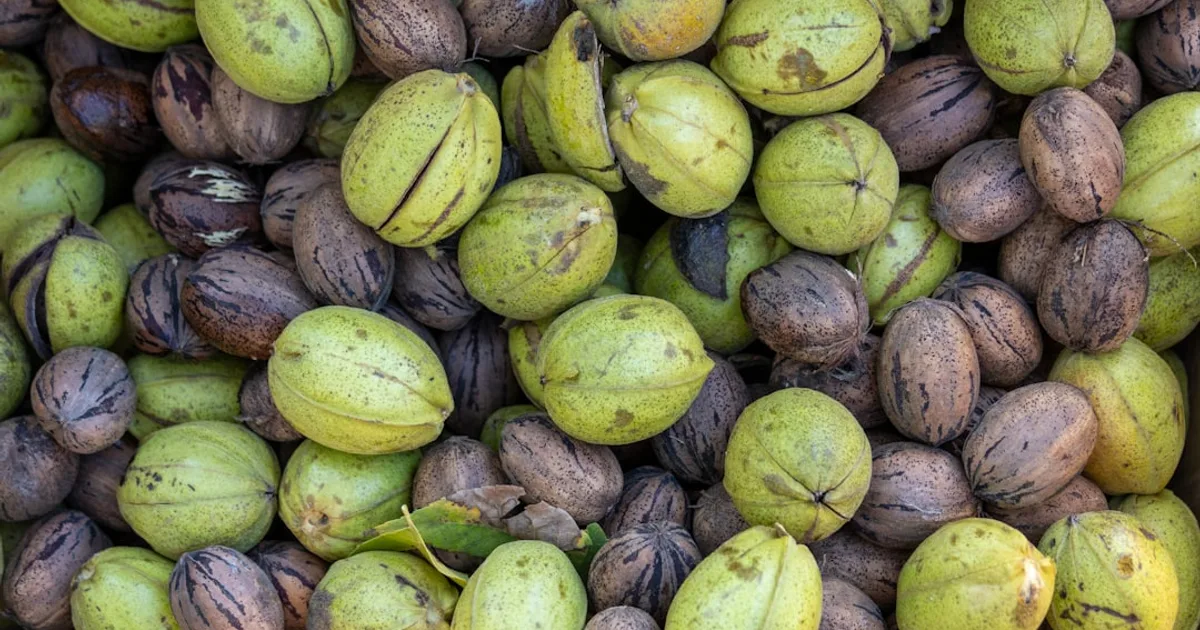
Pecan is the only nut tree native to North America, and the math on a mature tree is hard to ignore. Retail in-shell pecans run $7-14/lb at grocery stores. Shelled pecans go for $12-20/lb. A tree in full production - somewhere between years 10 and 20 - yields 50-100 lbs of in-shell nuts per season. Run the numbers on a single $39.99 bare-root tree: at year 10, producing 40 lb at $8/lb, that’s $320 per year from one tree. By year 20, a well-managed tree in good conditions will outproduce that estimate by a wide margin.
The US produces roughly 300,000 acres of commercial pecans - Georgia, New Mexico, and Texas dominate. That commercial scale is one reason pecan nuts are widely available at retail prices that make home production competitive. You’re not growing something obscure. You’re growing the same crop the commercial orchards grow, in your own yard, for a fraction of the retail price. Source: USDA NASS, Pecan Production, 2022 Census of Agriculture.
That said: this is not a crop for impatient growers. The first several years of a pecan tree’s life are about root and canopy establishment, not nut production. Understand the timeline before you plant.
The cross-pollination requirement - non-negotiable
Pecan trees are monoecious - male catkins and female flowers exist on the same tree - but this doesn’t mean a single tree will produce reliably on its own. The problem is timing.
Pecans are divided into two types based on when they shed pollen relative to female receptivity:
Type I (protandrous): pollen is shed before female flowers on the same tree are receptive. Examples: ‘Desirable’, ‘Wichita’. A Type I tree produces pollen early in the season, then becomes receptive to pollen from outside after its own pollen is spent.
Type II (protogynous): female flowers are receptive before pollen is shed on the same tree. Examples: ‘Stuart’, ‘Elliott’, ‘Kanza’. A Type II tree is receptive to outside pollen first, then sheds its own pollen later.
The practical implication: a single-variety planting will produce some nuts through wind drift from distant trees, but production is higher - and more reliable year to year - when you plant one Type I and one Type II variety within 40-50 feet of each other. The two types’ timing offsets complement each other perfectly. What one tree sheds, the other is ready to receive.
Texas A&M AgriLife Extension pecan program maintains variety type classifications and cross-pollination recommendations at pecans.tamu.edu. Consult their variety selector before purchasing trees.
Your initial investment to do this correctly is $79.98 - two bare-root trees. That changes the break-even calculation but not the long-term ROI. Two trees at full production at conservative yields ($8/lb, 40 lb/tree) yield $640/year combined. The initial cost is recovered in the first productive year.
Multi-year production timeline
| Year | Expected Yield (per tree) | Value at $8/lb | Cumulative Value (2 trees) |
|---|---|---|---|
| 1-5 | 0 (establishment) | $0 | $0 |
| 6-8 | 5-15 lb | $40-120 | $80-240 |
| 9-12 | 20-40 lb | $160-320 | $320-640/yr |
| 13-20 | 40-80 lb | $320-640/yr | Cumulative $2,000-3,000+ |
| 20+ | 50-100+ lb | $400-800/yr | - |
Initial investment: $79.98 for two trees. At conservative year 7-8 yields (10 lb per tree x 2 trees x $8/lb = $160/year), break-even on tree cost arrives around year 8-9. After that, annual inputs are minimal - water, zinc, mulch - and the trees produce for decades.
This timeline assumes no major disease pressure and correct variety pairing for your climate. Adjust expectations downward if you’re in a humid region with high scab pressure and you’ve planted susceptible varieties.
Variety selection
Five varieties cover most home grower situations in the US:
| Variety | Type | Origin | Zones | Notes |
|---|---|---|---|---|
| ’Desirable’ | I | Deep South | 7-9 | Primary commercial variety in Georgia and Texas; large nuts, excellent flavor; not scab-resistant |
| ’Wichita’ | I | Texas | 6-9 | High yield, slightly smaller nut, strong heat tolerance; popular in west Texas and New Mexico |
| ’Stuart’ | II | Southeast | 6-9 | Heirloom variety; widely available; good cold hardiness; large nut; susceptible to scab in the East |
| ’Elliott’ | II | Southeast | 7-9 | Scab-resistant; the most important variety for humid climates east of the Mississippi; smaller nut but reliable production without a spray program |
| ’Kanza’ | II | USDA ARS | 5-6 | Released by USDA ARS for northern growers; lower yield ceiling than southern varieties but cold-hardy; best option for zones 5-6 |
Source for ‘Kanza’ release: USDA ARS, Kanza Pecan, Agricultural Research Service release documentation, ars.usda.gov.
Pairing guidance: for humid eastern gardens, ‘Elliott’ (Type II) paired with ‘Desirable’ or another Type I gives you scab resistance on the reliable producer and a strong pollinator. For northern gardens in zones 5-6, ‘Kanza’ (Type II) paired with a zone-appropriate Type I (‘Wichita’ where winters are mild enough) is the combination most likely to survive and produce.
Pecan scab - the disease that determines your variety choice
If you’re east of the Mississippi in zones 6-9, pecan scab (Venturia effusa, formerly Cladosporium caryigenum) is the most important factor in variety selection. Full stop.
Scab is a fungal pathogen that causes black lesions on developing nuts and leaves during warm, humid conditions. In a bad scab year, an unprotected orchard of susceptible varieties in the Southeast can lose 50-100% of its crop. That’s not an exaggeration - commercial pecan growers in Georgia manage scab with 6-10 fungicide applications per season. A home grower without a spray program on a susceptible variety in a wet year should expect significant crop loss.
The practical solution is variety resistance. ‘Elliott’, ‘Kanza’, ‘Caddo’, and ‘Creek’ carry real scab resistance. If you’re growing east of the Mississippi in a humid climate, these are your default choices. Don’t plant ‘Desirable’ or ‘Stuart’ without understanding that scab management is part of the commitment.
In drier climates - New Mexico, Arizona, west Texas - scab pressure is minimal. The same varieties that require spray programs in Georgia grow clean and unsprayed in the Pecos Valley. Geography changes what you need to worry about.
Zinc deficiency - the most common problem nobody expects
Zinc deficiency is the single most common nutritional problem in home-grown pecans, and it’s the one most likely to go undiagnosed until trees are producing well below their potential.
The symptom is called rosette: small, crinkled, clustered leaves on the growing tips, sometimes with mottled coloring. Growth stalls. Nut production drops or fails to develop. Trees look like they’re struggling without an obvious cause.
The mechanism: most pecan-growing soils are neutral to alkaline. High soil pH locks zinc into insoluble compounds the roots can’t absorb. The tree is surrounded by zinc but can’t access it.
The treatment is chelated zinc applied as a foliar spray - not soil amendment, which won’t solve a pH-driven uptake problem. Texas A&M AgriLife Extension pecan program documents the standard protocol as chelated zinc foliar spray in early spring before budbreak, then at 2-week intervals through June - typically 3-4 applications per season. This is documented as essential annual practice across many Texas and southeastern soils.
Without zinc management, even a well-sited tree in good soil will underperform. Budget for chelated zinc and a pump sprayer in your annual maintenance plan. The material cost is under $30/year for a home-scale planting.
Source: Texas A&M AgriLife Extension, Pecan Production and Zinc Management, Overton, TX; extension.tamu.edu.
Zone requirements and site selection
Most pecan varieties require zones 6-9. ‘Kanza’ extends production into zone 5. ‘Posey’ is sometimes cited as another zone 5-hardy option but is less widely available.
The zone range requirement is about two things that pull in opposite directions: winter chill and summer heat. Pecan needs winter chill hours - roughly 200-1000+ hours below 45°F depending on variety - to break dormancy properly and set flower buds. It also needs a long, warm growing season of 200+ frost-free days for nut fill. Too short a season and the nuts don’t fill. Too warm a winter and the tree doesn’t chill properly. This is exactly why commercial production concentrates in the South: long, hot summers combined with real winters.
Site requirements beyond climate:
Deep soil is mandatory. Mature pecan taproots go 5-10 feet deep. Rocky, shallow soils - anything less than 3 feet to bedrock - will limit the tree’s development and yield potential. If you’re on a shallow soil in a productive zone, pecan is not your nut crop. Grow hazelnut instead.
Drainage matters. Pecans tolerate periodic flooding better than most fruit trees, but sustained waterlogged conditions cause root rot and poor development. Well-drained bottomland soil - the environment where pecans grow naturally along river bottoms in the South - is ideal. Heavy clay that stays wet through spring needs drainage improvement before planting.
Space. Mature pecan trees are large - 70-100 feet tall and nearly as wide in ideal conditions. Home growers rarely see full-size trees because they’re harvested young or the site constrains growth, but allow a minimum 30-40 feet between trees and 20+ feet from structures. The canopy shades significant ground area. Plan the site with the 20-year tree in mind, not the 5-year sapling.
Harvest
Pecans signal ripeness the same way year after year: the outer green husk splits open and the nuts drop with shaking or wind. You don’t need to determine ripeness by calendar or appearance - the tree tells you.
Harvest promptly from the ground. In-shell pecans left on wet soil absorb moisture, which accelerates mold development inside the shell and compromises kernel quality. After a rain, get to the nuts within a day or two. A nut roller or garden rake over a cleared area under the canopy makes ground-level harvest practical.
Storage: in-shell pecans keep 6 months at cool room temperature, 12+ months refrigerated, and 2 years frozen without significant quality loss. Shelled pecan halves keep 6-9 months refrigerated or 2 years frozen. The high oil content that makes pecans rich is the same reason they go rancid at room temperature faster than lower-fat nuts. Refrigerate or freeze anything you won’t use within a few weeks.
Cracking: for large harvests, a mechanical pecan cracker - the lever-style “Texan” crackers available for $20-50 - saves significant hand fatigue compared to nutcrackers. They’re sized for pecan and crack the shell cleanly without pulverizing the kernel.
Other problems
Pecan weevil (Curculio caryae) is the most damaging insect pest on home-scale plantings. Adult weevils bore into developing nuts in August and September; larvae develop inside the nut, feeding on the kernel. Emergence timing varies by location and year, making insecticide application difficult to time correctly. Commercial orchards use scheduled trunk-drench or perimeter sprays; home growers often rely on a combination of monitoring with pyramid traps (which capture emerging adults) and promptly removing all fallen nuts from the ground to break the life cycle. Weevil larvae overwinter in the soil; removing and disposing of infested fallen nuts reduces next-year populations.
Hickory shuckworm (Cydia caryana) larvae tunnel through the outer shuck of developing nuts, interfering with nut fill. In heavy infestations, shucks stick to the shell after husk split, a symptom called “sticktight.” Primarily a commercial production problem; light infestations on home plantings don’t usually cause total crop failure, but heavy pressure in susceptible seasons can reduce yield.
Fall webworm (Hyphantria cunea) produces silken nests on branch tips in late summer. Primarily cosmetic on mature trees - defoliation of individual branches doesn’t affect overall tree health. Remove nests by hand on young trees where full canopy is important for establishment.
Related crops: Chestnut, Walnut
Related reading: Fruit Tree Payback Timeline - when perennial crops cover their cost
Growing Pecan? Track your harvest value and break-even date in the Garden ROI app.
Get the App