
Plum
Prunus domestica
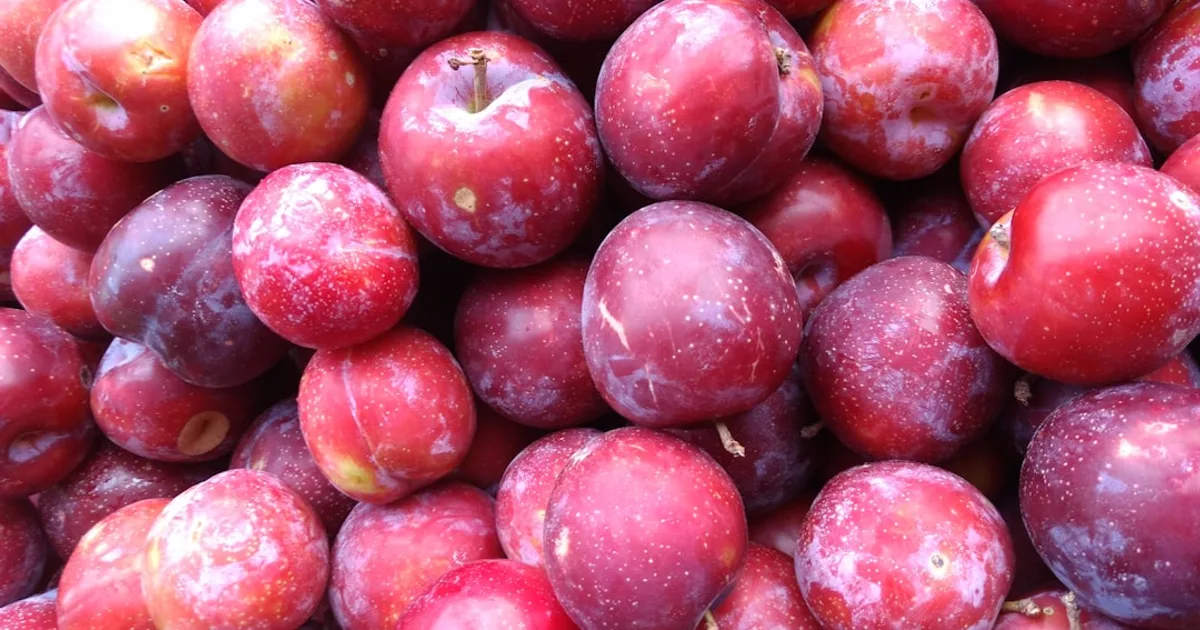
A mature plum tree in a good year produces more fruit than most households can eat fresh. A medium-sized European plum (Prunus domestica) in full production yields 50-100 lb. At $2/lb retail, that’s $100-200 in fresh fruit from a tree that, after the initial 3-4 year establishment period, requires mainly a seasonal pruning and some thinning. The annual input drops to near zero while the output continues for decades.
The challenge with plums, as with any fruit tree, is the patience required. The tree doesn’t produce real fruit in years one and two, production builds in years three and four, and the full harvest arrives in year five and beyond. You’re making a long-term investment in a permanent site.
What it actually is
Prunus domestica is the European plum species, the one responsible for most supermarket prune-plums and many fresh market plums. It includes distinct types:
European plums (P. domestica): freestone, oval to round, typically blue-purple or yellow-green, with firm dry flesh suited for fresh eating, cooking, and drying into prunes. Most are self-fertile, which matters in small gardens where space for two trees is limited. Hardy to zone 4 in most varieties.
Japanese plums (P. salicina): round, larger, juicier, higher sugar. The typical supermarket plum - red, black, or yellow, with soft, sweet flesh. Most Japanese plums require cross-pollination from another Japanese plum variety. Less cold-hardy than European plums (zone 5-6 minimum, zone 4 with protected siting).
American plums (P. americana and hybrids): hardiest of the group (zone 3), smaller fruit, tart flavor. Good for preserves, not ideal for fresh eating.
For most home gardeners, European plums offer the best combination of self-fertility, cold hardiness, disease resistance, and versatility. Key self-fertile European varieties:
| Variety | Fruit | Flavor | Ripens | Zone | Notes |
|---|---|---|---|---|---|
| Stanley | Dark blue-purple, medium, oval | Sweet, mild, freestone | Late August-September | 4-7 | Most widely planted; reliable, productive |
| Italian Prune | Blue-purple, oval | Rich, sweet when ripe | Late August | 5-8 | Same as Stanley for most purposes |
| Damson | Small, blue-black | Tart, complex | September | 5-7 | Not sweet for fresh eating; superior for jam, preserves |
| Greengage (Reine Claude) | Green-yellow, round | Exceptionally sweet, rich | August | 5-8 | Considered finest-flavored European plum |
| Mirabelle | Very small, yellow | Sweet, aromatic | August | 5-8 | French specialty; excellent fresh and in tarts |
| Mount Royal | Blue-purple, oval | Sweet, good fresh | Late August | 4-6 | Best for zones 4-5; very cold-hardy |
The ROI case
Plum is a long-horizon investment. The economics over a 15-year period look like this for a single Stanley tree:
| Year | Input | Yield (lb) | Value @$2/lb | Cumulative net |
|---|---|---|---|---|
| 1 | $24.99 tree + $10 planting | 0 | $0 | -$34.99 |
| 2 | $5 fertilizer | 2 lb | $4 | -$35.99 |
| 3 | $5 fertilizer | 10 lb | $20 | -$20.99 |
| 4 | $5 fertilizer | 25 lb | $50 | $24.01 |
| 5-10 (per year avg) | $5/year | 60 lb | $120/year | - |
| 10-year cumulative | ~$95 total | ~300 lb | ~$600 | ~$505 |
The tree breaks even at year 4 and returns roughly $115/year net in fruit value for the following decade, from a fixed one-time investment. Years 4-20 cost essentially nothing; the tree just produces.
The prune and preserve dimension adds further value. Surplus European plum production (inevitable in a good year) can be made into jam, preserves, plum butter, or dried into prunes. Good prune jam retails at $5-8 per half-pint jar; a bushel of plums (50 lb) makes approximately 20-25 half-pint jars of jam. At $6/jar, that’s $120-150 in jam value from a single tree’s seasonal surplus.
Growing requirements
Site selection: permanent. Choose carefully because the tree lives there for 20-40 years. Requirements: 6-8 hours of full sun, excellent air drainage (avoid frost pockets - low spots where cold air settles), no standing water (stone fruits are highly susceptible to crown and root rot), and enough space for the mature tree (8-15 feet diameter for most semi-dwarf types).
Sizing: most nursery trees are sold on semi-dwarf rootstock (e.g., St. Julien A or Pixy), reaching 10-15 feet. Standard rootstocks produce larger trees (15-20 feet). Semi-dwarf on St. Julien A is the typical recommendation for home gardens - manageable size for pruning and harvest, reasonable productivity.
Pollination: self-fertile European plums don’t require a second tree, but having a second compatible variety increases set and yield. If you have space for two trees, plant them - production improves notably with cross-pollination.
Planting: plant bare-root trees in early spring as soon as soil can be worked, before bud break. Container-grown trees can go in spring or fall. Dig a hole wide enough that roots spread without bending; plant at the same depth as the nursery, or slightly higher in clay soils. Water in well and mulch 3-4 inches deep around the root zone (not touching the trunk).
Pruning: European plums are typically trained to an open center or modified central leader form. First 3 years of pruning establish the scaffold structure; subsequent annual pruning removes crossing branches, water sprouts, and opens the canopy to light and air. Prune in late winter before bud break. Clean cuts with sharp tools prevent disease entry.
Thinning: in years when the tree sets a heavy crop (many do), thin excess fruitlets in early summer to 3-4 inches between fruit. This concentrates the tree’s resources into larger, better-quality fruit and prevents branch breakage under excess weight. It feels wrong to remove fruit, but the result is better.
What goes wrong
Brown rot (Monilinia fructicola and M. laxa) is the dominant stone fruit disease in humid climates. It causes fruit to rot on the tree, covered in gray-brown fungal spores. Spread accelerates in wet weather at harvest time. Prevention: remove and dispose of mummified fruit (fruit that dries on the tree carries the fungus through winter), thin fruit for airflow, apply copper fungicide in early spring at bud swell. Damson and certain European plums have better brown rot resistance than Japanese types.
Plum curculio (Conotrachelus nenuphar) is a weevil that lays eggs in developing fruit, leaving characteristic crescent-shaped scars. Infected fruit drops early. In organic management, a kaolin clay spray (Surround WP) at petal fall and weekly thereafter through fruit set provides significant protection by deterring egg-laying.
Black knot (Apiosporina morbosa) produces elongated, rough black galls on branches. Cut out all affected wood well below the visible gall, disinfect pruning tools between cuts. Remove wild cherry and plum trees near the garden if possible; they’re reservoir hosts.
Frost damage to blossoms: European plums bloom relatively late compared to peaches and cherries, reducing frost risk. Still, a late frost after bloom kills flowers and eliminates the year’s crop. In frost-prone sites, choose late-blooming varieties (Stanley, Italian Prune) or provide frost cloth protection during bloom.
Alternate bearing: some trees produce heavily one year and lightly the next. Consistent annual pruning and fruit thinning reduce this tendency. Heavy thinning in an “on” year reduces crop stress and supports better production the following year.
Harvest and use
European plums ripen from August through September depending on variety and zone. The fruit is ripe when it comes free of the spur with a gentle twist, not when it reaches full color - color change happens 2-3 weeks before full ripeness. Ripe plums feel slightly soft at the tip and smell like plums.
Don’t pick and refrigerate immediately. Plums continue ripening after picking. Let them reach room temperature ripeness, then refrigerate for up to a week.
Fresh eating: European plums are typically sweeter and less acid than Japanese types when fully ripe. Greengage and Mirabelle are exceptional for fresh eating at peak ripeness.
Cooking and preserves:
- Plum jam is one of the easiest jams - European plums are high-pectin, so they set without added pectin.
- Plum tart (tarte aux quetsches in Alsatian cooking) uses halved plums arranged on pastry cream in a tart shell. One of the best fruit tarts possible.
- Italian prune plums are the classic choice for plum cake in German and Eastern European tradition (Pflaumenkuchen, Švestkový koláč).
- Plum butter: cook down large quantities with minimal sugar, then can or freeze.
- Dried prunes: European plums with high sugar content can be dried whole (with pit) or halved. A food dehydrator at 135°F for 12-20 hours produces shelf-stable prunes.
Preserving surplus: the heavy crop years when the tree produces 80-100 lb are the preservation moments. Freeze pitted plum halves on a sheet pan then transfer to bags - they keep 12 months and are excellent in crumbles, cakes, and sauces through winter. A well-stocked freezer from one good plum year covers household baking through the following winter.
Related reading: Mulberry - another long-horizon perennial fruit; Calendar - pruning and spray timing by zone; Fruit Tree Payback Timeline - when each tree covers its cost
Growing Plum? Track your harvest value and break-even date in the Garden ROI app.
Get the App