
Rhubarb
Rheum rhabarbarum
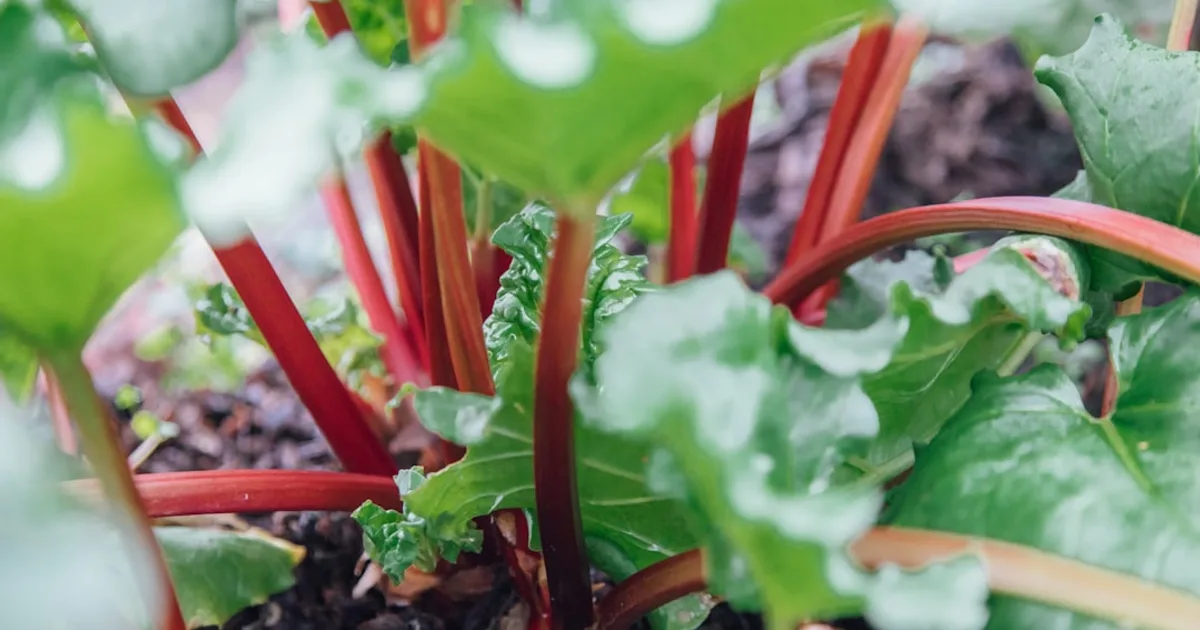
Rhubarb (Rheum rhabarbarum) is one of the few crops where planting it is better described as an investment than a garden project. You won’t harvest the first year. You’ll harvest lightly the second year. From year three onward, a healthy crown requires almost no input and produces 3–6 lb of stalks annually for 20 years or longer without replanting. The math on that per-season cost is essentially zero.
What rhubarb actually is
Rhubarb is a perennial vegetable classified and sold as a fruit. Only the stalks are edible - the leaves contain high concentrations of oxalic acid and are toxic. This is not a minor caveat: rhubarb leaf consumption has caused poisoning and fatalities. Discard leaves in a compost pile or trash, never on the ground where livestock or children might access them.
The stalk color - red, pink, or green - varies by cultivar and has no bearing on ripeness or flavor. ‘Victoria’ is a green-stalked cultivar that predates most red types and is highly productive. ‘Canada Red,’ ‘Crimson Red,’ and ‘Valentine’ are red-stalked cultivars marketed for appearance. Red-stalked types are popular for fresh sale but taste essentially the same as green (University of Minnesota Extension, Rhubarb in the Garden, 2021).
Rhubarb requires a dormancy period with temperatures below 40°F to break dormancy properly and produce vigorously. This makes it suited to Zones 3–7 but problematic in Zones 8 and warmer, where insufficient winter chill leads to poor spring regrowth. It is not a warm-climate crop.
The ROI case
A crown at a garden center costs $6–$12. One crown, well-established, yields 3–6 lb per season starting in year three (Cornell Cooperative Extension, Rhubarb, 2020). At $2.50–$4.00/lb retail (USDA AMS, 2023), that’s $7.50–$24 annually from a single crown. After the initial planting cost is recouped in years three to four, every subsequent harvest is pure return.
Crown division adds to the math. Every 4–5 years, a rhubarb crown should be divided to maintain vigor. Each division becomes a new producing crown. A single plant becomes two, then four. After 10 years of division, a gardener who started with one $10 crown has a permanent rhubarb planting worth several hundred dollars in transplant value, generating free divisions indefinitely.
Growing requirements
Plant crowns in early spring when soil can be worked, or in fall in mild climates. Set the crown bud (the growing point) 2 inches below soil surface. Planted too deep, crowns rot; too shallow, they dry out and heave during freeze-thaw cycles.
Space 3–4 feet between crowns in all directions. Rhubarb grows large - mature plants reach 3 feet across with substantial root systems. Crowding stresses plants and reduces yield.
Rhubarb is not particular about soil but performs best in well-drained, fertile loam at pH 6.0–6.8. Waterlogged soil causes crown rot. Amend beds with 3–4 inches of compost before planting. Top-dress each crown with compost in early spring annually.
Remove flower stalks immediately when they appear. Flowering redirects energy from leaf and stalk production. A crown that is allowed to go to seed exhausts itself and yields poorly for the rest of the season. Snap the flower stalk off at the base as soon as you spot it.
Year one and two management
Year one: do not harvest anything. The crown needs to establish a root system. If you harvest stalks in year one, you weaken the plant and set back the timeline for productive harvests.
Year two: harvest no more than one-third of the stalks. Take the larger, outer stalks and leave the smaller central ones to continue feeding the crown.
Year three and beyond: harvest freely through the spring season, stopping when stalk diameter decreases noticeably (a sign the plant is tired). Stop harvesting by midsummer to allow the plant to rebuild energy reserves for next year.
What goes wrong
Crown rot (Phytophthora spp., also Rhizoctonia spp.) causes crowns to turn brown and mushy, usually as a result of waterlogged soil or planting too deep. No effective treatment; remove affected crowns. Replant in improved drainage.
Rhubarb curculio (Lixus concavus) is a rust-colored snout beetle that bores into rhubarb stalks, crowns, and roots, leaving characteristic frass-filled tunnels. Infested stalks wilt and yellow. Hand-pick adults in early summer. Remove dock (Rumex spp.) weeds from the vicinity - the beetle’s primary host plant.
Leaf spot (Ramularia rhei) produces small, water-soaked spots on leaves that expand and turn reddish-brown with pale centers. It’s rarely serious enough to impact the harvest. Remove heavily infected foliage.
Frost damage to emerging stalks in early spring is common and usually not serious. Damaged stalks turn dark and mushy; cut them off and the plant will produce more. A hard freeze on newly emerged crowns can kill them back, but established roots typically resprout without permanent damage.
Harvest and storage
Harvest rhubarb stalks by grasping near the base and pulling with a slight twist - the stalk should snap cleanly from the crown. Don’t cut with a knife unless necessary; cutting leaves a stub that may rot and introduce disease.
Stalks should be firm and crisp. Flaccid or pithy stalks are overmature or dehydrated; they’re edible but texture and flavor suffer. Target stalks that are 12–18 inches long for maximum yield per harvest.
Trim leaves immediately and compost or discard them. Stalks keep refrigerated for 2–3 weeks in a bag. For longer storage, chop and freeze raw without blanching; frozen rhubarb works well in pies, jams, and sauces.
20-year perennial economics
Most garden crops are annual contracts. You put in money and labor in spring and collect in fall, then start over. Rhubarb is a 20-25 year investment with a single upfront cost and near-zero carrying costs after establishment.
Here is the actual math on one crown.
Initial investment: $8-15 for a bare-root crown or small starter plant. Year one, you put it in the ground and walk away. Year two, you take a light harvest - call it 1-2 lb. Year three onward, a healthy established crown yields 4-10 lb of stalks per season (Penn State Extension, Rhubarb, Fact Sheet HO-40). Spring retail prices for rhubarb peak in March through May before supply catches up with demand; USDA AMS market reports show rhubarb moving at $2.50-4.00/lb at peak spring retail. That puts annual yield value at $10-40 per crown once the plant hits full production.
Run that out over 20 years:
| Scenario | Yield/Year | Price/lb | Annual Value | 20-Year Total | Initial Cost | Net Return |
|---|---|---|---|---|---|---|
| Conservative | 4 lb | $2.50 | $10 | $200 | $15 | $185 |
| Mid-range | 7 lb | $3.00 | $21 | $420 | $12 | $408 |
| Strong | 10 lb | $4.00 | $40 | $800 | $10 | $790 |
No annual seed cost. No transplant cost. The recurring input is a shovelful of compost each spring and division every 4-5 years. Operating cost over 20 years: negligible. No other common garden crop - not tomatoes, not peppers, not squash - delivers this ratio of total return to initial investment. Tomatoes require fresh transplants or seed starts every year. Rhubarb just keeps going.
The break-even point on a $12 crown at mid-range yields: year five, assuming you harvest nothing in year one, half a yield in year two, and full production from year three. After that, every harvest is pure return.
Crown division economics
The 20-year math above covers one crown. Division changes the picture further.
Rhubarb crowns need to be divided every 4-5 years to maintain vigor. Left undivided, a large old crown produces increasingly smaller stalks as the growing points compete with each other. Division is not optional maintenance - it is what keeps the plant productive. The method: dig the entire crown in early spring before growth begins, split it with a sharp spade into sections each containing at least one prominent bud, and replant at the original spacing.
Each division produces 3-5 transplantable sections from one established crown. At retail garden centers, rhubarb crowns sell for $8-15 each. When you divide a 5-year-old crown and get four sections, you have produced $32-60 worth of transplants from a plant you would have divided anyway.
A gardener who starts with one crown and divides on schedule builds out like this:
- Year 1: 1 crown planted
- Year 5: first division, 1 crown becomes 3-4 crowns
- Year 10: second division of original plants, plus first division of year-5 plants - 9-16+ crowns
- Year 15: third round of divisions - 27-80+ theoretical crowns (limited by available bed space)
A 15-year rhubarb planting that has been properly managed produces enough divisions to fill a large permanent bed, supply neighbors, or sell at a farm stand or plant swap. Each division given away or sold is worth $8-15 retail. The plant that cost you $12 in year one has generated a supply of divisions worth several hundred dollars over its life, on top of the harvest value.
Spring price premium
Rhubarb has the most pronounced seasonal price spike of any common garden crop. The season is short and front-loaded: production starts in April or May, peaks in May and June, then tapers. By August, most commercial rhubarb is off the market entirely. Retail availability drops to near zero in fall and winter, and what little exists carries a significant scarcity premium.
USDA AMS terminal market and retail data shows rhubarb pricing tracking a consistent spring pattern: early season (March-April) prices are elevated as buyers compete for limited early supply, typically $2.50-4.00/lb at retail. Peak season (May) drops slightly as supply increases but remains well above commodity vegetable pricing. By late summer, the market largely disappears.
Your garden rhubarb delivers its main harvest in May and June - exactly the window when retail prices are still riding the spring premium. You are not competing with off-season imports or greenhouse production. There is no off-season rhubarb import market of consequence. The price you compare against is the actual spring retail price.
The preservation strategy extends that window: rhubarb freezes extremely well without blanching. Chop stalks into 1-inch pieces, spread on a sheet pan to freeze individually, then bag. Frozen rhubarb bakes and stews indistinguishably from fresh. Jam and compote extend the season further. The effective yield from your May-June harvest, stretched through frozen and preserved stock, covers rhubarb needs well into fall at a cost of $0/lb.
Zone requirements
Rhubarb is the rare crop defined as much by where it won’t grow as where it will.
The plant needs winter dormancy triggered by sustained cold. Specifically, crowns require 500 or more hours below 40°F (the standard chilling hour calculation used in perennial fruit production) to break dormancy fully and push vigorous spring growth. Without adequate chilling, plants may leaf out weakly, produce thin stalks, or fail to come back reliably after a few years.
USDA Hardiness Zones 3-8 cover the range where rhubarb performs well long-term. Zone 3 (minimum -40°F to -30°F) is fine - rhubarb is extremely cold-hardy and handles Minnesota and northern Wisconsin winters without protection. Zones 4-7 are the sweet spot: reliable winter dormancy, strong spring growth.
Zone 8 is marginal. Mild winters in much of Zone 8 accumulate chilling hours inconsistently. Plants may produce adequately for a few years and then gradually decline as they fail to get proper dormancy. Some Pacific Northwest Zone 8 locations with cool, wet winters work reasonably well; the warm Zone 8 climates of Georgia or coastal Texas do not.
Zone 9 and warmer: rhubarb is not a viable long-term perennial. Plants may survive and produce briefly but will not persist and will not deliver the 20-year ROI that defines the crop’s value. This is the crop that cold-climate gardeners have and warm-climate gardeners don’t. That scarcity is part of what holds the retail price.
A note on the leaves
Rhubarb leaves contain oxalic acid at concentrations high enough to cause poisoning. USDA FoodData Central data shows rhubarb leaves contain higher oxalic acid than the stalks; ingestion of large quantities has caused toxicity cases in humans and fatalities in livestock. This is not a fringe concern or a precautionary overstatement - it is an established toxicological fact.
Only the stalks are edible. Cut leaves off immediately after harvest and compost or discard them. Do not leave cut leaves on the ground in areas accessible to children, poultry, or other livestock.
Related crops: Strawberry, Garlic
Related reading: First Three Years ROI - how to calculate the full lifecycle return on a perennial planting; Perennial vs. Annual ROI - how rhubarb fits into the perennial economy as a zero-input crop after establishment; Rhubarb ROI Analysis - stalks per crown per year and the actual grocery savings math
Growing Rhubarb? Track your harvest value and break-even date in the Garden ROI app.
Get the App