
Rutabaga
Brassica napus var. napobrassica
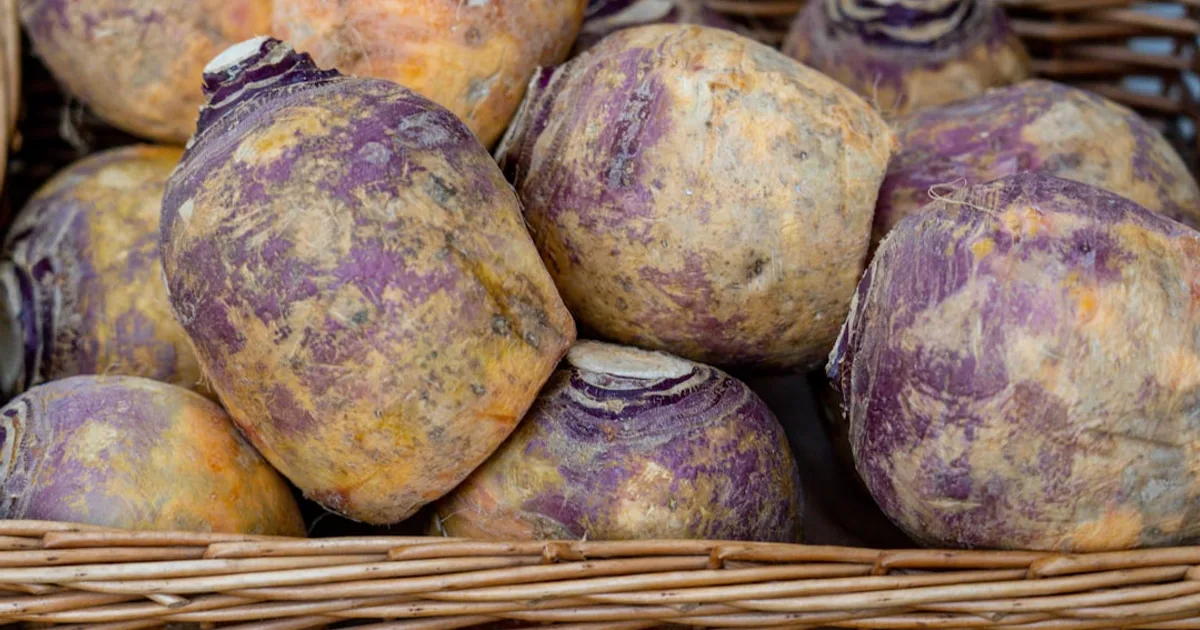
Rutabaga (Brassica napus var. napobrassica) is what you get when cabbage (Brassica oleracea) and turnip (Brassica rapa) cross. The hybrid species - B. napus - is also the source of canola oil, which tells you something about how widely the species is used in agriculture despite being largely invisible in American home gardens. Rutabagas are larger, denser, and milder than turnips with higher dry matter content. That’s why they’re the better storage crop. Turnips are fast and fresh; rutabagas are slow and built to last.
What you’re actually growing
The edible part is the swollen hypocotyl - technically a combined root and stem structure - typically purple-green above the soil line and yellow-white below, with yellow-orange flesh inside. The flavor is earthy and mildly sweet raw, but cooking transforms it. Raw rutabaga tastes medicinal. Roasted at 400°F it becomes sweet and nutty, closer to a parsnip than anything else. That transformation is the reason you cook it long and hot.
The Scots figured this out centuries ago. “Neeps and tatties” - mashed rutabaga served alongside mashed potato - is the traditional accompaniment to haggis on Burns Night. The combination works because rutabaga’s dense, slightly sweet flesh holds up to the fat and salt in the haggis where a lighter vegetable wouldn’t. Beyond Scotland, rutabaga belongs in root vegetable soups, roasted alongside carrots and parsnips, or mashed on its own with butter and black pepper. It absorbs fat well and softens predictably.
Do not skip the high heat. Rutabaga roasted at 350°F stays dense and slightly waxy. At 400-425°F the exterior caramelizes and the interior softens completely. The flavor difference is significant.
Rutabaga vs. turnip
These two vegetables share shelf space at most grocery stores and they’re often lumped together in gardening advice, but they solve different problems. If you want a root vegetable quickly, grow turnips. If you want one that holds through winter, grow rutabagas.
| Characteristic | Rutabaga | Turnip |
|---|---|---|
| Flavor | Earthy-sweet, mild | Sharper, peppery |
| Harvest size | 3-5 lbs | 0.5-1.5 lbs |
| Days to maturity | 90-100 days | 35-60 days |
| Storage life | 4-6 months | 3-4 months |
| Best culinary use | Roasting, mashing, long-cooked soups | Raw, quick-cooked, braised greens |
| Key role | Winter storage crop | Fast succession crop |
The practical implication: if you’re planning a root cellar or even just a cold garage shelf, rutabaga earns that space more than turnips do. A turnip picked in October will be soft by December. A rutabaga stored properly in October can still be firm in February or March.
Varieties
The variety you choose matters less than timing and soil prep, but there are real differences worth knowing.
| Variety | Origin | Days to Maturity | Key Trait |
|---|---|---|---|
| American Purple Top | North American standard | 90 days | Reliable germination, widely available, good all-around flavor |
| Laurentian | Canadian heirloom | 100 days | Smooth skin, excellent storage quality, developed for northern climates |
| Joan | Modern British | 85 days | Disease-resistant, faster maturity, good for shorter growing seasons |
| Helenor | Swedish heirloom | 95 days | Exceptional flavor, dense flesh, worth seeking out for table quality |
American Purple Top is the default choice for most North American growers - seed is easy to find and it performs consistently. Laurentian is the better choice if storage life is the primary goal; it was bred in Canada specifically for cold-cellar keeping. Joan is useful in Zone 4-5 where the window between last frost and first frost is tight. Helenor is harder to source but worth it if you’re growing primarily for eating.
The ROI case
A $1.99 packet of rutabaga seed is one of the least expensive entries in the root vegetable category. One packet plants a 25-foot row; at 6-inch spacing you get 40-50 plants. Each root at harvest weighs 1-3 lbs depending on season length and soil. USDA AMS Specialty Crop Market News (2023) reports rutabaga at $1.50-$2.50/lb at retail.
The per-pound return isn’t the highest in the garden, but the storage case changes the math.
A single plant producing a 4 lb root is realistic with good growing conditions - larger than the conservative average, but not uncommon in a well-amended bed. Here’s how the value calculates across the storage window:
| Timing | Price/lb | Value of 4 lb root | Notes |
|---|---|---|---|
| At harvest (September) | $2.00 | $8.00 | Fresh market price |
| Stored to November | $2.00 | $8.00 | Same price, but you’re not buying it |
| Stored to January | $2.25 | $9.00 | Winter premium begins |
| Stored to February | $2.50 | $10.00 | Highest value window |
That 4 lb root grown for $0.05 in seed cost (roughly 1/40th of a $1.99 packet) returns $8-$10 in grocery value depending on when you consume it. More practically: in January and February, fresh root vegetables at retail are expensive and the selection is thin. Parsnips, celeriac, and rutabaga at $2.50/lb are the premium roots, and you’ve had yours sitting in damp sand since October.
The honest caveat is that the 4 lb root requires good growing conditions. In poor soil or with moisture stress, 1.5-2 lb is more realistic. Even at that yield, the math works - $3.75-$5 in value from $0.05 in seed.
One row of rutabagas can offset 3-4 months of grocery purchases for this vegetable category.
The waxing question
Commercial rutabagas are dipped in paraffin wax before shipping to extend shelf life during distribution - this is why they look artificially shiny in stores. Home-grown, unwaxed rutabagas store just as well under proper conditions. The wax is a commercial processing step designed for the supply chain, not a requirement of the vegetable itself.
Some gardeners do wax home-grown roots for very long storage: trim the tops and tail, let the roots cure for a week in a cool dry spot, then dip in melted food-grade paraffin and let harden. This can extend storage to 6-8 months. For most home growers it’s unnecessary - proper cool, humid storage conditions achieve the same result without the extra step. If you’re storing into late spring, waxing is worth considering.
Planting timing
Rutabaga needs cool temperatures to develop its characteristic sweetness. The roots that formed during summer heat are edible but denser and less sweet than roots that developed as temperatures dropped in fall. Plan the crop to mature in cool weather.
Count back 90-100 days from your first fall frost date. In Zone 5-6, first frost typically falls between October 1 and October 15. That puts the planting window at late June to mid-July. Zone 4 growers should aim for mid-June. Zone 7 growers can push into late July.
Summer heat won’t kill the plant during this window. The seedlings germinate and the plant establishes in July heat, but the root development that matters - the bulking up and sugar accumulation - happens in August and September as temperatures drop. A rutabaga planted in late June in Zone 5 is doing most of its useful work after Labor Day.
Direct sow 1/2 inch deep, 3-4 seeds per inch, in rows 18 inches apart. Thin to 6 inches apart when seedlings reach 3-4 inches tall. Rutabagas do not transplant reliably - direct sowing is standard.
Growing requirements
Soil pH 5.5-7.0. Like all brassicas, rutabagas are susceptible to clubroot (Plasmodiophora brassicae) in acidic soil below pH 6.5 - liming to above 7.0 suppresses clubroot. Test soil before planting in any bed with a brassica disease history.
Rutabagas are heavy feeders with some sensitivity to boron deficiency, which causes internal brown discoloration called “brown heart.” A soil test before planting catches boron deficiency. If deficient, apply 1 tablespoon of borax per 100 square feet dissolved in water (University of Minnesota Extension, Growing Rutabagas, 2019). Do not over-apply - excess boron is toxic to plants and the margin between deficiency correction and toxicity is narrow.
Water 1 inch per week consistently. Drought stress causes woody texture. Inconsistent moisture - wet-dry-wet cycles - causes cracking. Mulch the bed after thinning to buffer soil moisture during August heat.
What goes wrong
Clubroot (Plasmodiophora brassicae) is the most serious brassica disease. It deforms roots into distorted, club-shaped growths and persists in soil for 20+ years once established. Rotate brassicas out of infected beds, lime to pH 7.2+, and apply lime in the planting hole. There is no cure once established in a bed.
Flea beetles (Phyllotreta species) chew small holes in cotyledons and young leaves. Severe infestations can kill seedlings. Row covers prevent access. Diatomaceous earth around the stem base deters adults.
Turnip mosaic virus (TuMV) causes yellowing and distorted growth. It spreads via aphids; control aphids early with insecticidal soap or strong water spray. Remove infected plants.
Root maggot (Delia radicum, cabbage root fly) larvae tunnel into roots. Row covers at planting prevent egg-laying. Beneficial nematodes (Steinernema feltiae) applied to soil target larvae.
Brown heart (internal discoloration) is boron deficiency, not disease. You won’t know it’s there until you cut the root open - the outside looks normal. Prevention via soil testing is the only reliable approach.
Harvest and storage
Harvest after a few light frosts but before the ground freezes. Frost sweetens flavor by converting starches to sugars - this isn’t folk wisdom, it’s a measurable starch-to-sugar conversion that happens in response to cold. Roots are ready when they reach 3-5 inches in diameter. Larger roots can become woody in the core.
Twist off tops 1 inch above the root and leave the root intact. Brush off loose soil. Do not wash before storage - moisture on the skin during storage promotes rot.
Store at 32-40°F in high humidity (90-95% relative humidity). Pack in damp sand or wood shavings in bins, or store in mesh bags in the coldest part of your refrigerator. Penn State Extension (Storing Vegetables and Fruits at Home, 2022) recommends the damp sand method for roots held longer than 2 months, as it maintains humidity more consistently than open storage. Under good conditions, rutabagas hold 4-6 months.
A root cellar is ideal but not required. An unheated garage that stays above freezing, a cold basement corner, or the bottom drawer of your refrigerator all work. The refrigerator works for 1-3 months; after that, humidity control becomes harder without packing material.
Related crops: Turnip, Arugula
Related reading: Beginner Homestead Crops - storage crops that pull their weight in a first-year homestead setup
Growing Rutabaga? Track your harvest value and break-even date in the Garden ROI app.
Get the App