
Scallion
Allium fistulosum
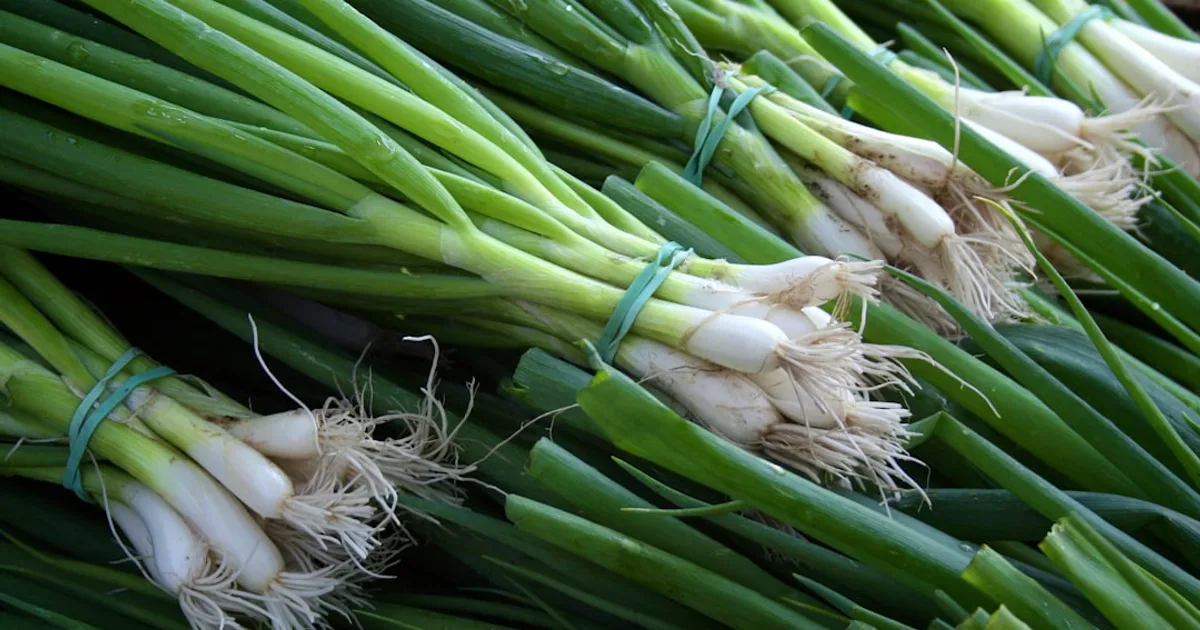
Scallion (Allium fistulosum) is the true bunching onion - it does not form a bulb, it is harvested entirely for its green tops and slender white base, and it will regrow from the cut base for two to three additional harvests. A $2.49 seed packet planted in succession every three weeks keeps you in green onions from spring through late fall. If you’ve been buying bunches at $1.50 each, that adds up faster than you think.
What you’re actually growing
The common name “scallion” is applied loosely to several things. True scallion is Allium fistulosum, the Japanese bunching onion - it forms hollow cylindrical leaves and a small white pseudostem but never a distinct bulb. What you see in grocery store bins labeled “green onions” is sometimes A. fistulosum, sometimes immature bulbing onion (A. cepa) harvested before bulb development. They look similar but A. fistulosum is more cold-tolerant, perennializes in zones 6+, and regrows more reliably after cutting.
Standard varieties include ‘Evergreen Hardy White,’ ‘Red Beard,’ and ‘Parade.’ Some Asian varieties (‘Tokyo Long White,’ ‘Ishikura’) produce longer, thicker white shanks - these command a slight premium at farmers markets.
The ROI case
A $2.49 packet seeds 5-10 row feet. Harvest begins 60-70 days after germination. One row foot at standard spacing (1 inch between plants) holds 12 plants, and a bunch of 6-8 scallions weighs about 2 oz at the grocery store. That’s 24-32 oz, or 1.5-2 lb per row foot over the season with cut-and-come-again management.
At $3-5/lb retail (USDA AMS Specialty Crop Market News, 2023), a 5-foot row returns $22-50 in gross value through the growing season. The per-harvest value is modest but the cumulative return across multiple cuts is substantial relative to the input cost.
The kitchen scrap regrowth method is worth understanding: when you trim a bunch of store-bought scallions, the root end (1-2 inches with intact roots) will regrow to harvest size in 10-14 days when placed in a glass of water or planted in potting mix. This gives you one additional harvest from a $1.50 grocery store purchase. Repeated cycles are possible, though plant vigor declines after 3-4 cuttings.
Succession Schedule: Continuous Harvest from a Single Bed
One sowing gives you scallions for two to three weeks before the bed is spent. Succession planting every 3 weeks from 4 weeks before last frost through early July gives you continuous production from late spring through October.
This table uses Zone 6 timing (last frost May 10, first fall frost October 15). Adjust sowing dates 1-2 weeks earlier for Zone 7+, 1-2 weeks later for Zone 5.
| Sowing date | Germination | First harvest | Harvest window |
|---|---|---|---|
| April 12 (4 weeks before LF) | April 22 | June 15-20 | Late June - early July |
| May 3 (1 week before LF) | May 13 | July 5-10 | July |
| May 24 (2 weeks after LF) | June 3 | August 1-5 | August |
| June 14 | June 24 | August 22-25 | Late August - September |
| July 5 | July 15 | September 10-15 | September - October |
Source: Penn State Extension Vegetable Production Guide (2023) succession intervals for alliums.
Five rows of 5 feet each - one sown every 3 weeks - requires roughly 25 row feet total and about 0.8 oz of seed ($2.49 covers this easily). Each 5-foot row produces 1.5-2 lb over its productive life. Five rows: 7.5-10 lb total over the season. At $4/lb: $30-40 in gross value from one $2.49 seed packet.
Scallion vs. Bulbing Onion: When Each Makes Sense
These are fundamentally different crops that occupy different places in a production plan.
| Factor | Scallion (A. fistulosum) | Bulbing onion (A. cepa) |
|---|---|---|
| Days to harvest | 60-70 | 100-130 |
| Space per unit | 1 inch | 4-6 inches |
| Storage life | 1-2 weeks fresh, 6 months frozen | 3-6 months cured |
| Yield per plant | 1-2 oz | 4-10 oz (head weight) |
| Retail price | $3-5/lb | $0.80-1.50/lb conventional |
| Best use | Continuous fresh supply, garnish | Cooking, long-term storage, large-scale use |
Source: Penn State Extension Allium Production Guide (2022).
The ROI case for scallions is stronger than bulbing onions on a per-square-foot, per-day basis: they return value in 60-70 days versus 100-130; they occupy 1 inch of row space versus 4-6 inches; and their retail value per pound is 3-4x higher. What bulbing onions offer is storage. If you cook with onions daily and can cure and store a 20 lb harvest through winter, bulbing onions make sense in bulk. If you want fresh green onions week to week without committing to long curing times, scallions win.
Both can coexist in the same garden without competition - scallions in the gaps and edges, bulbing onions in a dedicated row.
Overwintering in Zone 6+
Allium fistulosum varieties with good cold hardiness - particularly ‘Evergreen Hardy White’ and ‘Parade’ - survive Zone 6 winters reliably when planted in fall and mulched with 2-3 inches of straw after the ground cools but before it freezes.
Fall-plant timing: sow 6-8 weeks before hard freeze (Zone 6: plant by mid-October). Plants establish to 4-6 inches before dormancy. They overwinter as small plants and resume vigorous growth in March - often 3-4 weeks before anything else in the garden is ready to harvest.
This first-of-spring harvest is the practical payoff. When the garden is still mostly bare in late March and early April, overwintered scallions are at their peak and ready to cut. You get the earliest possible fresh harvest from any allium, and from plants that cost nothing beyond what you already spent in fall.
The mulch matters: 2-3 inches of straw insulates the crowns without smothering them. Remove the mulch in March as growth resumes to prevent rot. Overwintered plants will run to seed in early summer and should be replaced by a spring succession planting rather than carried into a second year. Source: Penn State Extension Allium Production Guide (2022).
Growing requirements
Scallions germinate well in cool soil (45-85°F) and grow best in cool weather. They tolerate light frost and can be planted 4-6 weeks before last frost in spring. In zones 6+, fall-planted scallions overwinter and resume growth early in spring.
Direct sow 0.25 inches deep in well-prepared soil. Thin to 1-2 inches between plants. Close spacing is fine - scallions are harvested before they need much lateral room.
Soil pH 6.0-7.0. Scallions are light feeders. Moderate compost amendment before planting is sufficient; additional fertilization is rarely needed for a 60-70 day crop.
Four to six hours of direct sun produces acceptable yields. Full sun (8 hours) produces faster growth and thicker shanks but is not required. This partial-shade tolerance makes scallions useful in spots unsuitable for most vegetables.
Keep evenly moist. Dry conditions produce thinner, stronger-flavored shanks; excess moisture causes the base to rot at the soil line.
What goes wrong
Onion maggot (Delia antiqua) is the most damaging scallion pest in the Northeast and Upper Midwest. Larvae tunnel into the base of the plant, causing yellowing and collapse. Adult flies emerge in spring and are attracted to fresh allium plantings. Row cover placed at planting and left in place through the season prevents egg-laying. There is no organic treatment once larvae are inside the plant - remove and discard affected plants.
Downy mildew (Peronospora destructor) produces pale spots on leaves with grayish sporulation visible in humid conditions. Remove affected leaves and improve airflow. Copper fungicide provides preventive protection in high-pressure seasons.
Pink root (Phoma terrestris, same as described for onion and shallot) produces pink, shrunken roots. Rotate alliums out of affected beds for 4+ years.
Scallion beds become weedy quickly because of the upright, non-competitive growth habit. Mulching between rows after germination suppresses most competition.
Harvest and storage
Cut the entire plant at soil level when the green tops reach 12-14 inches tall and the white base is 0.5-1 inch in diameter. Alternatively, cut 2-3 inches above soil level and allow regrowth - this cut-and-come-again method yields two or three additional harvests from the same root, though each successive harvest produces thinner tops.
Fresh-cut scallions last 7-10 days refrigerated, wrapped loosely in a damp paper towel inside a plastic bag. For longer storage, chop and freeze in a single layer on a sheet pan before transferring to bags. Frozen scallions lose their texture but retain flavor for cooked applications for up to 6 months.
Do not store scallions at room temperature - they yellow and wilt within 2 days.
Related reading: Companion Planting Basics - alliums as pest confusers near carrot - what the evidence actually shows
Growing Scallion? Track your harvest value and break-even date in the Garden ROI app.
Get the App