
Sea Kale
Crambe maritima
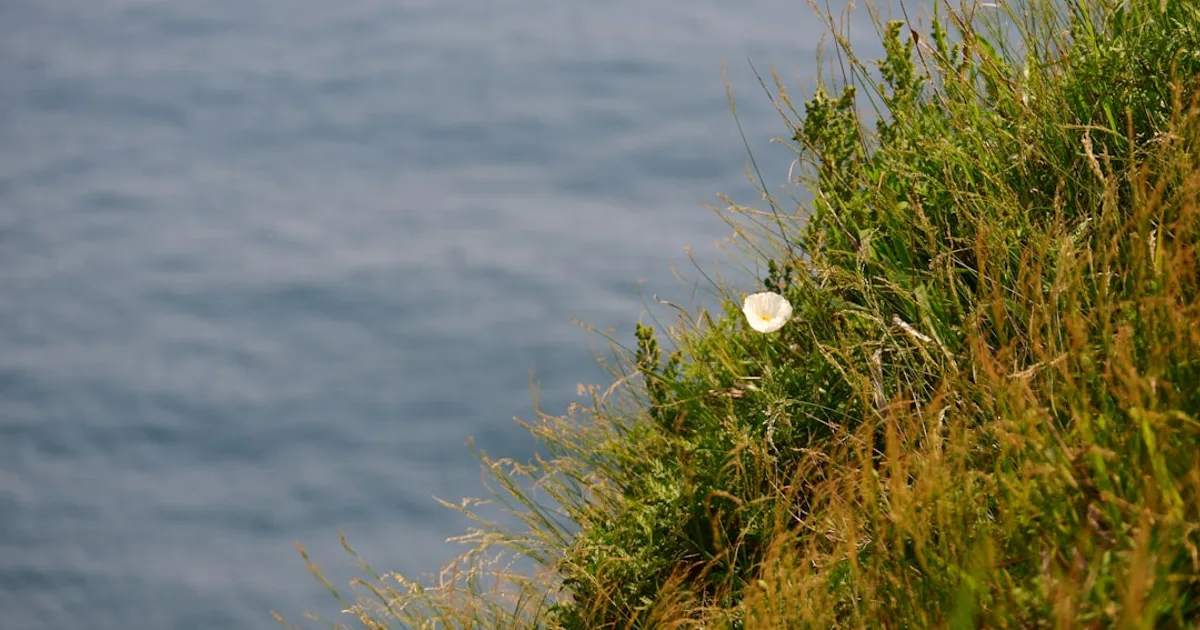
Sea kale is one of those plants that disappeared from American gardens not because it stopped being useful, but because supermarkets made it easier to forget it existed. It was grown at Kew Gardens. John Evelyn wrote about it in 1699. High-end London restaurants still put it on their menus every February. In the US, almost nobody grows it. That gap is the opportunity.
The edible portion - pale, tender forced shoots harvested in late winter - sells for $15-25 per pound at the specialty markets and farm stands that carry it at all. One established crown produces 1-1.5 lb per year with no inputs beyond an upturned pot and some patience. The plant is nearly pest-free, tolerates poor sandy soil that would fail most vegetables, and given reasonable care will outlive the gardener who planted it.
What it actually is
Crambe maritima is a perennial member of the mustard family (Brassicaceae) native to the sea cliffs and shingle beaches of Britain, northern France, and the Baltic coast. The plant grows as a large, spreading mound of deeply lobed, blue-green leaves with a waxy, slightly glaucous surface that sheds water. A mature crown reaches 3-4 feet in diameter. The whole thing looks more like an ornamental than a food plant until you know what to do with it.
Sea kale is winter-hardy to USDA Zone 4 (-20 to -30°F / -29 to -34°C). The root crown goes fully dormant in winter, and that dormancy is part of the production cycle. Unlike asparagus, which produces whether or not you force it, sea kale in its natural state produces an edible spring flush that is coarser and more bitter than what you get through the forcing process. The whole value proposition depends on blanching.
The crown expands slowly over years, eventually reaching the size of a large dinner plate underground. A 10-year-old established crown is a permanent feature of the garden - one that produces on its own schedule regardless of what’s happening in the rest of the beds.
The forcing method
This is the technique that makes sea kale worth growing and the reason it was so popular with serious kitchen gardeners in Victorian England. In February or early March - before any shoots have broken the soil surface - place a large, light-excluding cover over the dormant crown. Traditional options include a terracotta forcing jar (purpose-built with a removable lid for checking progress), a large upturned clay pot with the drainage hole blocked, a wooden crate lined with burlap, or any opaque container that sits flush with the soil and sheds water.
The cover needs to be large enough to let shoots expand without crowding - at minimum 12 inches in diameter for a young crown, 18-24 inches for a mature one. Height matters too: shoots can reach 8-10 inches before you want to harvest, so the cover needs at least that much interior clearance.
What happens inside the cover is straightforward. The excluded light prevents chlorophyll development. Shoots that would otherwise emerge dark green with a somewhat bitter brassica sharpness instead grow pale cream to ivory, with a mild, nutty flavor that tastes more like a delicate asparagus than any standard spring vegetable. The texture is tender enough to eat raw in a salad or to shave over a finished dish.
Monitor every few days once nighttime temperatures consistently stay above freezing. Shoots typically emerge within 2-4 weeks depending on soil temperature. Harvest when shoots reach 6-8 inches tall and before the leaves start to unfurl and expand - once the leaf tips begin to open, the texture coarsens and the window closes fast.
Cut at the base with a sharp knife. Do not strip the crown bare. Leave 1-3 unforced shoots to grow out through the full season - these will photosynthesize, rebuild the crown’s carbohydrate reserves, and support next year’s forcing. Remove the cover after harvest and let the remaining shoots grow freely until frost kills them back in fall.
That’s the full cycle. Fourteen days of forcing, one modest harvest, and eleven months of doing nothing.
Multi-year production
Sea kale asks for patience during establishment. There is no shortcut that doesn’t compromise the long-term health of the crown.
| Year | Production | Notes |
|---|---|---|
| Year 1 | No harvest | Establish root system; plant grows full leaf canopy; do not force |
| Year 2 | No harvest | Crown expands; continue building root mass; still do not force |
| Year 3 | First modest harvest: 0.5-0.75 lb forced shoots | Force for 1-2 weeks only; leave most shoots unforced |
| Year 4 | Full production: 1-1.5 lb forced shoots | Full forcing period; harvest over 2-3 weeks; leave 2-3 shoots unforced |
| Year 5-9 | 1.5-2 lb forced shoots per crown | Crown continues expanding; yields stable and increasing |
| Year 10+ | 2-3 lb forced shoots per crown | Crown is permanent fixture; productivity plateau; dividing creates new stock |
The two-year establishment period is non-negotiable. A crown forced in its first or second year will produce a small harvest but often fails to recover fully - the root system isn’t deep enough to handle both the energy depletion of forcing and the task of re-establishment. Year three is the earliest safe first harvest, and even then, a conservative approach - one to two weeks of forcing rather than the full period - protects the plant.
A 10-year-old crown forced each February becomes, for practical purposes, a permanent food source. Crowns this age can be carefully divided to propagate additional plants, giving you free planting stock.
The ROI case
The math on sea kale is front-loaded with patience and back-loaded with returns.
A single plant starts at $4.99. Years one and two produce nothing. Starting in year three, the production schedule runs as follows, valued at a conservative $18/lb - the lower end of specialty market pricing:
| Year | Input cost | Harvest (lb) | Value at $18/lb | Cumulative net |
|---|---|---|---|---|
| Year 1 | $4.99 | 0 | $0 | -$4.99 |
| Year 2 | $0 | 0 | $0 | -$4.99 |
| Year 3 | $0 | 0.6 lb | $10.80 | +$5.81 |
| Year 4 | $0 | 1.25 lb | $22.50 | +$28.31 |
| Year 5 | $0 | 1.5 lb | $27.00 | +$55.31 |
| Year 6-10 | $0 | 1.5 lb/yr | $27.00/yr | ~$190 cumulative net |
| Year 11-20 | $0 | 2 lb/yr | $36.00/yr | ~$540 cumulative net |
Yield estimates based on grower documentation from Heritage Seed Market and RHS trial records for established Crambe maritima crowns in UK kitchen garden conditions. Individual results vary by soil depth and winter severity.
Cumulative value over 20 years from one $4.99 planting, at $18/lb: approximately $544 in forced shoot value. The only recurring inputs are the time to place and remove the forcing cover and an annual application of compost.
At the $25/lb ceiling for forced sea kale at high-end specialty markets, that 20-year figure exceeds $750 from a single crown.
The break-even point is year three. Everything after that is profit from a plant that requires essentially no management.
Growing requirements
Sea kale’s coastal origin tells you nearly everything you need to know about how to grow it. It evolved on shingle beaches and sea cliffs - which means free-draining, relatively poor soil with good sun exposure. What kills it is the opposite: heavy clay, standing water, or shaded conditions that reduce the vigor needed to recover after forcing.
Soil: Deep, fertile, well-drained soil with good structure. Sandy loam is ideal. If your soil is clay-heavy, build a raised bed or amend heavily with grit and compost before planting. The crown sits near the surface, but roots extend 18-24 inches down; those lower roots cannot sit in wet soil through winter. Target pH 6.5-7.5.
Sun: Full sun, minimum 6 hours per day. Sea kale planted in partial shade produces weak, spindly growth and does not build the crown mass needed for productive forcing.
Space: Plan for a crown that reaches 3-4 feet in diameter at maturity. This is not a plant for tight raised beds or densely planted gardens. A mature sea kale crown needs room to expand and adequate air circulation.
Hardiness: Zone 4-9. In Zone 4 and 5, mulch the crown with 4-6 inches of straw or shredded leaves after the foliage dies back in fall to protect from hard freezes. Remove mulch in late winter before forcing begins.
Watering: Moderate water during establishment in the first two years. Once the root system is deep and established, sea kale is drought-tolerant - a useful quality in a plant that will occupy the same spot for decades. Avoid overhead watering if possible; the large waxy leaves channel water toward the crown, and sitting moisture encourages rot at the soil surface.
Planting: Sea kale can be started from seed (slow - adds a year compared to division or root cuttings) or from thong cuttings - pencil-thick root sections 3-5 inches long, planted horizontally 2-3 inches deep in early spring. Thong cuttings are the traditional propagation method and establish more reliably than seed. Plant in permanent position immediately; sea kale resents root disturbance once established.
Feeding: A top-dressing of compost each spring after the forcing cover comes off is sufficient for established plants. Young plants benefit from a balanced fertilizer during the first two growing seasons to accelerate crown development. Excess nitrogen produces lush but floppy foliage; don’t overdo it.
What goes wrong
Sea kale is notably resistant to most common garden pests. Its coastal-origin chemistry produces compounds that deter many of the insects that hammer other brassicas.
Clubroot (Plasmodiophora brassicae) is the primary disease risk, as with all Brassicaceae. It’s a soil-borne pathogen that deforms roots and eventually kills infected plants. There is no cure. If you’ve had clubroot problems with cabbages or Brussels sprouts in a bed, don’t plant sea kale there. Start with disease-free stock; maintain soil pH above 7.0 to suppress spore germination.
Slugs target emerging forced shoots in wet springs, particularly in the humid Pacific Northwest. Place a ring of diatomaceous earth or coarse grit around the forcing cover. Check under the cover when you monitor for shoot development.
Crown rot results from planting in soil that doesn’t drain freely, especially combined with a wet winter. Symptoms are obvious - a soft, foul-smelling crown base and failure of shoots to emerge in spring. Prevention through site selection is the only reliable approach; there is nothing to do once rot has set in.
Aphids (Brevicoryne brassicae, the cabbage aphid) occasionally colonize unforced shoots in summer. They’re a minor nuisance on a large established plant. A strong spray of water dislodges them; insecticidal soap handles persistent infestations.
Failed re-establishment after forcing usually means the crown was forced too early (before year three) or too aggressively (all shoots harvested with none left to regenerate). If shoots return weak and sparse the summer following a forcing, let the plant grow completely undisturbed for a full season without forcing the following winter.
Historical and market context
Sea kale was a mainstream English kitchen garden crop from roughly 1700 through the early 20th century. It was grown at Kew Gardens, recommended by William Curtis in the Botanical Magazine in the 1790s, and discussed as a superior forced vegetable by Philip Miller in The Gardeners Dictionary (1768). John Evelyn’s earlier description in Acetaria: A Discourse of Sallets (1699) confirms it was already well-known in English horticulture before that.
The plant’s disappearance from common cultivation tracks directly with the expansion of imported vegetables and refrigerated distribution through the 20th century. Once you could buy asparagus from California year-round, there was less commercial incentive to maintain the forcing infrastructure needed for sea kale. The knowledge survived in heritage seed catalogs and in the kitchens of a handful of British restaurants, but it never crossed the Atlantic at scale.
Today, sea kale forced shoots appear occasionally at specialty farm stands and high-end farmers markets in coastal areas, and at a small number of fine-dining restaurants in the northeast and mid-Atlantic US. Most buyers have never seen it before and need a brief explanation. At $18-25/lb, it sells readily to the same market that buys ramps, fiddlehead ferns, and forced chicory.
For the home gardener, the forcing window runs roughly February through March in Zone 6 - six to eight weeks when the crown is the only thing in the garden producing food.
Related crops: Asparagus - similar establishment patience, comparable long-term ROI model; Artichoke - fellow perennial vegetable with a multi-year establishment curve
Growing Sea Kale? Track your harvest value and break-even date in the Garden ROI app.
Get the App