
Artichoke
Cynara scolymus
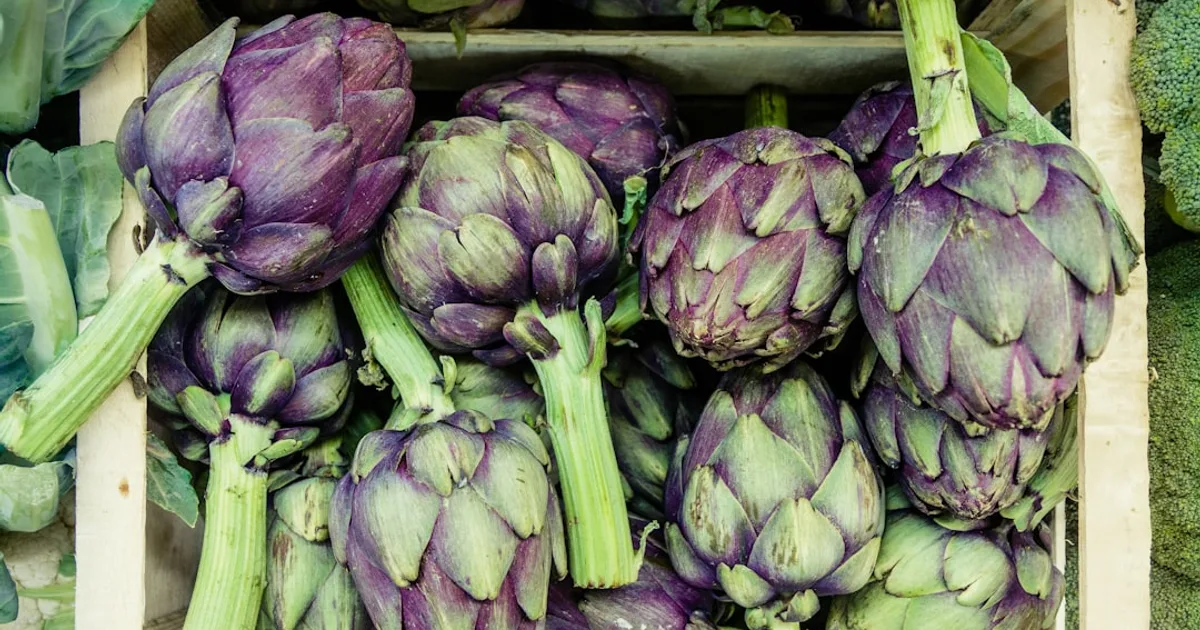
Artichoke (Cynara scolymus) is a thistle. That matters because it behaves like one - it’s a large, architectural plant that demands 4-6 square feet per crown, wants warm summers and mild winters, and produces flower buds that you harvest before they open. The bud is the vegetable. Let it bloom and you get a spectacular purple thistle flower and no food.
The crop divides sharply by climate, and that division shapes every decision you make about growing it. In Zone 7 and warmer, artichokes are perennials that live and produce for 5-10 years from a single planting. In Zones 5-6, they die back in winter and you grow them as annuals - unless you use a specific cold treatment to trick the plant into flowering its first year instead of sitting dormant and doing nothing.
What You’re Actually Growing
C. scolymus is the cultivated form of cardoon (C. cardunculus), and young plants of both species look nearly identical. The large, lobed, silvery-gray leaves that push up in spring are the tell. What you eat is the immature flower bud - specifically, the base of the bud (the heart) and the fleshy tissue at the bottom of each bract (scale). The bracts are the tough outer layers you peel away or scrape with your teeth. If you’ve only ever bought artichokes trimmed and packed in brine, growing them whole is a different experience.
The plant produces one primary terminal bud per stem - the largest head. After you cut that, the stem pushes out secondary lateral buds from the leaf axils below the cut. Those secondary heads are smaller, typically golf-ball to tennis-ball size, but fully edible and they extend your harvest by three to six weeks. A well-managed perennial plant will also push up new basal shoots each season, each capable of producing their own terminal bud the following year. Don’t pull the plant after first harvest - you’re just getting started.
The ROI Case
A $3.99-$5.99 packet of artichoke seed contains 25-30 seeds. You need 3-5 seeds per planting location to ensure germination, then thin to one, so one packet covers 5-10 planting spots. Nursery crowns or starts run $4-8 each but give you a one-year head start over seed.
At full production, a single perennial crown in Zone 7+ yields 6-12 heads per season when you count both main and secondary buds. Retail artichoke heads run $3-5 each at grocery stores; at farmers markets, specialty varieties regularly fetch $4-6 per head because artichokes require real space and hands-on harvest judgment. Growers who sell at market can legitimately price them at $4-5 each for standard Green Globe and $5-6 for purple or specialty types.
Work through the math on a typical perennial plant:
| Scenario | Heads/Year | Price/Head | Annual Value |
|---|---|---|---|
| Conservative (Zone 7, grocery retail) | 6 | $3.00 | $18 |
| Moderate (Zone 8, good management) | 8 | $4.00 | $32 |
| Strong (Zone 8-9, farmers market) | 10 | $4.50 | $45 |
| Peak (Zone 9, farmers market, specialty variety) | 12 | $5.00 | $60 |
Your initial investment is $4-8 for a crown or a share of a seed packet. In year one, you probably break even or come close. In year two, you’re producing $18-60 in harvest value from a plant that cost nothing additional to establish. Multiply that over five to eight years of production and the per-plant economics are about as good as any perennial vegetable in a temperate garden.
Annual growers in colder zones see thinner returns. One season of production must offset seed cost, bed preparation, and the labor of starting seeds in January. The ROI is still positive - a $4 packet of ‘Imperial Star’ that produces 6 heads at $3.50 each returns $21 on a $4 input - but you’re starting over each spring.
Perennial vs. Annual Culture: The Clear Dividing Line
Zone 7 and warmer: Plant once, mulch the crowns in fall, and harvest for the better part of a decade. Established plants in Zone 8-9 can produce two flushes per year in mild climates - one in late spring and another in fall after summer heat breaks. The first two years are establishment years with lighter production. Years 3-7 are peak production. After 8-10 years, crowns become congested and production drops; divide them and replant to reset the clock.
Zone 6 and colder: Artichokes don’t survive winters reliably enough to count on as perennials. You grow them as annuals. The problem is that artichokes need a cold period to trigger flowering - without it, the plant just grows leaves. It will get big. It will look impressive. It will not make heads in year one. To get a harvest, you need to trick the plant into thinking it lived through a winter. That trick is vernalization, and the timing and temperatures matter.
The Vernalization Trick for Zones 5-6
Artichokes require exposure to temperatures between 35°F and 50°F for at least 2-3 weeks to break vegetative dormancy and initiate flowering. In perennial production zones, winter provides this naturally. In Zones 5-6, you create it artificially using a cold treatment in early spring before transplanting.
Here’s the exact sequence:
January: Start seeds indoors under grow lights. Artichoke seeds germinate best at 70-75°F. Sow 3-4 seeds per cell, thin to one. Germination takes 10-14 days.
Mid-February to early March: When seedlings reach 6-8 inches tall with several true leaves, they’re ready for cold treatment. Move them to an unheated garage, cold frame, or similar space where nighttime temps regularly drop to 35-45°F. You want consistent cold exposure - aim for at least 2 weeks where the plants experience temps in that range for several hours each night. Daytime temps in the 50s are fine. Don’t let them freeze hard; you want cold, not killing.
Late March: Bring plants back indoors or into a heated greenhouse to resume active growth. They’ve experienced their “winter.” Harden off normally over 7-10 days before transplanting.
After last frost (typically May in Zone 6): Transplant outside. Plants treated this way will produce heads that same summer, typically 85-100 days from transplanting depending on variety.
Without vernalization, your Zone 5-6 artichokes will grow into impressive 4-foot plants that produce nothing harvestable. Cornell Cooperative Extension documented this in Artichoke Production in New York (2019) - the cold treatment combined with early-flowering varieties is the only reliable path to first-year production in northern climates.
Variety Comparison
Not all artichokes perform equally across zones, and the variety choice is one of the few decisions that actually changes your outcome.
| Variety | Days to Maturity | Best For | Head Characteristics | Notes |
|---|---|---|---|---|
| Green Globe | 85-100 days | Zone 7-9 perennial | Large, globe-shaped, tight bracts | Standard commercial variety; what you see in grocery stores; needs natural vernalization |
| Imperial Star | 85 days | Zone 5-6 annual | Medium-large, globe | Bred specifically for annual production; most reliable for cold-climate growers using vernalization trick |
| Violetto (Violetto di Chioggia) | 100-120 days | Zone 7-9 perennial | Elongated, purple-tinged bracts | Italian heirloom; strong flavor; slower to produce; underperforms in cold climates; specialty market premium |
| Big Heart | 85-90 days | Zone 7-9 perennial | Very large, nearly thornless | Commercial favorite; easier to handle at harvest; reliable producer |
If you’re in Zone 5-6, ‘Imperial Star’ is not optional - it’s the variety that makes annual production work. ‘Green Globe’ grown in Zone 6 with vernalization produces heads less reliably than ‘Imperial Star’ under the same treatment. The variety was developed at UC Davis ARS specifically to solve this problem.
If you’re in Zone 7+ and selling at a farmers market, ‘Violetto’ earns a premium. The purple color and distinctive elongated shape stand out in a market display and justify the $5-6/head price. The slower production timeline is the trade-off.
Growing Requirements
Soil pH 6.0-7.0. Artichokes are heavy feeders - they produce a large above-ground structure, and that structure needs nitrogen to build quickly. Work 4-6 inches of finished compost into planting areas before setting out transplants. A pre-plant broadcast of balanced fertilizer (10-10-10) at label rates improves establishment.
Space plants 4-5 feet apart in all directions. This is non-negotiable in terms of air circulation and bud quality. Crowded plants produce smaller heads and are more prone to botrytis in humid climates.
Water 1.5-2 inches per week during active growth. Inconsistent moisture causes buds to be small or to open prematurely - a bud that starts to flower drops its edible quality fast because the bracts loosen and the heart becomes bitter. Drip irrigation or soaker hoses work better than overhead watering, which promotes foliar disease.
Fertilize every 4 weeks from spring through early summer with a balanced fertilizer. Once buds are sizing up, back off the nitrogen - late-season nitrogen pushes vegetative growth at the expense of bud fill.
Overwintering in Zone 7-8: After the first hard frost, cut the plant back to 6-8 inches. Cover the crown with 6 inches of straw, shredded leaves, or another insulating mulch. Pull the mulch back in spring once new growth pushes. In Zone 9+, plants often stay evergreen through mild winters with no intervention required.
Harvesting the Full Plant: Primary, Secondary, and Tertiary Buds
Most first-time artichoke growers harvest the main terminal bud and then either pull the plant or wait too long on secondary buds. That’s leaving real harvest on the table.
The harvest sequence for a single stem goes like this:
Primary (terminal) bud: The largest head, at the top of the main stem. Harvest when fully sized with tight, compact bracts - before any purple tinge appears at the tips. That purple is the bud starting to open; once it starts, the window closes fast. Cut the stem 2-3 inches below the bud with a sharp knife.
Secondary buds: After the terminal bud is cut, the stem pushes lateral buds from the leaf axils below the cut. These develop over the following 3-6 weeks. They run roughly half to two-thirds the size of the primary bud. Harvest them using the same indicators - tight bracts, no opening. These secondary heads are the ones that extend your harvest window and add to your total head count. On a well-fed perennial plant, you can reasonably expect 3-5 secondary buds per stem.
Tertiary buds: On vigorous perennial plants, a third flush of smaller buds sometimes develops after the secondaries are harvested. These are small - often ping-pong ball size - but perfectly edible. They work well trimmed and roasted whole, quartered in pasta, or preserved in oil. Don’t ignore them.
The total head count cited in the ROI section above - 6-12 per plant per season - includes all three tiers. A plant producing 3 terminal buds, 8 secondary buds, and 4 tertiary buds is not unusual for an established perennial in Zone 8.
After harvest, cut spent stems back to the crown. New basal shoots will develop over the rest of the season; these become next year’s productive stems.
What Goes Wrong
Artichoke plume moth (Platyptilia carduidactyla) is the most serious pest in California, which produces over 99% of commercial US artichokes. The larvae tunnel into buds and stems. Look for frass - fine sawdust-like material - near the stem attachment point of developing buds. Remove and destroy affected buds immediately. Spinosad is effective as a preventive spray; apply in spring when adults are active.
Botrytis blight (Botrytis cinerea) kills buds and crowns in wet, cool conditions. Gray fuzzy growth on bracts or the crown base is the diagnostic. Improve air circulation by giving plants adequate spacing, use drip irrigation, and remove affected tissue promptly. Copper-based fungicides applied preventively help in historically wet springs.
Aphids - typically Aphis fabae (black bean aphid) or Macrosiphum euphorbiae (potato aphid) - concentrate on new growth and beneath developing bud bracts. A strong stream of water dislodges them. Insecticidal soap handles heavier infestations without affecting beneficial insects.
Crown rot from waterlogged soil kills perennial plantings and wipes out your multi-year investment in a single wet winter. Raised beds or well-amended, well-drained soil prevents it. Don’t plant artichokes in low spots or areas where water sits after rain.
No heads in year one (cold climates): If your Zone 5-6 plants made impressive foliage but no buds, you either skipped vernalization or the cold treatment wasn’t long enough or cold enough. Next season, start seeds earlier (January), let seedlings reach 6-8 inches before cold treatment, and make sure the treatment location actually hits 35-45°F consistently for at least two weeks. A garage that stays at 55°F won’t do it.
Harvest Timing and Storage
Cut buds when fully sized with tight, compact bracts and no color change at the tips. The window between “ready” and “opening” is about 4-7 days depending on temperature - warmer conditions accelerate the opening. Check every two days once buds reach full size.
Artichokes hold well in the refrigerator for 1-2 weeks. Store unwashed in a plastic bag with a small amount of water in the bottom to maintain humidity around the cut stem end - the same way you’d store fresh-cut flowers. Don’t wash until you’re ready to cook.
For farmers market sellers, freshness shows. Artichokes with tight, squeaky bracts and no browning at the cut sell; ones that have been sitting for a week with loose bracts don’t. Harvest the morning of market day or the evening before.
Related crops: Arugula, Fennel, Cardoon
Related reading: First Three Years ROI - modeling establishment costs for perennial vegetables across multiple harvest seasons
Growing Artichoke? Track your harvest value and break-even date in the Garden ROI app.
Get the App