
Shallot
Allium cepa var. aggregatum
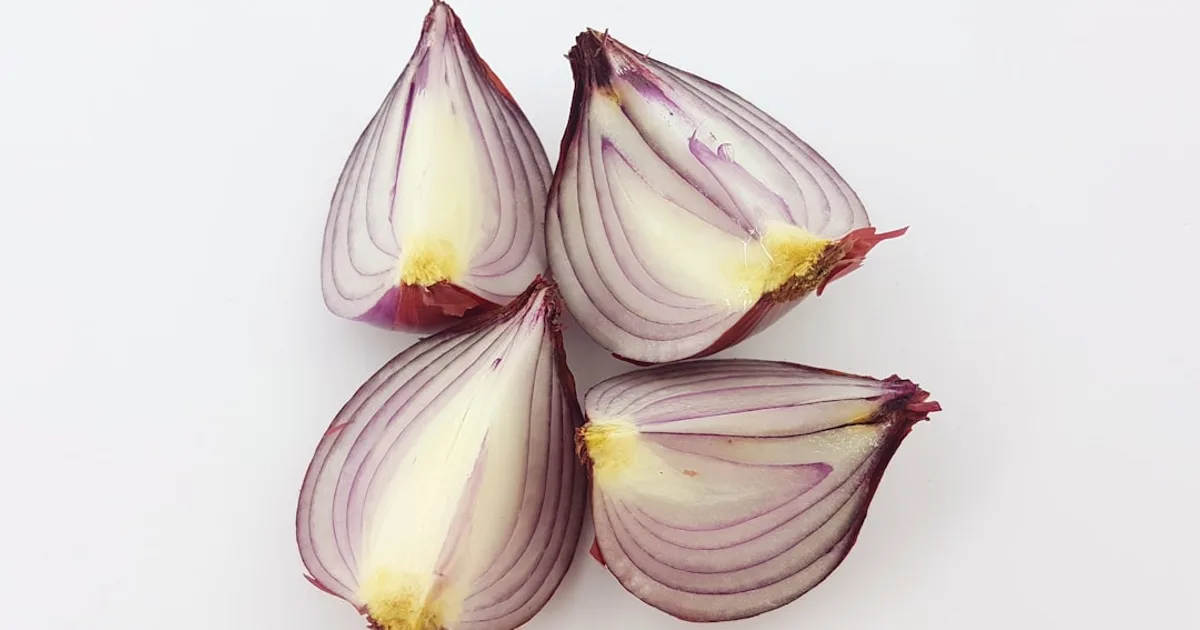
Each shallot bulb you plant produces a cluster of 6-8 new bulbs at harvest. Plant one, pull seven to ten. That multiplication rate is the central ROI argument for shallot (Allium cepa var. aggregatum): your seed cost in year one is $3.99, and if you save the largest bulbs from the harvest, your seed cost in year two is zero. Retail price runs $4-7/lb (USDA AMS Specialty Crop Market News, 2023) for a crop that is, by weight, mostly what you put in the ground a few months ago.
What you’re actually growing
Shallot is a variety group within the onion species (Allium cepa) selected for its clustering habit. Rather than forming a single bulb like a standard onion, shallot produces a clump of 4-12 smaller elongated bulbs from a single planted clove. The flavor is milder than onion, with allium pungency softened by a slight sweetness and complexity that cooks value in raw applications - vinaigrettes, mignonette, compound butters - where raw onion would be too harsh.
Two main types dominate the market. French gray shallots (the ‘grise’ types) are the classic gourmet variety with gray-purple skin and intensely flavored flesh, but they produce fewer offsets (4-6) and store less long than other types. Dutch shallots (yellow and red-skinned types like ‘Dutch Yellow,’ ‘Red Sun’) produce more offsets per set and store better. For home production maximizing the multiplication math, Dutch types are practical. For flavor in cooking, French types are worth the slight compromise in yield.
| Type | Example cultivars | Offsets per set | Storage (months) | Skin color | Flavor | Typical retail |
|---|---|---|---|---|---|---|
| French gray | ’Grise de Bretagne’, ‘Griselle’ | 4-6 | 3-4 | Gray-purple | Intense, complex | $7-9/lb |
| Dutch yellow | ’Dutch Yellow’, ‘Zebrune’ | 6-10 | 5-6 | Golden-tan | Mild, sweet | $5-7/lb |
| Dutch red | ’Ambition’, ‘Red Sun’ | 6-8 | 4-5 | Red-purple | Mild | $4-6/lb |
Retail pricing from USDA AMS Specialty Crop Market News (2023). Offset data from NC State Extension Allium Production Guide. If you’re growing for self-sufficiency and replanting your own sets, Dutch types give you more bulbs to work with each year. If you’re growing for use in raw applications where flavor is the point, French gray is worth the lower multiplication rate.
The ROI case
A $3.99 packet contains 10-15 sets (small dried bulbs ready to plant). Each set produces 6-8 new bulbs at harvest. From 12 sets, you get 72-96 bulbs. Those bulbs weigh 2-6 oz each depending on growing conditions - total harvest from 12 sets might be 4-8 lb. At $5/lb average retail (USDA AMS, 2023), your $3.99 input returns $20-40 in food value.
Year two: select 12-15 of your largest, healthiest-looking harvested bulbs, let them cure and dry, and replant them in fall or spring. Seed cost: $0. The cycle is self-sustaining as long as you reserve enough from each harvest to replant.
The year-by-year math shows how quickly the initial investment becomes irrelevant:
| Year | Sets planted | Bulbs harvested | Harvest weight | Value at $5/lb | Sets reserved for replanting | Net value | Cumulative input cost |
|---|---|---|---|---|---|---|---|
| Year 1 | 12 sets ($3.99) | 72-96 bulbs | 4-6 lb | $20-30 | 15 best bulbs | $16-26 | $3.99 |
| Year 2 | 15 sets (free) | 90-120 bulbs | 5-7.5 lb | $25-37.50 | 20 best bulbs | $25-37.50 | $3.99 |
| Year 3 | 20 sets (free) | 120-160 bulbs | 6-10 lb | $30-50 | 25 best bulbs | $30-50 | $3.99 |
Cumulative 3-year value: $71-113.50 from a $3.99 initial investment. By year two the input cost has been fully amortized and you’re producing $25+ from $0 annual input. USDA AMS Specialty Crop Market News (2023) for pricing.
Shallot vs onion: the same bed, different return
For a 4x8 bed (32 sq ft) dedicated to alliums, shallots outperform storage onions per pound of retail value. At 6-inch spacing, that bed holds 128 sets/plants of either crop.
| Crop | Plants per 4x8 bed | Yield per plant | Total yield | Retail price | Bed value |
|---|---|---|---|---|---|
| Shallots | 128 sets | 0.25-0.5 lb per cluster | 32-64 lb | $5/lb | $160-320 |
| Storage onions (yellow) | 128 plants | 0.25-0.5 lb per bulb | 32-64 lb | $0.75-1.00/lb | $24-64 |
The shallot premium - roughly 5x more retail value per pound compared to storage onions - reflects their positioning as a specialty allium. Both are roughly equal in growing difficulty and bed requirements. The math is straightforward: if you’re going to dedicate allium bed space, shallots return more per square foot. USDA AMS for both price points.
Growing requirements
Shallots are cool-season crops, planted either in fall for spring harvest (zones 6+) or in early spring for summer harvest. Fall planting (2-4 weeks before first frost) produces the best results where winters are mild enough - the bulbs establish roots before dormancy and hit the ground running in spring. Spring-planted shallots give a late summer harvest.
Soil pH 6.0-7.0. Shallots require loose, well-drained soil - they develop poorly in heavy clay or compacted conditions where the expanding bulb cluster has nowhere to go. Work compost 8-10 inches deep before planting.
Plant sets 1 inch deep, pointed end up, 6 inches apart in rows 12 inches apart. Planting too deeply delays emergence and can cause rot in wet soils.
Consistent nitrogen through the first 60 days of growth drives good top development, which drives bulb size. Side-dress with a balanced fertilizer (10-10-10) at 4-6 weeks after emergence. Stop fertilizing when the tops begin to yellow and fall - pushing growth at this point delays bulb ripening.
Reduce watering as tops begin to fall. Excess moisture during bulbing causes soft bulbs with poor storage life.
What goes wrong
Pink root (Phoma terrestris) turns roots pink to red and kills them, stunting plant growth severely. There is no cure. Rotate alliums out of infected beds for 4+ years. Resistant varieties are the practical long-term solution.
Onion thrips (Thrips tabaci) rasp leaf tissue, leaving silver-white streaks. Severe infestations stunt growth and reduce bulb size. Spinosad applied when thrips are first observed controls populations before they establish.
Botrytis leaf blight (Botrytis squamosa) causes white speckling on leaves, progressing to collapse in wet, humid conditions. Improve airflow and avoid overhead irrigation. Copper-based fungicides provide partial preventive control.
White rot (Stromatinia cepivora) produces fluffy white mycelium on bulbs and roots, causing rapid collapse. Soil-borne; once present, it persists for 20+ years. Prevention through rotation and using clean transplants is the only effective management.
Weeds compete heavily with shallots, which have narrow upright foliage that doesn’t shade out competition well. Keep beds hand-weeded, particularly in the first 6 weeks after planting.
Harvest and storage
Harvest when approximately half the tops have yellowed and fallen over. At this stage the outer skin (the papery wrapper) is forming on the individual bulbs. Dig the clusters carefully to avoid bruising - damaged bulbs don’t store.
Cure shallots in a warm, dry, well-ventilated location (80-90°F) for 2-4 weeks. Spreading them on a screen or wire mesh rack allows airflow around each bulb. The outer wrapper dries and hardens; the neck dries to a thin papery point.
Properly cured shallots store 4-6 months at room temperature in a dry location with good airflow. French types typically store 3-4 months; Dutch types 5-6 months. Inspect stored shallots monthly and remove any that are softening.
Culinary applications
Shallot is underused in home cooking because most people treat it as an expensive onion substitute. It isn’t. Shallot has milder sulfurous compounds than onion and a complexity that raw onion lacks, which makes it the correct choice in applications where raw onion would be sharp or harsh.
Vinaigrette: macerated shallot is the standard base for French-style vinaigrette. Dice one shallot finely, cover with the vinegar from your dressing recipe (1-2 tablespoons), and let it sit for 10 minutes before adding oil. The acid draws out the harsh volatile compounds while leaving the aromatic complexity. Result: a vinaigrette with allium presence that isn’t sharp or aggressive. Use 1 small shallot per 3 tablespoons oil and 1 tablespoon vinegar.
Mignonette for oysters: 2 shallots very finely minced plus 1/4 cup red wine vinegar plus cracked black pepper. Rest 30 minutes to 1 hour before serving. This is the application where French gray shallots specifically matter - the intensity of the griselle types survives the acid and provides the allium backbone the sauce needs. Dutch yellow shallots produce a milder, thinner mignonette.
Pan sauce: when building a pan sauce after searing meat, minced shallot goes into the hot pan after the fat is added and before deglazing. It softens in 60-90 seconds and provides a sweet allium foundation that doesn’t overpower the fond the way onion would. Use 1-2 shallots per pan sauce for two servings.
Shallot confit: whole shallots, peeled, slow-cooked in butter or olive oil at 200-225°F for 90 minutes until completely tender, golden, and sweet. They collapse into softness. Serve alongside roasted meats or mix into mashed potatoes. Keeps refrigerated for 2 weeks. This is the use that converts people who think shallots are expensive and precious - the long slow cook transforms them into something that doesn’t resemble raw alliums at all.
Compound butter: shallots softened in a small amount of butter or white wine, then mixed into softened room-temperature butter with fresh thyme and salt. Roll in plastic wrap, refrigerate until firm. Slice rounds onto steaks, chicken, or fish directly from heat. One shallot per 4 tablespoons butter.
Related reading: Garlic ROI Analysis - the same multiplication math applied to garlic, with the full per-clove cost breakdown
Frequently Asked Questions
How does shallot multiplication work?
Each shallot bulb planted divides into a cluster of 6 to 8 daughter bulbs by harvest. Plant 1, pull 6 to 8. Save the largest bulbs from your harvest and your seed cost in year 2 is zero. This multiplier effect makes the ROI math better every successive year.
How do I cure shallots?
After pulling, dry shallots in a warm, well-ventilated spot with low humidity for 3 to 4 weeks until tops and outer skins are completely papery-dry. Braiding or laying flat on a screen works well. Properly cured shallots keep 6 to 8 months at room temperature in a cool, dark location.
What makes shallots different from small onions?
Shallots have more complex flavor - milder and sweeter than standard onions with a hint of garlic. They multiply from a single bulb rather than forming one large bulb, and at $4 to $7/lb retail they are more valuable per pound than storage onions at $1 to $1.50/lb.
Growing Shallot? Track your harvest value and break-even date in the Garden ROI app.
Get the App