
Snap Pea
Pisum sativum var. macrocarpon
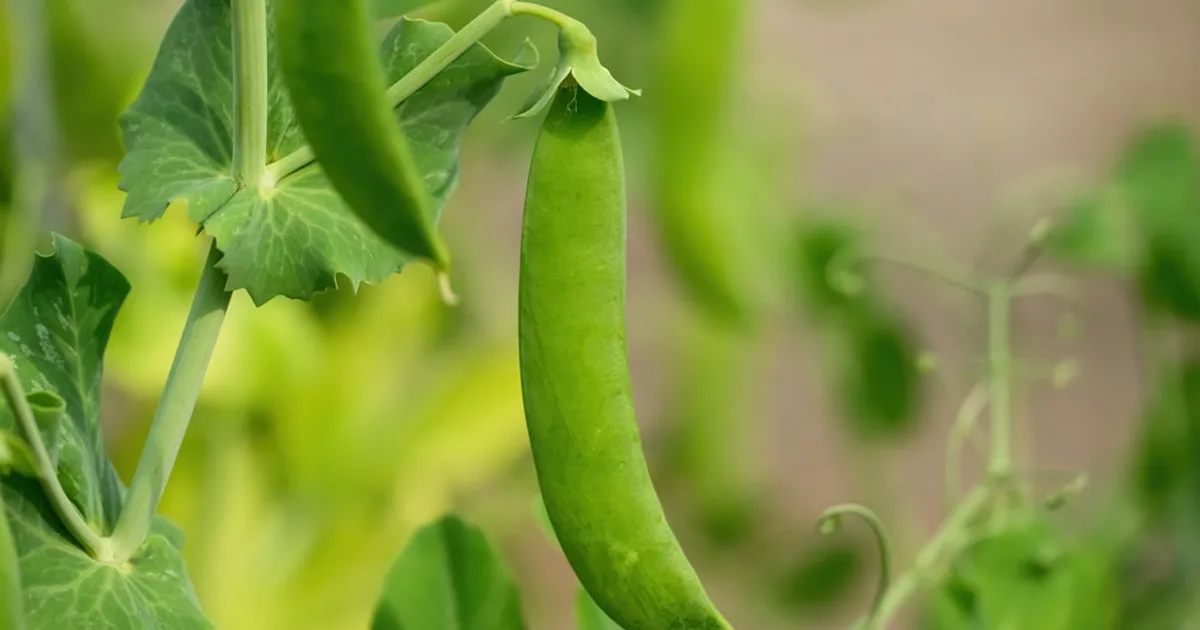
Snap peas are the clearest argument in vegetable gardening for growing something yourself. A $2.99 seed packet, a 10-foot row, and decent spring weather gets you 3-5 pounds of peas worth $4.50/lb at the grocery store. That’s roughly $18 of produce against $3 in seeds. No other crop makes that case so quickly or so clearly.
The math gets better when you factor in what you’re actually buying at the store. Retail snap peas are picked days before they reach you. Sugar in snap peas converts to starch at 70°F - at room temperature, 50% of the sugars convert in six hours. Refrigeration slows this, but it doesn’t stop it. By the time a grocery store snap pea reaches you, it’s a shadow of what it was when it left the field. The peas you eat within hours of picking from your own garden are different in flavor from what you can buy. That’s not marketing language. It’s biochemistry.
What it actually is
The snap pea is a type of garden pea (Pisum sativum) bred for pod thickness, structural sweetness, and palatability at full maturity. Three distinct eating-pea types exist: shelling peas (harvested for the seeds inside a tough, inedible pod), snow peas (P. sativum var. macrocarpon, harvested immature when flat, peas barely formed), and snap peas (harvested when pods are fully rounded and plump, both pod and peas sweet and tender). Snow peas and snap peas are both eaten pod-and-all. The difference is harvest timing and pod wall thickness.
The original ‘Sugar Snap’ variety was introduced by Calvin Lamborn through the Cornell breeding program in 1979 and won an All-America Selections award that year. Before it, you ate the peas or ate the pod - not both at full maturity. ‘Sugar Snap’ changed that. Its thick, crunchy pod walls and the sweetness of the peas inside at full size are still the benchmark. Everything since has been breeding around that original.
Variety comparison
Not all snap peas behave the same in the garden. Bush types stay short and need no support. Climbing types need a trellis but yield more per linear foot. The table below covers the most widely available varieties (days to maturity from direct sow, per Cornell Cooperative Extension and variety trial data from Oregon State University Extension).
| Variety | Type | Days to Maturity | Height | Disease Resistance | Notes |
|---|---|---|---|---|---|
| Sugar Ann | Bush | 52 days | 18 in | Moderate | Earliest to produce; good for short seasons |
| Cascadia | Climbing | 60 days | 30-36 in | Powdery mildew | Reliable performer; semi-determinate |
| Avalanche | Climbing | 60 days | 36-40 in | Moderate | White flowers; sweet flavor; good fresh eating |
| Super Sugar Snap | Climbing | 64 days | 4-5 ft | Powdery mildew, enation | Disease-resistant upgrade to original ‘Sugar Snap’ |
| Sugar Snap (OP) | Climbing | 70 days | 5-6 ft | Low | Original open-pollinated variety; best raw flavor |
Bush types like Sugar Ann top out at 18 inches. They need no support whatsoever, which makes them useful in containers or in beds where you can’t drive stakes. The trade-off is yield: climbing types produce 30-40% more per linear foot than bush types, assuming you support them properly. ‘Super Sugar Snap’ at 64 days hits a useful middle point - most of the flavor of the original ‘Sugar Snap’ with added resistance to powdery mildew and pea enation mosaic virus, and it finishes a full week faster.
If you’re growing snap peas for the first time, start with ‘Sugar Ann’ so you don’t have to build a trellis, understand the crop, then switch to a climbing type once you’ve got the timing down.
The ROI case
Fresh snap peas retail at $3-6/lb at grocery stores, with $4.99/lb typical for conventional peas at a mid-tier grocery chain (USDA AMS Specialty Crop Market News). Frozen snap peas run $2.50-3.50/lb. The premium for fresh reflects the sugar-conversion issue mentioned above - retailers know buyers want the sweetest pod available, and fresh commands that premium.
Worked calculation:
- Seed cost: $2.99 per packet
- Yield per 10-foot row: 3-5 lb (conservative: 4 lb)
- Retail equivalent: 4 lb x $4.50/lb = $18.00 gross value
- Net value (first year, no trellis cost for bush type): $18.00 - $2.99 = $15.01
- Net value (first year, climbing type with trellis): $18.00 - $2.99 - $10.00 trellis = $5.01
That trellis math flips immediately in year two. A basic trellis - T-posts and netting - costs $5-15 and lasts 10+ years. Spread across a decade, the amortized trellis cost per season is under $1.50. Climbing types also produce 30-40% more per linear foot, so the actual yield on a climbing row at 5 lb x $4.50 = $22.50 against $2.99 seed and $1.50 amortized trellis = $18.01 net. Better than the bush type every year after the first.
The case for snap peas over buying frozen: frozen snap peas at $3/lb are fully available, convenient, and last a year. Home-grown fresh snap peas eaten same-day are not a substitute for frozen peas in a stir-fry - they’re a categorically different product. The comparison isn’t really cost per pound. It’s whether you want that flavor at all, because you can’t buy it at any price.
Succession planting - the schedule that matters
This is where most first-year snap pea growers leave yield on the table. A single spring sowing gives you a 2-3 week harvest window, and then the heat shuts it down. Staggered sowings spaced two weeks apart extend that window across the entire cool season. Add a fall planting and you get a second run.
The table below is built for Zone 5-6 with a last frost date around May 10-15 and a first fall frost around October 10.
| Sowing | Sow Date | First Harvest | Harvest Window | Yield / 10-ft Row |
|---|---|---|---|---|
| Spring 1 | Mar 20 | Jun 1 | Jun 1 - Jun 18 | 2.5-3 lb |
| Spring 2 | Apr 3 | Jun 15 | Jun 15 - Jul 2 | 3-4 lb |
| Spring 3 | Apr 17 | Jun 29 | Jun 29 - Jul 12 | 2-3 lb (heat risk) |
| Fall 1 | Aug 15 | Oct 1 | Oct 1 - Oct 18 | 3-4 lb |
| Fall 2 | Sep 1 | Oct 12 | Oct 12 - Oct 25 | 2-3 lb (frost risk) |
A few notes on this table. Spring sowing 3 is marginal in a hot year - if your June temperatures run consistently above 80°F, that sowing will stall before it finishes. The fall sowings are often the most rewarding. Cool fall temps slow sugar-to-starch conversion on the vine, so fall-harvested snap peas are frequently sweeter than spring ones. Fall sowing 2 races the frost, and you may need to cover plants if a hard freeze arrives before the pods fill out.
Five successions per season from one crop is unusual. Most crops don’t give you this flexibility. Snap peas do because the cool-season windows on both ends of summer align perfectly with a two-week sowing interval.
Growing requirements
Plant in full sun - 6 hours minimum, though snap peas tolerate partial shade better than most fruiting vegetables. They grow best at 60-65°F and stop producing new flowers once temperatures hold above 80°F. That ceiling is firm. You can’t push them through summer heat.
Sow seeds 1 inch deep, 2-3 inches apart, in rows 18-24 inches apart. Soil temperature at sowing should be at least 45°F for reliable germination - cooler than that and you’ll get spotty stands. Germination takes 7-14 days at 45-65°F soil temp (Penn State Extension).
Inoculate seeds with pea-specific rhizobium inoculant (Rhizobium leguminosarum bv. viciae) before planting, particularly if peas haven’t been grown in that bed in the past three years. Inoculated peas fix their own nitrogen from the air. Uninoculated peas in nitrogen-poor soil will produce thin, pale plants and disappointing yields. The inoculant costs about $3-5 and treats multiple packets.
Soil pH of 6.0-7.0 is the target. Peas tolerate average fertility - in fact, high-nitrogen fertilizers push leafy growth at the expense of pod production. If your soil is reasonably amended, skip the nitrogen side-dress and let the rhizobia do the work.
Water at 1 inch per week consistently through flowering and early pod set. Drought stress during flowering causes flower drop. A missed week at the wrong time can cut yield. Reduce irrigation slightly once pods begin to fill - waterlogged roots at that stage promote root rot.
Trellis requirements by type
Bush types (Sugar Ann, 18 inches): no support needed. They flop a bit at full growth but stay off the ground adequately. For better airflow and cleaner pods, stake every 3 feet with short brush sticks.
Climbing types (Sugar Snap, 5-6 feet; Super Sugar Snap, 4-5 feet; Cascadia, 30-36 inches): need real support before they need it. Install trellis or netting before seeds germinate. Pea tendrils grab anything they find - string, netting, wire, a neighboring plant. If there’s nothing to grab, the vines pile on each other and airflow drops, which invites powdery mildew.
Simple trellis options: two T-posts at row ends with jute twine strung horizontally every 6 inches; metal T-posts with woven wire fencing; bamboo poles with plastic bird netting. None of these are expensive. A basic setup for a 10-foot row runs $5-15 in materials.
The sugar conversion science
Once you cut or snap a pea pod from the plant, enzymes begin converting its simple sugars to complex starches. This is the same mechanism that drives the “harvest to pot immediately” advice for sweet corn. At 70°F, roughly 50% of the sugar content of a fresh snap pea converts to starch within 6 hours. That’s not a slow degradation - it’s a noticeable one. The pea that tasted bright and sweet at 8am tastes duller and starchier at 2pm if left on the counter.
Refrigeration slows the conversion but doesn’t stop it. At 35-40°F, the same process takes days rather than hours. This is why same-day garden snap peas taste so different from store-bought: a commercial pea travels from field to packinghouse to truck to distribution center to store shelf over 4-7 days, refrigerated the whole way. By the time you buy it, a substantial fraction of its sugar has already converted. You’re tasting a pod that has already declined.
The practical rule: harvest in the morning when it’s cool, refrigerate immediately, eat within 24 hours for full sweetness. If you’re blanching and freezing, do it within 2-3 hours of harvest to lock in as much sugar as possible before the conversion advances.
What goes wrong
Powdery mildew (Erysiphe pisi) is the most common late-season problem. White powdery coating spreads across leaves and pods as temperatures rise and humidity fluctuates. By mid-June in Zone 5-6, an unresistant variety will almost always show some mildew. Resistant varieties (‘Super Sugar Snap,’ ‘Cascadia’) are the best long-term fix. For current-season management: remove affected leaves, improve airflow by thinning the planting if it’s dense, and apply sulfur fungicide preventively before symptoms appear if you’ve had repeated problems.
Pea aphid (Acyrthosiphon pisum) clusters on new growth and developing pods. A strong spray of water knocks colonies off; they rarely return in force after one knockdown. Broad-spectrum insecticides kill the parasitic wasps and ladybeetles that do most of the aphid control work for free - skip them.
Pea enation mosaic virus (PEMV) causes distorted, blistered leaves and bumpy, malformed pods. It’s transmitted by aphids. There’s no cure once the plant is infected. Control aphids early, grow resistant varieties (Super Sugar Snap), and remove infected plants promptly.
Fusarium wilt (Fusarium oxysporum f. sp. pisi) and root rot (Aphanomyces euteiches) are soilborne and build up when peas are grown in the same bed repeatedly. Rotate peas to a different part of the garden every 3-4 years. Infected plants yellow, collapse, and die before they finish cropping. There’s nothing to do once it’s established in a bed except rotate out.
Poor germination in cold, wet soil is the most common early-season failure. Seed companies will tell you to plant as soon as the soil can be worked - sometimes that means planting into soil that’s 40°F and waterlogged after a wet March. Seeds rot before they germinate in those conditions. Wait for soil temps above 45°F and let the soil dry enough that you’re not compacting it when you walk on it.
Harvest and storage
Start checking pods 5-7 days after flowers open. The pod is ready when it’s plump and fully rounded - you can see the peas pressing against the pod walls from the outside. Bright green, firm pod walls that snap cleanly. If the pod has started to shift from bright green toward yellow-green, it’s past peak. The sugars have advanced toward starch and the pod walls have begun to toughen.
Pick every day or every other day during peak production. Leaving mature pods on the plant signals it to stop flowering and begin setting seed. Regular picking extends the productive season by 2-3 weeks.
Fresh snap peas keep 3-5 days refrigerated in a sealed bag. For the best flavor, eat within 24 hours of harvest. For freezing: blanch 2 minutes in boiling water, transfer immediately to an ice bath, drain thoroughly, pack flat and freeze. They’ll keep 8-12 months but the texture softens. Frozen snap peas work fine cooked into stir-fries or soups. They don’t work raw in salads - that crunch is gone.
Related crops: Garden Pea, Lettuce
Related reading: Succession Planting Calendar - how to time spring and fall plantings of cool-season crops including snap peas; First Garden: 10 Best Crops - snap peas lead on quality gap; Continuous Harvest Crops - succession planting schedule
Frequently Asked Questions
How tall a trellis do snap peas need?
Standard varieties (Sugar Snap, Super Sugar Snap) grow 4 to 6 feet and need a sturdy trellis at that height. Dwarf types (Sugar Ann, Oregon Sugar Pod) stay 18 to 24 inches and can be grown without support. Match the trellis to the variety on the packet.
How long is the snap pea harvest window?
Snap peas produce for 2 to 4 weeks in cool weather before heat stops flowering. Harvest pods every 1 to 2 days once production starts - unharvested pods signal the plant to stop producing. Consistent picking is the most reliable way to extend the harvest.
Can I plant snap peas in fall as well as spring?
Yes. Plant a fall crop 8 to 10 weeks before first frost. Fall peas often have better flavor because pods develop as temperatures cool rather than warm. In zones 8 to 10, snap peas are grown as a winter crop from October through February.
Growing Snap Pea? Track your harvest value and break-even date in the Garden ROI app.
Get the App