
Water Chestnut
Eleocharis dulcis
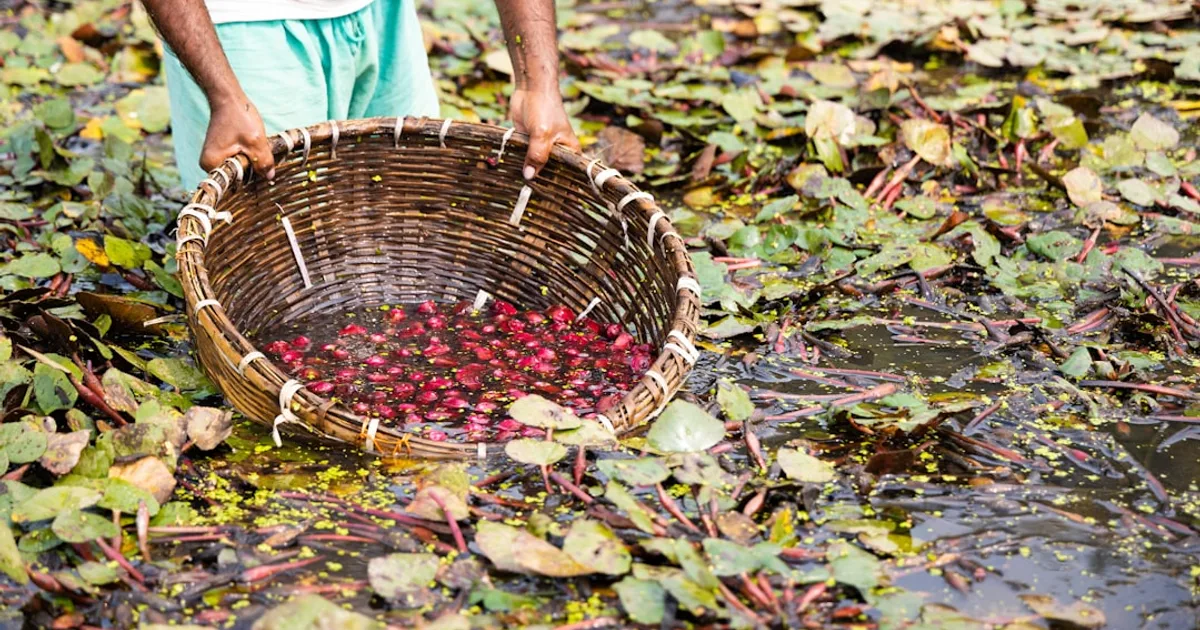
Fresh water chestnuts and canned water chestnuts are barely the same vegetable. Canned water chestnuts retain crunch - that part is real - but the flavor is flat and starchy. Fresh water chestnuts, especially harvested and used the same day, taste sweet with an apple-adjacent freshness before the starch fully develops. At Asian grocery stores where fresh are available, they run $4-6/lb. Growing them at home doesn’t require a pond: a 25-gallon stock tank, a kiddie pool, or a lined half-barrel works fine.
This crop also uses space no other food crop does - water space. If you have an area suited to a container pond or small water garden, water chestnuts fill it productively.
What It Actually Is
Eleocharis dulcis is an aquatic sedge native to tropical Asia and Africa, widely cultivated across China, Southeast Asia, and Australia for the edible corms that develop in the mud at the plant’s base. The above-ground part looks like a cluster of hollow, dark green sedge stems 3-5 feet tall. The edible corms are small (golf-ball to egg-sized), brown-skinned, and white-fleshed inside; they develop in the mud throughout the growing season and multiply into a dense cluster by fall.
Critical species note: do not confuse Eleocharis dulcis with water caltrop (Trapa natans), also called “water chestnut” in English. Trapa natans is the horned, floating aquatic plant that is a federally listed noxious weed in parts of the northeastern US and invasive in freshwater systems. It is not Eleocharis dulcis, it is not edible in the same way, and it is not what’s sold at Asian grocery stores. Eleocharis dulcis is native to Asia, not invasive in US waterways, and is the only water chestnut discussed in this entry.
The distinctive crunch of cooked water chestnuts comes from phenolic cross-linking in the cell walls - a covalent bond structure that doesn’t break down at typical cooking temperatures (Waldron et al., Journal of Agricultural and Food Chemistry, 1997). This is why stir-fried water chestnuts stay crunchy after several minutes of high heat, unlike most vegetables.
The ROI Case
Water chestnut’s value case is quality and access. Fresh water chestnuts are unavailable at conventional supermarkets in most US areas; at Asian specialty markets where they appear, $4-6/lb is standard (specialty market retail pricing; USDA AMS does not track this crop).
| Planting | Container size | Yield | Value @$5/lb | Start cost | Net |
|---|---|---|---|---|---|
| Single tub | 25 gal | 2-4 lb | $10-20 | $1.75* | $8.25-18.25 |
| Kiddie pool | 100 gal | 8-15 lb | $40-75 | $3.49 | $36.51-71.51 |
| Ground pond (small) | 200+ gal | 20-35 lb | $100-175 | $6.99 | $93-168 |
*Estimated from $3.49 grocery-store corm purchase.
After year 1, seed cost drops to zero - save the smallest corms from each harvest to replant. The corm multiplication ratio is high: one planted corm produces 10-25 corms over a season in good conditions.
Zone Fit
Zones 9-11: perennial outdoor production. Plants overwinter in the mud with minimal cold protection. Once established, they return each spring from overwintered corms without replanting. Manage as a permanent water garden feature; harvest a portion each fall, leaving the rest to continue.
Zones 7-8: annual outdoor production with reliable results. Plant corms in the outdoor container after water temperature reaches 60°F (typically May). Harvest before hard freeze (November in Zone 7). The 180-210-day requirement fits comfortably within the frost-free season.
Zones 5-6: possible with indoor starts. Start corms indoors 6-8 weeks before last frost in shallow trays filled with 2-3 inches of mud and 1-2 inches of water. Set the trays in a warm (65°F+) location; sprouts emerge in 2-3 weeks. Transplant started plants into the outdoor container after last frost when water temperature is above 60°F. In Zone 5, harvest in late October before hard freeze; corms will be smaller than in warmer zones but productive.
Zone 4 and colder: marginal. The growing season may not provide adequate time for full corm development. Container production is possible with aggressive indoor starts (10 weeks) and early harvest timing. Results are uncertain.
Growing Requirements
Containers: water chestnut doesn’t require a natural pond. Any container holding water and providing full sun works: 25-gallon stock tanks, 100-gallon kiddie pools, lined half wine barrels, or small preformed garden ponds. The container needs to hold 6-10 inches of mud plus 4-8 inches of water above the mud surface.
Soil preparation: fill 6-10 inches deep with heavy, clay-loam soil mixed with compost. Avoid potting mix with perlite, bark, or peat - these float. The corms need dense, rich mud to anchor and develop. Work a slow-release aquatic plant fertilizer or a handful of balanced granular fertilizer into the soil before flooding.
Corm propagation: source starting corms from an Asian grocery store (they’re often sold by the pound in the produce section in fall). Select firm, plump corms with visible growth buds - small white-tipped sprouts at one end. Set corms 2 inches deep in the mud, 8-12 inches apart, in late spring when outdoor water temperature is above 60°F.
Corm division for year-2 planting: after the first harvest, sort through the corms and set aside the 20-25% of smallest, firmest corms with intact growth buds for replanting. Store in moist sand or peat at 40-50°F through winter (a garage or basement works). Replant in spring. This eliminates the grocery store corm cost from year 2 onward.
Maintaining water level: keep standing water at 4-8 inches above the soil surface throughout the growing season. Top up as water evaporates; never let the mud dry out. Water chestnuts are obligate aquatic plants - they do not tolerate soil drying.
Fertilizing: once a month through the growing season, push a slow-release aquatic plant fertilizer spike into the mud at the base of the plants. Adequate nitrogen supports the above-ground stem growth that drives corm development below.
Full sun: non-negotiable. Water chestnuts need 8+ hours of direct sun for adequate stem growth and corm development. Partial-shade containers produce sparse growth and poor yields.
What Goes Wrong
Insufficient sun: the primary production problem. A container placed in partial shade produces weak stems and few corms. Site the container where it receives uninterrupted full sun.
Corms fail to develop well: usually caused by insufficient fertilization, cool temperatures during the growing season, or harvesting too early. Corms develop primarily in late summer through fall as day length shortens - harvesting before late October in Zone 6-7 means small, underdeveloped corms.
Pest pressure: very low. The aquatic environment excludes most soil-dwelling pests, and the sedge foliage is generally unpalatable to common garden insects. This is one of the practical advantages of aquatic crop culture.
Algae: algae grow in the standing water and can become dense. This is normal and doesn’t harm the plants; the sedge stems shade the water over time and reduce algae. For cosmetic management, add aquatic barley straw pellets.
Mosquitoes: standing water breeds mosquitoes. Apply Bti dunks (Bacillus thuringiensis var. israelensis) to the water monthly through the growing season. Bti is specific to mosquito and black fly larvae; it does not affect other organisms or the edibility of the crop.
Frost damage: the above-ground stems die at first frost - this is the harvest signal in northern zones. The corms in the mud can withstand temperatures a few degrees below freezing, but sustained hard freeze damages them. Harvest before hard freeze in Zone 5-6.
Harvest
In late fall (October-November in Zones 6-7; October-January in Zones 9-11), after the above-ground stems have died back or before first hard freeze, it’s harvest time. Drain the container if possible; or reach into the mud and dig corms by hand. Work systematically through the mud to find all corms - they’re distributed throughout the container.
Rinse corms under running water. The thin brown outer skin peels easily with a vegetable peeler, revealing bright white flesh. Fresh water chestnuts have a distinctive sweet, apple-adjacent flavor within hours of harvest; this sweetness diminishes over days as starch develops.
Preservation
Fresh: refrigerate unwashed corms for up to 2 weeks. Once peeled, use within 3 days. The fresh eating window is short - quality is best within 24-48 hours of harvest.
Frozen: peel, slice, and freeze for stir-fry applications. The crunch diminishes slightly after freezing but is still notably better than canned. Freeze raw slices on a sheet pan, then bag. Add directly to stir-fry from frozen without thawing.
Canned equivalent comparison: commercially canned water chestnuts go through blanching and canning at 240°F - this softens them somewhat and drives off most of the fresh flavor. Canned water chestnuts maintain the textural crunch property but lose the sweetness and apple-adjacent freshness. Home-frozen slices are closer to fresh than canned by a significant margin.
Water chestnut flour: dried and ground water chestnut starch produces a thickening agent with properties different from cornstarch - clearer, with a slightly smoother texture and a neutral flavor. Commercial water chestnut powder (mah tai fun) is available at Chinese grocery stores; making it at home from fresh water chestnuts requires a dehydrator and grinder. The commercial product is adequate.
Kitchen Applications
Stir-fry standard: the essential application. Peel and slice into thin rounds or quarters; add in the last 2-3 minutes of the stir-fry (not at the beginning - they don’t benefit from long cooking and their flavor can become musky with extended heat). The crunch is the point; add them late to maintain it.
Dumpling filling (jiaozi): minced pork mixed with finely chopped water chestnut, ginger, scallion, and soy sauce. The water chestnut prevents the filling from becoming dense and adds textural variation. Classic Cantonese preparation.
Fresh eating: peel a fresh water chestnut and eat it like a piece of fruit. The sweetness and apple-adjacent flavor are most pronounced within hours of harvest. This experience has no canned equivalent.
Water chestnut cake (mah tai gou): Cantonese steamed cake made from water chestnut flour, fresh water chestnut pieces, and sugar. Steamed in a pan, cooled, then pan-fried before serving. Sweet, slightly gelatinous, served at dim sum. Homegrown fresh water chestnuts in this recipe produce a better result than canned.
Hot and sour soup: sliced water chestnuts added in the last 2 minutes. The crunch adds textural contrast to the soft tofu and mushrooms.
Related crops: Taro - fellow aquatic-tolerant root crop; Chinese Broccoli - Asian market stir-fry companion; Lotus Root - another aquatic crop for container water gardens
Related reading: Summer Garden Planning - fitting aquatic containers into seasonal planting plans
Growing Water Chestnut? Track your harvest value and break-even date in the Garden ROI app.
Get the App