
Sweet Basil
Ocimum basilicum
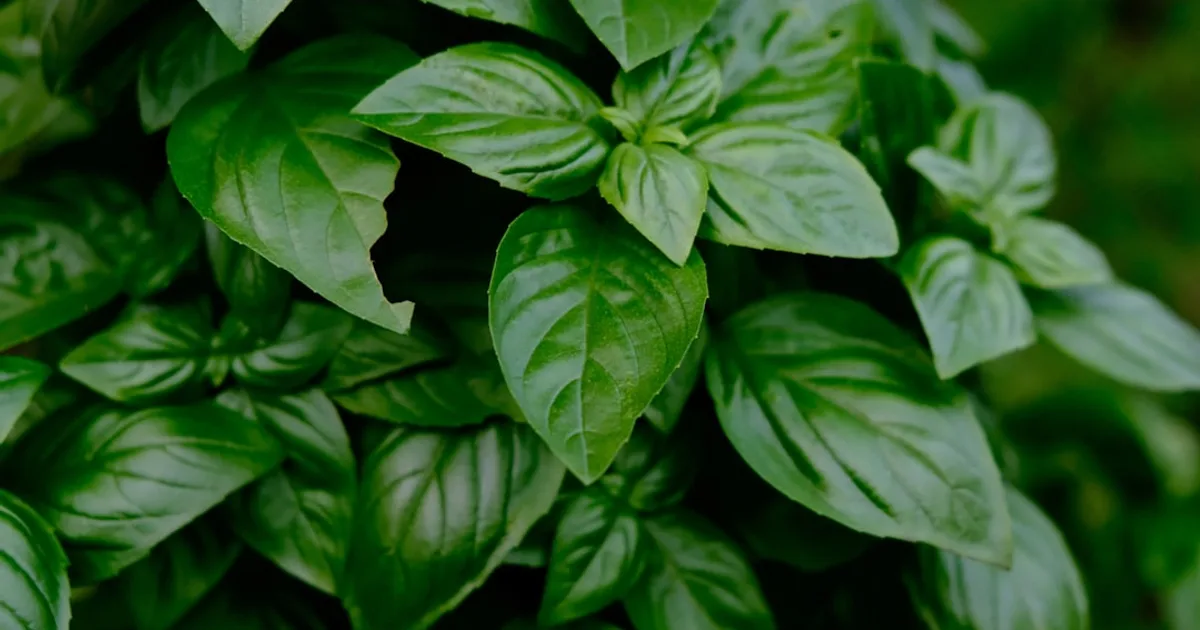
Basil (Ocimum basilicum) is one of the few culinary herbs where a single healthy plant offsets what you’d spend at the grocery store over a season. The price picture is more complicated than it first looks: a $3–$4 clamshell at the supermarket weighs 0.75 oz, which works out to $64–$85/lb. That’s the retail packaging premium, not the commodity price of the herb itself. Loose bunch fresh basil at farmers markets and grocery stores runs $6–$10/lb for conventional and $10–$14/lb for organic, based on USDA Agricultural Marketing Service retail price surveys. Those are the numbers that matter for ROI comparisons - the clamshell price tells you what the packaging costs, not what the basil is worth. You won’t replicate commercial greenhouse yields in a raised bed, but you also don’t need to. Three to four well-managed plants will cover a typical household through the growing season and leave plenty for freezing.
What you’re actually growing
The species Ocimum basilicum covers a lot of ground. The four types worth knowing:
Genovese (broad, cupped leaves, intensely aromatic) is the standard culinary type for Italian cooking and pesto. Highest leaf yield of the common types, with the familiar sweet-clove aroma driven by linalool and estragole. This is what most home gardeners want.
Thai basil (O. basilicum var. thyrsiflora) has narrower leaves, purple stems, and a licorice-anise profile from high methyl chavicol content. It holds up better in high heat cooking than Genovese and won’t substitute for it in cold applications like pesto. It’s a different ingredient for practical purposes.
Lemon basil (O. basilicum ‘Citriodorum’ group) smells like it sounds - citral-dominant aromatic profile. Lower yield but commands premium pricing at specialty markets. Useful for seafood dishes and herb-based drinks.
Purple/Dark Opal basil is ornamental as much as culinary. Attractive in the bed, makes striking herb vinegars, but lower yield and milder flavor than Genovese. Don’t expect Genovese flavor from it.
If you want pesto, grow Genovese. If you’re cooking Southeast Asian food, grow Thai basil. They are not interchangeable.
The ROI case
Seed cost for a full packet runs $2.50–$4.00 and contains far more seeds than you’ll use in a season. Basil germinates readily; start six to eight seeds, transplant the four strongest, putting your cost per plant at $0.50–$0.75 from seed.
Yield and value depend on which variety you grow. Genovese basil - the standard culinary type - yields 0.5–1.5 lb per plant per season with regular harvest (Penn State Extension, Herb Production, 2019). At $6–$10/lb loose retail (USDA AMS), a single Genovese plant returns $3–$15 in grocery value. That’s a modest number for a single plant, but the seed cost is pennies. Four to six plants in a small bed covering 8–12 sq ft will reliably outperform what you’d buy in clamshell packages over a summer.
Thai basil (O. basilicum var. thyrsiflora) yields similarly to Genovese but commands $8–$14/lb at specialty retailers and farmers markets. Lemon basil (O. basilicum ‘Citriodorum’ group) is lower-yielding (roughly 0.3–0.7 lb/plant) but runs $10–$16/lb where available. Purple or dark opal basil is ornamental as much as culinary - attractive in the bed but lower leaf yield and milder flavor than Genovese.
The case for growing your own is strongest if you cook with fresh basil regularly through summer. The economics don’t favor growing basil over dried basil (dried is cheap), but dried basil is a different ingredient for practical purposes - the volatile compounds that make fresh basil worth growing (linalool, eugenol, estragole) evaporate largely during drying.
Growing requirements
Basil is a tropical plant and it behaves like one. It will not tolerate frost, and chilling injury begins below 50°F - leaves turn black and the plant declines even if temperatures recover (UC Cooperative Extension, Basil Production in California, ANR Publication 7240). Wait until nighttime temperatures are reliably above 50°F before setting transplants out. This is not a guideline you can push.
Start seeds indoors six to eight weeks before your last frost date. Basil germinates in 5–10 days at 70–75°F soil temperature. Don’t rush the hardening-off process - a week of gradual outdoor exposure prevents the cold shock that sets plants back by two weeks.
Soil pH in the 6.0–7.0 range works well. Basil is not as pH-fussy as some herbs, but drainage matters more than anything: waterlogged roots invite fusarium wilt faster than anything else you’ll encounter. Raised beds with well-amended soil drain reliably; in-ground beds with heavy clay need organic matter worked in before planting.
Fertilize conservatively. Basil grows fast and doesn’t need heavy feeding. A balanced granular fertilizer worked in at planting, followed by a liquid balanced fertilizer once a month, is more than adequate. Excess nitrogen pushes lush foliar growth but dilutes the aromatic oils that make the herb worth growing - the same mechanism that makes tomatoes watery when over-fertilized (Penn State Extension, Herb Production, 2019).
Pinching: the one technique that matters most
Once a plant has three to four sets of leaves, pinch out the central growing tip, cutting just above the second or third leaf node. This redirects energy into lateral branches and turns a single-stem plant into a bushy one that produces leaves for months rather than weeks. After that, pinch continuously - every time you see a flower stalk emerging, remove it. Once basil sets seed, leaf production slows and the remaining leaves take on a bitter edge.
You don’t need to be precise about this. Harvest frequently by cutting stems six inches down, above a leaf node, and the plant will branch from that point. Frequent cutting is essentially the same as deliberate pinching.
What goes wrong
Basil downy mildew (Peronospora belbahrii) arrived in the United States around 2007 and is now widespread. It appears as yellow patches on the upper leaf surface with a gray-purple fuzzy sporulation on the undersides - distinct from the yellow of nitrogen deficiency, which lacks the underside sporulation. There is no effective home remedy once infection takes hold. Remove affected plants. The pathogen spreads via windborne spores and thrives in humid conditions with poor airflow; spacing plants and watering at the root zone reduce pressure but don’t eliminate it. Cornell Plant Pathology (Wyenandt et al., Plant Disease, 2010) has documented race variation in the pathogen, so resistant cultivars - ‘Eleonora’ and ‘Aroma 2’ have shown better tolerance - are worth considering if downy mildew is a recurring problem in your region.
Fusarium wilt (Fusarium oxysporum f.sp. basilici) causes sudden wilting of one branch or the whole plant, often with brown vascular discoloration visible if you cut the stem. It’s soilborne and persists for years. There’s no treatment. Don’t plant basil in the same bed where you’ve had fusarium wilt. Some commercial sweet basil cultivars are fusarium-resistant; check seed catalogs for this designation.
Fusarium wilt and the Genovese problem
Fusarium wilt has fundamentally changed what Genovese basil looks like in commercial production since around 2012. Fusarium oxysporum f.sp. basilici spread through contaminated seed and is now endemic in most major basil-producing regions in the U.S. and Europe. Cornell University Plant Pathology documented the outbreak’s progression and the near-collapse of the fresh-cut Genovese market in certain regions (Elmer & Ferrandino, Cornell Cooperative Extension, 2014). The pathogen clogs the plant’s vascular system; by the time you see wilting, the plant is already dying.
Identification is specific: the plant wilts suddenly, often in one branch first, and the stem shows brown or reddish-brown discoloration in the vascular tissue when cut crosswise. This is different from drought wilt, which recovers with water, and from root rot, which usually shows at the base first. If the stem is brown inside and the soil isn’t bone dry, assume fusarium.
The soilborne inoculum persists for years. Crop rotation doesn’t fully eliminate it because the pathogen can persist in soil even without a host. Resistant varieties are the practical answer.
The Cornell-linked varieties worth knowing:
-
Nufar - the first commercially successful fusarium-resistant Genovese type, developed through breeding work that included Cornell collaborators. It has the Genovese leaf shape and flavor profile and has been widely adopted in commercial production as the standard resistant cultivar. Seed is readily available from major suppliers.
-
Devotion - bred by PanAmerican Seed, also fusarium-resistant, with a compact habit that works well in containers. Flavor runs close to standard Genovese.
-
Dolce Fresca - All-America Selections winner, bred for fusarium resistance and downy mildew tolerance. Compact plant, good for small-space growing or pots. Flavor is mild Genovese, not as intense as Nufar.
If you’re growing Genovese basil in a bed that has had basil previously, start with Nufar or Dolce Fresca and avoid standard Genovese seed unless you can confirm the bed has no history of wilt. The yield penalty for using resistant varieties is negligible; there’s no good reason to gamble on susceptible seed in a contaminated bed.
Aphids colonize new growth and secrete honeydew that leads to sooty mold. A hard water spray removes most colonies. Insecticidal soap works for heavier infestations.
Japanese beetle (Popillia japonica) feeds on basil leaves and can skeletonize plants quickly in regions where populations are high. Hand-picking in the morning (when beetles are sluggish) is the most practical control for a small number of plants.
Harvest and storage
Cut stems in the morning after dew dries and the aromatic oils are at their peak. Use immediately or store stems upright in a glass of water at room temperature - not in the refrigerator, which will blacken leaves within a day or two. Basil keeps best at 65–68°F.
For longer storage, blend leaves with just enough olive oil to make a paste and freeze in ice cube trays. The color won’t be as bright as fresh, but the flavor holds better than drying. Full-leaf drying works but results in real flavor loss compared to the fresh herb - dried basil is useful for long-cooked dishes, not for finishing.
Preservation: the real numbers
Most gardeners who grow basil well end up with more of it than they can use fresh in August and early September. This is where the ROI story gets more interesting, because the gap between home-grown and retail gets wider when you’re measuring preserved product.
Freezing: two methods, different results
Oil-blanch freezing gives you the closest result to fresh. Blanch whole leaves in boiling water for two seconds, then transfer immediately to ice water. Pat dry, layer in a single layer on a baking sheet lined with parchment, freeze solid (one to two hours), then transfer to a sealed freezer bag. Frozen this way, basil holds for eight to ten months with minimal flavor loss. The blanching step deactivates the polyphenol oxidase enzyme responsible for browning, which is why the leaves come out green rather than black (UC Davis Postharvest Technology Center, Herb Handling, 2015). The texture goes soft - these leaves are for cooking, not for garnishing.
Raw freezing skips the blanch. The leaves turn black and the texture deteriorates faster, but the method is faster and works fine if you’re making pesto or soups where color doesn’t matter. Freeze in a single layer first to keep leaves from clumping, then bag them. Use within four to six months.
Oil paste - the method described above in the storage section - is the most practical approach for high-volume surplus. Blend leaves with olive oil in roughly a 2:1 ratio by volume, pour into ice cube trays, freeze solid, bag the cubes. Each cube equals roughly two tablespoons of fresh-packed basil. Drop a cube directly into a hot pan or into a sauce at the end of cooking.
Drying Genovese basil is not worth your time for culinary purposes. Linalool and eugenol - the volatile compounds that define fresh basil’s aroma - are largely gone after drying. What you get is a faint shadow of the fresh herb that functions as a completely different flavoring. Dried basil has its uses, but they don’t include replacing fresh basil in applications where fresh basil matters. If you have so much basil you don’t know what to do with it, make pesto.
Pesto batch math
One pound of fresh basil leaves (stems removed, leaves only) makes approximately two cups of finished pesto by standard formulations - about 1 cup basil packed, 1/3 cup pine nuts, 1/3 cup Parmesan, 2-3 cloves garlic, 1/2 cup olive oil per batch (Cornell Cooperative Extension, Basil, Vegetable Varieties for Gardeners database). Scale that up to a full-pound batch: roughly 3.5-4 cups of pesto.
At retail, prepared fresh basil pesto runs $8–$12 per cup (USDA AMS retail surveys for specialty food items, 2023). A full-pound batch produces $28–$48 in retail-equivalent pesto, not counting pine nuts, Parmesan, garlic, and oil. Strip out the added ingredients (figure $6–$9 in nuts, $3–$4 in Parmesan, $2–$3 in oil), and the basil itself is returning $17–$36 in final product value from one pound of leaves.
Now trace that back to seed cost. A healthy Genovese plant started from a $0.10 seed - pennies in a packet of 50-plus - yields 0.5–1.5 lb of leaves in a season with regular pinching (Penn State Extension, Herb Production, 2019). At the lower yield, that’s one batch of pesto, $17–$36 retail equivalent. At 1.5 lb yield, you’re closer to $25–$54. The $0.10 seed is not the variable that matters here.
What actually limits your return is whether you have freezer space and whether you make the pesto before the plant flowers. Both are solvable problems.
Basil salt is a preservation option with a longer shelf life than frozen pesto. Layer fresh basil leaves with fine sea salt in a jar (roughly 1 part salt to 3 parts basil by weight), pack tightly, and refrigerate or keep in a cool dark place. The salt draws moisture and acts as a preservative; the result keeps six months to a year and flavors pasta water, brines, and marinades directly. It’s not a substitute for fresh basil, but it’s a use for the stems and smaller leaves you’d otherwise discard.
Full-season management: one seed, one plant, October harvest
The typical trajectory for a basil plant is: plant in May, flush growth through July, set flower stalks in August, get ignored, die at first frost. That’s a 90-day plant. You can extend it to 150-plus days with two additional steps.
Pinching through August. The critical intervention is removing every flower stalk before it opens. Set a weekly reminder if you need to. Once basil goes fully to seed, the leaves turn bitter and production stops. Keep it from flowering and it keeps producing. This isn’t complicated but it requires showing up consistently.
September pot-up and indoor move. In the last week of August or first week of September - depending on your frost dates - dig your best-performing plant and move it into a 10–12” container with fresh potting mix. Bring it inside before the first frost forecast. A sunny south-facing window with six-plus hours of direct light will keep it alive and productive. Growth slows indoors but doesn’t stop. You can reasonably harvest fresh basil from a garden-started plant through October and into November if you started the transition early enough.
This doesn’t work if you wait until the night before frost. The plant needs time to adjust to indoor conditions - lower light, lower humidity, less airflow. Make the move two to three weeks before your average first frost date and you’ll have a plant that transitions successfully.
One practical note: basil grown indoors over winter tends to get leggy and is susceptible to spider mites in dry indoor air. It’s not a permanent houseplant. The goal is extending the harvest window by six to eight weeks, not overwintering indefinitely. Start fresh from seed next spring.
Related crops: Tomato, Mint, Thai Basil, Holy Basil
Related reading: Herb Preservation Guide - detailed methods for freezing, drying, and salting herbs through the season; Herb Garden ROI - the 8 highest-value culinary herbs compared; Companion Planting Basics - what the evidence actually says about common pairings; Dehydrator ROI - dried basil returns $250+/lb retail equivalent
Companion planting note: Basil is commonly planted near tomatoes based on folk claims about improved flavor and pest deterrence. Volatile compounds from basil (linalool, eugenol) have shown repellent effects on Spodoptera species and aphids in laboratory studies (Hummelbrunner & Isman, Journal of Chemical Ecology, 2001). Field-scale yield benefit has not been consistently demonstrated. Grow them together for the culinary convenience of having both in the same bed; don’t count on the pest deterrence as a control strategy.
Also: Organic Produce Cost Analysis - why fresh herbs show the largest premium between home-grown and retail organic prices
Frequently Asked Questions
How much basil does one plant produce?
A single basil plant produces around 0.5 lbs of fresh leaves over a growing season with regular pinching. Heavy harvesting encourages branching and extends productive life.
How long does basil take to grow?
Basil takes 50 to 75 days from seed to a mature, productive plant. It begins producing harvestable leaves around day 30 when about 6 inches tall.
Is growing basil worth it financially?
Grocery basil costs $8/lb or more as fresh bunches. A $3.50 seed packet can grow multiple plants, each producing 0.5 lbs or more - returns of 10x on seed cost are common in a good season.
How do you store fresh basil?
Fresh basil keeps best at room temperature in a glass of water like cut flowers. Refrigeration causes blackening. For longer storage, freeze in olive oil in ice cube trays or blend into pesto and freeze.
Growing Sweet Basil? Track your harvest value and break-even date in the Garden ROI app.
Get the App