
Dill
Anethum graveolens
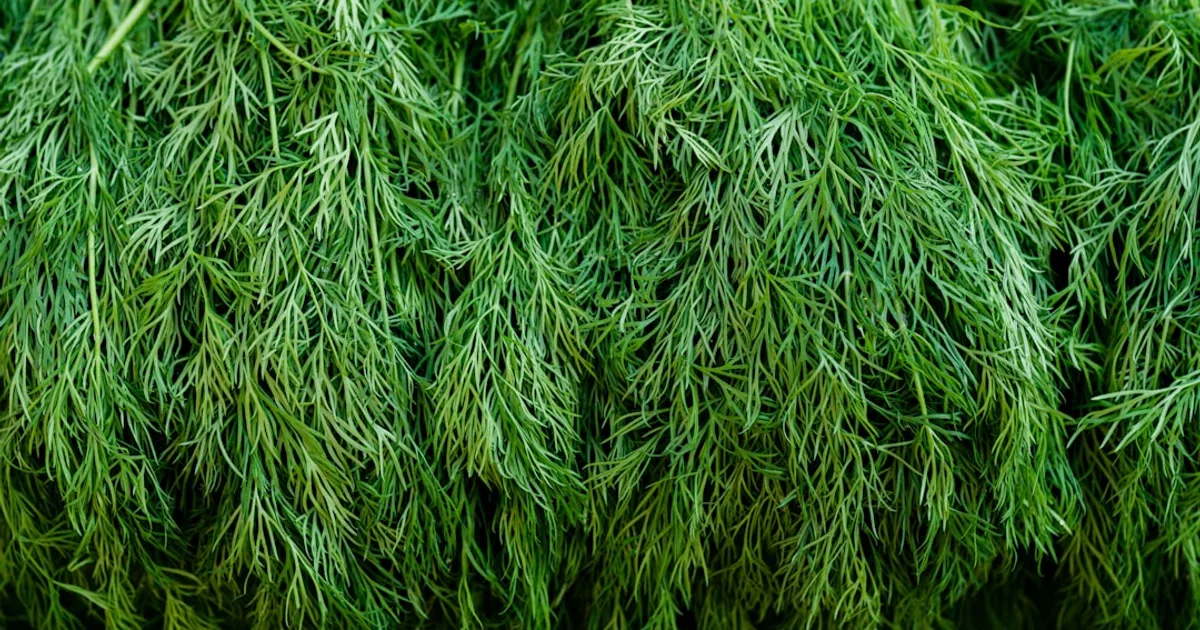
Dill (Anethum graveolens) is a plant you get two usable crops from - the feathery leaves (dill weed) and the seed heads (dill heads or dill seed). Fronds are ready in 40-60 days; full seed head maturity takes 90-110 days. You can harvest fronds continuously while waiting for the heads, or dedicate some plants to head production. A packet of dill seeds costs under two dollars and will last you multiple seasons.
What you’re actually growing
Anethum graveolens is a single species in the carrot family (Apiaceae) with relatively few cultivar types that matter for home growing. Standard tall varieties like ‘Mammoth’ and ‘Long Island Mammoth’ reach 3-4 feet and are the classic choice for dill heads and pickling - the large umbels produce more seed. Dwarf types like ‘Fernleaf’ stay under 18 inches and are bred for leaf production with delayed bolting, making them more practical for container growing or small beds where you want fronds rather than heads.
The primary flavor compounds in dill are carvone and limonene in the seed, with d-carvone dominating. In the fronds, phellandrene is the dominant volatile. The leaf and seed smell similar but are chemically distinct - they’re not interchangeable in cooking, and dill seed in a pickle recipe specifically means mature seed, not frond tissue.
The ROI case
Fresh dill at retail runs $2.00-$4.00 per bunch (typically 0.5-1 oz), putting the price at $4.00-$8.00/lb based on USDA AMS specialty herb retail surveys. Dill seed for pickling runs $3.00-$6.00 per ounce at specialty retailers. A healthy dill plant will produce 0.25 lb of fronds across multiple harvests, plus 1-3 tablespoons of seed per plant.
The math is clearest when you’re comparing dill head cost at pickling time. Fresh dill heads at farmers markets run $1.00-$2.00 each; one tall plant produces 3-6 heads depending on management. Growing your own for a pickle run - 6 quarts of cucumbers needs roughly 6 dill heads - saves $6-$12 against a seed cost of cents per plant.
Dill self-sows freely. Let two or three plants drop seed in a bed corner and you’ll have volunteers every spring with no additional planting. In year two and beyond, your seed cost is zero.
Per-plant dual-harvest value breakdown:
| Harvest type | Timing | Yield per plant | Retail value | Notes |
|---|---|---|---|---|
| Fronds (dill weed) | 40-60 days; multiple cuts | ~0.25 lb total | $1.00-2.00 ($4-8/lb) | USDA AMS fresh herb retail |
| Seed heads (pickling) | 90-110 days | 3-6 heads/plant | $1.50-3.00 ($0.50-1.00/head) | Farmers market rate, spring-summer |
| Dried seed | 110+ days | 1-3 tbsp/plant | $1.00-2.50 (bulk dried dill seed $8-15/oz) | Specialty retail; high value per ounce |
| Total per plant | $3.50-7.50 | From a seed cost of ~$0.04/plant |
The self-sowing return in year two and beyond turns this into a zero-cost crop. A dill plant that drops seed produces the following season’s volunteers with no intervention. The economic case for dill is strongest when you’re matching the harvest to an actual use: fresh fronds for a summer when you cook a lot of fish and salads; heads specifically timed to a cucumber harvest for pickling.
Succession sowing
Dill bolts in heat and has a compressed window for frond harvest - once flower buds form, the plant shifts its energy to seed production and frond quality declines. In most climates, a single spring sowing gives you fronds for 4-6 weeks before the plant wants to flower. To extend fresh frond availability through the season, sow every 2-3 weeks from last frost date through midsummer.
| Sow date (Zone 6 example) | Frond harvest window | Seed head timing | Notes |
|---|---|---|---|
| May 1 (last frost +2 weeks) | June 10-July 15 | Early August | First sowing; heads timed for early pickle season |
| May 21 | July 1-Aug 1 | Late August | Overlap with first sowing for continuous fronds |
| June 10 | July 20-Aug 20 | Mid-September | Late fronds; heads available for fall pickle run |
| July 1 | Aug 10-Sep 10 | Too late for heads | Fronds only; plant often doesn’t have time to mature seed |
In year two and beyond, self-sown volunteers tend to germinate when conditions are right - typically in spring - and supplement or replace intentional succession sowings. The volunteers emerge without consistent timing, which works fine if your goal is a continuous frond supply but makes head timing for a scheduled pickle day less predictable.
Growing requirements
Direct sow only. Dill has a taproot that establishes immediately after germination, and transplanting sets plants back - they often bolt prematurely when root-disturbed. Sow 1/4 inch deep, directly into the garden, after the last frost. Thin to 8-12 inches apart; crowded dill is weak dill.
Dill needs full sun - 6 hours minimum, more is better. In partial shade, plants get leggy, fall over, and produce sparse fronds. Soil pH of 5.5-6.5 works well. The plant is not heavy-feeding; a moderately fertile soil is adequate. Rich, high-nitrogen soil drives lush foliage growth but can reduce the aromatic oil concentration.
Plant tall varieties away from fennel (Foeniculum vulgare) - the two will cross-pollinate and the resulting seed from either parent may produce plants with muted flavor. Keep them separated by at least 50 feet if you’re growing both.
Dill tolerates drought better than most herbs once established. Once the taproot develops, the plant can handle brief dry spells without stress. During seedling establishment, consistent moisture matters.
What goes wrong
Parsley worm / black swallowtail caterpillar (Papilio polyxenes) is the most common visitor to dill. The caterpillars are green with black and yellow banding and will consume plants rapidly when populations are high. This is the larval stage of a native butterfly with ecological value. For home use, simply plant more dill than you need and accept some sharing, or hand-relocate larvae to wild carrot plants. For market production, row cover early in the season limits access.
Aphids colonize dill regularly, particularly soft new growth. A hard water spray removes most colonies. Insecticidal soap is effective for heavier infestations. Dill’s open flower umbels, once formed, attract beneficial predatory wasps (Trichogramma spp., Aphidius spp.) that reduce aphid populations over the season.
Root rot occurs in poorly drained soils or overwatered beds. Dill is more sensitive to wet feet than most garden plants once the taproot is established. Good drainage is non-negotiable.
Powdery mildew (Erysiphe heraclei) affects dill in humid conditions late in the season. By that point, the plants are usually approaching the end of their useful life anyway. Adequate spacing reduces pressure.
Harvest and storage
Harvest fronds by cutting stems above a leaf node. Don’t strip entire plants at once - leave 1/3 to 1/2 of the foliage intact at each harvest to maintain plant health. Fronds are most aromatic just as the plant begins forming flower buds; once the plant is in full flower, leaf production slows and the remaining leaves become less flavorful.
For dill heads (pickling), harvest when the majority of the florets have opened and a few seeds are forming on the outer edges of the umbel. At this stage the head is fragrant, the seeds are just setting, and the flavor is at its peak for brine applications. Use immediately or refrigerate for up to a week.
For dried dill seed, wait until the seeds turn from green to tan-brown. Cut the entire seed head, place upside down in a paper bag, and hang in a warm dry space for 1-2 weeks. Seeds will drop into the bag as they dry. Store in a sealed jar; dried seed keeps well for 2-3 years.
Fresh fronds can be frozen (chopped in ice cube trays with water) or dried, though drying loses roughly half the volatile oil content. Freezing preserves flavor better for cooked applications.
Culinary applications
Dill fronds and dill seed are chemically distinct and function differently in the kitchen. Fronds are dominated by phellandrene; seed by carvone and limonene. They’re not interchangeable, and recipes that specify one are not asking for the other.
Fronds (dill weed): apply raw or add in the last 30-60 seconds of cooking. Heat destroys phellandrene rapidly - dill cooked into a sauce for 10 minutes tastes like nothing. Applications: cucumber salad (sliced cucumber + rice vinegar + sugar + salt + dill, toss and refrigerate 20 minutes); tzatziki (Greek yogurt + grated cucumber + garlic + fresh dill + olive oil - the dill is added raw); new potato salad with dill (toss warm potatoes with butter, salt, and a generous fistful of chopped fresh dill); gravlax (salt-sugar-dill cure applied to salmon fillet for 24-48 hours under refrigeration - this is a preservation application where the dill is doing more than flavor).
Dill heads (whole heads for pickling): the head provides both the seed and the frond chemistry together. Standard dill pickle recipe: one head per quart jar, placed at the jar bottom before packing cucumbers. The head should be in full bloom with some seeds just starting to form at the outer edges - this is the maximum flavor stage. Fresh heads can be refrigerated for 5-7 days if your pickle day doesn’t line up exactly with harvest.
Dill seed (dried): for pickling brine, rye bread, Scandinavian fish dishes. Standard dill pickle brine uses 1 teaspoon of dried seed per quart jar if you don’t have heads. Dill seed in rye bread: 1 tablespoon per loaf, added to the dough. Dill seed vinegar: steep 2 tablespoons of seed in a cup of white wine vinegar for 2 weeks, strain - the result is excellent in potato salad dressing and in Scandinavian-style salads.
Related crops: Cucumber, Lettuce, Chervil, Lovage
Related reading: Companion Planting Basics - what the evidence actually says about common pairings; Lacto-Fermentation Preservation - dill’s role in fermented pickles and why growing your own changes the economics of a ferment; Herb Garden ROI - dill leads at 5.5x ROI multiple; Dehydrator ROI - dried dill returns $150+/lb retail equivalent
Growing Dill? Track your harvest value and break-even date in the Garden ROI app.
Get the App