
Collard Greens
Brassica oleracea var. viridis
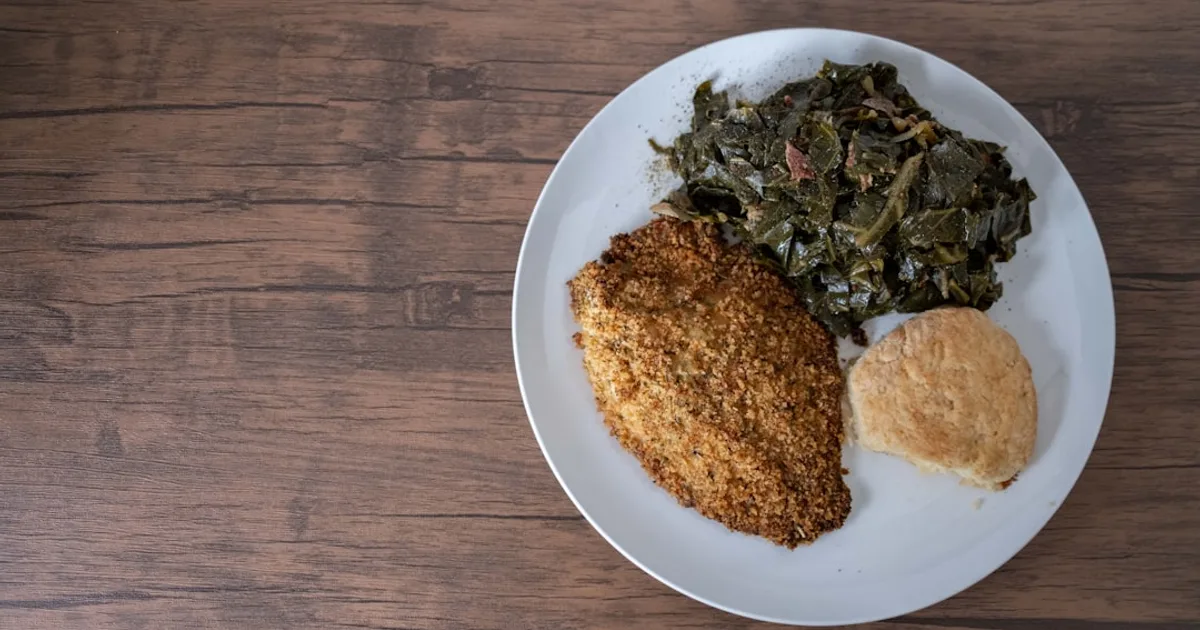
Collard greens (Brassica oleracea var. viridis) stay productive when kale quits. In the South they’re the default cool-weather green, tolerating the kind of summer heat that sends kale into bitterness and premature bolt. In Zone 6 and 7 gardens they’re something more useful than that: a single planting started in April can still be putting food on the table in February. No other green in the brassica family matches that window.
The frontmatter ROI number - 5 lbs, $12.50 gross on a $2.49 seed packet - tells you something, but it undersells the real story. That figure treats collards like a head lettuce: plant once, harvest once, done. Collards don’t work that way.
What You’re Actually Growing
Brassica oleracea var. viridis is a non-heading form of the same species that includes cabbage (B. oleracea var. capitata), kale (B. oleracea var. sabellica), and broccoli (B. oleracea var. italica). Collards occupy a distinct niche: large, smooth, dark green leaves that are thicker and tougher than kale, require longer cooking, and hold up to braising conditions that would reduce spinach to mush.
They’re the foundational green in Southern American cooking for a reason that has nothing to do with tradition and everything to do with practicality. Collards grow when other things won’t. They tolerate heat better than kale, which researchers at the University of Georgia attribute partly to their upright growth habit (better air circulation) and partly to their thicker, waxy leaf cuticle that reduces moisture stress (UGA Cooperative Extension Bulletin 1245, Collards, 2015). They’ll bolt in sustained heat, but later and more reluctantly.
They also survive cold that would kill everything else in the garden.
The Real ROI: Eight Months From One Planting
The basic math: a $2.49 packet contains 200-300 seeds. Start 6 plants; each returns somewhere between 1 and 3 lbs over a short season at $2.50/lb retail (USDA AMS terminal market pricing, conventional collards, 2023-2024 average). That’s $15-$45 gross from one packet. Decent.
The real math requires thinking about how cut-and-come-again crops actually work.
A collard plant started from seed in April in Zone 6 or 7 reaches harvestable size by June. At that point you start pulling the lower outer leaves - three or four at a time, cutting at the stem, leaving the central growing point intact. The plant keeps growing upward, adding new leaves from the center, shedding the oldest leaves at the base. You’re harvesting a moving window of foliage off a plant that’s actively adding new growth.
That plant doesn’t stop. You pull leaves in June, July, August. You pull leaves through September and October as the flavor improves with cooler nights. You pull leaves through November, through December, after hard freezes. In a Zone 7 winter with light row cover, you’re still pulling leaves in January and February. That’s 35-38 harvestable weeks from one planting.
Three plants at 0.5 lb harvested per week: 0.5 lb x 35 weeks = 17.5 lbs. At $2.50/lb retail that’s $43.75 in grocery value from a $2.49 seed packet - a return of more than 17:1. Even if you’re conservative and cut the yield estimate by a third, you’re still at $29 from $2.49. No other green in the garden produces that value from one planting without resowing.
| Scenario | Plants | Weeks | Yield/Week | Total Yield | Gross Value |
|---|---|---|---|---|---|
| Conservative (Zone 6, no protection) | 3 | 24 | 0.5 lb | 12 lbs | $30.00 |
| Standard (Zone 6-7, light row cover) | 3 | 35 | 0.5 lb | 17.5 lbs | $43.75 |
| Extended (Zone 7, mild winter) | 3 | 42 | 0.5 lb | 21 lbs | $52.50 |
| High-density (Zone 7, 6 plants) | 6 | 35 | 1.0 lb | 35 lbs | $87.50 |
Seed cost in all scenarios: $2.49.
Winter Hardiness: Collards Are the Last Green Standing
Established collard plants handle -10°F with light protection. That’s not a typo. Collards are the most cold-hardy of all the brassicas - hardier than kale, hardier than Brussels sprouts, hardier than cabbage. Penn State Extension reports established collard plants surviving temperatures as low as 5-10°F without any protection, and lower with floating row cover or a cold frame (Cool Season Vegetables, Penn State Extension, 2020).
The mechanism behind cold tolerance in brassicas involves the accumulation of cryoprotective compounds - soluble sugars, proline, and compatible solutes that lower the freezing point of cell contents and protect membranes during freeze-thaw cycles (Kacperska, A., Physiologia Plantarum, 2004). In collards this process is more pronounced than in most brassicas. A plant that has been through several frosts has different cell chemistry than a plant that hasn’t.
This is why Southern growers say collards “need kissing by frost.” It’s not sentiment. The first frost of the season triggers a starch-to-sugar conversion in leaf tissue that measurably improves flavor - leaves become sweeter, more complex, less sulfurous. December and January collards, harvested after multiple hard frosts, are the best collards of the year. They taste nothing like the leaves you pulled in July.
You want plants well-established before hard frost hits - that means root systems are developed and plants are at least 18 inches tall. A seedling hit by a hard freeze before it’s established won’t recover. But a mature plant that’s been growing since April? It’s adapted.
For overwintering in Zone 6, a simple low tunnel with 1.5 oz floating row cover is sufficient protection during most winters. In Zone 7 and south, established plants need nothing. They’ll stand through the winter on their own.
Variety Selection
Named varieties differ in leaf shape, cold hardiness, bolt resistance, and growth habit. For home gardens, the open-pollinated heirlooms are reliable and produce seeds you can save. For extended-season and overwintering goals, cold-hardiness ratings matter.
| Variety | Type | Days to Maturity | Cold Hardiness | Notes |
|---|---|---|---|---|
| Georgia Southern | OP heirloom | 70-80 | Good | Standard variety; heat and cold-tolerant; large loose leaves; best all-purpose choice |
| Vates | OP heirloom | 75 | Excellent | Slightly more cold-hardy than Georgia Southern; compact, slower to bolt; UGA recommends for fall/winter production |
| Flash | Hybrid | 60 | Good | Semi-savoyed, upright habit; uniform; good for spring planting when you need faster maturity |
| Champion | Hybrid | 60 | Good | Compact growth; suitable for containers or smaller beds; consistent leaf production |
| Top Bunch | Hybrid | 65 | Moderate | Bolt-resistant; better choice for spring plantings in zones where April heat arrives early |
| Blue Max | Hybrid | 68 | Excellent | Blue-green color; bred for cold hardiness; the best variety for overwintering trials; holds quality through hard freezes |
For fall and winter harvest goals, Vates or Blue Max. For spring planting where bolt resistance matters, Top Bunch or Flash. For an all-purpose heirloom where you want to save seed, Georgia Southern.
Long-Season Plant Management
A collard plant producing for eight months doesn’t look like a collard plant at transplant time. Over a full season the main stalk can reach 3-4 feet tall, with a canopy of 6-8 large leaves at the top and bare stalk below where you’ve taken the lower leaves throughout the season.
Managing the plant for continued production means a few specific things.
Remove lower leaves as they yellow or age. An older leaf redirecting resources back into the plant or senescing on the stalk is overhead with no yield return. Cut it clean. You want the plant directing energy into the new growth at the center and upper canopy.
Keep 6-8 functional leaves on the plant at all times. If you strip it down to two or three leaves chasing a big harvest, you’ve reduced the photosynthetic surface area the plant needs to produce the next flush of growth. Take the bottom third, leave the top two-thirds.
Side-dress with nitrogen every 6 weeks through the growing season. Collards are heavy feeders - leaf production is nitrogen-dependent, and a plant producing leaves continuously for eight months is drawing down soil nitrogen continuously. Blood meal (12-0-0), fish emulsion (5-1-1), or a balanced granular fertilizer (10-10-10) applied to the root zone and watered in will keep leaf production strong. Without consistent nitrogen inputs, leaves become smaller and thinner as the season progresses. You’ll see the decline before the season ends.
By midsummer the plant’s lower stalk will be bare and woody. This is normal. The leaves you want are at the top, and new growth continues from the center. Some gardeners stake the plant when it reaches 2-3 feet to prevent wind damage to the tall stalk.
Growing Requirements
Direct sow 2-4 weeks before last frost in spring, or start indoors 4-6 weeks before transplanting. Seeds germinate in 5-10 days at 65-85°F soil temperature. Thin to 18-24 inches apart - crowded plants have poor air circulation, which accelerates fungal disease and reduces yield.
Soil pH of 6.0-7.5. Work 2-3 inches of compost into the bed before planting. Collards will grow in poorer soil than most vegetables but they won’t produce the yield you want without adequate nutrients and consistent moisture.
Consistent watering reduces bitterness. Drought stress causes leaves to toughen and develop sharper sulfur compounds. Maintain 1-1.5 inches per week through summer, using drip irrigation or a soaker hose to keep foliage dry and reduce fungal pressure.
For fall production specifically: in Zone 6, direct sow in late July to early August. You need plants reaching near-full size before hard frost, not after. A small seedling going into fall doesn’t have time to establish before the cold hits. Plan backward from your first frost date - if first frost is October 15, back up 75 days and sow by July 31.
What Goes Wrong
Cabbage looper (Trichoplusia ni) and imported cabbageworm (Pieris rapae larva) are the primary defoliators. The adults lay eggs on leaf undersides; larvae feed from the outside in. Bacillus thuringiensis subsp. kurstaki (Bt) applied to foliage is effective and selective - caterpillars that ingest it die within a few days; beneficial insects are unaffected. Spinosad also works. Row cover at transplant time prevents adult access entirely.
Harlequin bug (Murgantia histrionica) is a significant pest in the South, causing stippling and wilting through piercing-sucking feeding. Hand-pick egg masses - red and white, laid in neat double rows on leaf undersides - and adults in early morning when they’re sluggish. Pyrethrin sprays provide some knockdown.
Black rot (Xanthomonas campestris pv. campestris) is the most serious bacterial disease of brassicas. It enters through leaf margins and causes V-shaped yellow lesions progressing to blackened veins, then spreads systemically. It’s seedborne and soilborne. Plant certified disease-free seed; rotate brassicas out of any bed where black rot has appeared for at least two years. There is no effective chemical treatment once a plant is infected (Cornell Cooperative Extension, Brassica Diseases, 2018). Pull infected plants and bag them - don’t compost.
Downy mildew (Hyaloperonospora parasitica) causes pale yellow patches on leaf surfaces with white sporulation on undersides in cool, wet conditions. Remove affected leaves; avoid overhead watering. More of a problem in spring than fall.
Aphids - specifically Brevicoryne brassicae, the cabbage aphid - colonize new growth, especially in fall. A strong spray of water dislodges them. Insecticidal soap works on contact. Parasitic wasps usually bring populations under control on their own if you haven’t sprayed with broad-spectrum pesticides.
Harvest and Kitchen Use
Begin harvesting outer leaves when the plant is 10-12 inches tall. Cut cleanly at the stem, leaving the central growing point intact. Take the lowest 3-4 leaves per harvest visit. Younger, upper leaves are more tender; older lower leaves are increasingly fibrous and better suited to long braising.
Post-frost leaves - harvested after the plant has been through several hard frosts - are noticeably sweeter and more complex in flavor. This isn’t a small difference. A July leaf and a January leaf from the same plant taste like different vegetables.
Fresh collards keep 5-7 days in the refrigerator wrapped loosely in a damp paper towel. For long-term storage, blanch 3 minutes, cool, drain, and freeze in airtight bags. Properly frozen collards hold quality for 10-12 months.
The Southern method of cooking collards - slow-braised for 1-2 hours with smoked pork (hock, neck bones, or fatback) - is not just tradition. The long braise does specific chemical work. Extended heat breaks down thioglucosides into milder flavor compounds, reducing the sharp sulfurous edge that makes raw or briefly cooked collards aggressive. It also softens oxalic acid crystals in the leaves, making the calcium in the greens more bioavailable (USDA ARS, Nutrient Data Laboratory, 2019). The braising liquid - called pot liquor in the South - concentrates the water-soluble vitamins, potassium, and other nutrients that cook out of the leaves. It’s drunk separately, and it’s nutritionally dense enough that some cooks treat it as the main product of the process.
You don’t have to cook collards that way. A quick sauté over high heat with garlic works, especially for the younger, more tender leaves you pull in summer. But for the big, tough, post-frost leaves of December, the long braise is the right tool.
Related reading: Beginner Homestead Crops - which cool-season crops give the most return for the least input
Growing Collard Greens? Track your harvest value and break-even date in the Garden ROI app.
Get the App