
Cowpea
Vigna unguiculata
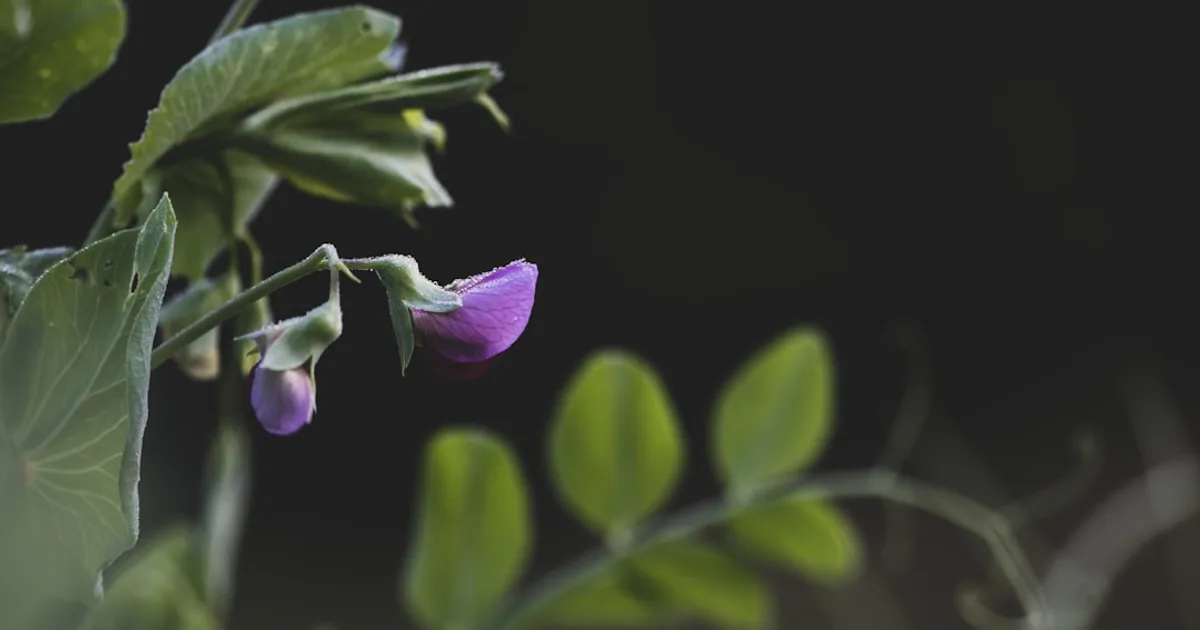
Cowpea (Vigna unguiculata) produces food and improves your soil at the same time. It thrives in heat and drought that shut down green beans and garden peas entirely. If you garden in Zone 7b or warmer and you’re not already growing it, you’re leaving a reliable summer crop on the table.
The financial case is straightforward: fresh-shelled cowpeas retail at $2-4/lb at Southern farmers markets (USDA AMS Specialty Crop Market News, regional data), and dried blackeyed peas carry $1.50-2.50/lb retail at natural food stores. Seed costs $3-5/lb, a $4 packet plants a 30-foot row. A 10-foot row of well-managed cowpeas yields 3-5 lb of fresh-shelled peas or 1-1.5 lb dried. The nitrogen your plants fix into the soil is a second return on that seed investment.
Species and variety context
Vigna unguiculata covers more ground than most gardeners realize. The same species that produces blackeyed peas in Texas also produces yard-long beans in Vietnamese kitchens. Knowing the subspecies and market classes is worth your time before you order seed.
Blackeyed peas are the most widely known market class in the United States - creamy white seeds with a black or dark-colored eye. ‘California Blackeye No. 5’ is the standard commercial variety; ‘Queen Anne’ and ‘Iron and Clay’ are also common. These dry well and dominate the Southern dried-pea market. Source: USDA GRIN (Germplasm Resources Information Network), Vigna unguiculata variety catalog.
Crowder peas pack so tightly in the pod that the seeds develop a squared-off or crowded appearance. ‘Purple Hull Pinkeye’, ‘Mississippi Purple’, and ‘Whippoorwill’ are the most widely grown crowder types. The flesh is starchier than blackeyed peas and the cooking liquor (pot likker) is darker and more flavorful. These are the preference in the Deep South for fresh-shell consumption. Source: Southern Exposure Seed Exchange variety descriptions.
Cream peas are pale tan to white with no contrasting eye. ‘White Acre’, ‘Lady Cream’, and ‘Zipper Cream’ are the primary market varieties. The flavor is milder and sweeter than blackeyed types, which gives them a following among people who find blackeyed peas too assertive. They shell easily, which matters if you’re processing large quantities by hand.
Yard-long bean (V. unguiculata subsp. sesquipedalis) - sometimes called asparagus bean or Chinese long bean - is the same species but a different growth habit entirely. Pods grow 12-24 inches long (most harvest at 14-18 inches for best texture) and are eaten fresh like a green bean, not shelled. They require warmer soil and longer seasons than other cowpea types but produce prolifically on trellis. The pod texture is slightly denser than a common green bean (Phaseolus vulgaris). This subspecies classification is confirmed in USDA GRIN taxonomy.
All of these are Vigna unguiculata. They share the same heat tolerance, drought resistance, and nitrogen-fixing capacity. The differences are in pod type, seed appearance, eating stage, and regional market preference.
Heat and drought profile
This is why cowpeas matter to gardeners in Zone 7b-11.
Cowpeas germinate in soil temperatures up to 95°F - most cool-season crops stop germinating around 75-80°F, and even heat-tolerant crops like green beans (Phaseolus vulgaris) see germination rates drop sharply above 85°F. Cowpeas continue producing through ambient air temperatures of 100°F. Green beans, snap beans, and garden peas cease production in sustained heat above 85-90°F; the plants are still alive, but they drop flowers and set no pods. Source: Texas A&M AgriLife Extension, Cowpeas: Growing Home Garden Vegetables in Texas.
The practical implication: if you’re in Zone 8-11, cowpeas give you a productive legume during the months when nothing else in that family will work. July and August in central Texas or the San Joaquin Valley are cowpea season. They are not an alternative to green beans - they fill a gap in the calendar that green beans cannot fill.
Drought tolerance develops quickly after establishment. During the first two to three weeks after germination, consistent moisture matters - roots are shallow and the plant is building structure. Once cowpeas reach 8-10 inches tall and begin to vine, they handle reduced water. In established plantings under normal summer conditions, 0.5-1 inch per week is adequate. This is substantially less than tomatoes (1.5-2 inches/week), corn (1-1.5 inches/week), or cucumbers (1-1.5 inches/week). Source: University of California Cooperative Extension, Water Use of Crops.
The drought tolerance comes from an extensive root system that reaches 18-30 inches deep under good soil conditions, combined with the plant’s ability to reduce leaf area and temporarily slow growth when water is limited, then resume production when moisture returns. A cowpea plant stressed by drought does not die the way a bean plant does - it pauses and waits.
Nitrogen fixation
Cowpeas are among the most efficient nitrogen-fixing legumes grown in temperate and subtropical agriculture. Under good inoculation and soil conditions, cowpeas fix 100-200 lbs of nitrogen per acre over a growing season. Source: Sustainable Agriculture Research and Education (SARE), Managing Cover Crops Profitably, 3rd edition.
To put that number in context: urea fertilizer (the most common nitrogen source in commercial agriculture) runs $0.50-0.60/lb of actual nitrogen depending on market conditions (USDA ERS fertilizer price data). Fixing 100 lbs of nitrogen per acre at $0.55/lb = $55/acre in soil amendment value. Fixing 150 lbs = $82.50/acre. On a home garden scale, a 100-square-foot cowpea planting (roughly 1/400 of an acre) fixes nitrogen equivalent to $0.14-$0.21 in urea - not dramatic in dollar terms, but 100% of it stays in your soil, available to the next crop, with zero application equipment needed.
The nitrogen fixation happens through Rhizobium bacteria housed in nodules on cowpea roots. These bacteria are present in most agricultural soils that have grown legumes in the past 3-5 years. If your soil has not grown legumes recently, inoculating seed before planting (with a Bradyrhizobium inoculant specific to cowpeas - not a generic legume inoculant) improves nodulation and fixation rates. Inoculant costs $5-10 for enough to treat several pounds of seed. Source: SARE, Managing Cover Crops Profitably.
The nitrogen benefit passes to the following crop. If you follow cowpeas with a heavy feeder - brassicas, corn, or winter squash - the residual nitrogen in decomposed root nodules and plant matter reduces your fertilizer need for that next crop. The value compounds over multiple seasons.
Fresh shell vs. dried: economics by the row
The decision between harvesting fresh-shell and letting pods dry on the vine changes the work profile, the timeline, and the financial return.
| Metric | Fresh shell (10-ft row) | Dried (10-ft row) |
|---|---|---|
| Typical yield | 3-5 lb shelled | 1-1.5 lb dried seed |
| Retail price range | $2-4/lb | $1.50-2.50/lb |
| Gross retail value | $6-20 | $1.50-3.75 |
| Labor to process | 20-40 min shelling | 5-10 min threshing + sorting |
| Storage life | 3-5 days refrigerated; 12 mo. frozen | 1-2 years in airtight container |
| Market window | Short (shelling window is days) | Year-round |
Sources: Yield estimates from USDA AMS Specialty Crop Market News Southern regional data; price ranges from USDA AMS Market News Portal for fresh shell cowpeas (Southern markets, 2022-2023) and natural food store retail surveys.
Fresh-shell cowpeas deliver higher gross value per pound but require harvesting at precisely the right stage - pods must be full but seeds should not yet have begun to dry - and shelling is labor-intensive. A 20-foot row of crowder peas at peak can take 45 minutes to shell. If you have a farm stand or can sell at market quickly, fresh-shell is the better financial return. If you’re preserving for household use, dried is easier to manage and stores without any energy input.
The hybrid approach: harvest a first pick at fresh-shell stage for table use, then let remaining pods fully mature and dry for seed saving or dried pea storage. The plant produces pods in flushes, so staggering harvest by timing and by row gives you both products from the same planting.
Frozen cowpeas are a legitimate market product in the South. Bags of frozen fresh-shelled cowpeas sell at $3-5/lb at regional grocery chains (Piggly Wiggly, Winn-Dixie, independent grocers). If you have the volume and a chest freezer, this is a viable preservation and direct-sale format.
Growing requirements
Sow directly into soil that has warmed to at least 65°F - do not rush this. Cold soil rots cowpea seeds faster than most legumes because the seed coat is relatively thin. In Zone 7b-8a, late April through early May; Zone 9-11, April through July for successive plantings. Cowpeas do not transplant well and do not benefit from indoor starting.
Sow 1 inch deep, 4-6 inches apart in rows 24-30 inches apart. If vining types, space rows 36 inches and provide trellis or allow to sprawl. Bush types (‘Iron and Clay’, ‘California Blackeye No. 5’) hold themselves up without support. Thin to 6-8 inches once seedlings are established.
Soil pH 5.8-7.0. Cowpeas tolerate poorer soils than most vegetable crops - this is part of their value as a cover crop and soil-building plant. Excess nitrogen fertilizer suppresses nodulation and reduces the plant’s incentive to fix atmospheric nitrogen. Do not apply high-nitrogen amendments at planting if your goal includes the nitrogen fixation benefit. Phosphorus availability improves nodulation; bone meal or rock phosphate at planting is a compatible amendment.
Full sun is non-negotiable for pod production. Plants in partial shade grow vigorously but produce few pods.
What goes wrong
Cowpea weevil (Callosobruchus maculatus) is the primary storage pest. Adults lay eggs on pods in the field before harvest; larvae burrow into dried seeds and consume the interior. You’ll find circular exit holes in stored dried peas. Prevention: freeze dried seed for 3-7 days at 0°F immediately after harvest and drying; this kills all life stages. Do not skip this step if you’re saving seed for next season. Source: University of California Statewide IPM Program, Cowpea Weevil.
Aphids (Aphis craccivora, the cowpea aphid) colonize stem tips and the undersides of leaves. Heavy infestations stunt growth and reduce pod set. Insecticidal soap or strong water spray handles light infestations. Beneficial insects - particularly Lysiphlebus testaceipes (a parasitic wasp) - naturally suppress cowpea aphid populations if you avoid broad-spectrum insecticides. Source: UC Davis ANR Publication 7430, Cowpea.
Root knot nematodes (Meloidogyne spp.) cause knotted root systems and stunted growth in sandy, warm soils - the same conditions where cowpeas thrive. If you have a history of nematode problems, ‘Mississippi Purple’ and ‘Iron and Clay’ have demonstrated better tolerance than standard blackeyed types. Soil solarization for 4-6 weeks before planting reduces populations in southern soils. Source: Texas A&M AgriLife Extension, nematode management publication L-5025.
Curly top virus, vectored by the beet leafhopper (Circulifer tenellus), causes stunting, leaf roll, and plant death in the Southwest. No treatment exists once infection occurs; the best management is row covers early in the season to exclude leafhoppers, and avoiding planting adjacent to alfalfa and sugar beet fields where leafhopper populations are high. Source: University of Arizona Cooperative Extension.
Pod shatter in dry conditions is worth noting: if you let pods fully dry on the vine and don’t harvest promptly, mature pods split and scatter seeds. Walk the row regularly once pods turn tan and dry.
Harvest and use
Fresh-shell harvest: pods should be fully filled and seeds visible as bumps along the pod, but the pod itself still green or just starting to turn. Squeeze the pod gently - seeds should feel firm. A pod that’s beginning to yellow but not yet papery is still usable. Once the pod turns papery, you’re into the dried-pea stage.
Dried harvest: leave pods on the plant until they are fully tan and papery, then pull the entire plant and hang it in a dry, well-ventilated location for two to three weeks to complete drying. Threshold by rolling pods between your palms over a tarp or by putting dried plants in a pillowcase and beating it against a hard surface. Winnow to remove chaff.
Fresh-shelled cowpeas cook in 20-30 minutes without soaking. Dried cowpeas rehydrate in 1-2 hours of soaking and cook in 45-60 minutes. The cooking liquor from crowder peas and blackeyed peas is flavorful on its own - Southern cooking traditions use it as a base for rice dishes and cornbread.
Yard-long beans: harvest at 14-18 inches when pods are still tender and before seeds develop significant size inside. Snap or cut; do not pull. The beans deteriorate quickly after harvest - use within two to three days or blanch and freeze.
Regional planting context
Zone 7b-11 is cowpea country. The southeastern United States, Gulf Coast, Southwest, and California Central Valley are all primary production zones. In these regions, cowpeas are one of the few productive vegetable crops during the peak summer heat window.
Zone 6-7a: possible with careful timing. You need at least 80 consecutive days above 70°F for a decent yield from most varieties. Choose fast-maturing varieties (‘California Blackeye No. 5’ at 65 days, ‘Iron and Clay’ at 60-70 days). Plant after soil reaches 65°F and expect one harvest window before fall. The results are workable but not the abundance you’d see in Zone 8.
Zone 5 and north: not a reliable crop. The season is too short for most varieties to complete their cycle, and the heat accumulation during the growing season is insufficient for the plant to produce well even if it survives germination. You can try in a particularly warm, sheltered microclimate with the fastest-maturing varieties, but expect disappointment. Use that space for crops adapted to your zone.
Related crops: Corn, Edamame, Lima Bean
Related reading: Best Crops by Zone - which heat-tolerant crops actually produce in Zone 8 and above
Growing Cowpea? Track your harvest value and break-even date in the Garden ROI app.
Get the App