
Edamame
Glycine max
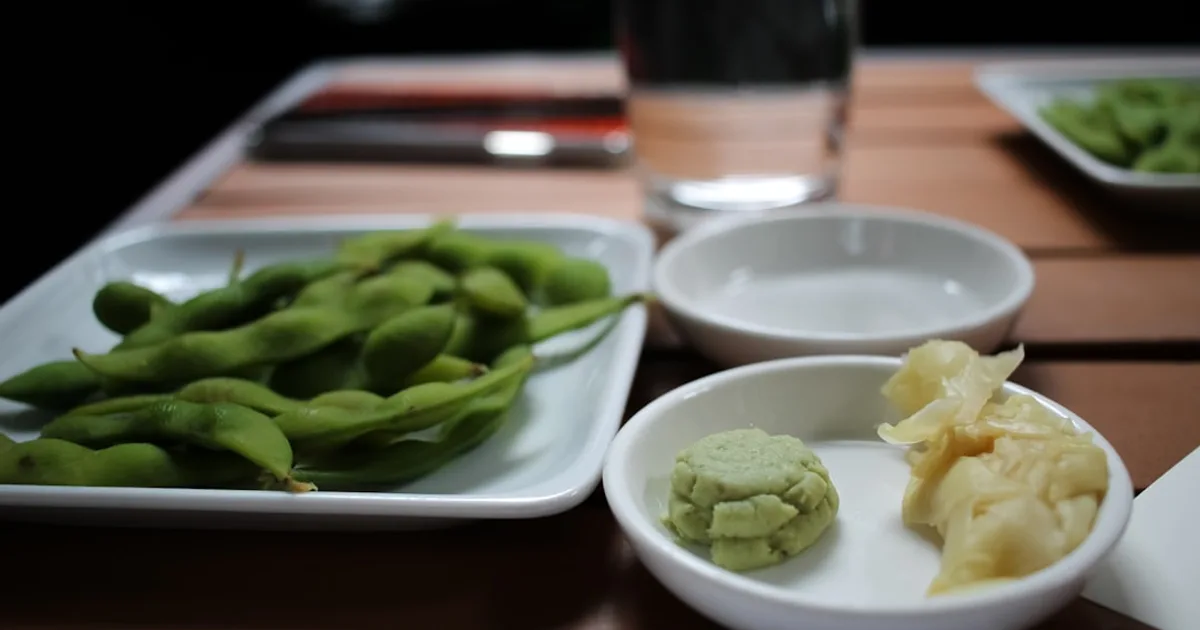
Edamame and soybeans are the same plant (Glycine max). The distinction is entirely in harvest timing: edamame is the soybean harvested at the green, immature stage before the beans dry down. One planting covers both options - eat what you want fresh over a narrow window, then let the rest dry on the plant for dried beans to use through winter.
The crop also fixes atmospheric nitrogen through a symbiotic relationship with Bradyrhizobium japonicum bacteria in root nodules. After harvest, cut the roots and turn the plants back into the soil. Most crops extract from the soil. Edamame leaves it better.
What it actually is
Glycine max is an annual warm-season legume (Fabaceae) domesticated in eastern China. Edamame-specific varieties - sometimes labeled “vegetable soybean” on seed packets - differ from field soybean varieties in bean size, sweetness, and tenderness. Field soybeans are edible at the green stage but smaller and starchier. If you want the experience that makes edamame worth growing, use a variety bred for the table.
Most edamame plants grow 18-24 inches tall as a compact, self-supporting bush. Each plant produces 40-80 pods with 2-3 beans each. That’s a lot of snacking material from a plant that takes up less space than a tomato cage.
The ROI case
A $2.99 seed packet plants a 10-foot row and returns roughly 1.5-2 lb of shelled edamame at peak harvest (based on standard variety performance data; Cornell Cooperative Extension soybean trial averages, 2022). At current retail prices, that row is worth between $7.50 and $10.00 in fresh product. The math:
Single-row ROI:
- Seed cost: $2.99
- Yield (shelled): 1.5-2 lb per 10-foot row
- Retail value at $5/lb: $7.50-$10.00
- Net value above seed cost: $4.51-$7.01
- Return on seed investment: 2.5x-3.3x
That calculation understates the real case. The return-on-seed math is straightforward, but the reason to grow edamame isn’t the math - it’s that fresh edamame eaten within two hours of harvest is a different product than anything you can buy. The sugars haven’t converted to starch yet. The flavor is sweet, grassy, and clean in a way that frozen can’t replicate. That gap has a real dollar value.
What you’re actually comparing against
| Source | Form | Price per lb | Notes |
|---|---|---|---|
| Costco frozen (Seapoint Farms) | Frozen, shelled | ~$3.50/lb | Imported, months from harvest |
| Grocery store frozen | Frozen, shelled | $4.00-$5.50/lb | Standard retail |
| Farmers market, fresh in-pod | Fresh, unshelled | $3.00-$4.00/lb in-pod | Weigh out before shelling |
| Farmers market, fresh shelled | Fresh, shelled | $5.00-$7.00/lb | When available |
| Home-grown, day of harvest | Fresh, shelled | $2.99/row (seed cost) | Flavor window: 2-4 hours |
The frozen Costco bag is a fine product for stir-fries and smoothies. But it left a field in China 6-12 months ago. The fresh farmers market product is good, and at $5-7/lb for shelled beans it represents what the home-grown alternative replaces in dollar terms.
The freshness argument is not marketing language. Edamame - like sweet corn - converts sugars to starch rapidly after harvest. University of Illinois Extension research on sweet corn documents this conversion beginning within hours of harvest; the same biochemistry applies to edamame. Growing your own and eating it the same day eliminates that conversion entirely.
Variety selection
Not all edamame varieties perform equally in all climates. Days-to-maturity ranges matter a lot if you’re in a short-season region, and pod size and sweetness vary by variety.
| Variety | Days to Maturity | Pod Size | Notes |
|---|---|---|---|
| Envy | 75 days | Medium | Standard variety, widely adapted, reliable germination |
| Midori Giant | 75 days | Large | Bigger pods and beans; good fresh eating variety |
| Chiba Green | 68 days | Medium | Fastest common variety; good choice for Zone 5 and shorter seasons |
| Besweet 292 | 78 days | Medium-large | High sugar content; developed specifically for sweet flavor |
| Sayamusume | 75 days | Medium | Japanese heirloom; widely regarded as one of the best-flavored edamame varieties |
Chiba Green’s 68-day window opens options in Zone 5 and the upper Midwest that 78-day varieties don’t allow. If your growing season between last frost and first frost covers less than 100 days reliably, start with Chiba Green and use later-maturing varieties only in succession plantings early in the season.
Sayamusume is worth seeking out if you can find the seed. The flavor difference between a standard field-type edamame and a purpose-bred Japanese heirloom is not subtle.
Succession sowing: extending a short harvest window
Here’s the part most first-time edamame growers skip, and it’s why they feel like they got one good meal and then it was over.
Each variety has a harvest window of roughly 5-7 days at peak maturity - what growers call the M+R stage (more on that below). You plant, you wait 70-78 days, you have a week to harvest the whole planting before flavor declines. Then it’s done.
The fix is succession sowing. Sow a new row every 10-14 days from your last frost date until you’re 75 days before first frost. Four successions give you four harvest windows spread across the summer.
Example succession calendar for Zone 6 (last frost May 10, first frost October 15):
| Sowing Date | Expected Harvest (75-day variety) | Notes |
|---|---|---|
| May 10 (last frost) | July 24 | First sowing; use Chiba Green (68 days) to build in margin |
| May 24 | Aug 7 | Main succession |
| June 7 | Aug 21 | Late-summer harvest |
| June 21 | Sept 4 | Final succession; confirm days to first frost before planting |
For Zone 5 (last frost May 20, first frost October 1 - 133-day season), you can fit three 10-14 day successions with 68-day varieties. With a 75-day variety you fit two successions before the cutoff.
The rule: count back from your average first frost date. A 75-day variety sown after July 3 in Zone 6 will not reach harvest before frost. Plan around that ceiling.
Each row takes up about 10 feet of bed space and costs $0.50-$0.75 in seed if you’re buying in bulk. The cost of four succession sowings is less than one bag of frozen edamame at the grocery store.
Inoculant: don’t skip this
Edamame is a soybean. Nitrogen fixation requires Bradyrhizobium japonicum bacteria in the root zone. These bacteria form nodules on soybean roots and pull atmospheric nitrogen into the plant - which is why edamame improves soil nitrogen instead of depleting it.
The problem: if you haven’t grown soybeans or edamame in that bed before, the right Bradyrhizobium strain may not be present in your soil. Without it, the plant grows fine but doesn’t fix nitrogen - you lose the soil improvement benefit and the plant is slightly less vigorous.
Fix: buy soybean inoculant. It’s a powder or granular product sold under names like Nitragin or Optimize, available at farm supply stores and online where soybean seed is sold. A package costs $3-5 and treats multiple plantings. Coat the seeds before sowing or apply the granular form in the seed furrow.
If you or a previous gardener has grown soybeans in that bed within the last three to four years, the bacteria may still be present. If you’re unsure, inoculate. The cost is trivial relative to the benefit.
One visual check post-germination: if inoculation worked, you’ll see small pink or reddish nodules on the roots when you pull a plant. White or absent nodules mean fixation isn’t happening.
Growing requirements
Edamame needs soil temperatures above 60°F to germinate reliably (USDA ARS soybean production guidelines). Below 55°F, germination stalls and seeds sit in damp soil long enough to rot. Wait 2-3 weeks past last frost unless soil temperature confirms the window is open.
Sow seeds 1 inch deep, 4-6 inches apart, in rows 18-24 inches apart. Germination takes 6-10 days at 70°F soil temperature. Direct sow rather than transplant - edamame develops its nitrogen-fixing root nodules during early establishment and does not recover well from root disturbance.
Target soil pH of 6.0-6.8 (Penn State Extension, Vegetable Production Recommendations). Phosphorus and potassium matter more than nitrogen here - the crop supplies its own nitrogen once inoculated. A low-nitrogen fertilizer (0-10-10 or similar) worked in at planting supports pod fill without overstimulating leaf growth.
Water 1-1.5 inches per week throughout the season. The critical period is flowering and pod fill - roughly a 3-week window in the middle of the crop’s development. Drought stress during pod fill directly reduces yield and bean size. Plants tolerate drier conditions during vegetative growth but not at this stage. If you’re going to water once during a dry stretch, water now.
Edamame doesn’t need staking, side-dressing with fertilizer mid-season, or pruning. It is among the lower-maintenance warm-season crops in the garden. Plant it, water it at pod fill, and harvest at the right stage.
What goes wrong
Bean leaf beetle (Cerotoma trifurcata) chews round holes in leaves and pods. Damage is mostly cosmetic unless pressure is severe. Spinosad or pyrethrin-based sprays handle heavy populations. Row cover over young plants prevents early-season colonization.
Soybean aphid (Aphis glycines) can build to damaging populations quickly, particularly in the upper Midwest. Natural enemies - lady beetles, lacewing larvae, parasitic wasps - provide real biological control when not disrupted by broad-spectrum insecticides. If aphid pressure is severe, insecticidal soap is effective and gentle on beneficials.
Soybean cyst nematode (Heterodera glycines) is a serious soilborne pest in Midwestern production regions. It causes yellowing, stunted growth, and sharply reduced yield. If you’re in the corn-soybean belt and have a history of nematode problems in that bed, check with your state extension office. Resistant varieties exist. Rotation with non-host crops (corn, wheat, brassicas) reduces populations over time.
Pod shattering happens when edamame is left past its harvest window. Dry, rattling pods mean the green-bean window closed and you’re now growing dried soybeans. That’s not a failure - dried soybeans are useful. But if you wanted edamame and missed the window, it’s gone for that planting.
Harvesting at M+R stage
The M+R stage is the target: pods are full (the beans press firmly against the pod walls), the pods are still bright green, and the beans inside are green and sweet. “M+R” refers to the number of filled pods at the main stem plus ramifications - commercial growers use this to standardize harvest timing. For home gardeners, the practical version is this: squeeze a pod. If the beans push back, you’re close. Shell one and taste it. If it’s sweet and bright green, you’re on time.
Once pods start yellowing, starch conversion is underway. The edamame window doesn’t extend - it closes.
At home, the most efficient harvest method is to pull the entire plant from the ground and strip the pods at the table. You’re not going back for a second picking with edamame the way you do with green beans. The plant hits its peak and you take the whole thing. Pull it, carry it inside, strip pods while it’s still field-warm, and cook within two hours.
Cook immediately or refrigerate for up to three days. For freezing: blanch pods in boiling salted water for 4-5 minutes, cool in ice water, drain, seal in bags, and freeze. Frozen home-grown edamame keeps 10-12 months and beats commercial frozen in flavor because you’re freezing at the right stage.
What you leave behind
After pulling plants, cut the roots and turn the plant matter back into the bed. The nitrogen-fixing nodules on the roots release their stored nitrogen as they decompose. This is not a small benefit - a healthy edamame planting can contribute 40-100 lbs of nitrogen per acre to subsequent crops (USDA SARE, Managing Cover Crops Profitably, 3rd ed.). Scaled to a 10-foot row, that’s a real addition to soil fertility that carries into next season’s planting.
Most warm-season vegetables extract. Edamame deposits. That asymmetry is worth accounting for when you’re deciding what goes in a particular bed.
Related crops: Garden Pea, Green Bean, Soybean, Mung Bean, Adzuki Bean, Tepary Bean, Cowpea
Related reading: Beginner Homestead Crops - crops that build soil as well as feed you, including nitrogen-fixing legumes
Growing Edamame? Track your harvest value and break-even date in the Garden ROI app.
Get the App