
Feijoa
Acca sellowiana
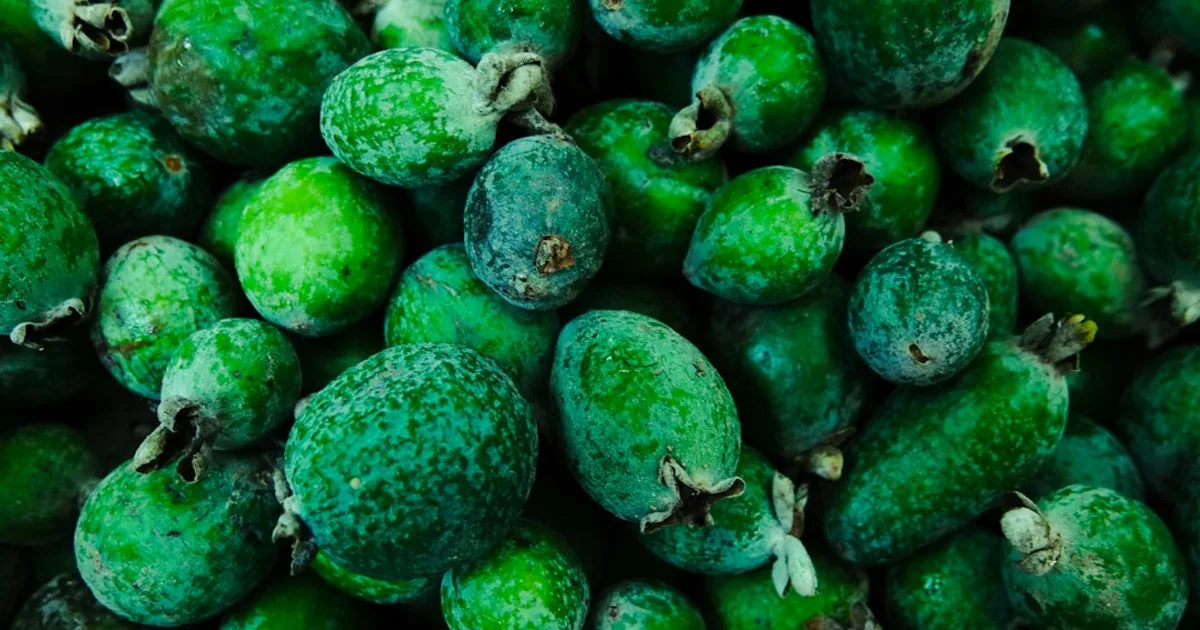
Feijoa (pronounced fay-JO-ah, though feh-JOA works too) is one of the few subtropical fruits that grows reliably in Zone 8-9 and occasionally Zone 7b with protection. The fruit has a flavor that doesn’t map neatly onto anything familiar - somewhere between pineapple, guava, and fresh mint, with a grainy tropical flesh and skin so aromatic it scents a room. In New Zealand and South America, where it grows broadly, it’s a staple fall fruit. In the US, it’s largely unknown except in coastal California and parts of the Pacific Northwest, where it sells for $5-10/lb at specialty stores when you can find it at all.
A mature feijoa shrub produces 15-30 lb of fruit annually in a climate it likes. It requires minimal pest management, tolerates drought once established, and even the petals of the flowers are edible - thick, sweet, and good to eat directly off the shrub when they fall. It is, in short, an underplanted, underappreciated shrub for warm-climate gardens.
What It Actually Is
Acca sellowiana (also classified as Feijoa sellowiana in older literature) is an evergreen shrub or small tree in the myrtle family (Myrtaceae), native to subtropical South America - specifically the highlands of southern Brazil, Uruguay, northern Argentina, and Colombia. It grows 10-15 feet as an unpruned shrub; it can be trained to a single-trunk small tree, maintained as a 6-8 foot hedge, or espalier-trained against a warm wall.
The flowers appear in spring and are ornamental: 1-inch wide, with white petals and a dramatic spray of red stamens. The white petals are sweet and edible - drop them into a fruit salad or just eat them off the plant. They taste of tropical fruit with a faint rose note. Cross-pollination is done by bees drawn to the anthers; in low-bee gardens, hand-pollination with a small brush or shaking branches during bloom improves fruit set.
Cultivars for home gardens:
| Variety | Fruit size | Flavor | Self-fruitful | Notes |
|---|---|---|---|---|
| Coolidge | Large | Rich, aromatic | Yes | Most widely planted; best single-shrub choice |
| Unique | Medium | Good | Yes | Self-fruitful; compact growth |
| Mammoth | Very large | Good | No | Largest fruit; needs cross-pollinator |
| Nazemetz | Large | Very good | No | High yield; popular in California |
| Pineapple Gem | Medium | Excellent, complex | No | Very good flavor; needs cross-pollinator |
| Apollo | Large | Sweet, rich | No | New Zealand selection; high-yielding |
For a single-shrub planting, ‘Coolidge’ or ‘Unique’ are the only reliable choices. For maximum yield and fruit size, plant two compatible varieties - ‘Coolidge’ + ‘Nazemetz’ or ‘Mammoth’ + ‘Coolidge’ are effective pairs. Cross-pollination increases yield in all varieties, including those listed as self-fruitful.
The ROI Case
Feijoa is a long-investment crop. Expect no fruit in years 1-2 and modest fruit in year 3. By year 5, a well-sited shrub should be producing 15-20 lb annually. Shrubs are long-lived - 20-30+ years of productive life is normal.
Specialty market pricing: $5-10/lb where available (specialty and Latin market retail; USDA AMS does not maintain a price series for this crop). Commercial availability is thin in most US regions outside California, Hawaii, and parts of the Pacific Northwest.
| Year | Yield estimate | Value @$6/lb | Shrub cost | Cumulative net |
|---|---|---|---|---|
| 1 | 0 | $0 | -$24.99 | -$24.99 |
| 2 | 0 | $0 | - | -$24.99 |
| 3 | 3 lb | $18 | - | -$6.99 |
| 4 | 8 lb | $48 | - | $41.01 |
| 5 | 15 lb | $90 | - | $131.01 |
| 7 | 20 lb | $120 | - | $311.01 |
| 10 | 25 lb | $150 | - | $611.01 |
A two-variety planting doubles the shrub cost but improves total yield, so net ROI tends to be better than single-variety planting after year 5.
Zone Fit
Zones 9-11: feijoa’s native range analog. Grow as a permanent landscape shrub; productive for decades. In Zone 9 coastal California, established plantings are largely self-maintaining. In Zone 10-11, summer heat may reduce flowering; coastal or high-elevation sites within those zones are more productive than inland heat zones.
Zones 8-9: the practical sweet spot for most US growers. Reliable outdoor production with minimal cold protection. Established shrubs handle brief dips to 15°F (-9°C) without lasting damage. Zone 8 winters can kill young plants in a severe cold event - plant in spring to allow maximum establishment before first winter.
Zone 7b: marginal but possible in sheltered microclimates. A south-facing wall exposure, urban heat island, or protected courtyard can push the effective zone one step warmer. The main risk isn’t winter kill on an established plant - it’s late spring frosts during the long fruit development window. Fruit that sets in spring can be killed by a late frost in April-May. Most Zone 7b attempts succeed some years and lose the fruit crop to frost other years; it’s not a reliable production zone.
Zone 7a and colder: not suitable for outdoor production. Feijoa can be grown in large containers (25-gallon minimum) moved indoors in winter, but the management overhead is high and yields are reduced compared to in-ground Zone 8+ plantings.
Heat sensitivity: feijoa tolerates heat but fruit quality is best in mild, maritime climates. The Pacific Coast of California and the Pacific Northwest in Zone 8-9 are ideal. Inland Zone 9 (Central Valley, interior Arizona) with sustained summer temperatures above 100°F produces lower-quality fruit and can cause sunscald on developing fruit. Afternoon shade or whitewashing the trunk reduces heat damage in hot inland sites.
Propagation
From cuttings: feijoa propagates from semi-hardwood cuttings taken in late summer (August-September). Take 4-6 inch cuttings from current-season growth, wound the base, dip in rooting hormone (IBA 3,000-8,000 ppm), and plant in well-draining perlite or coarse sand. Maintain at 65-70°F with bottom heat; roots form in 6-10 weeks. Cutting propagation is the standard commercial method and preserves variety identity.
From seed: feijoa seeds from ripe fruit germinate readily in warm soil (70-75°F). Seedlings grow slowly and begin fruiting in 4-7 years, versus 3-4 for cuttings-grown plants. Seedlings are genetically variable - you don’t know what flavor or productivity you’ll get. Named varieties should always be propagated from cuttings.
Grafting: occasionally used to propagate named varieties onto more vigorous rootstocks, but cuttings are more practical for home gardeners.
Growing Requirements
Cold hardiness: established shrubs survive brief frosts to 15°F (-9°C); some sources document survival to 10°F with protection (Gilman & Watson, Feijoa sellowiana Fact Sheet, University of Florida IFAS, 2014). Young plants under two years old are less cold-hardy than established shrubs; protect the first two winters in Zone 8 with frost cloth on forecast freeze nights. The fruit itself is damaged at temperatures below 28°F during the harvest window.
Soil: adaptable. Tolerates pH 6.0-7.5, clay-loam to sandy loam, and relatively poor soils. Requires adequate drainage - standing water causes root rot. Feijoa is notably tolerant of salt spray and alkaline conditions, making it useful in coastal and arid-soil gardens where many other fruit crops fail.
Water: moderate during establishment (first 2-3 years), drought-tolerant once established. In its native range it grows in regions with distinct dry seasons. Irrigation through dry summers improves fruit size and yield in the US; drought-stressed trees produce smaller fruit. Drip irrigation at the root zone is more effective than overhead watering.
Light: 6+ hours of direct sun for adequate fruiting. In hotter climates, afternoon shade extends from beneficial to necessary. In cloudy coastal climates, maximize sun exposure for best yield.
Pruning: minimal for productivity. Feijoa produces fruit on new growth and on older wood. Annual light pruning after harvest to maintain shape and air circulation is sufficient. If grown as a hedge, it tolerates hard pruning (to 4-6 feet) after harvest in late winter. Heavy pruning reduces fruiting for one season.
Pollination: see cultivar table above. Cross-pollination with a different variety improves yield in all varieties, including self-fruitful ones. Plant compatible varieties within 10-15 feet of each other.
What Goes Wrong
Premature fruit drop vs. ripe drop: feijoa signals ripeness by falling, which makes premature drop confusing. To distinguish: taste-test dropped fruit. Ripe fruit is fully aromatic and sweet inside with pale cream-to-yellow flesh. Premature drop (caused by drought stress, waterlogged roots, nutrient deficiency, or irregular watering) produces fruit that is white and starchy inside with little flavor development. Consistent irrigation during fruit development prevents most premature drop.
Internal browning (brown center): calcium deficiency or temperature fluctuations during fruit development. Apply gypsum (calcium sulfate) to the root zone in early spring - 1-2 lb per shrub for established plants. Consistent soil moisture helps calcium uptake.
Scale insects: Coccus hesperidum (soft brown scale) and related species occasionally colonize stems and leaf undersides. Pest pressure is generally low. Apply horticultural oil spray (1-2% dilution) in late winter while the plant is dormant; insecticidal soap during the growing season for active infestations. Do not spray during bloom - feijoa pollinators are essential to fruit set.
Failure to fruit in cold-limit zones: Zone 7b plantings may flower successfully but lose developing fruit to late spring frosts. A single late frost in April or May kills the tiny developing fruit, which won’t be replaced that season. Frost cloth over the shrub on forecast frost nights during fruit development is the management tool; a well-chosen sheltered site is the longer-term solution.
No fruit from incompatible single-variety planting: several varieties (Mammoth, Nazemetz, Apollo, Pineapple Gem) do not reliably self-pollinate. A single shrub of one of these varieties may flower abundantly and produce little or no fruit. Verify variety self-fruitfulness before purchasing; add a cross-pollinator if needed.
Harvest
Feijoa tells you when it’s ready. Ripe fruit falls from the shrub on its own. The standard harvest method is to check daily during the 3-6 week harvest window (October-December in most US growing zones) and collect fallen fruit from the ground. Placing netting or a tarp under the shrub simplifies collection and prevents the fruit from bruising on hard ground.
If you want to pick rather than collect drops: hold a fruit and apply gentle pressure. Ripe fruit gives slightly to the squeeze - the interior has softened. Unripe fruit is rock-hard. Alternatively, gently shake individual branches; ripe fruit releases with minimal effort.
At commercial scale in New Zealand, harvest is done by laying catch nets under the trees and shaking branches at intervals. This same method scales to backyard production with a bedsheet.
Shelf life is short. Fresh feijoa lasts 3-5 days at room temperature and 1-2 weeks refrigerated. This is the most important practical fact about the crop. A mature shrub can drop 3-5 lb per day during peak harvest - you need a preservation plan before the fruit comes in, not during.
Eating: slice in half lengthwise and scoop out the flesh with a spoon. The skin is edible but slightly bitter and astringent in most varieties; most people scoop and discard the skin. The interior flesh is slightly grainy (like a ripe pear), aromatic, and sweet-tart.
The flowers: the thick white petals of feijoa flowers are edible and good - sweet, with tropical fruit flavor. Pull individual petals off and eat them fresh off the plant during bloom. Don’t spray during flowering if you plan to eat the petals or maintain pollinator activity.
Preservation
Fresh: 3-5 days at room temperature; up to 2 weeks refrigerated. Refrigerate promptly from a large daily drop - room-temperature feijoa ripens quickly and passes its peak in 3-4 days. The skin turns soft and slightly brown when overripe; the flesh becomes mealy rather than grainy. Refrigerating at 40°F extends the window but doesn’t eliminate the urgency.
Frozen pulp: the most practical method for large surpluses. Scoop the flesh from the skin, place in airtight containers or freezer bags, and freeze immediately. Frozen feijoa pulp keeps 10-12 months and retains flavor well for cooked applications - jam, crumble, smoothies, chutney, sauce. The texture softens after freezing, so it’s not suitable for fresh-eating applications after thawing. The flavor, however, holds well because feijoa’s aromatic compounds are stable enough to survive freezing (unlike delicate herbs that go flavorless).
Freeze in meal-sized portions (1-2 cups) for flexibility. Label with the date - feijoa pulp doesn’t look descriptive frozen.
Jam and preserves: the best single outlet for high-volume harvests. Feijoa jam cooks like guava: the pectin content is moderate, so added commercial pectin shortens cooking time and produces a more reliable set. Basic ratio: 4 cups feijoa pulp, 2.5-3 cups sugar, 2 tablespoons lemon juice, 1 packet pectin. Process in a water bath canner per standard guidelines (USDA NCHFP, Complete Guide to Home Canning, 2015, Guide 7). Finished jam shelf life: 12-18 months.
Chutney: feijoa chutney processes and keeps like any vinegar-acidified fruit chutney. Combine feijoa pulp with ginger, onion, apple cider vinegar, brown sugar, and warm spices (cinnamon, clove, black pepper). Water-bath process for shelf stability. Keeps 1 year. The flavor pairs with aged cheese, pork, and game.
Dehydration: not well-suited. Feijoa’s aromatic compounds largely evaporate during drying; the result is sweet but loses the flavor complexity. Not recommended when freezing or preserves are an option.
Kitchen Applications
Feijoa’s primary application is fresh eating. The flavor is complex enough that the best way to understand it is to eat one - ripe, scooped from the skin with a spoon, within a day or two of falling from the tree.
Fresh eating: scoop flesh and eat directly. Slice into rounds and add to fruit salad. Dice and combine with berries; the tartness complements strawberry and blueberry. For a simple dessert, halve feijoas and serve with a spoon and a drizzle of honey.
Feijoa crumble: scoop flesh from 1-1.5 lb of fruit (about 15-20 small feijoas), toss with 3 tablespoons brown sugar and 1 tablespoon lemon juice. Top with a standard oat crumble (1 cup rolled oats, 1/2 cup flour, 1/3 cup cold butter, 1/3 cup brown sugar). Bake at 375°F for 25-30 minutes until bubbly and browned. Better than apple crumble. Serve warm with vanilla ice cream or unsweetened yogurt.
Feijoa jam: equal parts fruit pulp and sugar by weight, plus lemon juice. Simmer until the mixture reaches 220°F (gel point). The resulting jam has outstanding tropical fruit flavor - brighter and more complex than commercial guava jam.
Feijoa chutney: pulp combined with ginger, onion, apple cider vinegar, and brown sugar, reduced to chutney consistency. The tartness of feijoa translates better to savory-adjacent preparations than most sweet fruits; the flavor sharpens in the vinegar base. Excellent alongside aged cheddar, pork loin, or duck.
Feijoa smoothie: blend 1 cup feijoa pulp with 1/2 cup full-fat yogurt, 1 banana, and ice. The flavor holds well blended; the banana tempers the tartness without masking the feijoa character.
Feijoa cake: feijoa pulp replaces applesauce or bananas in quick breads and cakes. Substitute 1 cup feijoa pulp for 1 cup mashed banana in any banana bread recipe. The flavor is more tropical and less sweet than banana; reduce sugar by 20% to compensate for the tartness.
Related crops: Pomegranate - fellow subtropical fruit with Mediterranean-climate preference; Fig - drought-tolerant companion in warm-climate gardens; Loquat - similar climate range and ornamental-plus-edible value
Related reading: Fruit Tree Payback Timeline - how long-lived fruit plants amortize initial investment over decades
Growing Feijoa? Track your harvest value and break-even date in the Garden ROI app.
Get the App