
Loquat
Eriobotrya japonica
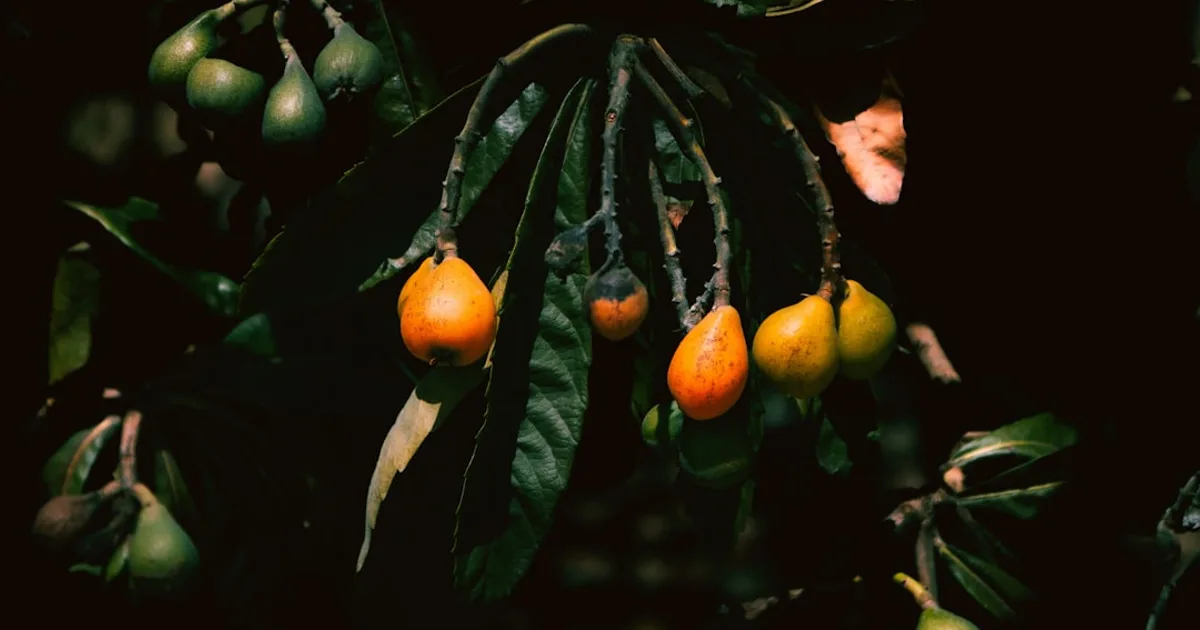
Loquat occupies a timing window no other fruit tree uses: late winter to early spring. While citrus is winding down and stone fruit trees haven’t bloomed yet, loquat fruits are ripening - clusters of small orange fruits that taste like a cross between apricot, peach, and mango, with a hint of floral bitterness. In zones 8-10, a mature loquat tree produces 20-50 lbs of fruit in February-April with essentially no competition from anything else in the orchard.
At Asian and Latin American markets, fresh loquats sell for $4-8/lb when you can find them. Most Americans have never tasted a fresh loquat, which reflects their near-total absence from mainstream supermarkets - the fruit bruises easily, has a 2-week shelf life at room temperature, and doesn’t ship commercially. The only way to eat them fresh with any regularity is to grow them.
What it actually is
Eriobotrya japonica is in the rose family (Rosaceae), native to southeastern China, and has been cultivated in Japan for over 1,000 years. Despite the common name, it’s not related to the kumquat. The tree grows 10-25 feet tall as an open-branching evergreen with large, deeply veined leaves that are dark green above and rusty-woolly underneath. It produces flowers in fall and early winter - unusual timing that means it’s often in bloom during the holiday season, with flowers that smell like almonds and honey.
Fruits are oval to pear-shaped, 1-2 inches long, in clusters of 5-20. Skin is pale yellow to deep orange depending on variety and ripeness; flesh is white to orange, sweet-tart with 1-5 large brown seeds that make up a significant portion of the fruit by weight.
Two type groups dominate home production:
| Group | Flesh color | Flavor profile | Examples | Best use |
|---|---|---|---|---|
| Japanese | White | Mild, sweet, delicate | Champagne, Vista White, Big Jim | Fresh eating |
| Chinese | Orange | Rich, more tart, aromatic | Advance, Early Red, Gold Nugget | Preserves, fresh eating |
Champagne (white-fleshed) is the most commonly available variety in the US and is excellent for fresh eating - mild enough that the flavor doesn’t overwhelm. Advance (orange-fleshed) has more complex flavor and higher natural pectin content, making it the better jam and jelly choice. Big Jim is one of the largest-fruited varieties, producing fruits up to 2.5 inches long with a higher flesh-to-seed ratio than most - the practical advantage being less seeding labor per pound of edible yield. Gold Nugget is a California-bred orange-fleshed variety with good sweetness and strong production in zone 9-10. All four are self-fruitful.
A note on seed sources: nurseries sell both named grafted trees and seedling trees. The distinction matters. A grafted ‘Champagne’ or ‘Big Jim’ will fruit in 2-3 years, produce fruit true to the variety’s flavor and size, and reach full production by year 5-7. A seedling tree - often sold more cheaply with no variety name - will take 8-10 years to fruit and produce fruit of unknown quality. For a backyard planting where you’re committing decades of space to a single tree, buy the grafted named variety. The $5-10 premium over a seedling is trivial against a decade of earlier production.
The ROI case
Loquat takes 3-5 years from nursery planting to reach real production. A mature tree in a good site is one of the most productive subtropical fruit trees per square foot.
| Year | Yield | Value @$5/lb | Tree cost | Cumulative net |
|---|---|---|---|---|
| 1-2 | 0 | $0 | -$19.99 | -$19.99 |
| 3 | 3-5 lb | $15-25 | - | -$4.99 to $5.01 |
| 4 | 10-20 lb | $50-100 | - | $45.01-$100.01 |
| 5 | 20-35 lb | $100-175 | - | $145.01-$275.01 |
| 7 | 35-50 lb | $175-250 | - | $320.01-$525.01 |
Winter scarcity premium: loquats ripen when fresh local produce options are limited. At farmers markets in February-March, the premium over summer stone fruit is real - $6-10/lb is realistic for quality fresh loquat where no one else is selling them.
Jam and jelly: loquat jam is uncommon enough that it commands $8-15 per jar at markets. The fruit has good natural pectin content and makes a clear, amber-colored jam with an apricot-adjacent flavor.
Growing requirements
Climate: loquat is evergreen and reliably cold-hardy to about 12°F (-11°C) for mature trees. Flowers and developing fruit are damaged at 26-28°F. Zone 8 trees will fruit in most years but lose the crop to late frost in cold winters. Zone 9-10 is the reliable production zone. In borderline zones, plant in a protected south-facing location or against a south-facing wall.
Size management: left unpruned, loquat reaches 20-25 feet and becomes difficult to harvest. Annual pruning after harvest, removing 20-30% of the canopy, keeps trees at 8-12 feet and improves harvestability. Thinning fruit clusters to 3-4 fruits per cluster also increases individual fruit size.
Fruit thinning: loquat sets fruit in large clusters, often more than the branch can properly size. Thin to 4-6 fruits per cluster when fruits are marble-sized. This improves fruit size and reduces branch breakage under crop load.
Soil: highly adaptable. Tolerates a wide pH range (5.5-7.5), moderate clay, and poor drainage better than most fruit trees. Best production in well-drained loam. Doesn’t require annual fertilization in most soils - overfertilizing with nitrogen promotes vegetative growth at the expense of fruit production.
Pollination: loquat is generally self-fruitful. A single tree produces a crop. Cross-pollination can increase yield slightly.
What goes wrong
Fire blight (Erwinia amylovora): the same bacterial disease that affects apple and pear strikes loquat, causing shoot tips to blacken and die in a characteristic “shepherd’s crook” shape. Spreads in wet spring weather. Prune affected shoots 12 inches below visible infection; sterilize pruning tools between cuts with 10% bleach solution. Copper-based bactericides applied at early bloom help prevent infection.
Fruit fly: in zones where Mediterranean fruit fly (Ceratitis capitata) or oriental fruit fly (Bactrocera dorsalis) is present, loquat is a preferred host. Protein bait traps, kaolin clay, or exclusion netting over developing fruit clusters.
Frost damage to flowers: loquat blooms in November-January, when frosts are possible in zones 8-9. A single hard freeze during bloom eliminates the year’s crop. In marginal zones, cover small trees with frost cloth on nights below 28°F during bloom.
Sunburn: in hot inland areas (California Central Valley, Arizona), loquat leaves and fruit can sunburn in summer. Whitewash the trunk, provide afternoon shade, or choose a protected site.
Harvest and use
Loquats are ripe when fully colored (yellow to orange depending on variety), yield slightly to gentle pressure, and detach easily from the cluster. They don’t ripen after picking - pick fully ripe. Taste-test a fruit before harvesting the whole cluster.
Handle carefully - the skin bruises easily. Store at room temperature for up to 2 weeks; refrigeration extends this to 4-6 weeks but dulls flavor.
Preparation: peel the thin skin (comes off easily when ripe), cut in half, remove the seeds (1-5 per fruit), and eat fresh. The seed cavity is large relative to the fruit; expect 50-60% edible yield by weight after seeding.
Seed toxicity: loquat seeds contain amygdalin, a cyanogenic glycoside present in the seeds of most rose family fruits - apple seeds, cherry pits, apricot pits, and peach pits all contain it too. When chewed or crushed, amygdalin breaks down to release hydrogen cyanide. The seed-to-flesh ratio in loquat is high enough that this is worth being explicit about: discard the seeds entirely. Don’t chew them out of curiosity. Don’t feed them to children who might mistake them for something edible. The flesh is completely safe; the seeds are not food.
Core preparations:
-
Fresh eating: the primary use. Ripe loquats need nothing. The flavor - sweet-tart, apricot-peach adjacent with a floral note - is best understood fresh. Cut in half and remove seeds; no peeling required if you don’t mind the slight tannic quality of the skin.
-
Loquat jam: halved and seeded loquats cooked down with sugar (1:1 by weight) and lemon juice. The natural pectin content produces a set without added pectin if you cook it down sufficiently. Color varies from pale gold to deep amber. Excellent on toast; good with blue cheese and soft cheeses.
-
Loquat syrup: simmer halved loquats in simple syrup (equal parts sugar and water) for 15-20 minutes, strain. The resulting syrup has the fruit’s floral quality and can be used in cocktails, over ice cream, or stirred into sparkling water.
-
Sorbet: pureed loquat flesh (seeded, peeled for smoothest texture) frozen with simple syrup. The flavor holds well in frozen form; the slight tartness is amplified by cold, which makes it more interesting than the fresh fruit alone.
-
Japanese preserved loquat (biwa no kanroni): the Japanese preparation - loquats poached in sugar syrup with sake and salt until translucent. A traditional Japanese confection that extends the short harvest window.
The Off-Season Advantage at Market
Loquat’s February-April harvest window is its strongest commercial argument. At farmers markets during those months, the competition is almost entirely stored root vegetables, greenhouse greens, and citrus. Fresh tree fruit is nonexistent except in the warmest zones. A loquat grower showing up with a flat of ripe fruit in late February is selling something no one else has.
This timing advantage doesn’t happen by accident - it’s a function of the tree’s unusual phenology. Loquat flowers in November-December, when most other fruit trees are fully dormant. That November bloom means February fruit. Any grower who understands this can plan around it: hold back a portion of the crop from the first ripening branches, keep harvesting as more clusters ripen through March, and you have 6-8 weeks of market presence with essentially no local competition.
Fresh loquat at farmers markets in zones 8-10 sells for $3-6/lb when available and often higher. The reason prices can hold at the top of that range is simple supply scarcity: the fruit doesn’t exist in supermarkets, almost no one is selling it locally, and buyers who know the fruit will pay for it. Buyers who don’t know it will try it at a sample price and often buy a full flat. The barrier isn’t finding customers - it’s having enough fruit. A single mature loquat at 30-40 lb production generates $150-240 at $5/lb, from one tree in a season that runs 6-8 weeks.
Processing for extended market presence: fresh loquats have a 2-week room-temperature shelf life, which limits how long you can hold inventory. Converting surplus into jam, jelly, or syrup extends the earning window well past the fresh harvest. Loquat jam is uncommon enough that it commands premium pricing - $10-15 per 8 oz jar at specialty markets and farmers market stands. A 10 lb surplus run of loquat jam (after accounting for the seeding labor and the 50-60% edible yield) might yield 12-15 jars, representing $120-225 in product from fruit that would otherwise rot before it could be sold. Loquat syrup in small bottles ($8-12 per 8 oz bottle) is a faster processing path than jam: no canning required, just refrigerate and sell fresh or frozen.
Related reading: Apricot - the closest flavor parallel among stone fruits; Feijoa - fellow subtropical fruit with cult following
Growing Loquat? Track your harvest value and break-even date in the Garden ROI app.
Get the App