
Fenugreek
Trigonella foenum-graecum
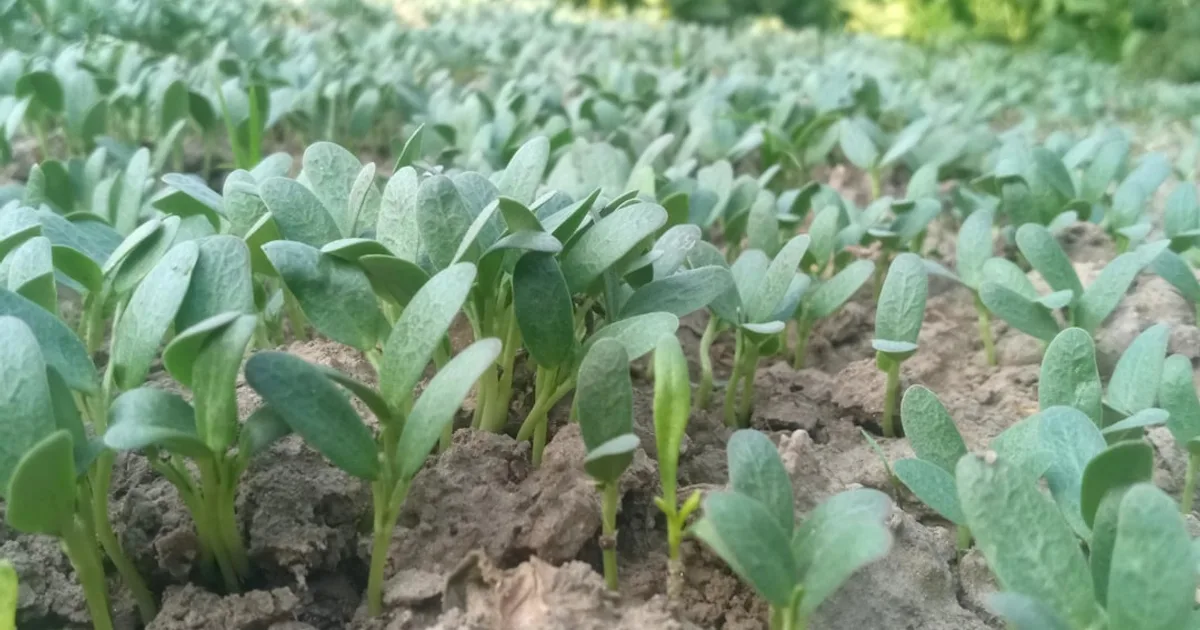
The fenugreek seeds in your spice cabinet are the same seeds you plant in the garden. Buy a $3 jar of fenugreek at any Indian grocery, plant half of it, and in 30 days you’re harvesting fresh methi leaves worth $4-6 per pound at farmers markets (USDA AMS Specialty Crop Market News, 2023). Wait another 15 days and you get seeds. It’s a fast, nitrogen-fixing legume that gives you two harvests and improves the soil it grows in.
What it actually is
Fenugreek (Trigonella foenum-graecum) is a legume in the family Fabaceae, native to the Mediterranean and western Asia. It’s been cultivated for at least 4,000 years - seeds have been found in Egyptian archaeological sites. The plant grows 18-24 inches tall with clover-like trifoliate leaves, small white flowers, and elongated seed pods containing 10-20 hard, yellow-brown seeds.
The leaves (called methi in South Asian cooking) have a flavor that’s bitter, slightly maple-like, and distinctive. The characteristic maple-curry flavor comes from sotolone, a lactone compound that’s also responsible for the maple note in aged fenugreek-spiked cheeses and, at low concentrations, in maple syrup itself. That same compound is present in both the fresh leaf and the dried seed, though the proportions differ between them.
Both leaf and seed are distinctly flavored and not interchangeable with each other or with other herbs. If you cook Indian food and have ever struggled to find fresh methi, you already understand the value here.
The ROI case
This is where fenugreek gets interesting, because you have three distinct strategies from the same packet of seed.
Strategy 1: Leaf harvest only. Fenugreek matures fast - 30-40 days to harvestable greens. Three successions over a season, each from the same small bed, produce about 0.4 lb of fresh methi leaves per harvest. At $6/lb retail (USDA AMS, 2023): 1.2 lb total leaf yield, $7.20 in value.
Strategy 2: Seed harvest only. Plant once, let the crop go to seed. Four square feet produces about 0.5 lb of dried seeds at 60-70 days. Bulk fenugreek seed at Indian groceries runs $8-12/lb. Call it $8: $4.00 in value.
Strategy 3: Leaf plus seed. Make two leaf cuts, then let the plants go to seed for a final seed harvest. You get about 0.8 lb of leaf yield from the two cuts plus 0.3 lb of dried seeds.
| Strategy | Leaf yield | Leaf value | Seed yield | Seed value | Total |
|---|---|---|---|---|---|
| Leaf harvest only (3 successions) | 1.2 lb | $7.20 | - | - | $7.20 |
| Seed harvest only (1 crop) | - | - | 0.5 lb | $4.00 | $4.00 |
| Leaf + seed (2 cuts then seed) | 0.8 lb | $4.80 | 0.3 lb | $2.40 | $7.20 |
All three strategies run from a single $2.49 packet - or less, because the grocery store seed hack changes the math entirely.
The grocery store seed hack
Fenugreek seeds at Indian and Middle Eastern grocery stores sell for $2-4 per 8 oz bag. That’s the same price as a garden seed packet, but you get four to eight times the seed volume. The seeds are identical to planting seeds - fenugreek is fenugreek, and the culinary-grade whole seeds in the spice aisle germinate just as well as anything in a garden catalog.
Buy organic or verify the seeds are whole and untreated before planting. Most culinary fenugreek is sold as-is with no coating or fungicide treatment - just the raw seed. If the bag says “whole fenugreek seeds” and lists fenugreek as the only ingredient, you’re good.
This is one of the few crops where the spice aisle functions as the seed source. The $2.49 seed packet is optional.
South Asian culinary context
Fresh methi (fenugreek leaves) is a foundational ingredient in Indian cooking, not a specialty item. Three dishes that show up regularly in home cooking across the subcontinent:
Aloo methi - potatoes sautéed with fresh methi leaves, cumin, garlic, and spices. One of the most common everyday dishes in North Indian home cooking. The fresh leaves go in at the end of cooking. The bitterness softens against the starch of the potato. If you grow fenugreek and cook Indian food, this is where most of your leaf harvest goes.
Methi paratha - fresh methi leaves chopped and worked directly into whole wheat flatbread dough before rolling and cooking on a dry griddle. The leaves wilt and distribute through the bread. It’s a standard winter breakfast in Punjabi households and requires a substantial amount of fresh leaf per batch.
Dal methi - any lentil preparation (dal) finished with fresh methi leaves added in the last 5 minutes of cooking. The leaves wilt but retain some texture and the bitterness rounds out the richness of the dal.
Dried fenugreek leaves - called kasuri methi or kasoori methi - are used differently. They’re crumbled and sprinkled onto dishes at the end of cooking: butter chicken, paneer makhani, rajma. The drying concentrates the sotolone compounds and creates a slightly different flavor profile than fresh - more intensely aromatic, less bitter. At Indian grocery stores, dried kasuri methi sells for $3-6 per oz, or roughly $48-96 per pound (USDA AMS Specialty Crop Market News, 2023).
That price is why the kasoori methi production angle is worth understanding.
Kasoori methi: the high-value dried leaf
The retail price of dried kasuri methi - $48-96/lb - reflects how labor-intensive commercial production is, how small the crop is at industrial scale, and how concentrated demand is in specific communities. For a home grower, that price gap is an opportunity.
Harvest your second and third leaf cuts, strip the leaves from the stems, and spread them in a single layer on a clean surface or screen. Air-dry for 4-5 days in a warm spot with good air circulation. The leaves shrink sharply - fresh-to-dried ratio is roughly 8:1 by weight. Crumble the dried leaves and store in an airtight glass jar.
The yield math: 0.5 lb of fresh methi leaves produces about 1 oz of dried kasuri methi. At $4/oz retail, that’s $4 in value from a single cutting of a modest planting. Over a season of successions, a dedicated 4 sq ft bed of fenugreek can realistically produce 3-4 oz of dried kasuri methi worth $12-16 at grocery store prices.
Store dried kasuri methi in glass, away from light. It holds flavor for 6-12 months before the aromatics start to fade.
Succession table for continuous leaf harvest
Fenugreek goes from seed to harvest in 30-40 days - fast enough to run multiple successions in the spring and fall windows before heat pushes the plants to bolt. In Zone 5-6, the spring window for leaf harvest runs roughly April 1 through June 1 before summer heat arrives.
Each sowing uses about 2 sq ft and roughly $0.20 in seed at grocery-store bulk prices. Expect 0.3-0.4 lb of fresh leaves per sowing from that area.
| Sow date | Harvest date | Yield (fresh leaf) | Value at $6/lb |
|---|---|---|---|
| Apr 1 | May 1-10 | 0.35 lb | $2.10 |
| Apr 15 | May 15-25 | 0.35 lb | $2.10 |
| May 1 | Jun 1-10 | 0.35 lb | $2.10 |
| May 15 | Jun 15-25 | 0.30 lb | $1.80 |
Four sowings, 8 sq ft total, $0.80 in seed cost from bulk: approximately 1.35 lb of fresh methi leaf, $8.10 in value. The late May sowing often yields less because the plants are moving toward bolt faster as days lengthen and temperatures climb.
A fall succession in Zone 5-6 is workable if you start in late August and get the harvest in before first frost - fenugreek can handle light frost but not a hard freeze.
Growing requirements
Direct sow seeds 0.5 inch deep, 2-3 inch spacing, as soon as soil temperature reaches 55°F. Fenugreek does not transplant well due to its taproot. Germination occurs in 3-5 days at 65-75°F.
Soil pH of 6.0-7.0. Fenugreek is not demanding about soil fertility - it manufactures its own nitrogen through legume nodulation. High nitrogen fertilization suppresses nodulation and reduces the nitrogen-fixing benefit. Plant in average, well-drained garden soil without supplemental nitrogen.
Full sun (6+ hours). Fenugreek tolerates brief drought once established but produces the most tender leaves under consistent moisture. Dry conditions accelerate seed development at the expense of leaf quality - if you’re growing for leaves, keep the moisture consistent.
Cover crop rotation value
Fenugreek fixes atmospheric nitrogen through root nodules (Rhizobium symbiosis), adding 50-100 lbs of nitrogen per acre equivalent to the soil profile at end of season (SARE, Sustainable Agriculture Research and Education Cover Crop Reports, 2021). Scaled to a home garden 4x8 bed (32 sq ft, or 0.000073 acres), that math produces roughly 0.004-0.007 lbs of nitrogen added - call it $0.005-0.01 of fertilizer value at $0.50/lb N.
The nitrogen numbers at home garden scale are trivial in dollar terms. The real soil benefit is organic matter: when you till the root mass and stems into the bed after harvest, you’re adding biomass that feeds soil biology and improves structure over a season. Following fenugreek with a heavy-feeding brassica or allium crop is sound rotation practice even if the N numbers don’t move the needle on your fertilizer budget.
What goes wrong
Powdery mildew (Erysiphe polygoni) is common on fenugreek in humid conditions, particularly on older plants. Harvest leaves early in the season before mildew establishes, or make successive short-cycle plantings rather than maintaining individual plants for extended periods.
Root rot in poorly drained soil kills plants quickly. Fenugreek’s taproot is particularly sensitive to waterlogging. Ensure drainage.
Aphids colonize fenugreek’s tender growing tips. Beneficial insects usually manage light infestations; insecticidal soap for heavy ones.
Pod shattering at seed harvest: fenugreek seed pods dry and open explosively when fully ripe. Monitor seed pods closely - harvest entire plants when pods are fully tan and dried but before they begin to open. Thresh immediately after cutting by spreading the plants on a tarp and walking on them, or beating them against the inside of a container.
Harvest and storage
For leaf harvest (methi): cut stems 2-3 inches above ground when plants are 8-10 inches tall, typically 25-35 days after germination. Plants regrow for a second cutting. Use immediately, refrigerate for 4-5 days, or dry for kasuri methi as described above.
For seed harvest: let the plant continue growing after your final leaf cut. Pods form 45-60 days from planting. Harvest when pods are fully brown and dry. Shell seeds by hand or thresh. Store dried seeds in glass jars - they remain viable for planting and cooking for 2-3 years.
The dual-use reality of this crop is what separates it from most herbs: the same plants that supply your kitchen also improve your soil and stock your spice shelf. The seed packet is optional. The grocery store seed hack applies from day one.
Related crops: Arugula, Spinach, Cilantro
Related reading: Cover Crops 101 - how nitrogen-fixing legumes like fenugreek fit into a garden rotation plan
Growing Fenugreek? Track your harvest value and break-even date in the Garden ROI app.
Get the App