
Kohlrabi
Brassica oleracea var. gongylodes
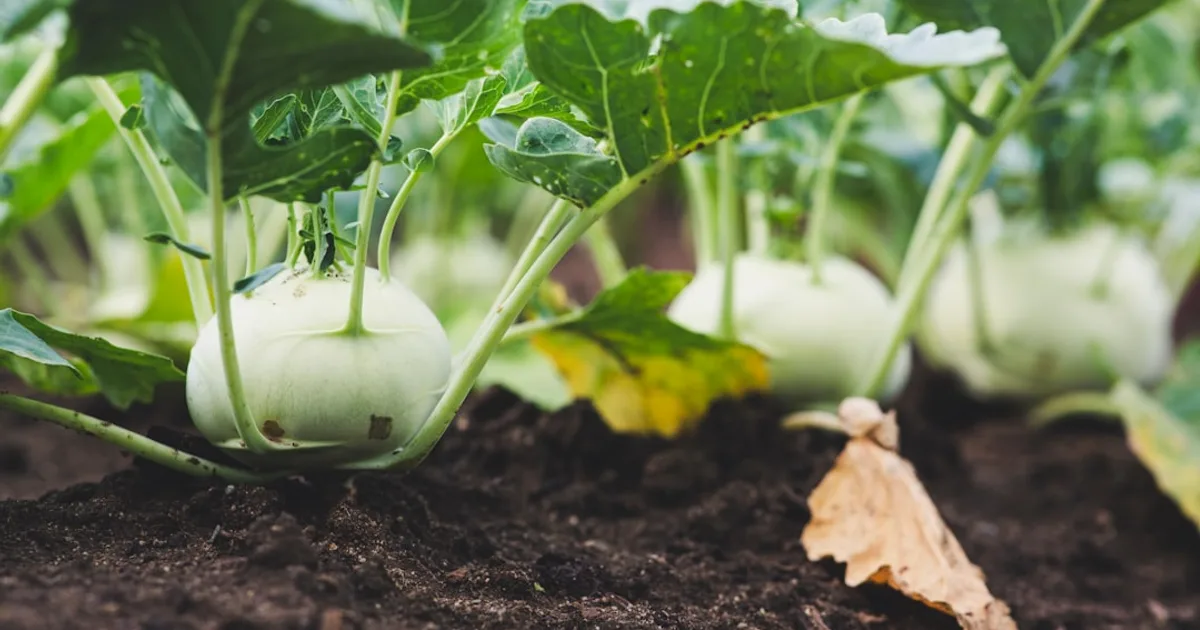
Kohlrabi (Brassica oleracea var. gongylodes) matures in 45–60 days - faster than any brassica except radish. It occupies a productive window in spring and fall when most summer crops can’t yet go in the ground, and it uses that window efficiently. Fresh kohlrabi at retail runs $2–$4/lb; at farmers markets, purple varieties and large specialty kohlrabi fetch $3–$5/lb (USDA AMS Market News, 2023).
What it actually is
Kohlrabi is not a root vegetable. The swollen structure you eat is a modified stem - the stem of the plant enlarged just above the soil line. This distinction matters for growing because it means compaction and rocky soil affect kohlrabi much less than they affect carrots or beets. The edible portion grows above ground.
Both the swollen stem and the leaves are edible. The leaves are nutritionally dense - similar in profile to kale, which is the same species - and can be cooked exactly like kale. Most gardeners eat the leaves as a bonus harvest while waiting for the bulb to size up.
Cultivar choices are limited but important:
| Cultivar | Type | Days to maturity | Harvest size | Skin color | Notes |
|---|---|---|---|---|---|
| White Vienna | Standard green | 45-50 days | 2-3 inches | Pale green | Mild flavor, widely available; harvest promptly to prevent woody texture |
| Green Vienna | Standard green | 50-55 days | 2-3 inches | Medium green | Very similar to White Vienna; slightly richer flavor |
| Purple Vienna | Purple-skin | 50-55 days | 2-3 inches | Purple (white flesh) | Same growing characteristics as Green Vienna; stronger farmers market appeal |
| Kossak | Large-bulb | 80 days | Up to 8-10 inches | Yellow-green | Stays tender at larger sizes; useful for gardeners who harvest infrequently |
| Gigante | Italian heirloom | 130+ days | 10+ inches | Yellow-green | Grown for late-season large harvest; can store into winter |
Data from University of Illinois Extension Watch Your Garden Grow: Kohlrabi (2020) and Johnny’s Selected Seeds variety trials. For most home garden use, White or Purple Vienna at 45-55 days is the practical choice. Purple commands $1/lb premium at farmers markets over standard green types (USDA AMS Specialty Crop Market News, 2023).
The ROI case
A $2.49 packet contains 200-300 seeds. Direct sow in a 10-foot row at 4 inches apart and you get 30 plants. At 0.5-1 lb per bulb (Penn State Extension, Kohlrabi, 2021), that’s 15-30 lb per 10-foot row. At $2.50/lb (USDA AMS Market News, 2023), that’s $37.50-$75 per 10-foot row from a $2.49 seed packet.
The real advantage is timing. You can run two kohlrabi crops in a season - one in spring (sow 6 weeks before last frost, harvest by early summer) and one in fall (sow 8 weeks before first frost, harvest after light frosts improve flavor). That doubles the value from the same bed footprint.
For a 4x8 bed at 4-inch spacing (96 planting positions), the two-season math looks like this:
| Season | Sow date (Zone 6) | Harvest window | Plants | Yield | Value at $2.50/lb |
|---|---|---|---|---|---|
| Spring | April 1-7 (6 weeks before May 15 last frost) | May 25-June 15 | 96 | 30-50 lb | $75-125 |
| Fall | August 10-15 (8 weeks before Oct 15 first frost) | Sept 25-Oct 15 | 96 | 30-50 lb | $75-125 |
| Full year | 60-100 lb | $150-250 |
Realistic home-garden yield is on the lower end of these ranges - 30-40 lb per planting rather than 50 lb - giving a practical annual bed value of $150-200. The seed packet at $2.49 seeds both crops. Penn State Extension yield range used for per-plant calculations; USDA AMS for pricing.
Kohlrabi vs other spring brassicas
For a gardener with a 4x8 bed to fill before summer, the spring brassica options are usually kohlrabi, broccoli, or cabbage. They occupy the same cool-season window but differ in value and timing:
| Crop | Days to harvest | Yield per 4x8 bed | Retail price | Bed value | Bed cleared by |
|---|---|---|---|---|---|
| Kohlrabi (Purple Vienna) | 50-55 days | 20-35 lb | $3.50/lb (purple) | $70-122 | Early June |
| Broccoli | 60-85 days | 8-12 lb (heads only) | $2.50/lb | $20-30 | Late June |
| Cabbage | 70-80 days | 15-20 lb | $0.75/lb | $11-15 | Late June |
Kohlrabi wins on two dimensions: value per pound ($2.50-3.50/lb vs $0.75/lb for cabbage) and speed of bed clearance. Getting the bed cleared by early June instead of late June gives you 4 extra weeks to get tomatoes, peppers, or cucumbers established. The faster turnover is often as valuable as the crop itself. USDA AMS pricing; Penn State Extension Kohlrabi for yield data.
Growing requirements
Kohlrabi is a cool-season crop. Seeds germinate at soil temperatures as low as 40°F and growth is best between 60–75°F (University of Illinois Extension, Watch Your Garden Grow: Kohlrabi, 2020). At temperatures consistently above 80°F, the bulb becomes tough and pithy and the plant may bolt. Time plantings to finish before summer heat arrives.
Direct seeding is preferred. Sow seeds 0.25 inch deep, spacing 1–2 inches apart, then thin to 4–6 inches when plants are 3–4 inches tall. Wider spacing (6 inches) produces larger bulbs; tighter spacing (4 inches) is acceptable if you prefer smaller, more tender kohlrabi.
Soil pH 6.0–6.8. Consistent moisture is critical to prevent woody development. The bulb becomes pithy and tough if the plant experiences water stress during development. Mulch 2 inches around plants to buffer soil moisture; kohlrabi doesn’t compete well with weeds, and cultivation near the shallow stem base can damage plants.
Side-dress with a balanced fertilizer 3 weeks after sowing. Kohlrabi is a light to moderate feeder - excess nitrogen encourages leafy growth at the expense of bulb development.
What goes wrong
Cabbage aphid (Brevicoryne brassicae) forms dense gray-green colonies on leaf undersides and inside forming bulbs. A hard blast of water disrupts colonies; insecticidal soap for persistent infestations. Aphid pressure in fall crops is often heavier than spring crops.
Imported cabbageworm (Pieris rapae) is the larva of the white cabbage butterfly. Pale green caterpillars feed on leaves; heavy infestations can defoliate small plants. Row cover is the cleanest preventive measure. Bacillus thuringiensis var. kurstaki (Bt) applied to foliage kills young larvae on contact.
Clubroot (Plasmodiophora brassicae) is a soilborne pathogen causing gall-like swellings on roots and wilted, yellow plants. Infected plants are stunted and produce poorly. Clubroot persists in soil for 20+ years. Do not plant brassicas in infected soil; raise soil pH to 7.0–7.2, which reduces but does not eliminate the pathogen. Purchase transplants from certified disease-free sources.
Splitting happens when the bulb grows too large - typically over 3 inches in diameter for standard varieties. The bulb also becomes woody. Harvest on time.
Harvest and storage
Harvest kohlrabi when the swollen stem is 2–3 inches in diameter for standard varieties. At this size the flesh is crisp, sweet, and tender. Let it go beyond 3 inches and the texture becomes woody and fibrous. The exception is large-bulb varieties like ‘Kossak,’ which are specifically bred to stay tender at larger sizes.
Cut at the soil line. Leaves and stem are both edible - store the leaves separately and use them within 2–3 days. The bulb keeps refrigerated for 2–3 weeks. For longer storage, peel, cube, and blanch 3 minutes before freezing.
Raw kohlrabi sliced thin is one of the better raw vegetable preparations in a brassica. The flavor is mild - somewhere between broccoli stem and apple. It doesn’t need cooking.
Culinary applications
Most gardeners who grow kohlrabi eat it one way: raw slices, maybe with salt. It’s good that way. It’s also underused.
Raw: peel the outer skin first - it’s tough and slightly fibrous regardless of size. The flesh beneath is crisp and mild, somewhere between a broccoli stem and an apple. Slice thin, eat plain or with a pinch of salt and lemon juice. This works as a snack, a crudité, or a component in a vegetable plate.
Kohlrabi slaw: julienne kohlrabi on a mandoline or with a sharp knife - about 2 cups per serving. Combine with julienned carrot (1/2 cup) and thin-sliced tart apple (1/4 cup). Dress with 2 tablespoons apple cider vinegar, 1 tablespoon olive oil, 1 teaspoon honey, salt. Rest 10 minutes. The kohlrabi stays crisper than cabbage and the texture holds for several hours without going soggy.
Roasted: quarter or halve the kohlrabi (halves for smaller bulbs, quarters for anything over 2 inches). Toss with olive oil, salt, and pepper. Roast at 400°F for 25-30 minutes until the cut surfaces are caramelized and tender throughout. The mild sweetness concentrates under heat. A squeeze of lemon after roasting brightens the dish. This works as a side vegetable in the same applications you’d use roasted turnip or parsnip.
The leaves: don’t discard them. Young, tender kohlrabi leaves are mild enough for salads; larger leaves can be sauteed in olive oil with garlic exactly as you’d cook kale or collard greens - they’re the same species. Strip the leaves from the stem, cut into 1-2 inch pieces, cook in oil over medium heat until wilted and slightly tender, 4-5 minutes. They cook down. If you’re harvesting regularly, the leaves represent roughly 30-40% of the plant’s total edible mass.
Storage: kohlrabi doesn’t store well once cut - it’s roughly 85% water and begins to desiccate within a day of being peeled or sliced. Store whole, unpeeled bulbs in the refrigerator for 2-3 weeks. For longer storage, peel, cube into 1-inch pieces, blanch 3 minutes in boiling water, cool in ice water, and freeze in bags. The texture softens in frozen applications but holds up well in soups or roasted preparations.
Related reading: Succession Planting Calendar - how to schedule spring and fall kohlrabi crops around your summer plantings
Growing Kohlrabi? Track your harvest value and break-even date in the Garden ROI app.
Get the App