
Mustard Greens
Brassica juncea
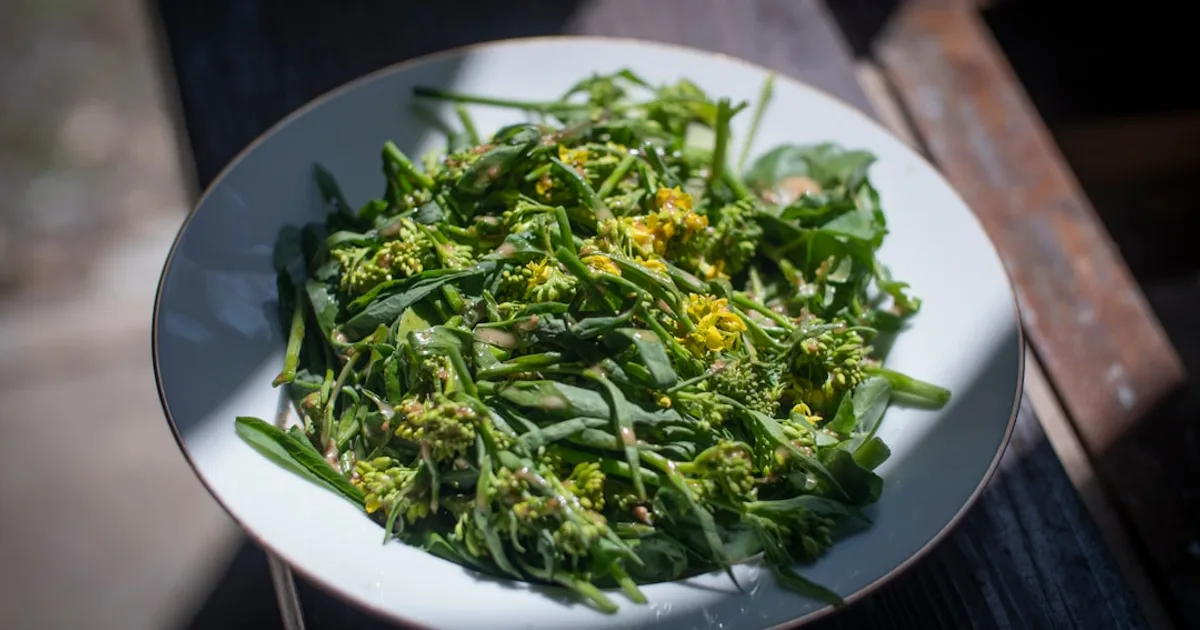
Mustard greens (Brassica juncea) are the fastest-returning leafy green you can plant after radish. From direct sowing to first cut, you’re looking at 35 days. The leaves are spicy - more so than arugula, less fire than raw horseradish - and that heat level is what divides gardeners on them. If you cook them, the sharpness mellows. If you eat them raw, young leaves under an inch are much milder than mature leaves, which is why baby mustard greens end up in spring salad mixes at specialty grocers.
B. juncea is also used as a cover crop and soil biofumigant - the glucosinolates in the plant’s tissue suppress certain soilborne pathogens and nematodes when the green matter is tilled in before it fully decomposes. This dual-use profile makes mustard greens one of the more practical plants you can put in your rotation.
What you’re actually growing
B. juncea is a distinct species from cabbage, kale, or broccoli (B. oleracea) and from turnip (B. rapa). It’s the source of most commercial mustard seed. The leaves range from flat to deeply crinkled, and color runs from bright green to red-purple depending on variety.
‘Southern Giant Curled’ is the traditional green type - large, crinkled leaves with moderate heat. ‘Red Giant’ has reddish-purple leaves with more pronounced heat and better heat tolerance before bolting than green types. ‘Mizuna’ is technically B. rapa var. nipposinica and a separate species; it’s sometimes grouped with mustard greens culinarily but is a distinct crop (see the mizuna entry). ‘Amara’ is an Ethiopian variety with very strong flavor, grown as both food and biofumigant.
Variety comparison
Not all mustard greens taste the same or behave the same in your garden. These are the five varieties worth growing for food:
| Variety | Leaf size/color | Heat level | Days to harvest | Notes |
|---|---|---|---|---|
| Giant Red | Large, burgundy-red | Hot - peppery | 45 days | Excellent heat tolerance before bolt; holds color after cooking |
| Southern Giant Curled | Large, bright green, crinkled | Moderate - mild heat | 40 days | Classic Southern variety; good for braising and fresh use |
| Tendergreen | Medium, smooth green | Mild | 30 days | Fastest to harvest; best for raw use and baby greens |
| Osaka Purple | Medium, purple-tinged | Moderate | 40 days | Ornamental quality plus fully edible; good in fall |
| Florida Broadleaf | Large, flat green | Mild-moderate | 40 days | Heat-tolerant; bred for fall planting in warm climates |
Tendergreen is the right choice if you want the most neutral flavor or if you’re selling baby greens. Giant Red and Southern Giant Curled hold up best in long braises. Florida Broadleaf is underrated for fall crops in zones 7 and above - it keeps producing later into the season than most.
The ROI case
A $1.99 packet of mustard greens seed plants a substantial row. At 3-inch spacing you get 80-100 plants per 25-foot row. Baby greens can be harvested as a cut-and-come-again crop at 35 days; full-size leaves by 45-50 days.
Here’s what the numbers look like on a 10 square foot planting:
- Seed cost: $1.99 packet (covers 10 sq ft with seed to spare)
- Expected yield: 4-6 lbs across 2-3 cuts from a 10 sq ft bed
- Retail value: USDA AMS Specialty Crop Market News reports bunched mustard greens at $2.50-$3.50/lb at farmers market and specialty retail (USDA AMS, 2023)
- Baby mustard greens at farmers markets: $5.00-$8.00/lb for specialty mix
- Full-season value from 10 sq ft: $12-$20 at retail pricing, $25-$40 if sold as baby greens
The cut-and-come-again characteristic is the real return mechanism. Cut leaves 1 inch above soil and the plant regrows. A well-managed planting yields 2-3 cuts before bolting, which means roughly 3x the yield per plant compared to a single-harvest crop.
The seed-to-value ratio here is hard to beat. Even at the conservative end - 4 lbs at $2.50/lb - you’re getting $10 return on a $1.99 investment from one 10 sq ft patch. That’s before you account for the fall planting.
Mustard greens also function as a low-cost cover crop when finished. Till remaining plants into soil 2-3 weeks before planting the next crop. The decomposing tissue suppresses some fungal pathogens.
Succession planting windows (Zones 5-6)
Spring successions are worth doing, but the fall planting consistently outperforms all of them combined. Here’s why: fall days are getting shorter, temperatures are cooling, and after a light frost the leaves actually sweeten. You’re not racing against bolt the way you are in spring.
Spring succession schedule (Zones 5-6)
| Sow date | Days to first harvest | Productive window | Notes |
|---|---|---|---|
| March 15 | ~35 days (harvest mid-April) | Mid-April to early May | Start under row cover; light frost is fine |
| April 1 | ~35 days (harvest early May) | Early May to late May | Open growing; prime spring weather |
| April 30 | ~40 days (harvest early June) | Early to mid-June | Race against heat; bolt risk increases |
Three spring sowings give you roughly 8 weeks of continuous harvest. Each planting has a 2-3 week window before heat pressure mounts.
Fall planting (Zones 5-6)
| Sow date | Days to first harvest | Productive window | Notes |
|---|---|---|---|
| Aug 20 - Sep 5 | ~40 days (harvest Oct 1-15) | October through first hard frost | Best flavor window; frost sweetens leaves |
A single fall planting sown August 20 through September 5 routinely outproduces all three spring successions in total yield. The plants mature as temperatures cool and day length shortens - the opposite of the spring setup where you’re always fighting toward bolt. After a light frost (28-32 degrees), the leaves take on a sweeter, more complex flavor. This is not a marginal effect; it’s a real and noticeable change.
You want to time the fall sowing so plants have 6-8 weeks to establish before your first hard frost (below 25 degrees). A light frost is fine and improves flavor. A hard freeze kills the plants.
Growing requirements
Direct sow spring or fall; mustard greens grow best in cool weather (45-75 degrees F) but tolerate light frost and handle early-season heat better than spinach before bolting. In most climates, two windows exist: early spring (sow 4-6 weeks before last frost) and late summer for fall harvest (sow 6-8 weeks before first frost).
Sow 1/4 inch deep, 1 inch apart, in rows 12 inches apart. Thin baby greens by harvesting selectively. For full-size plants, thin to 6 inches.
Soil pH 5.5-7.0. Not particular about soil type as long as drainage is adequate. A basic soil prep with 2 inches of compost is sufficient; mustard greens are not heavy feeders.
Bolting (sending up a flower stalk) is triggered by long days combined with heat. Once the plant bolts, leaves become very hot and tough. In spring plantings, bolt typically occurs in June as days lengthen and temperatures rise. Fall plantings often get 2-3 weeks longer before bolting because day length is decreasing. Red types generally have slightly better bolt tolerance than green types.
Biofumigation
When you hear that mustard suppresses soilborne disease, this is the mechanism: Brassica juncea produces glucosinolates throughout its tissues - roots, stems, and leaves. When you till the plant into the soil at or near flowering stage, the tissue breaks down and the glucosinolates convert to isothiocyanates. These compounds volatilize into the soil air spaces and suppress Verticillium wilt (Verticillium dahliae), Rhizoctonia root rot (Rhizoctonia solani), and certain plant-parasitic nematodes (Oregon State University Extension, 2016).
The key is timing and soil conditions. Till at flowering, not after seeds set. Keep the soil moist after incorporation to help volatilization. Work the material into the top 6-8 inches and tarp or roll the bed immediately to trap the gases. The suppression effect typically lasts 2-4 weeks, which is long enough to break a disease cycle before planting a susceptible crop. UC Davis Plant Pathology has documented this in rotation trials for strawberry production, where mustard biofumigation reduced Verticillium pressure before replanting (UC Davis, 2018).
The economics of biofumigation are separate from food production, but they’re worth understanding. Broadcast seeding for biofumigation purposes runs $12-30 per pound of seed at higher seeding rates than food production. If you’re growing mustard greens for food first and biofumigation second, you get the soil benefit at essentially no additional cost - you harvest the leaves, then till the remaining plant material at flowering. That’s the smarter approach for home gardeners and small farms. Large-scale biofumigation uses higher seeding rates specifically to maximize biomass, but you don’t need that density to get real soil benefit from a food planting.
Southern cooking tradition
The long-braised mustard green is a tradition across the American South, and the technique exists for a reason: it works. Raw mustard greens have sharp, assertive flavor. A 45-90 minute braise with ham hocks, smoked turkey legs, or smoked turkey wings draws out the bitterness, softens the leaves, and concentrates a deep, complex flavor that has almost nothing in common with a quick saute.
The liquid left in the pot after braising is called pot likker. It’s nutritionally dense - carrying water-soluble vitamins and minerals from the long cooking - and in Southern cooking it’s consumed separately, either drunk from the bowl or used for dipping cornbread. This is not a secondary use; it’s part of the dish. Some cooks consider the pot likker the point.
For the braise: start with washed, stripped leaves (tear or cut away the thick center rib). Render your smoked meat in the pot first, then add onion and garlic, then the greens in batches as they wilt down. Cover with water or stock, bring to a simmer, and cook low and slow for at least 45 minutes. The leaves should be very tender and the liquid should have turned a dark, savory green. Season with salt, a splash of apple cider vinegar to balance, and pepper. The vinegar addition is traditional and important - it cuts the residual bitterness and brightens everything.
Giant Red and Southern Giant Curled hold up better in long braises than milder types. Tendergreen is more suited to quick cooking or raw use; it falls apart in a long braise.
What goes wrong
Flea beetles (Phyllotreta species) are the most common problem - small, round holes in young leaves. Row covers prevent access. Heavy infestation on seedlings can kill plants. Diatomaceous earth around seedlings deters adults.
Aphids colonize new growth. Water blast; insecticidal soap for heavier infestations.
Downy mildew (Peronospora parasitica) causes yellow patches on upper leaf surfaces with white fuzzy growth underneath in cool, wet conditions. Improve air circulation, avoid overhead watering, and remove affected leaves. Copper-based fungicides help preventively.
Bolting is the primary productivity constraint - it’s triggered by heat and long days, not a disease or pest. The fix is timing, not treatment. Fall plantings escape much of the bolting pressure.
Harvest and storage
Begin harvesting baby leaves at 35 days, using scissors to cut 1 inch above the soil line. Let the stump regrow for subsequent cuts. For full-size leaves, snap or cut individual leaves from the outside of the plant inward, leaving the growing center intact. Harvest in the morning when leaves are crisp and temperatures are cool.
Fresh mustard greens wilt fast. Use within 3-5 days or store in a damp paper towel in a sealed bag in the refrigerator. For longer preservation, blanch and freeze - cooked mustard greens freeze well. Braised or sauteed mustard greens freeze better than spinach because the leaves are sturdier.
Related reading: Succession Planting Calendar - timing fast-maturing greens for continuous harvest through spring and fall
Growing Mustard Greens? Track your harvest value and break-even date in the Garden ROI app.
Get the App