
Napa Cabbage
Brassica rapa subsp. pekinensis
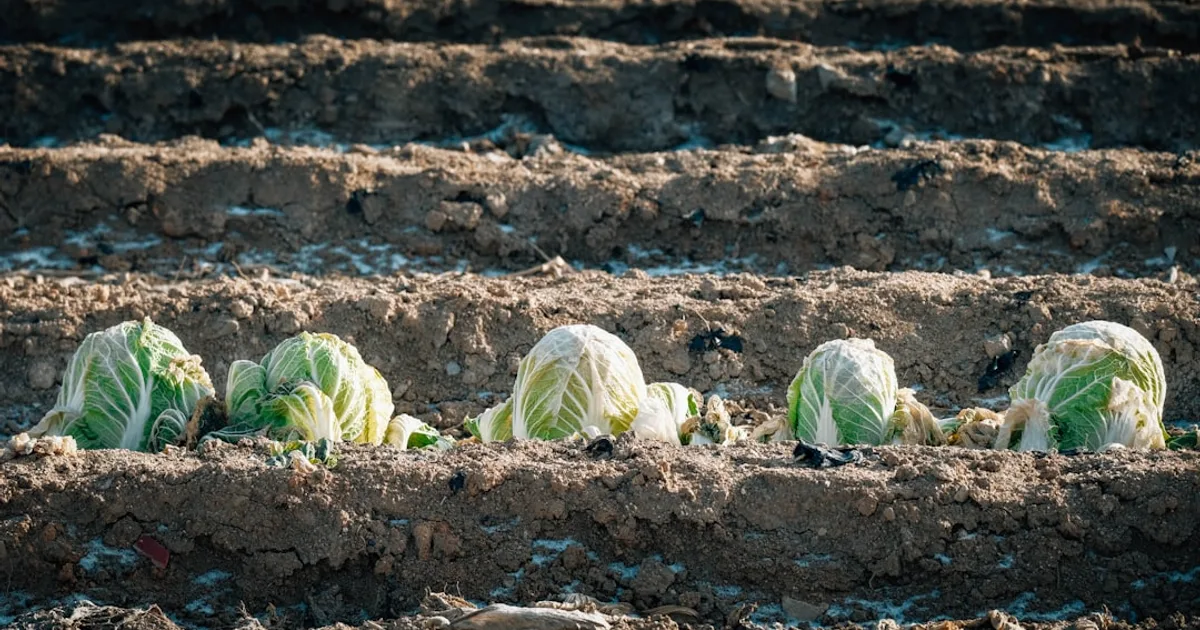
Napa cabbage (Brassica rapa subsp. pekinensis) is one of the more underrated row crops for the home garden. At $1.50-2.50 per pound retail (USDA AMS Specialty Crop Market News, 2023), it doesn’t look like much on paper. But each plant produces a single dense 4 to 6 pound head, and if you’re making kimchi, you’ve just converted $2/lb vegetable into a fermented product that sells for $8-12/lb at specialty stores. That’s a 3-5x value multiplier you produce with labor and salt.
What it actually is
Napa cabbage is in the Brassica rapa species, which makes it more closely related to turnips and bok choy than to regular cabbage (B. oleracea). The heads are elongated, with crinkled light-green leaves, mild flavor, and a high water content that makes them ideal for fermentation. The two main commercial types are barrel-head (compact, shorter, densely packed - good for kimchi) and cylinder-head (taller, lighter, preferred for salads and quick-cooking applications).
For cold-climate home production, barrel types do more work. They head more reliably, tolerate the compressed fall window better, and their density holds up through the salting and fermentation process without turning to mush.
Varieties
Not all napa cabbage behaves the same way, and the variety you choose matters more here than for most crops because you’re often growing toward a specific end use.
| Variety | Type | Days to Maturity | Head Size | Notes |
|---|---|---|---|---|
| Blues F1 | Barrel-head hybrid | 80 days | 4-6 lb | Dense, tightly wrapped; the standard kimchi choice |
| Rubicon | Cylinder-head hybrid | 75 days | 4-5 lb | Bolt-resistant spring type; better for salads and fresh eating |
| Minuet | Barrel-head hybrid | 60 days | 1-2 lb | Small household or container size; good for succession batches |
| Wong Bok | Heirloom open-pollinated | 80 days | 4-6 lb | Looser head; excellent fresh flavor but less ideal for kimchi |
Blues F1 is the workhorse for kimchi production - its tight, dense head holds its structure through salting and fermentation. Wong Bok has better flavor fresh but the looser leaf structure breaks down differently during fermentation; some fermenters prefer it, most don’t. Minuet is worth growing if you want to stagger small batches or have limited refrigerator space for fermentation jars.
The ROI case
A packet of napa cabbage seed costs $2.49 and contains 200-400 seeds - enough to seed a full row and thin down to 15-20 plants. Each plant yields one 4-6 lb head. At $2.00/lb average retail (USDA AMS Specialty Crop Market News terminal market data, 2023), a single head is worth $8-12. Your $2.49 seed investment produces 60-90 lbs of edible cabbage under reasonable conditions. That’s a 24:1 to 36:1 return by weight at current retail pricing.
The kimchi calculation changes things further.
Kimchi value conversion
This is where napa cabbage earns its place in a serious production garden. The inputs are cheap. The output is a fermented product that artisanal producers sell for $8-12/lb at specialty grocers and farmers markets (USDA AMS Specialty Crop Market News, 2023).
| Input | Amount | Cost |
|---|---|---|
| Napa cabbage | 5 lb | $10.00 |
| Non-iodized salt | 3-4 oz | $0.25 |
| Gochugaru (Korean red pepper flakes) | 2 oz | $1.00 |
| Garlic | 1 head | $0.50 |
| Fresh ginger | 1 oz | $0.30 |
| Fish sauce or soy sauce | 2 tbsp | $0.25 |
| Total input cost | $12.30 | |
| Output: finished kimchi | 4-4.5 lb | |
| Output value at $8/lb | $32-36 | |
| Output value at $12/lb | $48-54 | |
| Net gain (at $8/lb) | $19.70-23.70 | |
| Net gain (at $12/lb) | $35.70-41.70 |
Compare that to just selling or using the fresh cabbage: 5 lb at $2.00/lb = $10 gross, $0 in additional inputs, $10 value. The kimchi route returns 3-5x the value from the same raw weight. The additional cost is roughly $2.30 in fermentation ingredients per batch - a rounding error against the value created.
If you’re selling at a farmers market, the math gets more interesting. At $10/lb for artisanal kimchi (the midpoint of the range), a 15-plant planting yielding 75 lb of cabbage converts to roughly 60 lb of finished kimchi, worth $600. Your total input costs including seed and fermentation ingredients come to around $30-35. That’s not a business plan, but it demonstrates what fermentation does to the raw economics of vegetable production.
Growing requirements
Napa cabbage needs consistent soil moisture throughout heading. Inconsistent watering causes tipburn - brown, papery inner leaf edges caused by calcium deficiency triggered by irregular water flow to developing tissue - and cracked heads. Keep soil pH between 6.0 and 7.0 (Penn State Extension, Brassica Crops, 2019). Like all brassicas, napa benefits from nitrogen-rich soil; side-dress with a balanced fertilizer when plants are 6 inches tall.
Transplant or thin to 12-15 inch spacing. Crowding reduces head size. Napa needs at least 6 hours of direct sun; it will grow slowly in less and the heads will be loose and poorly formed.
Fall timing - why spring usually fails
If you’re in Zone 5, 6, or 7, plant napa cabbage in fall. This is not a preference - it’s the practical reality. Spring plantings in these zones almost always bolt before forming a proper head.
The problem is daylength. Napa cabbage is a quantitative long-day bolter: as daylength increases past 13-14 hours in late May and June, the plant shifts energy to flowering. You’re fighting the calendar, and the calendar wins. You can start seeds indoors in February, harden off carefully, and set out transplants in April - and still watch them send up a seed stalk in June before the head has a chance to form.
Fall is different. You’re direct sowing in July or August (Zone 5-6: direct sow in late July to early August, targeting 70-80 days before your first frost). Daylength is shortening through August and September. Temperatures are dropping toward the 60s and 50s that napa prefers for heading. The crop matures into conditions it was bred for, not against them. Fall-grown napa is sweeter, has better texture, and stores longer than anything you could produce in spring in a northern zone.
The practical guidance by zone:
- Zone 5-6: Direct sow late July to early August. Target harvest before first hard frost (below 25°F). Row cover extends the window.
- Zone 7: Direct sow August. Mild fall means more scheduling flexibility.
- Zone 8+: Fall is still best for quality, but spring planting is viable because your May daylengths are shorter and your springs are cooler. Watch for bolting in warm springs.
Don’t bother with spring planting unless you’re in Zone 8 or warmer, or you’re growing Rubicon specifically for its bolt resistance and you’re willing to gamble on the timing.
Succession planting for kimchi production
If your goal is kimchi, you don’t want 15 heads maturing in the same week. You want a steady stream of heads over 4-5 weeks so you can make manageable batches - 5 lb at a time fits a single gallon jar - rather than dealing with a hundred pounds of cabbage in one afternoon.
Stagger 3-4 plantings, 2-3 weeks apart, starting in late July (Zone 5-6). In practice:
- Planting 1: July 20-25 (matures mid-October)
- Planting 2: August 5-10 (matures late October)
- Planting 3: August 20-25 (matures early November, with row cover)
The third planting is a gamble in cold climates - it may not fully mature before hard frost - but if it does, you’ve extended your kimchi-making season by three weeks. Cover it with row cover when temperatures drop below 35°F at night.
Minuet, at 60 days, fits well in a late succession slot where you want to squeeze in one more batch before the season ends.
What goes wrong
Clubroot (Plasmodiophora brassicae) is the most serious brassica soilborne disease. It causes warty, distorted roots and wilting that looks like drought stress. There is no cure once the pathogen is in your soil. Raise soil pH to 7.0-7.2 with lime to suppress it (Cornell Cooperative Extension, Clubroot of Brassicas, 2018). Avoid moving soil from infected beds and practice a 4-year rotation with non-brassica crops.
Cabbage loopers (Trichoplusia ni) and imported cabbageworm (Pieris rapae) are the most common foliage pests. Both are caterpillars that feed on outer and inner leaves. Bacillus thuringiensis var. kurstaki (Bt-k) applied at egg hatch is highly effective and safe to use close to harvest. Row cover from transplant to heading prevents adult moth and butterfly egg-laying entirely - the better solution if you’re growing a lot of plants.
Aphids - particularly cabbage aphid (Brevicoryne brassicae) - colonize the interior of forming heads and are difficult to wash out once established. Inspect the interior of forming heads weekly. Strong water jets dislodge early colonies; insecticidal soap handles heavier infestations.
Black rot (Xanthomonas campestris pv. campestris) enters through leaf margins and progresses inward as a V-shaped yellow lesion with black veins. It spreads by rain splash and contaminated seed. Plant certified disease-free seed and avoid overhead irrigation during cool wet weather.
Harvest and storage
Squeeze the head firmly - it should feel dense and solid with no give. Harvest before temperatures drop below 25°F, which can damage outer leaves. Cut at the base with a sharp knife, leaving 2-3 outer wrapper leaves intact for protection.
Fresh storage: Whole heads keep 2-3 months at 32-36°F with 90-95% humidity - the coldest part of your refrigerator or a root cellar. High humidity prevents the outer leaves from drying out and the head from losing weight.
Fermented (kimchi) storage: 6-12 months refrigerated. Fermentation is essentially an indefinite preservation method at refrigerator temperatures - flavor deepens over months. A batch made in October is still excellent the following spring.
The combination of fresh storage and fermentation makes napa one of the highest-utilization crops in a cold-climate garden. You’re not racing to eat it before it goes bad. Heads that don’t fit in the refrigerator go into the next kimchi batch.
Making kimchi
For readers who haven’t made it - the process is simple. You don’t need special equipment or experience with fermentation.
The method:
- Quarter the head lengthwise, cut crosswise into 2-inch sections, or leave in quarters if you want whole-leaf kimchi (baechu-kimchi style).
- Weigh the cabbage. Use 2% salt by weight - for 5 lb (2,268g) of cabbage, that’s about 45g of non-iodized salt. Avoid iodized salt; iodine inhibits fermentation bacteria.
- Toss thoroughly and let sit 1-2 hours, turning occasionally. The cabbage will release significant liquid and wilt. This is correct.
- Rinse the cabbage two or three times in cold water to remove excess salt. Taste - it should be pleasantly salty but not overpowering. Squeeze out excess water.
- Make the paste: mix gochugaru (Korean red pepper flakes), minced garlic, grated fresh ginger, and fish sauce or soy sauce for a vegan version. Rough proportions for 5 lb cabbage: 4 tbsp gochugaru, 6 cloves garlic, 1 tbsp grated ginger, 2 tbsp fish sauce.
- Combine cabbage and paste, mixing thoroughly with gloved hands.
- Pack tightly into clean jars, pressing down to submerge the cabbage under its own liquid. Leave 1-2 inches headspace - it will expand as it ferments.
- Leave at room temperature (65-75°F) for 1-2 days. Taste daily. When it has a pleasant sourness and slight fizz, move to the refrigerator.
Kimchi made this way can be eaten immediately as a lightly fermented banchan, or left in the refrigerator for months as the flavor develops. Most kimchi fermenters find the flavor peaks around 3-6 weeks. After that it gets more sour, more pungent, better for cooking than eating fresh.
The entire process for a 5 lb batch takes about 3 hours active time, spread over 2 days.
Related crops: Garlic, Arugula, Kale
Related reading: Beginner Homestead Crops - where napa cabbage fits in a first-year production garden
Growing Napa Cabbage? Track your harvest value and break-even date in the Garden ROI app.
Get the App