
Nasturtium
Tropaeolum majus
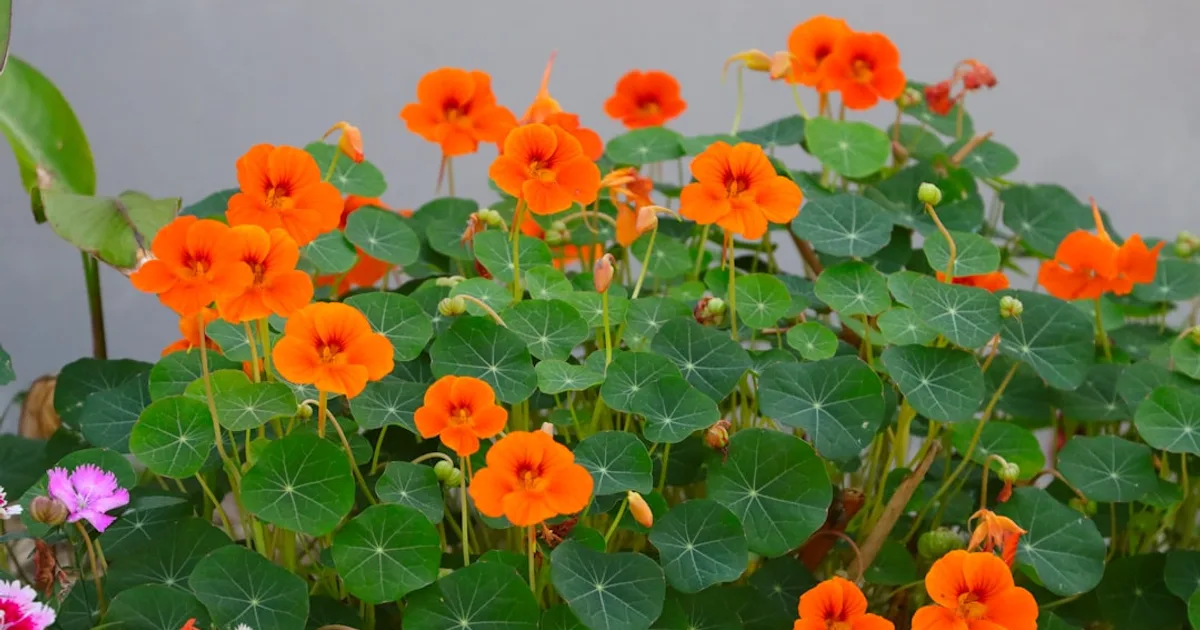
Nasturtium (Tropaeolum majus) is the fastest edible flower you can grow from seed - 35-52 days to first bloom, with minimal inputs and enough uses in the kitchen that calling it a companion plant understates it. The entire plant is edible: flowers at $8-12/lb at specialty markets (USDA AMS Specialty Crop Market News, 2023), peppery young leaves that stand in for watercress in salads, and unripe seed pods pickled exactly like capers. One $1.99 packet covers all of that.
What it actually is
Nasturtium belongs to the family Tropaeolaceae - it is unrelated to watercress (Nasturtium officinale) despite sharing a common name based on similar peppery flavor compounds (glucosinolates, specifically glucotropaeolin). The round, shield-shaped leaves and the spurred flowers in orange, yellow, and red shades are distinctive and unmistakable.
Two main growth habits exist: compact bush types that reach 10-15 inches and trailing/climbing types that sprawl or climb to 5-6 feet. Bush types suit bed edges and containers; trailing types work on trellises or as ground cover.
Nasturtiums are half-hardy annuals - frost-sensitive but cool-weather tolerant. They produce better in cooler conditions (55-65°F). In hot weather, they tend to flower less and produce more foliage. In very hot climates (zones 9-10), grow them as fall and winter annuals.
Variety comparison
These five varieties cover the main use cases. All are widely available from seed suppliers.
| Variety | Habit | Height | Best use |
|---|---|---|---|
| Whirlybird | Compact bush | 10-12 in | Containers, early flowering, no spur (easier to eat) |
| Alaska | Mounding | 12-15 in | Variegated leaves add ornamental value; good for market |
| Jewel Mix | Mounding/spreading | 12-15 in | Standard garden mix, good all-purpose production |
| Empress of India | Compact | 10-12 in | Dark foliage, deep red flowers, high visual impact |
| Moonlight | Trailing/climbing | 5-6 ft | Pale yellow flowers, trellises or slopes |
Whirlybird is the practical choice for containers and harvesting volume in a small space. Moonlight gives the best returns on a trellis where vertical space is available. Alaska’s variegated leaves have standalone market appeal even when flowers are limited.
The ROI case - three product streams
Most plants give you one harvest. Nasturtium gives you three if you work it properly: flowers, young leaves, and pickled seed pods. The math changes when you account for all three.
| Product | Harvest window | Yield (6 plants) | Retail equivalent | Seasonal value |
|---|---|---|---|---|
| Flowers | 10 weeks | 1-2 lb (0.1-0.2 lb/week) | $12/lb (USDA AMS, 2023) | $12-24 |
| Young leaves | 8 weeks | ~0.5 lb total | $5/lb (watercress equivalent) | $2.50 |
| Pickled seed pods | Mid-late season | 2-3 half-pint jars | $8/jar retail | $16-24 |
| Total | $30-50 |
Starting investment: $1.99 seed packet plus any container or bed space costs. If you use all three streams, the return on seed cost alone is 15-25x. That doesn’t mean you’ll recover $50 cash - it means you’ll displace $50 in grocery spending if you’re already buying specialty greens, edible flowers, or capers.
The single largest missed opportunity for most nasturtium growers is the seed pods. Flowers are obvious; leaves get eaten in salads. But most gardeners let the seed pods mature and fall without harvesting them at the green stage for pickling. That’s the highest-value stream per pound.
Growing requirements
Direct sow nasturtium seeds where they are to grow - they have a long taproot and resent transplanting. Sow after the last frost date, 0.5 inch deep, 6 inches apart. Germination in 7-14 days at soil temperatures of 55-65°F. Soaking seeds overnight speeds germination.
Soil pH of 6.0-7.5. Nasturtiums are most productive in poor to moderately fertile soil.
The lean soil requirement
Rich, heavily amended soil with high nitrogen drives leaf production at the expense of flowers. This is the single most common growing mistake with nasturtiums. If your beds have been well-composted for vegetables, those beds will produce lush nasturtium foliage and almost no flowers.
The fix is practical. Plant nasturtiums in the least-amended corner of your garden. Use containers filled with plain potting mix - no slow-release fertilizer pellets mixed in. Choose a bed that hasn’t been amended in the last two seasons. Apply no fertilizer, none at planting and none as a side-dress during the season. The stress of lean soil is what drives flowering. Think of it as deliberate neglect in service of production.
If your soil is already depleted or sandy, you may need to add nothing at all. If everything else in your garden gets regular compost, the nasturtiums get the spot that doesn’t.
Water lightly once established - 0.5-1 inch per week. Overwatering and high humidity increase aphid pressure and reduce flowering. Drought stress is tolerated better than wet roots.
Partial shade works in hot climates to extend the season. In cool climates (zones 4-6), full sun maximizes flower production.
What goes wrong
Aphids - specifically the black bean aphid (Aphis fabae) and the nasturtium aphid (Aphis nasturtii) - colonize nasturtiums heavily. This is documented behavior, not gardening folklore. Colorado State Extension identifies nasturtium as a sacrificial trap crop and recommends its intentional use as a preferred aphid host in vegetable gardens (CSU Extension, Integrated Pest Management in Home Gardens).
The mechanism is straightforward: nasturtium is a highly preferred host plant for several aphid species. When both nasturtium and most vegetable crops are present, aphids preferentially colonize the nasturtium first. By planting nasturtiums at bed edges, you concentrate the aphid population in a location you can monitor and remove without disturbing your food crops. When a nasturtium plant becomes heavily infested, pull it and dispose of it - bagged and in the trash, not composted. You remove the aphid population with the plant before it migrates to your cucumbers or beans.
The trade-off is real. If you’re growing nasturtiums for flower and seed pod harvest, the same aphid preference that makes them useful as a trap crop will cost you harvestable blooms. You can’t fully optimize both uses simultaneously. Decide going in whether this planting is a harvest crop or an aphid decoy, and manage accordingly. For harvest: monitor aphid colonies early, knock them off with water, and apply insecticidal soap before populations establish. For trap cropping: let the aphids build, then pull the plant.
Flea beetles (Phyllotreta spp.) create small round holes in leaves. Damage is mostly cosmetic. Row cover over young seedlings prevents flea beetle damage during the most vulnerable stage.
Cucumber mosaic virus (CMV) causes mosaic discoloration and leaf distortion. Aphids spread it. Controlling aphid populations is the primary prevention.
Powdery mildew (Erysiphe sp.) appears late in the season on crowded plantings. Thin plants for better airflow.
Harvest and storage
Flowers
Harvest in the morning just as they fully open. Pinch the flower off at the spur where it meets the stem. Regular harvesting encourages continued production - allowing flowers to go to seed signals the plant to wind down. This is the primary reason to harvest aggressively even if you have more flowers than you can use: the harvest itself sustains the production.
Flowers last 4-6 hours at room temperature, 24-48 hours refrigerated between barely-damp paper towels. They do not dry well.
Freeze individual flowers in ice cubes for presentation in drinks. The orange and yellow hold color when frozen - use the same technique as borage flowers. Drop one cube into summer cocktails, lemonade, or sparkling water. The flower stays visible through the ice and the presentation is noticeably better than nothing. It’s a good use of the surplus you’ll have mid-season when the plant is producing faster than you can cook with the flowers.
Young leaves
The first two to three sets of leaves are most tender and least fibrous. Young nasturtium leaves contain glucotropaeolin, the same glucosinolate that gives watercress its peppery bite - the flavor substitution is genuine, not just approximate (Padilla et al., Journal of Chromatography A, 2007). Use raw in salads or as a garnish. Harvest the same day you use them; they wilt quickly once cut.
Pickled seed pods (nasturtium capers)
This is the highest-value use and the most neglected one. The window is narrow: harvest green seed pods before they harden and begin to yellow. The three-lobed pods should be plump and firm, still fully green. Once they start to turn white or yellow, the texture degrades for pickling.
The flavor similarity to actual capers is not coincidence. Both nasturtium pods and Capparis spinosa (true capers) contain isothiocyanates - in nasturtium, the glucosinolates hydrolyze to allyl isothiocyanate on cell damage, producing a sharp, pungent note that mimics the caper’s characteristic bite closely enough for most cooked applications. The resemblance holds in pasta, chicken piccata, and sauces where capers are usually used as a background flavor element. At retail, capers run $15-25/lb at specialty grocers (USDA AMS, 2023) - harvesting even two jars from a $1.99 seed investment represents real displacement of that cost.
Pickling method:
Rinse the green pods. Make a 5% brine: 5g kosher salt per 100ml water. For each half-pint jar, add 1 clove of garlic, 8-10 black peppercorns, and a small sprig of fresh thyme if available. Fill the jar with pods. Combine the brine with an equal volume of white wine vinegar (1:1 brine to vinegar ratio), bring to a boil, and pour over the pods, leaving 0.5 inch headspace. For shelf stability, process in a water-bath canner for 10 minutes at a full rolling boil. For immediate use, skip the canner and refrigerate - use within 2 months. Water-bath processed jars keep 6-12 months on the shelf.
The only critical point is timing. If you miss the green window and the pods begin hardening, they are not worth pickling. Check the plants every 2-3 days during peak seed production.
Companion planting role
Nasturtium’s companion planting value is documented in two distinct ways.
The first is as an aphid trap crop, covered above. Colorado State Extension specifically recommends this use, and it is grounded in the pest’s documented host preference rather than anecdotal observation.
The second is as a pollinator attractor. The flower’s open, accessible structure and the nectar spur at the base attract bumblebees and honeybees. Planting nasturtium near cucumbers and zucchini - which require bee pollination for fruit set - increases pollinator visitation to those crops. This is the practical basis for the companion plant pairing in the frontmatter. It is not a pest-repellent mechanism; it is a pollinator-draw mechanism, and that distinction matters for setting expectations.
Nasturtiums self-sow, though less aggressively than borage. In zones 6-9, dropped seed germinates reliably the following spring. If you’re treating them as a perennial bed edge plant, let a few plants go to seed at the end of the season rather than pulling everything.
Related crops: Cucumber, Squash
Related reading: Companion Planting Basics - what the evidence actually says about nasturtiums as a trap crop and aphid management
Growing Nasturtium? Track your harvest value and break-even date in the Garden ROI app.
Get the App