
Acorn Squash
Cucurbita pepo
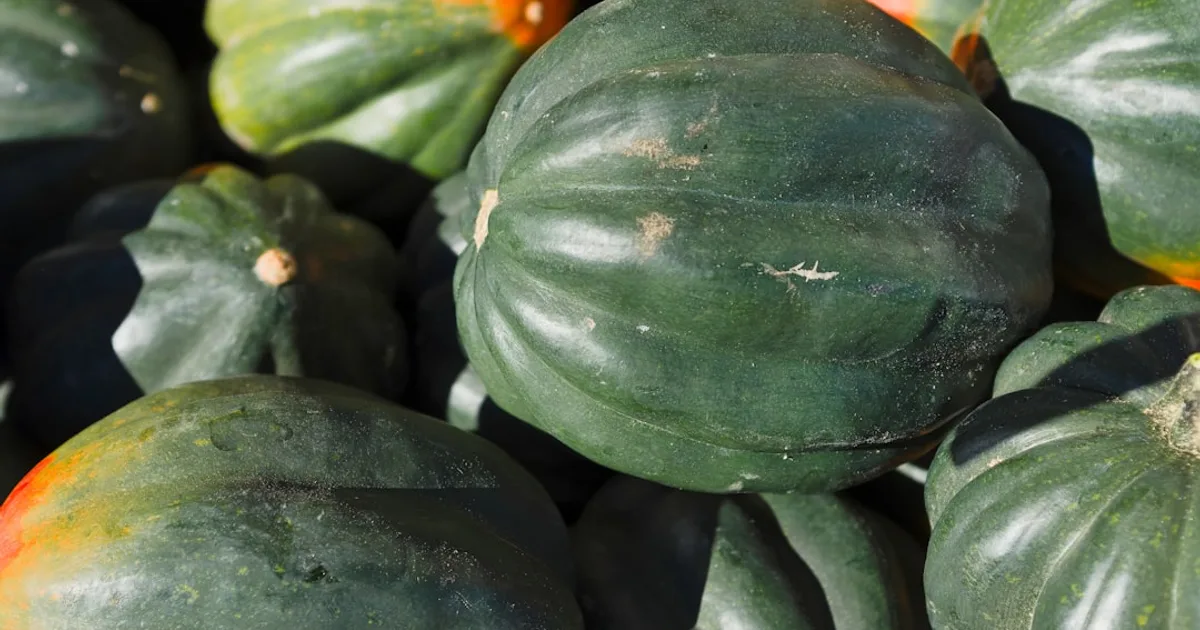
Acorn squash is one of the few crops where a $2.49 seed packet can reasonably return $20-45 in table value. One packet gives you enough seed for 2-3 plants. Each plant produces 4-6 fruit at $2-4 retail apiece at farm stands, $1.50-3.00 per squash in grocery stores. Do the math: 8-18 squash from $2.49 in seed, at an average of $2.50 each, puts gross value somewhere between $20 and $45. After seed costs, that’s a return ratio of 8x to 18x on a crop that largely takes care of itself once established.
The catch is storage. Acorn squash does not keep the way butternut keeps. If you plant it thinking you’ll have winter squash from September through February, you’ll be disappointed. Plan for 4-6 weeks of peak quality from harvest, not four months. That changes how you manage the harvest and when you cook it. Understanding that timeline is the difference between eating excellent squash in October and November versus discovering a pile of soft, flattened squash in January.
What it actually is
Cucurbita pepo is the same species as zucchini, spaghetti squash, and delicata - one of the most widely cultivated vegetable species globally. Acorn squash sits within that species as a distinct type: ribbed acorn shape, pointed at the blossom end, dark green to golden exterior depending on variety, orange-yellow flesh. Fruit size runs 1-3 lb depending on variety. The flavor is sweeter and more substantive than spaghetti squash, with a nuttiness that takes well to brown butter, maple, and warm spices.
The vine is vigorous. Standard varieties send out runners 6-10 feet in multiple directions. Compact and semi-bush varieties like Honey Bear stay in a tighter footprint - more on that in the space-versus-yield section below.
Varieties worth knowing
The seed rack at a hardware store will have Table Ace and probably Carnival. That’s fine. But if you’re ordering from a seed catalog, the variety decision matters more than most people realize, particularly if space is a constraint.
Honey Bear is the variety most worth seeking out for home gardens. It’s an All-America Selections winner - that designation requires performance trials across multiple growing regions, not just a marketing claim. The fruit runs 1-1.5 lb, which is smaller than standard, but the flavor is consistently rated best-in-class and the compact semi-bush vine takes up roughly half the space of a standard acorn type. Days to maturity: 80. Storage: 6-8 weeks.
Table Ace is the reliable standard. Dark green ribbed fruit, 2-3 lb, 80 days. If you’ve eaten acorn squash from a grocery store, you’ve probably had Table Ace or something close to it. It stores 6-8 weeks and produces well across a wide range of conditions.
Carnival has variegated skin - cream, orange, and green patches - which makes it attractive as a table decoration before you cook it. Flavor is slightly sweeter than Table Queen types. Days to maturity: 85. Storage is shorter than Table Ace; plan to use Carnival first in the lineup.
Sweet Reba is an open-pollinated variety with semi-hull-less seeds - you can eat the seeds after roasting without the tough hull getting in the way. Good flavor, productive vines. 80 days.
Thelma Sanders is an heirloom with cream-tan skin that looks nothing like the typical dark green acorn. The flesh is sweet and dry-textured. Takes a bit longer at 90 days, but it’s distinctive on the table and worth growing if you have the season for it.
| Variety | Fruit size | Skin | Days | Storage | Notes |
|---|---|---|---|---|---|
| Honey Bear | 1-1.5 lb | Dark green | 80 | 6-8 weeks | AAS winner; compact vine; best flavor |
| Table Ace | 2-3 lb | Dark green | 80 | 6-8 weeks | Standard; reliable; widely available |
| Carnival | 1.5-2 lb | Mottled multicolor | 85 | 4-6 weeks | Ornamental + edible; use first |
| Sweet Reba | 1.5-2 lb | Green | 80 | 6-8 weeks | Semi-hull-less seeds |
| Thelma Sanders | 1.5-2 lb | Cream/tan | 90 | 6-8 weeks | Heirloom; sweet dry flesh |
The ROI case
A $2.49 packet of acorn squash seed contains enough for 2-3 plants with seed to spare. At 4-6 fruit per plant and $2.50 average value per fruit (splitting the difference between grocery store and farm stand pricing), the yield math looks like this:
| Plants | Fruit per plant | Total fruit | Value @ $2.50/fruit | Seed cost | Net return |
|---|---|---|---|---|---|
| 2 | 4-6 | 8-12 | $20-30 | $2.49 | $17.51-27.51 |
| 3 | 4-6 | 12-18 | $30-45 | $2.49 | $27.51-42.51 |
| 4 | 4-6 | 16-24 | $40-60 | $2.49 | $37.51-57.51 |
Those numbers assume no inputs beyond the seed packet - no fertilizer, no amendments, no row cover. Add $5-10 in compost and a balanced fertilizer application and the net still looks strong.
One important framing: acorn squash is not the highest-value crop per square foot. Tomatoes and peppers produce more dollar value from a smaller footprint over a longer harvest window. Acorn squash’s advantage is that it matures to full value with minimal ongoing attention. Once the vines are established and fruiting, there’s nothing to do except keep pests off and wait.
Space vs. yield: standard vs. compact
Standard acorn squash - Table Ace, Carnival, Sweet Reba - needs 8-12 square feet per plant when you account for vine spread. Honey Bear runs closer to 4-6 square feet as a semi-bush type.
That difference matters when you’re doing per-square-foot comparisons:
| Variety type | Space per plant | Fruit per plant | Value @ $2.50 | Value per sq ft |
|---|---|---|---|---|
| Standard (Table Ace) | 10 sq ft | 4-6 | $10-15 | $1.00-1.50/sq ft |
| Compact (Honey Bear) | 5 sq ft | 3-5 | $7.50-12.50 | $1.50-2.50/sq ft |
Honey Bear yields somewhat fewer fruit per plant, but because it occupies half the space, the per-square-foot return is better. In a garden where space is the limiting factor, Honey Bear is the practical choice.
For comparison, a well-managed tomato plant in the same 10 square feet might return $15-30 in fruit value but requires staking, pruning, and regular harvesting from July through frost. Acorn squash requires almost none of that once it’s established.
Growing requirements
Direct sow after soil temperature reaches 65°F - use a cheap probe thermometer if you’re guessing. Acorn squash’s 80-day maturity gives it flexibility that butternut doesn’t have. In zones 4-5, direct sow in late May to early June for a late-September harvest. In zones 6-9, late May works. Acorn squash does not transplant particularly well due to the taproot; direct sowing is the right method.
Plant 3-4 seeds per hill 1 inch deep, spaced 4-6 feet apart for standard types, 3-4 feet for compact. Thin to the two strongest plants per hill once seedlings hit 4 inches.
Soil should be fertile and well-drained. Work a 3-inch layer of compost into the planting hill before sowing. Side-dress with a balanced fertilizer (10-10-10 or similar) when vines reach 2-3 feet; again at fruit set. The second feeding at fruit set is where a lot of home gardeners skip a step, and it shows in undersized fruit.
Consistent moisture at the root zone is critical during fruit development. Irregular watering during early fruit set causes blossom end drop and soft spots on developing fruit. Drip irrigation delivers water where it needs to go and keeps foliage dry, which reduces fungal disease pressure.
Male flowers appear first, often 1-2 weeks before female flowers. Female flowers have a small immature fruit at the base. Bees handle pollination; if you’re seeing female flowers fall off unpollinated, either bee activity is low or the timing is off. Hand-pollinate by transferring pollen from a male flower to the center of a female flower with a small paintbrush or by pressing the flowers together.
What goes wrong
Powdery mildew (Erysiphe cichoracearum and related species) is universal on Cucurbita by late summer. It looks like white powder on the upper leaf surfaces. For acorn squash harvested at 80 days, it’s less critical than for butternut that needs another 6 weeks, but it still accelerates defoliation. Treat with potassium bicarbonate spray, remove the worst-affected leaves, and maintain air circulation between plants.
Squash vine borer (Melittia cucurbitae) is the most destructive pest in eastern North America. The adult moth lays eggs at the base of the stem; larvae bore in and feed on the interior of the vine, causing sudden wilting and collapse. Row cover until flowering prevents egg-laying. After removing cover for pollination, inspect the base of vines weekly for the telltale sawdust-like frass at entry holes. Inject Bacillus thuringiensis var. kurstaki (Bt) into active borer holes with a syringe and mound soil over the injection area so the vine can re-root above the damage.
Squash bugs (Anasa tristis) cluster on leaf undersides and lay bronze-colored egg masses in neat rows. Remove egg masses before they hatch - nymphs are much easier to kill than adults. Neem oil spray is effective on young nymphs; adults are more resistant.
Waterlogged soil causes root rot and vine collapse fast. Raised planting hills help drainage in heavy soils. If you’re planting in a low spot that holds water, pick a different location.
Harvest: the signal to stop, not to wait
Harvest when the skin is fully colored and hard, the stem is completely corky and dry, and the skin resists a fingernail pressed firmly against it. For dark green varieties, the skin should be a deep, even green - not lighter green or streaked. The ground spot where the fruit rested on the soil should have turned from white to tan or orange.
Leave 2-3 inches of stem attached. A broken-off stem shortens storage life because it creates an entry point for rot.
Here is the critical distinction from butternut: acorn squash does not benefit from extended post-harvest curing. Butternut needs 4+ weeks of curing at 80-85°F to harden the skin and develop full sugar content. Spaghetti squash benefits from 2-4 weeks. Acorn squash is different. A short 7-10 day cure at 70-75°F to let the cut stem dry and the skin surface harden is useful. Beyond that, extended curing actively degrades acorn squash quality - the skin thickens and toughens, the flesh gets stringier, and the flavor flattens. This is not speculation; it’s a consistent finding in post-harvest quality research on Cucurbita pepo types.
The practical consequence: don’t harvest your acorn squash and stack it in the barn until January assuming it will improve with time. It won’t. Eat it in October and November when it’s at its best.
Storage: 4-6 weeks at 50-55°F is the practical window for peak quality. Some sources cite up to 3 months for acorn squash, and it may technically survive that long, but the eating quality declines after 6-8 weeks. Honey Bear and Table Ace hold reasonably well for 6-8 weeks. Carnival is shorter - use it first.
Compare this to butternut, which keeps 4-6 months in the right conditions. If you want winter squash still tasting good in February, plant butternut alongside your acorn. Eat the acorn first.
Storage priority order for a mixed winter squash harvest: Carnival first (4-6 weeks), Table Ace and Honey Bear next (6-8 weeks), butternut last (months).
Stuffed acorn squash: the highest-value preparation
Acorn squash’s natural bowl shape is not an accident of geometry - it’s the reason to grow it. Halved acorn squash holds a substantial filling and roasts to a self-contained serving vessel that requires nothing else on the plate.
The cutting question matters. Halving vertically through the stem gives two boat-shaped halves that present well and sit stably on the plate. Halving horizontally through the equator gives two bowl-shaped halves that hold more filling but don’t sit as flat. Vertical halving is better for presentation; horizontal is better for maximum stuffing capacity.
Method: halve the squash (vertically for presentation), scoop the seeds, brush the cut surfaces with oil and season with salt and pepper. Place cut-side down on a parchment-lined sheet pan. Roast at 375°F for 20 minutes. The cut-side-down phase is important - direct contact with the pan caramelizes the cut surface and accelerates cooking without drying the flesh.
After 20 minutes, flip the halves cut-side up, fill each cavity with your prepared stuffing, and return to the oven for 20-25 more minutes until the flesh is fully tender when pierced and the stuffing is heated through and browned on top. Total time: 40-45 minutes at 375°F.
For stuffing, the combinations that work reliably: Italian sausage cooked and crumbled with sautéed onion, garlic, and fresh sage; wild rice with mushrooms, thyme, and Parmesan; quinoa with roasted vegetables and feta; lentils with harissa and goat cheese. The squash flesh is sweet enough that a slightly savory-bitter stuffing balances better than a sweet one.
The seeds can be cleaned and roasted at 325°F with oil and salt for 20-25 minutes. They’re smaller than pumpkin seeds and cook faster.
Other preparations that work
Roasted with brown butter and maple: halve, scoop, brush with oil, roast cut-side-down at 400°F for 35-40 minutes until fully tender. Finish with a tablespoon of brown butter and a teaspoon of maple syrup in each cavity. This is the simplest preparation and it works.
Soup: roast until tender, scoop the flesh, and blend with chicken or vegetable broth, a small amount of cream, and ginger or nutmeg. Acorn squash soup is somewhat sweeter than butternut soup and has a slightly thinner texture. Strain through a fine mesh strainer if you want a restaurant-grade finish.
Mashed: scoop roasted flesh and mash with butter and a small amount of heavy cream. Works well alongside roast chicken or pork in the same way that sweet potato does, but slightly less sweet. Season aggressively with black pepper and salt.
Related reading: Butternut Squash - longer storage, longer season; Spaghetti Squash - different texture profile, medium storage
Growing Acorn Squash? Track your harvest value and break-even date in the Garden ROI app.
Get the App