
Romanesco
Brassica oleracea var. botrytis
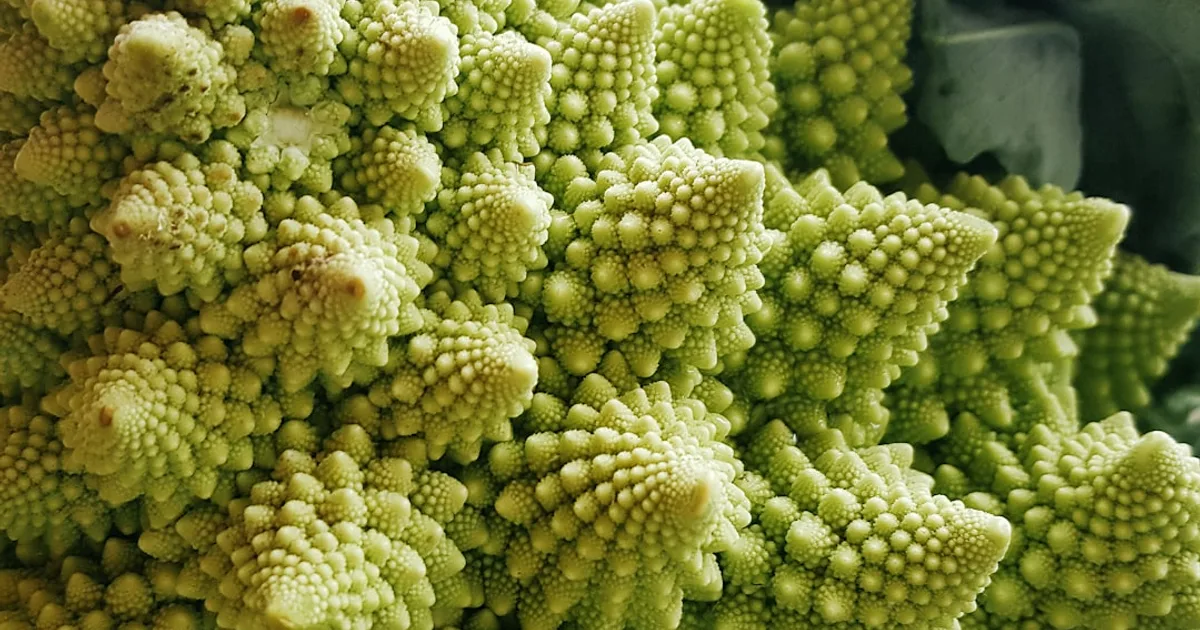
Romanesco sells for $4-7 per pound at farmers markets and specialty grocers where it appears at all, which isn’t many (USDA AMS Specialty Crop Market News, 2023). The visual - a chartreuse spiral fractal head in which each spire is a smaller replica of the whole - draws buyers who have never seen it before. That visual alone moves product at markets. Growing it successfully requires the same precision timing cauliflower demands: get it right and you get a spectacular head; get it slightly wrong and you get nothing worth harvesting.
What it actually is
Romanesco is Brassica oleracea var. botrytis - the same variety designation as cauliflower, not broccoli. In Italy it goes by “broccolo romanesco” in some regions and “cavolfiore romanesco” in others, and the naming has shifted by decade and locality. English sources have imported that confusion, which is why you’ll find it described as a type of broccoli in some seed catalogs and a type of cauliflower in others. Botanically, it’s a cauliflower. It forms a single, dense, spiraling head rather than branching florets, requires identical growing conditions to cauliflower, and has the same heading-phase temperature sensitivity.
The fractal geometry is real mathematics, not marketing language. Each spire on a romanesco head replicates the geometry of the whole head - a three-dimensional logarithmic spiral stacked into a larger logarithmic spiral. The number of spirals on a well-formed head is typically a Fibonacci number: 5, 8, 13, or 21, depending on the variety and the size of the head. This is not a trait plant breeders selected for. It’s an emergent property of the head’s growth pattern. University of Rome researchers published work in 2021 documenting the developmental genetics behind the pattern - the growth dynamics that produce the spiral architecture arise from the suppression and re-activation of meristematic tissue during head development (Bertrand et al., Science, 2021). The plant builds this structure without any outside help.
The flavor is milder than white cauliflower with a slightly nuttier edge. It holds its structure better under heat, which matters in the kitchen.
The ROI case
A packet of romanesco seed costs $3.49 and contains 20-30 seeds. Each plant produces one main head, typically 1.5-2.5 lb at maturity, plus side shoots after harvest. At $5/lb - the low end of specialty market pricing - a 2 lb head returns $10.00. The $3.49 seed packet plants a 15-foot row.
Regular white cauliflower in conventional grocers runs $2-3/lb (USDA ERS Vegetable and Pulses Yearbook, 2023). Romanesco at farmers markets and specialty retailers reliably gets $4-7/lb because it’s visually unusual and scarce. It doesn’t compete on price with grocery store cauliflower. It competes as a specialty product that buyers haven’t seen before. Vendors who grow it consistently report it as one of their most reliably sold specialty brassicas, specifically because repeat customers return for it.
The honest limitation: unlike tomatoes or peppers, which give you a range of marketable harvest across a long season, romanesco gives you one shot per plant. A botched timing call - planting too late in spring, underestimating fall frost dates - means no usable head. Plan planting quantities accordingly and factor in a 20% miss rate on your first attempt.
Varieties
Not all romanesco is the same. Performance varies by variety, particularly for spring planting and in warmer zones. Source: Johnny’s Selected Seeds and High Mowing Organic Seeds variety trial data.
| Variety | Days to Maturity | Head Size | Color | Performance Notes |
|---|---|---|---|---|
| Veronica | 78-85 days | 1.5-2.5 lb | Chartreuse | Most widely available; reliable, consistent heads; better heat tolerance than most romanesco; standard choice for first-time growers |
| Minaret | 85-100 days | 2-3 lb | Pale green | Older heirloom; more variable head formation; taller, more pronounced spires; longer season limits its use in short-season areas |
| Gitano | 75-82 days | 1.5-2 lb | Bright green | More heat-tolerant than Veronica; better choice for spring planting or zones 7-8 where shoulder seasons are warm |
| Neon | 70-80 days | 1-1.5 lb | Vivid green | Very uniform heads; developed for commercial production; smallest head size of the group but excellent visual consistency |
Veronica is the right default. If you’re in zone 7 or 8 doing a spring planting, use Gitano instead.
Growing requirements
The core constraint: romanesco forms its head only in cool weather. The target temperature during heading is 55-70°F. Above 75-80°F, the head buttons (forms small premature structures), rices (develops a coarse, granular texture), or doesn’t form at all. The plant has no mechanism to wait out a heat spike. Your entire timing strategy is about making sure the heading phase falls within that temperature window.
Soil: pH 6.0-7.0. Heavy feeder - work in 3-4 inches of compost before transplanting. Side-dress with a balanced nitrogen fertilizer (10-10-10 or equivalent) when plants reach 12 inches tall. Nitrogen deficiency shows as yellowing outer leaves and slows vegetative growth, which compresses your timing window.
Water: 1-1.5 inches per week, consistent. Uneven water - wet-dry-wet cycles - causes the head to crack or develop unevenly. Mulch around the base after transplanting to buffer soil moisture swings.
Spacing: 18-24 inches between plants. Crowding reduces head size.
Blanching: Romanesco doesn’t require blanching. White cauliflower needs its leaves tied over the developing head to keep it white - UV exposure turns it yellow. Romanesco’s natural color is chartreuse-green; UV light has no adverse effect on it. You don’t tie leaves, you don’t check on the head every two days to adjust the tie. That’s one management task cauliflower demands that romanesco doesn’t.
Fall planting: the more reliable window
Fall planting is more reliable than spring in most of the US for one structural reason: temperatures drop toward the heading phase rather than rising away from it. In spring, you’re racing to get the plant to head before summer heat arrives. In fall, time is working with you - as the plant matures, the weather cools. You have more margin for error.
Two additional fall advantages: pest pressure from imported cabbageworm (Pieris rapae) and cabbage looper (Trichoplusia ni) is typically lower in fall than in late spring and summer. And the plant’s long vegetative period - which it needs to build enough leaf mass to support a full head - can run through summer heat without any problem. The vegetative phase isn’t temperature-sensitive. Only the heading phase is.
Back-calculate your fall planting date from your first expected frost:
| Zone | First Fall Frost | Indoor Start Date | Transplant Date | Expected Harvest |
|---|---|---|---|---|
| Zone 4 | Oct 1 | June 15 | August 1 | Sept 25 - Oct 10 |
| Zone 5 | Oct 15 | June 25 | August 10 | Oct 5 - Oct 20 |
| Zone 6 | Nov 1 | July 1 | August 15 | Oct 15 - Nov 1 |
| Zone 7 | Nov 15 | July 15 | September 1 | Oct 20 - Nov 10 |
| Zone 8 | Dec 1 | August 1 | September 15 | Nov 1 - Dec 1 |
These dates assume 85-day varieties (mid-range for Veronica). For Minaret at 100 days, start 2 weeks earlier. Frost dates sourced from NOAA Climate Normals 1991-2020.
Spring planting: a narrower window
Spring planting works, but the window is tight and zone-dependent.
In zones 7-8, spring planting is viable because the shoulder season is long enough. You transplant early - as soon as soil temperature reaches 40°F - and the plant has time to build vegetative mass through cool spring weather and form a head before heat settles in. Gitano’s better heat tolerance makes it the right variety here.
In zones 5-6, spring planting is a gamble. You need to transplant by April 1 at the latest, grow through whatever cool weather remains in April and May, and hope the plant reaches heading stage before temperatures consistently exceed 75-80°F. In practice, many spring-planted romanesco plants in zone 6 bolt without forming a usable head. The window closes before the plant is ready. This isn’t a failure of technique - it’s a climate constraint. If you want to try it, use Gitano, transplant by April 1, and accept that it may not head.
In zones 4-5, skip spring planting entirely. Focus your effort on the fall crop, where the timing math works in your favor.
What goes wrong
Buttoning - small, premature heads forming on young plants that should still be in vegetative growth - is caused by cold stress below 45°F on seedlings before transplanting, or by transplanting root-bound plants whose roots were circling in cell packs. Harden off transplants over 7-10 days before setting them out and don’t hold them in 72-cell trays past 5-6 weeks.
Riciness (a rough, grainy, open texture instead of tight spirals) comes from heat during the heading phase, or from delayed harvest after the head is mature. The fix for heat is timing; the fix for delayed harvest is checking more frequently as the head approaches full size.
Clubroot (Plasmodiophora brassicae) builds in soil where brassicas grow repeatedly. Rotate all Brassica oleracea crops - broccoli, cauliflower, cabbage, kale, romanesco - on a minimum 4-year cycle. There is no cure once the soil is infected.
Imported cabbageworm (Pieris rapae) and cabbage looper (Trichoplusia ni) lay eggs on leaves and the larvae feed through the head. Row cover from transplant through heading is the cleanest prevention. If you find larvae, Bt-k (Bacillus thuringiensis var. kurstaki) applied when larvae are young and small is highly effective and safe for beneficial insects.
Downy mildew (Peronospora parasitica) shows as yellow patches on upper leaf surfaces with gray-purple sporulation underneath. It’s primarily a seedling-stage problem in cool, wet nursery conditions. Avoid overhead irrigation on young transplants; use bottom watering or drip from the start.
Companion planting
Garlic planted at the perimeter of a romanesco bed is a traditional companion because allium sulfur compounds may deter brassica pests, particularly aphids and cabbage worms. The evidence is mixed. Nault and Speese (2002, Journal of Economic Entomology) found some pest deterrence under specific conditions in controlled trials, but the effect is inconsistent across studies. Practically: garlic planted around the bed edge costs almost nothing and may help. It’s a low-cost intervention worth trying rather than something you can rely on.
Arugula works differently - as a relay crop rather than a true companion. Sow arugula in early spring in the same bed where you plan the fall romanesco. Harvest arugula through April and May. By late June, when you’re ready to transplant romanesco for the fall crop, the arugula has bolted or been cleared and the bed is free. The arugula doesn’t share space with romanesco at any point - it just makes productive use of ground that would otherwise sit empty through spring.
Harvest and side shoots
Harvest the main head when it’s fully formed, tightly spiraled, and bright chartreuse. The spirals should be compact and firm. Once the curd begins to loosen - individual spires separating from each other - quality declines fast. Cut with a sharp knife leaving 2-3 inches of stem.
After the main head is harvested, romanesco produces side shoots from the leaf axils - small, spiraling secondary heads that don’t match the visual scale of the main head but are fully edible and flavorful. They extend your harvest by 2-4 weeks. Harvest side shoots when they’re tight and compact, 2-4 inches across, before they open and loosen. They’re best treated like small broccoli florets - roasted, added to pasta, or eaten raw.
Storage and cooking
Romanesco stores unwashed in the refrigerator for up to 2 weeks. It holds visual quality longer than broccoli, which yellows faster.
The best cooking application for the visual is roasting whole or in wedges at 425°F for 20-25 minutes. Romanesco’s denser cell walls resist collapse better than cauliflower or broccoli, so it holds its fractal structure through high heat. Cut into wedges and roasted, the internal geometry is still fully visible on the plate. Drizzle with olive oil, season with salt before roasting, and finish with nothing else unless the occasion calls for it.
Other solid preparations: raw in a crudite platter (holds shape well, flavor closer to raw cauliflower with a nuttier note); blanched and tossed with pasta - Italian preparations typically pair it with anchovy-based sauces, which work well with the mild nuttiness; pickled in an agrodolce preparation where the firm texture survives the brine without going soft.
Related crops: Garlic, Arugula, Kale
Related reading: Spring Garden Planning - how to back-calculate planting dates for long-season brassicas like romanesco and cauliflower
Growing Romanesco? Track your harvest value and break-even date in the Garden ROI app.
Get the App