
Sea Buckthorn
Hippophae rhamnoides
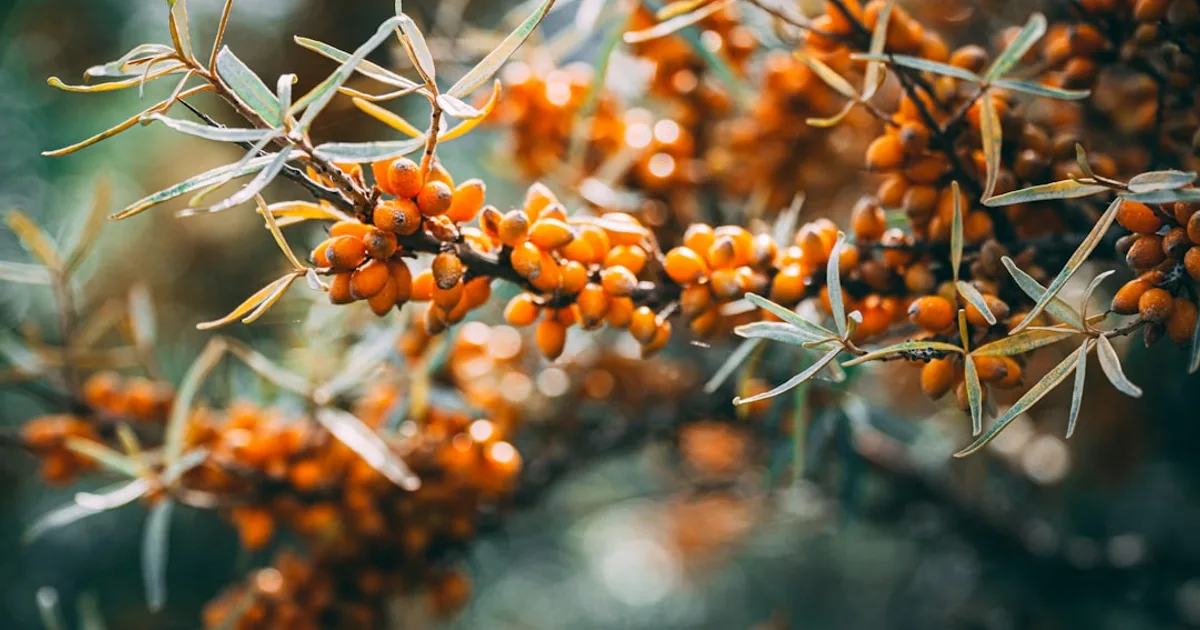
Sea buckthorn grows where almost nothing else will. It’s hardy to -40°F, fixes atmospheric nitrogen through root nodules, tolerates salt spray and infertile sandy soils, and produces berries that retail for $15-25/lb at health food stores and specialty markets. The plant is a native of Eurasia’s harsh coastal and mountain zones - the Russian and Tibetan medical traditions have used it for centuries, and modern research has confirmed the berries are extraordinarily high in vitamins C, E, and A, carotenoids, and fatty acids unusual in plant foods.
The berry itself is difficult: dense, sour, and astringent fresh, with an intense flavor somewhere between sea buckthorn and nothing else in the English-speaking kitchen. It’s not a berry you eat by the handful. It’s a berry you juice, blend into smoothies, make into syrup, or preserve. The commercial market is in juice and supplements, and home production competes with retail prices that would be strong ROI for any berry crop.
What it actually is
Hippophae rhamnoides is in the oleaster family (Elaeagnaceae), native to coastal and mountain regions across Eurasia from western Europe to China. It’s a thorny, deciduous or semi-evergreen shrub growing 6-20 feet tall with narrow, silver-green leaves, and clusters of small orange-yellow berries that appear in August-October and can persist on the branch through winter. The plant fixes nitrogen through root nodule associations with Frankia bacteria, which means it improves soil fertility in addition to producing fruit - a benefit that compounds over years.
Dioecious: sea buckthorn has separate male and female plants. You need at least one male within 100 feet of females for berry production. The typical planting ratio is 1 male per 6-8 females. Males are identified by buds (they look different from female buds) but not reliably until the plant is 3-4 years old - buy from nurseries that sex their plants. Some named varieties: Leikora and Frugana (female, German varieties); Pollmix (male, bred for large pollen production).
Harvest difficulty: the berries grow directly on the branches (not on pedicels), are soft when ripe, and release juice when picked. This makes hand-harvesting tedious and staining. Commercial operations use shaking equipment or freeze whole branches and strip frozen berries. Home-scale: cut whole branches with berries, freeze, then strip frozen berries into a bucket. Much easier than picking individual ripe berries.
The ROI case
Sea buckthorn is slow to establish and requires two plants minimum. But established shrubs produce for 30+ years with no replanting.
| Year | Female plants | Yield (2 females) | Value @$20/lb | Plant cost (1M + 2F) | Cumulative net |
|---|---|---|---|---|---|
| 1-3 | 2 | 0 | $0 | -$59.97* | -$59.97 |
| 4 | 2 | 2-4 lb | $40-80 | - | -$19.97 to $20.03 |
| 5 | 2 | 6-10 lb | $120-200 | - | $100.03-$220.03 |
| 7 | 2 | 10-15 lb | $200-300 | - | $300.03-$520.03 |
| 10 | 2 | 15-20 lb | $300-400 | - | $600.03-$920.03 |
*Three plants at ~$20 each (1 male, 2 female).
Juice value: sea buckthorn juice at health food stores runs $15-25 per liter. A liter requires roughly 1-1.5 lbs of berries. At 10 lbs of berries from two established shrubs, you’re producing the equivalent of $100-150 in retail juice value.
Seed oil value: sea buckthorn seed oil - cold-pressed from the seeds after juice extraction - is a premium cosmetic ingredient sold at $20-50/oz at health food and cosmetic retailers. The oil is rich in omega-7 fatty acids (palmitoleic acid), vitamin E, and carotenoids that give it a distinctive orange color. Used in skin-care applications for hydration and anti-aging effects. The seeds are a byproduct of juice pressing - if you’re processing for juice anyway, saving and cold-pressing the seeds captures additional value from material that would otherwise go to compost. Cold-pressing seeds requires a dedicated oil press; at home scale, a small screw press capable of handling hard seeds is the appropriate tool. Yield: approximately 1 oz of oil per pound of seeds, and you’ll collect seeds from the juice-pressing process in proportion to berry volume processed.
Growing requirements
Hardiness: reliably hardy to zone 3 (-40°F). This is unusually cold-hardy for a fruit-producing shrub - it survives conditions that kill elderberry, currant, and most other fruiting shrubs. In zones 7-8, it grows but may not fruit as heavily due to insufficient winter chill.
Soil: one of the most soil-adaptable plants in temperate horticulture. Thrives in sand, gravel, poor infertile soils, and even saline soils where other plants fail. Nitrogen fixation means it doesn’t need fertilization in most conditions. The primary requirement is good drainage - it doesn’t tolerate waterlogged soil despite being called “sea” buckthorn.
Suckering: sea buckthorn spreads aggressively by root suckers. An established planting will expand its footprint 2-4 feet per year through suckers. Mow or cut suckers outside the desired planting area regularly; they do not come up from seed in most conditions but the root spread is persistent.
Thorns: the branches are heavily thorned. Work gloves and long sleeves are non-negotiable during pruning and harvest. This also makes sea buckthorn an excellent barrier hedge or wildlife habitat planting.
Wind pollination: no bees required; pollen is wind-dispersed. Plant male within 100 feet, preferably upwind of females.
Nitrogen fixation: sea buckthorn fixes atmospheric nitrogen through Frankia bacteria in root nodules - the same mechanism as alder and sweet fern. An established planting accumulates nitrogen in the surrounding soil over years. This is worth considering in site planning: sea buckthorn grown as a hedgerow alongside a vegetable garden fertilizes the adjacent beds passively. The nitrogen-fixing rate has been measured at 40-180 kg N/ha/year in established stands (Gupta et al., Bioresource Technology, 2003) - real contribution to soil fertility.
Salt and wind tolerance: sea buckthorn’s native habitat is coastal dunes and mountain slopes where wind, salt spray, and poor soil would eliminate most plants. It functions as a windbreak in exposed locations where other shrubs fail to establish. For coastal and high-elevation gardens, sea buckthorn fills a productive role where most fruiting shrubs can’t survive. The combination of nitrogen fixation, wind tolerance, and high-value fruit production in a single low-maintenance plant is unusual in temperate horticulture.
What goes wrong
No fruit on female plants: almost always either (1) no male in range, (2) male and female varieties have non-overlapping bloom periods, or (3) plants are too young (typically 3-4 years minimum). Confirm you have a correctly timed male variety within range.
Wilt disease (Verticillium dahliae): causes sudden wilting and dieback of branches. No reliable treatment; remove affected branches and monitor. Good drainage and plant vigor are the best prevention.
Root suckers taking over: the most common management problem. Sea buckthorn will colonize a surprisingly large area over time if suckers aren’t controlled. Establish a clear perimeter at planting and mow the boundary annually.
Harvest difficulty: underestimated by most first-time growers. The frozen-branch method is strongly recommended. Cut fruiting branches in August-September when berries are fully orange, place in a freezer overnight or until solid, and strip frozen berries into a container over a tarp. Work over a surface you don’t mind staining permanently. The juice is oil-based, deeply pigmented, and does not wash out of fabric or wash off skin easily - wear old clothes and nitrile gloves. Harvest early in the morning before temperatures warm and berries begin to soften.
Harvest and use
Harvest August-October when berries are fully orange and beginning to soften. They persist on the branch through winter (birds generally leave them alone) but quality declines with extended frost-thaw cycles.
Processing: most fresh berries go directly into juice via a food mill, juicer, or blender-and-strain process. The seeds and skins contain the omega-7 fatty acids and are worth extracting if you’re making oil, but for juice they’re strained out.
Flavor note: raw sea buckthorn juice is intensely sour, astringent, and deeply orange-flavored. It needs sweetening for most applications. Diluted 1:4 with water and sweetened with honey is the standard drinking preparation.
Core preparations:
-
Sea buckthorn juice: berries processed through a food mill or juicer, strained, sweetened to taste with honey or sugar. Dilute 1:4 with water for drinking. The juice is extraordinarily high in vitamin C (roughly 10x the concentration of orange juice). Keeps refrigerated 1-2 weeks; freezes well.
-
Sea buckthorn syrup: reduce fresh juice with sugar to a thick syrup (1:1 juice to sugar by volume). A tablespoon over yogurt, ice cream, or stirred into sparkling water concentrates the flavor into a manageable form.
-
Sea buckthorn vinaigrette: juice thinned with olive oil, honey, and a pinch of salt. The acidity is high enough that it functions as both the acid and flavor component in a salad dressing without additional vinegar.
-
Berry leather: puréed berries spread thin on a dehydrator sheet and dried at 135°F until pliable. Concentrated and shelf-stable; the flavor is intense. Used in tea preparations and as a flavor concentrate.
-
Russian sea buckthorn tea (oblepikha chai): dried berries or berry leather simmered in hot water with honey. Traditional in Russian folk medicine and still common in Russia and Central Asia. The flavor is fruity, tart, and warming.
-
Sea buckthorn jam: cooked with sugar (2:1 berries to sugar by weight) and strained for seeds. High natural pectin content produces a firm set without added pectin. The orange color is striking; flavor is intensely tart-sweet with floral notes.
Summary of Value Streams
| Product | Retail price | Home production notes |
|---|---|---|
| Fresh/frozen berries | $8-15/lb | Primary harvest; sell or process |
| Juice | $15-25/liter | Berry processing; dilute before drinking |
| Syrup | $12-20/8 oz jar | Reduced juice + sugar |
| Seed oil (cosmetic) | $20-50/oz | Cold-press seeds from juice processing |
| Dried berries/leather | $8-15/oz | Dehydrate; concentrated form |
| Jam/preserves | $8-14/8 oz jar | High pectin; sets easily |
An established two-female planting producing 15 lb of berries annually, converted to multiple products rather than sold fresh, represents $200-400+ in retail-equivalent value from a $60 initial investment. The plant lasts 30+ years.
Related reading: Aronia - fellow high-antioxidant native shrub; Elderberry - companion planting partner with similar zone hardiness; Berry ROI Comparison - comparing fruit shrubs by production value
Growing Sea Buckthorn? Track your harvest value and break-even date in the Garden ROI app.
Get the App