
Serviceberry
Amelanchier alnifolia
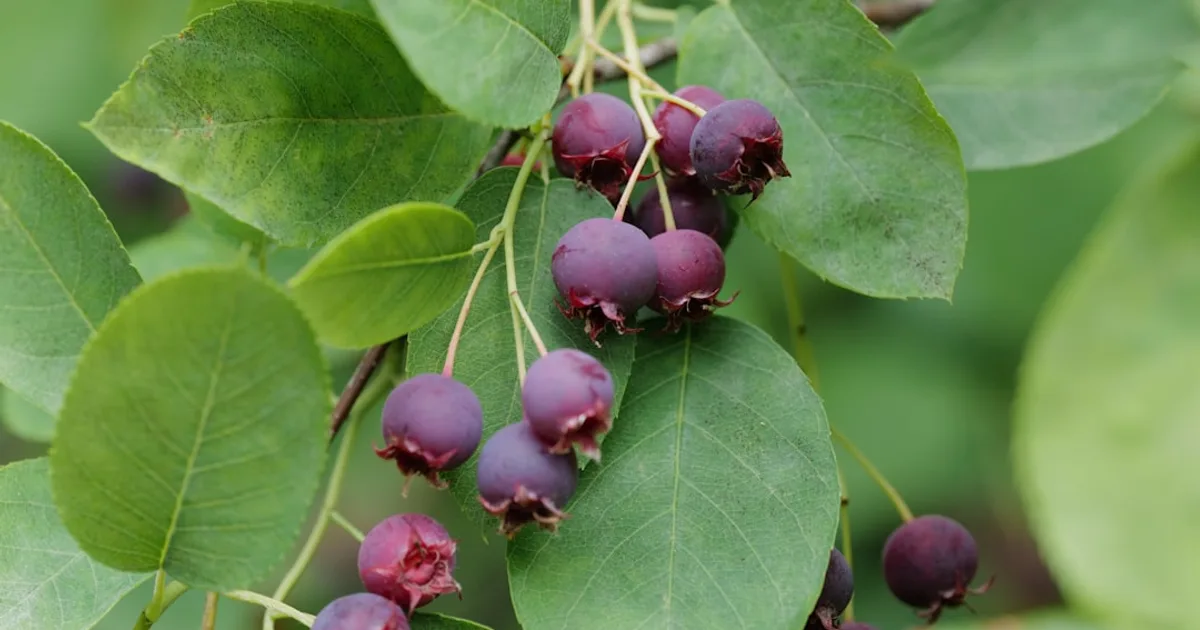
Serviceberries ripen in June - before blueberries, before most other summer fruit - and they taste like a blueberry that spent the season near an almond tree. The flavor is mild, sweet, with a distinctive hint of marzipan that comes from benzaldehyde in the seeds. At the handful of farmers markets that carry them, they fetch $8-15/lb. The shrubs grow wild across North America from Newfoundland to the Pacific Northwest, cold-hardy from Zone 2 to Zone 9, tolerating both wet and dry sites, and requiring minimal maintenance after establishment.
Most American gardeners have never intentionally planted or harvested a serviceberry. That’s not a case against them - it’s a case for planting them now before summer fruit production is two seasons out.
What It Actually Is
The genus Amelanchier contains several species sold under overlapping common names: serviceberry, Juneberry, shadbush, saskatoon. The species distinction matters for edible production:
-
A. alnifolia (saskatoon serviceberry): western North American species, zones 2-7; largest fruit of the genus; basis for most improved fruiting cultivars. This is the primary species for edible production.
-
A. canadensis (eastern serviceberry): common in wet, low-lying areas in the eastern US; smaller fruit; more shrubby form. Good wildlife plant; less optimized for eating than alnifolia cultivars.
-
A. arborea (downy serviceberry): small tree form, 15-25 feet; primarily ornamental; smaller, less flavorful fruit. Often sold for landscape use.
-
A. × grandiflora (apple serviceberry): hybrid of A. arborea × A. laevis; upright small tree form; good combined ornamental and edible value.
For a garden planted specifically for fruit production, start with A. alnifolia cultivars. They have larger, better-flavored fruit than the common wild-type eastern species, and the shrub form is manageable.
Key cultivars for edible production:
| Variety | Species | Fruit size | Flavor | Form | Zones |
|---|---|---|---|---|---|
| Regent | A. alnifolia | Large | Excellent, sweet | Dwarf shrub (4-6 ft) | 3-7 |
| Smoky | A. alnifolia | Large | Sweet, mild | Upright shrub (6-8 ft) | 3-8 |
| Martin | A. alnifolia | Very large | Rich, complex | Shrub (6-8 ft) | 3-7 |
| Thiessen | A. alnifolia | Very large | Sweet-tart | Tall shrub (10 ft) | 3-7 |
| Autumn Brilliance | A. × grandiflora | Medium | Good | Small tree (15-20 ft) | 4-9 |
‘Regent’ is the most widely available improved cultivar and a reliable first choice. Its compact form (4-6 feet) makes it nettable against birds, manageable in smaller spaces, and productive within 3 years of planting.
The ROI Case
Serviceberries are a long-lived, once-planted investment. The plants rarely need replacement and increase in production through the first 10-15 years. At farmers market pricing, the per-pound value often exceeds $10 due to scarcity - serviceberries are undersupplied commercially because they don’t ship well (short shelf life) and production is small-scale.
Specialty fruit market pricing: $8-15/lb where sold (specialty and farmers market retail; USDA AMS does not maintain a regular price series for this crop).
| Year | Yield per shrub | Value @$10/lb | Shrub cost | Cumulative net |
|---|---|---|---|---|
| 1-2 | 0-0.5 lb | $0-5 | -$19.99 | -$14.99 |
| 3 | 3 lb | $30 | - | $15.01 |
| 4 | 6 lb | $60 | - | $75.01 |
| 5 | 10 lb | $100 | - | $175.01 |
| 10 | 15 lb | $150 | - | $800+ (est.) |
| 20+ | 15-20 lb | $150-200 | - | Long-term positive |
The timing premium reinforces the ROI: June harvest when no other summer fruit is available commands the best farmers market pricing of any berry crop. A well-established shrub produces market-value fruit for 20+ years from a single $20 investment.
Zone Fit
Zones 2-4: serviceberry is one of the only fruiting shrubs reliably productive this far north. A. alnifolia handles temperatures to -50°F (-46°C). This cold hardiness is not just survival - these plants are native to the Canadian prairies and grow naturally in Zone 2. Where blueberries, peaches, and even cherries fail, serviceberry produces consistently.
Zones 5-7: ideal growing conditions. Full production from established shrubs; no special protection needed. Plant in any reasonably drained site.
Zones 8-9: productive but at the warm edge of the range. Spring bloom timing may be subject to late frost damage in some years because the plants bloom early. Choose A. × grandiflora types for slightly better heat tolerance.
Zone 10 and warmer: not suitable. Serviceberry requires winter chilling hours to bloom and fruit.
Growing Requirements
Site selection: the most adaptable fruiting shrub in North American horticulture. Tolerates wet, seasonally flooded soil - it grows naturally along stream banks and wet edges. Also tolerates dry, rocky upland sites. Prefers slightly acidic to neutral pH (5.5-7.0). Grows in partial shade (4-5 hours of direct sun) and produces reasonable fruit; full sun maximizes yield.
Cross-pollination: most A. alnifolia cultivars are self-fertile - one plant produces fruit without a pollinator. Cross-pollination between two different cultivars improves fruit set and berry size. If you plant two, choose varieties that bloom simultaneously (Regent and Smoky, or Regent and Martin bloom at compatible times).
Planting: bare-root plants are typically available in early spring. Plant while dormant, before buds break. Dig a hole twice as wide as the root ball; backfill without amendments (adapts better to native soil than amended beds). Water in thoroughly. Keep consistently moist the first season; established plants are drought-tolerant.
Pruning: minimal. The natural form is attractive and productive. Remove dead and crossing branches in late winter. For established multi-stemmed shrubs, renewal-prune the oldest 2-3 canes at ground level every 4-5 years to stimulate vigorous new growth.
Wildlife value: serviceberry is among the most important native wildlife plants in North America. Over 35 bird species eat the berries (USDA NRCS, Native Plant Materials Program). This is a feature for naturalistic garden designs and a planning reality for fruit production - birds will find the crop before you do.
What Goes Wrong
Birds take the crop: the primary challenge. Serviceberries ripen quickly over 7-10 days, and robins, cedar waxwings, and other birds harvest them efficiently. Net plants 2 weeks before expected ripeness - before berries begin to color - or lose most of the crop. The compact form of shrub types like ‘Regent’ makes netting practical; tree forms (A. arborea, A. × grandiflora) are much harder to protect.
A practical approach: net two shrubs, leave two unnetted for birds. You both eat well.
Cedar-apple rust (Gymnosporangium juniperi-virginianae): serviceberry is an alternate host for this fungus (Eastern red cedar / juniper is the primary host). Orange, gelatinous galls on leaves and fruit develop in wet springs. Avoid planting near Eastern red cedars; no effective chemical control; remove affected fruit. Most years this is cosmetic rather than production-limiting.
Late frost damage: serviceberries bloom early - often while there is still frost risk in Zones 5-6. A late frost after bloom drops flowers and eliminates that season’s fruit. Nothing to do about it; the shrub is otherwise unaffected. Planting on a north-facing slope or in a slightly shaded site delays bloom by 5-7 days, reducing frost exposure risk.
Fireblight (Erwinia amylovora) in warm, wet springs: the same disease that affects apples and pears. Causes shoot tip die-back with a characteristic “shepherd’s crook” curl. Prune affected tissue back 12 inches into healthy wood; disinfect pruners between cuts with 10% bleach solution.
Harvest and Use
Berries ripen over 1-2 weeks in June, turning from red-pink to deep blue-purple at peak ripeness. They don’t all ripen simultaneously - check every 2-3 days and pick when individual berries reach full blue-purple color and release easily with gentle pressure. Unripe berries (still pink or red) are tasteless and slightly astringent; fully ripe berries are sweet with the characteristic almond note.
Fresh shelf life is short: 3-5 days refrigerated before berries soften and begin to ferment. Do not expect serviceberries to hold like blueberries. Pick what you can use in a few days; freeze the rest immediately.
Freezing: the best preservation method given the short fresh shelf life. Freeze immediately after picking on a sheet pan; transfer to bags once frozen. Frozen serviceberries retain excellent flavor for 10-12 months. Use frozen berries in any cooked preparation.
The almond note explained: serviceberry seeds contain amygdalin, the same compound present in cherry pits, almond kernels, and apple seeds. In small quantities it contributes the characteristic marzipan-adjacent flavor without any toxicity concern at normal eating quantities. The note is most pronounced in freshly picked ripe berries.
Pie: the signature prairie Canadian preparation, where saskatoon (serviceberry) pie is as foundational as apple pie. Fill a standard 9-inch pie shell with 4-5 cups serviceberries, 3/4 cup sugar, 2 tablespoons cornstarch, 1 tablespoon lemon juice. The berries don’t need pre-cooking. Bake at 375°F for 45-55 minutes until crust is golden and filling is bubbling. The flavor is sweeter and more complex than blueberry pie.
Jam: the most reliable processed use. Serviceberries have good pectin content; cooked with sugar they gel readily without added pectin. Combine 4 cups berries with 2 cups sugar and juice of one lemon; cook down until it sheets from a spoon (220°F).
Fresh eating: the purest use for good-quality ripe fruit. Pick and eat. The almond note is strongest when the berries are still slightly warm from the sun.
Muffins and pancakes: substitute 1:1 for blueberries in any recipe. The flavor holds through baking.
Planning for Production
Serviceberry production planning differs from annual crops because you’re working with a 3-5-year establishment timeline. The decisions you make at planting define what you harvest for the next 20 years.
How many to plant: a mature A. alnifolia shrub (like ‘Regent’ or ‘Smoky’) produces 10-15 lbs of fruit at full production. A household that uses berries regularly for fresh eating, pies, and jam wants 3-5 shrubs. Two of those should be netted; one or two can serve as wildlife habitat and observation.
Spacing: 6-8 feet between shrubs if planting multiple. They spread modestly by suckering; allow room for this and either remove suckers or let the colony expand slightly each year. A colony of 5-6 suckers from an original planting, managed as a dense hedgerow, maximizes fruit production per linear foot.
Interplanting: serviceberry works in a food forest understory role. Planted beneath the canopy gap of a larger fruit tree (apple, pear) or along the dripline of deciduous shade trees, it produces adequately in 4-6 hours of sun while the other plants occupy different vertical layers. It does not need the premium sunny real estate that tomatoes or peppers require.
Net before you think you need to: birds find serviceberries before they’re ripe to human taste. Cedar waxwings in particular descend on serviceberry shrubs as soon as berries begin to color. Net while berries are still red-pink, before they turn blue. Netting after that point often means the birds have already scouted and will find their way through any loose sections.
Related crops: Aronia - fellow early-season native berry; Honeyberry - another cold-hardy early-season berry; Elderberry - native fruit with different season and flavor
Related reading: Berry ROI Comparison - per-shrub economics for serviceberry, blueberry, raspberry, and aronia; Fruit Tree Payback Timeline - how long-lived fruit plants amortize initial investment
Growing Serviceberry? Track your harvest value and break-even date in the Garden ROI app.
Get the App