
Swiss Chard
Beta vulgaris var. cicla
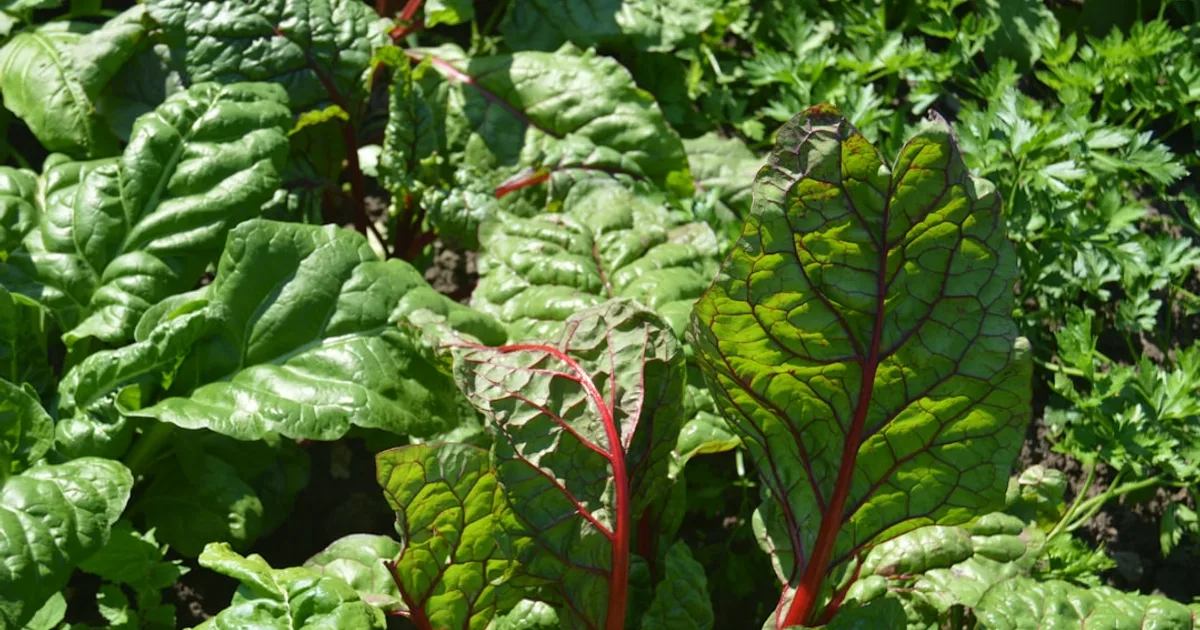
Swiss chard (Beta vulgaris var. cicla) is the crop that keeps producing leafy greens after spinach has quit. Once temperatures climb above 75°F, spinach bolts - it throws up a flower stalk, the leaves turn bitter, and the plant is done. In most of Zone 5-6, that happens in late May or early June. Chard doesn’t care. It keeps going through July, August, and into November. That season extension, from a single planting and a $2.49 seed packet, is the whole argument for growing it.
What you’re choosing between
Chard cultivars differ mainly in stem color and yield. The differences matter for how you use the harvest and how the bed looks.
Rainbow chard (sold as Bright Lights) produces a mix of red, yellow, orange, white, and pink stems on the same plant. It’s the most visually striking option and earns its place in ornamental kitchen gardens. Yield is slightly lower than the big-stemmed varieties, but for most home gardeners the difference is negligible.
Fordhook Giant is the white-stemmed standard. It produces the heaviest individual leaf weight and the thickest, most substantial midribs. If you’re growing chard primarily as a cooking green and want maximum pounds per bed, this is the one.
Peppermint (also listed as Candy Stripe) has red and white striped stems. Primarily ornamental, with flavor and texture comparable to other varieties.
Ruby Red / Rhubarb Chard runs deep red through the stems, midribs, and leaf veins. The color holds reasonably well when cooked quickly; it fades with prolonged heat. Slightly less yield than Fordhook but a useful visual contrast in mixed beds.
For most gardens: grow Bright Lights if you want the ornamental effect, Fordhook Giant if you want the most food.
The ROI case
Fresh bunched chard retails for $3–$4/lb at farmers markets and grocery stores (USDA AMS Specialty Crop Market News, Farmers Market Prices, 2024). A single plant yields roughly 1 lb across the growing season under normal conditions - but the math improves when you account for season length. Spinach gives you 6–8 weeks of production before it bolts. A chard plant started in spring runs from late May through October or November in Zones 5-6. That’s one planting doing the work of three successive spinach sowings.
The $2.49 seed packet contains far more seed than you’ll use in a season. Chard seed germinates well at 50–85°F soil temperature, so you can start seeds indoors 4 weeks before last frost and transplant out, or direct-seed 2–4 weeks before last frost once soil is workable.
Season Length: What Chard Does That Other Greens Can’t
The value of chard is clearest when you put it next to the alternatives occupying the same bed space.
| Crop | Productive season (Zone 6) | Plantings needed for continuous harvest | Approx. yield per 10 sq ft over full season |
|---|---|---|---|
| Spinach | 4-6 weeks per sowing | 3-4 for spring + 1 for fall | 5-8 lb |
| Lettuce (cut-and-come) | 3-4 weeks per sowing before bolting | 4-5 for extended season | 6-10 lb |
| Arugula | 3-4 weeks per sowing | 4-5 for extended season | 4-6 lb |
| Swiss chard | Late May through October-November; 5-6 months | 1 planting per season | 8-12 lb |
| Kale | April through December; 7-8 months | 1 planting per season | 6-10 lb |
Sources: Penn State Extension, Cool-Season Vegetable Production (2021); Cornell Cooperative Extension, Chard (2019).
One chard planting carries a 10-square-foot bed from late May through the first hard frosts of November. In the same period, you’d replant spinach 3 to 4 times and arugula 4 to 5 times to maintain comparable output. The management savings are real: chard doesn’t bolt, doesn’t need succession planting, and produces every week from the same crown. In July and August, when spinach and lettuce are completely done in Zone 5-7, chard is at peak production.
Per-season yield accumulation tells the story clearly. A single chard plant in a properly maintained bed, harvested weekly (outer leaves only), produces roughly 0.15 to 0.25 lb per harvest. At a 7-day interval over 26 weeks (late May through November): 26 weeks × 0.20 lb = 5.2 lb per plant. At 4 plants per standard 4x4 bed: approximately 20 lb per bed per season. At $3.50/lb: $70 from a $2.49 seed investment and a 4x4 bed section.
Growing requirements
Chard is a biennial. It completes its lifecycle over two years - vegetative growth the first year, seed production the second. The important distinction from spinach is what triggers bolting. Spinach bolts from heat stress. Chard bolts from day length and age, not temperature. That’s why it stays productive through summer heat that would end a spinach planting (Penn State Extension, Cool-Season Vegetable Production, 2021; Cornell Cooperative Extension, Chard, 2019). Afternoon shade in Zone 6-7 extends production further, but it isn’t required.
Soil pH of 6.0–7.0. Chard is a moderate feeder. Work compost into the bed before planting and side-dress with a nitrogen fertilizer (blood meal or balanced granular) every 4–6 weeks. Nitrogen-deficient plants produce pale, small leaves. Consistent moisture - 1 to 1.5 inches per week - keeps leaves tender. Water stress at the midrib thickens the stems and makes them fibrous sooner than they otherwise would be.
One important seed note: what’s sold as a chard “seed” is actually a dried fruit cluster containing 2–4 true seeds fused together. You will get multiple seedlings from each seed you plant. Thin aggressively to 6–9 inches between plants. Crowded chard produces smaller leaves, poorer airflow, and more disease pressure. Most gardeners underthin and regret it by July.
What goes wrong
Leaf miners (Liriomyxa brassicae) are the most common chard pest. The adult fly lays eggs on leaf undersurfaces; the larvae tunnel through the leaf tissue, leaving pale, winding white trails visible from above. The leaves are still edible if you remove the affected portions, but heavy infestations reduce yield and look terrible. Row cover installed at planting and maintained until temperatures make it impractical prevents adults from reaching the leaves. There are no effective chemical controls once larvae are inside the leaf.
Cercospora leaf spot (Cercospora beticola) appears as circular tan spots with purple or reddish-purple borders. It spreads in wet conditions and is worse in crowded plantings. Space plants properly, avoid overhead irrigation in the evening, and remove affected leaves promptly. Copper fungicide at early infection stages can slow spread but won’t eliminate an established infection.
Aphids colonize the undersides of leaves and growing tips. The cabbage aphid (Brevicoryne brassicae) and green peach aphid (Myzus persicae) are the usual culprits on chard. A hard water spray knocks most populations back; insecticidal soap handles heavier infestations. Avoid broad-spectrum insecticides that kill the parasitic wasps that keep aphid pressure in check naturally.
Harvest and kitchen use
Harvest outer leaves at 8–12 inches long, cutting cleanly at the base of the stem. Always leave at least 4–5 inner leaves intact around the central growing point. That growing point is the engine of the plant - remove it and you’ve ended production. Harvesting outer leaves only, every 7–14 days, keeps the plant producing continuously.
How to Cook It: Stems and Leaves Are Different Ingredients
The most common chard mistake is treating the whole leaf as a single ingredient. The midrib and stem require 3 to 4 minutes of cooking time. The leaf blade needs 1 to 2 minutes. Cook them together without adjustment and you end up with overcooked, mushy leaves or undercooked, tough stems. The solution is to treat them separately.
Sautéed with garlic (the standard preparation): Strip the leaf blade from the midrib. Slice midribs crosswise into 1/2-inch pieces. In a wide pan over medium heat, heat olive oil, add garlic, then add the sliced stems. Cook 3 to 4 minutes until stems are just tender. Add the torn leaf blades, toss, and cook 1 to 2 more minutes until wilted. Season with salt and a squeeze of lemon. The result is two textures from one plant - stems with bite, leaves silky. This works with any chard color.
Rainbow chard color note: The yellow, orange, and red stem pigments (betacyanins and betaxanthins) are water-soluble and fade with extended heat. If color in the final dish matters, cook rainbow chard briefly and plate immediately. Fordhook Giant stems are white and hold their appearance regardless of cooking time.
In soups and stews: Add stems at the same time as other vegetable aromatics, 20 to 30 minutes before serving. Add the leaf blades in the last 5 minutes. The leaves hold well in brothy soups without turning muddy - unlike spinach, which can develop an unpleasant texture if overcooked in liquid.
Stem gratin: Blanch the midribs in salted water for 5 minutes, drain, and layer in a buttered baking dish with béchamel sauce and grated Gruyère. Bake at 375°F until browned, 20 to 25 minutes. The stems absorb the sauce without turning mushy. This is a useful application for large late-season stems that are too thick to sauté comfortably.
Young leaves under 6 inches are tender enough to eat raw in salads. Mature leaves work best cooked.
Chard wilts fast after harvest. Refrigerate it unwashed with a slightly damp paper towel in the bag; it’ll hold 3–5 days. For longer storage, blanch and freeze - it holds quality for 8–10 months frozen (National Center for Home Food Preservation, Freezing Vegetables, 2021).
Related reading: Succession Planting Calendar - where chard fits in the season when spinach and lettuce have bolted
Frequently Asked Questions
How do I harvest Swiss chard so it keeps producing?
Cut outer leaves at the base, leaving the inner growing crown intact. This cut-and-come-again approach allows the plant to continuously push new leaves. Do not pull the entire plant. A single planting can produce from May through November in most zones from one $2.49 packet.
Does Swiss chard tolerate heat better than spinach?
Yes. Chard continues producing through summer temperatures that bolt spinach and lettuce. Quality decreases in extreme heat above 90 degrees and leaves can become mildly bitter, but the plant survives and resumes full production as temperatures moderate in fall.
How long does Swiss chard produce in a season?
A single planting in zones 5 to 7 typically produces from late May through October or November - 5 to 6 months from one direct sowing. Chard tolerates light frost to about 28 degrees, extending the harvest window well past what most greens allow.
Growing Swiss Chard? Track your harvest value and break-even date in the Garden ROI app.
Get the App