
Spaghetti Squash
Cucurbita pepo
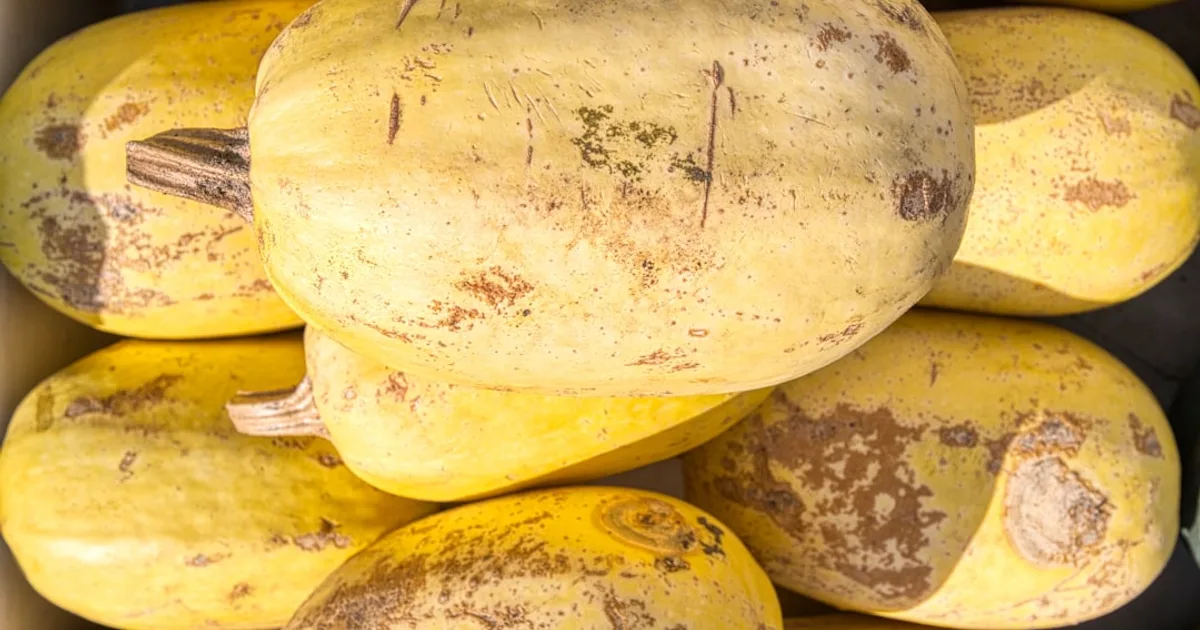
Spaghetti squash sells for $3-5 at the grocery store - roughly $1.50-2/lb for a 2-3 lb fruit. It’s not the most expensive item in the produce aisle, which is exactly why it’s worth growing: it stores for months, it’s large enough that each fruit provides multiple servings, and it produces 2-3 fruits per plant in a season. A few plants in the garden means you can stop buying it for most of winter.
The novelty of the stringy flesh is well-established at this point. For gardeners, the real case is storage value: a 3-plant patch producing 6-9 squash between September and first frost yields 18-27 lb of vegetable that keeps in a root cellar or cool basement until March.
What it actually is
Cucurbita pepo is the same species as zucchini, acorn squash, and pumpkins - one of the most genetically diverse domesticated vegetables. Spaghetti squash is distinguished from other winter squash by its flesh, which separates into long strands when cooked rather than forming a solid mass. The strand texture comes from the cell structure of the mature fruit.
The squash are oblong to football-shaped, typically 2-4 lb, yellow at full maturity. Immature spaghetti squash is pale green and firmer; the flesh strands are less developed. Harvest at full yellow color.
Varieties:
Most home garden seed packets are sold as generic “spaghetti squash” without named varieties. Some specialty catalogs offer:
- Orangetti: smaller (1.5-2 lb), orange-skinned, slightly sweeter. Earlier (80-85 days). High beta-carotene.
- Primavera: earlier-maturing, more compact vine.
- Tivoli: bush-type vine - a significant advantage for small gardens. 2-3 feet rather than 6-8 feet.
The standard type performs fine; named varieties matter mainly if space or season length is a constraint.
| Characteristic | Notes |
|---|---|
| Fruit size | 2-4 lb typical |
| Flesh color | Yellow |
| Strand formation | Best at full maturity (full yellow color) |
| Storage | 3-6 months at 50-60°F |
| Vining space | 6-8 feet per plant (standard) |
The ROI case
Spaghetti squash’s financial value is modest per pound but substantial per square foot when storage value is included. The math below treats each month of storage as equivalent to purchasing a fresh squash at retail.
A standard vine plant produces 2-4 squash per season (2-3 lb each). Three plants at 6-foot spacing in a 15-foot row section produce 6-12 squash per season.
| Scenario | Plants | Yield | Value @$1.75/lb | Seed cost | Net |
|---|---|---|---|---|---|
| 3-plant hill | 3 | 15-25 lb | $26-44 | $1.25* | $24.75-42.75 |
| 6-plant row | 6 | 30-50 lb | $53-88 | $2.49 | $50.51-85.51 |
*Estimated from $2.49 packet at approximately 25-30 seeds.
The storage argument is the real value. Squash harvested in September and stored properly are worth the same in February as they were at harvest. Many winter vegetables don’t offer this: lettuce and fresh greens require continuous planting, but a squash sitting in the basement requires nothing.
Winter storage value math: a 4 lb spaghetti squash harvested in September and stored properly to February represents $6-10 in avoided produce cost in a month when winter squash at retail is at its seasonal price peak. Three plants producing 9 squash (3 per plant) between September and first frost gives you roughly 36 lb of stored squash - enough to supply a household weekly serving through February. That’s $54-90 in produce value consumed over 5 months, from a $1.25 seed investment and a single growing season.
The pasta substitute angle: a 5 lb spaghetti squash cooked and separated into strands yields roughly 4 cups of cooked “pasta.” Replacing one pasta dinner per week for a household of four replaces approximately 8 oz of dry pasta per meal. Dried pasta at grocery store prices runs $0.50-1.50 per 8 oz serving (mainstream brands) to $2-4 per serving (specialty/artisan pasta). A 5 lb squash at $1.50-2.50/lb costs $7.50-12.50 retail - about even or slightly higher per serving than commodity pasta, but comparable to specialty pasta, and with better nutritional density. From your own garden, the cost per squash is fractions of a cent in seed.
Growing requirements
Timing: direct sow after soil reaches 65°F and frost risk is past. In zones 5-7, this is late May to early June. Spaghetti squash matures in 90-100 days, which means starting by early June in zone 5 to harvest before frost.
Indoor starting is rarely necessary but can add 2-3 weeks in short-season climates. Start 3-4 weeks before transplant date in individual large pots (squash roots dislike disturbance). Transplant after last frost.
Space requirements: vines reach 6-8 feet long. Hill planting (2-3 seeds per hill, thin to the strongest plant) at 4-6 foot centers is traditional. Training vines in a circle around the hill keeps them contained. Bush varieties like Tivoli need only 2-3 feet.
Soil and fertility: squash are heavy feeders. Prepare planting hills with generous compost incorporation. Side-dress with balanced fertilizer when vines reach 2-3 feet, and again when fruit sets. Nitrogen supports vine growth; phosphorus and potassium support fruit development.
Pollination: like all cucurbits, spaghetti squash produces separate male and female flowers on the same plant. Male flowers appear first (no fruit at the base); female flowers have a small immature squash at the base. Bees handle pollination in most gardens. In low-pollinator conditions or early in the season, hand-pollinate with a small brush or by touching the center of a male flower to the center of a female flower.
Watering: consistent moisture at the root zone; avoid overhead irrigation that wets the leaves and stems. Drip irrigation or soaker hoses reduce fungal disease pressure.
What goes wrong
Powdery mildew (Podosphaera xanthii) is nearly universal in spaghetti squash by late summer - white powdery coating on leaves, typically starting on older leaves and spreading. It’s ugly but manageable. Plants that get powdery mildew in August and September can still produce a full crop; treat with potassium bicarbonate spray to slow progression and remove severely affected leaves. Preventive treatment starting in July helps.
Squash vine borer (Melittia cucurbitae) is the most destructive pest in eastern North America. The adult moth lays eggs at the base of the vine; larvae bore into the stem and destroy it from the inside. Prevention: row cover over young plants until flowering, then remove for pollination. Inspect the base of vines weekly and apply Bt directly at the entry point of any borer holes found. Aluminum foil wrapped around the base of the stem confuses the adult moth.
Squash bugs (Anasa tristis): flat, gray-brown insects that cluster on leaves and cause wilting. Remove egg masses (bronze-colored, laid in neat clusters under leaves) by hand. Neem oil spray on young nymphs. Squash bugs are harder to control once adult populations are established.
Poor fruit set often results from incomplete pollination. If flowers are developing but fruit aborts early, hand-pollinate to confirm. Also check that you have both male and female flowers open simultaneously - males often precede females by a week or more.
Fruit rot where squash touches soil. Place a piece of cardboard, plastic mulch, or a small board under developing squash to lift them off the soil surface.
Harvest and storage
Harvest when the skin is fully yellow and hard. A fingernail pressed into the skin shouldn’t dent it. The stem end will be slightly corky. For best storage, leave 2-3 inches of stem attached - stemmless fruit rots faster.
Curing: after harvest, cure in a warm (70-80°F), well-ventilated location for 10-14 days. Curing hardens the skin and heals any minor surface wounds, extending storage life.
Storage: 50-60°F, dry, with good air circulation. A cool basement shelf, root cellar, or unheated room works. Properly cured spaghetti squash stores 3-6 months. Check periodically and use any that show soft spots.
Preparing: the standard method is halving lengthwise, scooping seeds, brushing with olive oil, and roasting cut-side-down at 400°F for 35-45 minutes until tender. The strands scrape out with a fork. The seeds can be rinsed, salted, and roasted at 325°F for 15-20 minutes - similar to pumpkin seeds.
Core preparations:
-
Simply roasted with olive oil, salt, and pepper: the most direct preparation. The strands have a mild flavor that takes well to almost any topping.
-
With marinara and meatballs: the classic low-carb pasta substitute. The strand texture is pasta-like; the flavor is mild enough to work as a background for the sauce.
-
Brown butter and sage: brown butter until nutty, add fresh sage leaves until crisp, toss with squash strands and Parmesan. Better than it sounds.
-
Spaghetti squash fritters: mix strands with egg, cheese, and herbs; pan-fry like latkes. Good way to use up squash mid-winter.
-
Cold in salads: the strands hold texture well cold. Dress with vinaigrette, add cherry tomatoes, cucumber, and fresh herbs for a grain-free grain-salad type dish.
How Spaghetti Squash ROI Compares to Other Winter Squash
Butternut squash retails at $1.75-2.50/lb versus spaghetti squash’s $1.50-2.50/lb - a modest price advantage for butternut, with better storage life (butternut commonly holds 4-6 months versus spaghetti squash’s 3-5 months). Butternut’s denser flesh means more usable cooked weight per pound. In straight ROI terms, butternut is a slightly stronger performer per pound of seed investment.
Winter squash varieties as a category - delicata, acorn, kabocha, hubbard - cover different culinary applications. Acorn squash ($1.50-2.00/lb) stores 2-3 months; its smaller size (1.5-2.5 lb per fruit) means individual-serving portions without leftovers, which has practical kitchen value. Spaghetti squash’s niche is the pasta-substitute angle - no other winter squash delivers the same texture in that role. The choice between them is partly culinary and partly based on how much storage space and growing area you have available.
For a first-time winter squash planting, spaghetti squash and butternut together provide complementary harvest windows, different culinary applications, and good overall season coverage from two seed packets costing $2-3 each.
Related reading: Acorn Squash - fellow winter squash with different flavor profile; Butternut Squash - longest storage of the winter squash types
Growing Spaghetti Squash? Track your harvest value and break-even date in the Garden ROI app.
Get the App