
Bee Balm
Monarda didyma
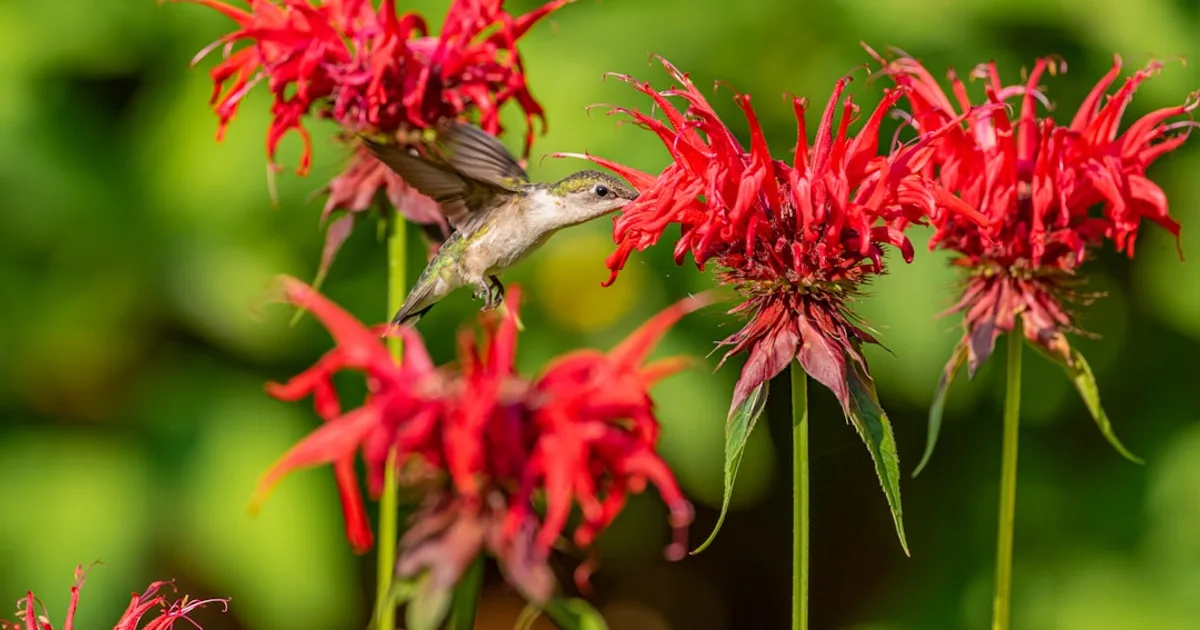
Bee balm is the plant that colonial Americans drank when they stopped drinking British tea. After the Boston Tea Party in 1773, Oswego tea - an infusion of Monarda didyma leaves used by the Oswego people of the Great Lakes - became a patriotic substitute. The flavor is herbal, slightly spicy, with a bergamot quality that sits between oregano and Earl Grey tea. It’s the herb behind the “bergamot” note in proper Oswego tea, distinct from the citrus bergamot used in commercial Earl Grey but sharing the aromatic family.
Beyond the tea, bee balm is one of the best perennial plants for a food garden. It spreads aggressively by rhizome, filling a bed from a single plant in 2-3 years. It blooms prolifically in shaggy red, pink, or lavender heads that attract hummingbirds, bumblebees, and every pollinator in the neighborhood. The leaves and flowers are both edible. It asks for little beyond a drink of water in dry spells.
What it actually is
The genus Monarda contains 16 North American native species. Three are commonly grown in gardens:
| Species | Common name | Flower color | Flavor | Zone | Notes |
|---|---|---|---|---|---|
| M. didyma | Bee balm, scarlet bee balm | Red, pink, white | Mild, bergamot, slightly sweet | 3-9 | Most culinary use; edible flowers |
| M. fistulosa | Wild bergamot | Lavender, pink | More intense, oregano-adjacent | 3-9 | Stronger flavor; better for drying |
| M. citriodora | Lemon bee balm | Lavender | Lemon-thyme character | Annual; all zones | Distinct flavor profile; annual |
M. didyma is the primary culinary species, with the mildest and most tea-appropriate flavor. M. fistulosa (wild bergamot) has more intense, almost medicinal flavor that holds up better to drying and makes a more assertive herb tea.
Named cultivars matter for disease resistance: standard species M. didyma is highly susceptible to powdery mildew. Mildew-resistant cultivars (‘Jacob Cline’, ‘Marshall’s Delight’, ‘Raspberry Wine’) are strongly recommended - they maintain foliage through the season instead of going brown in August.
Medicinal and Antimicrobial Properties
The essential oils in bee balm leaves contain thymol and carvacrol - the same compounds present in high concentrations in thyme and oregano, and responsible for those herbs’ documented antimicrobial activity. In Monarda species, carvacrol and thymol content varies by species and growing conditions, but is measurable and consistent with other Lamiaceae herbs used medicinally (Hawkins et al., Industrial Crops and Products, 2013).
Traditional use: the Oswego people and neighboring Great Lakes nations used Monarda preparations as a disinfectant for skin wounds, as a treatment for colds and fever (both the aromatic steam and the tea), and as a topical application for bee stings. When settlers adopted Oswego tea as a British tea substitute, they were borrowing from an established medicinal plant tradition, not just finding a flavored beverage.
The antimicrobial claim deserves precision: lab studies showing carvacrol and thymol activity against bacterial strains in vitro do not directly translate to clinical treatment of infections in humans. The appropriate framing is “traditional use supported by reasonable phytochemical basis” rather than “proven medical treatment.” But the herb’s use as a topical antiseptic in mild situations (rinse for minor mouth irritation, external wash for minor skin wounds) is consistent with its chemistry and traditional record.
The ROI case
Bee balm’s financial ROI is modest but consistent, and improves each year as the planting spreads.
| Year | Plants/clumps | Fresh yield | Dried equivalent | Value @$12/lb dried | Seed cost | Cumulative net |
|---|---|---|---|---|---|---|
| 1 | 1 | 0.25 lb fresh | ~0.04 lb dried | $0.48 | -$2.49 | -$2.01 |
| 2 | 2-3 (spread) | 0.5 lb fresh | ~0.08 lb dried | $0.96 | - | -$1.05 |
| 3 | 4-6 (full bed) | 1.0 lb fresh | ~0.16 lb dried | $1.92 | - | $0.87 |
| 5 | Established bed | 2.0 lb fresh | ~0.3 lb dried | $3.60 | - | $4.47 |
The dollar numbers are small. The value isn’t primarily financial for most growers - it’s the pollinator habitat, continuous ornamental bloom, access to a fresh herb that doesn’t exist at any grocery store, and the perennial character that requires no replanting.
Flower value: bee balm petals retail at farmers markets and specialty food suppliers for $20-40/lb when sold as edible flowers. Dried flowers in small quantities (1 oz) go for $6-12 on specialty herb sites. A productive patch in full bloom produces more edible flowers than most households can use, with surplus available for direct sale or gifting.
Growing requirements
Establishment: bee balm grows easily from seed started indoors 8-10 weeks before last frost, or direct sown in fall or early spring. Germination at 65-70°F in 10-15 days. Plants don’t bloom in their first year from seed; expect blooms in year two. Division of existing clumps is the fastest way to establish a productive patch.
Spreading: this plant spreads by underground rhizomes, easily 12-18 inches per year in each direction from an established clump. Within 3 years, a single plant fills a 4-square-foot area. Contain it with buried edging if you don’t want it spreading into neighboring beds; otherwise let it expand and harvest from the entire patch.
Division: divide every 2-3 years in early spring before new growth reaches 6 inches. Dig the clump, separate into 4-6 inch sections with several stems each, discard the woody central core, and replant the vigorous outer sections. Division rejuvenates the planting and gives you propagating material to expand or share.
Powdery mildew management: the biggest aesthetic problem with M. didyma. By August, susceptible varieties look brown and ragged. Use mildew-resistant cultivars. If you have susceptible types, cutting plants back by half after first bloom flush often prevents the worst of the mildew and triggers a second flush of cleaner growth.
Harvest: cut stems when 1/3 to 1/2 of the flowers on a stem are open. The fully open phase is peak for both visual quality and aromatic oil content. Dry in bundles upside-down in a well-ventilated space.
What goes wrong
Powdery mildew (Erysiphe cichoracearum): white powdery coating on leaves, worst in humid summers. Disfiguring but not fatal. Plant resistant varieties (see above); cut back affected foliage in August and it often regrows cleanly in fall.
Overcrowding and declining bloom: established patches that haven’t been divided in 4-5 years become congested and produce fewer flowers. The center of old clumps becomes woody and unproductive. Divide every 2-3 years to maintain vigor.
Slug damage on young plants: slugs eat emerging shoots in early spring when soil is still cool and moist. Diatomaceous earth ring around new growth, refreshed after rain; hand-pick at dusk or dawn. Established plants with woody crowns are rarely damaged by slugs.
Harvest and use
Harvest flowers when 1/3 of the florets on the head are open. Harvest leaves from the upper half of the stem before flowers open - flavor is most volatile-rich at this stage. Both flowers and leaves have the same basic flavor, with flowers being more delicate.
Drying: cut stems at 50% bloom, bundle loosely, hang in a well-ventilated location out of direct sun. Dry time 1-2 weeks. Strip leaves from stems after drying; store in a sealed glass jar. Dried bee balm holds its flavor for 12-18 months.
Flavor intensity: M. didyma is mild enough to use generously; M. fistulosa is stronger and more oregano-like, suitable in smaller quantities.
Core preparations:
-
Oswego tea: 1 tablespoon fresh leaves (or 1 teaspoon dried) per cup of boiling water; steep 5-7 minutes. The flavor is herbal with a floral bergamot quality - not identical to Earl Grey but in the same register. Fresh leaves make a noticeably better tea than dried.
-
Herb butter: fresh bee balm leaves and flowers minced into softened butter with salt and lemon zest. Melted over grilled chicken, fish, or corn. The flowers make the presentation arresting; the flavor adds herbal complexity without overpowering.
-
Salad garnish: fresh petals stripped from the flower head and scattered over green salads, grain bowls, or cold pasta dishes. The color (red, pink, lavender depending on variety) is dramatic; the flavor is mild enough that it functions as both visual and culinary accent.
-
Infused honey: fresh bee balm flowers packed into a jar, covered with honey, left to infuse at room temperature for 2 weeks, strained. The honey takes on the floral-herbal quality. Used in tea, spread on toast, or as a glaze for roasted meat.
-
Savory applications: the M. fistulosa (wild bergamot) type, with its stronger oregano-adjacent flavor, works in cooked applications - added to tomato sauces, pizza preparations, or bean dishes. Use like oregano, in smaller quantities.
Pollinator Garden Value
Bee balm is one of the most productive pollinator plants available to North American gardeners. The bloom period (June-August, or July-September depending on climate and variety) coincides with the peak nectar demand period for native bees. Monarda species are native North American plants that co-evolved with native bee populations - bumblebees, carpenter bees, and many native sweat bee species feed on them specifically. Hummingbirds visit the red and pink varieties reliably.
Beyond ecological value, pollinator garden plants have a genuine commercial market. Plug plants (small divisions or seedlings) of named bee balm varieties sell for $4-8 each at native plant nurseries and farmers markets with plant sales. A well-established bee balm patch divided in early spring produces 6-12 divisions per clump. At $5/plant, one spring division of a 3-clump planting generates $30-60 in plant sales - more than the dried herb value in most years. Selling native pollinator plants at farmers markets or through community plant swaps is a realistic secondary market for gardeners with established patches.
The combination of three value streams - culinary herb (fresh and dried), edible flowers (sold or used), and native pollinator plants (sold as plugs or divisions) - makes bee balm one of the more financially multidimensional perennial herbs available for home gardens, even if no single stream produces dramatic returns.
Related reading: Lavender - fellow perennial herb with edible flowers, tea value, and pollinator habitat; Echinacea - native pollinator plant with medicinal herb market; Thyme - culinary herb sharing thymol/carvacrol chemistry
Growing Bee Balm? Track your harvest value and break-even date in the Garden ROI app.
Get the App