
Black Currant
Ribes nigrum
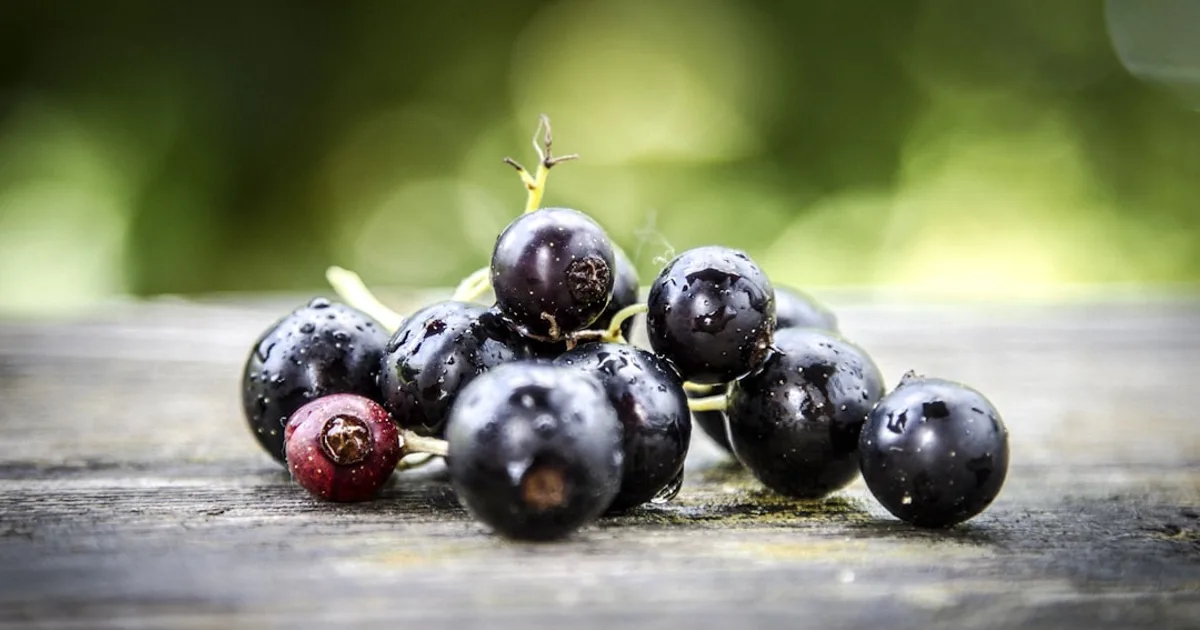
Before you order plants, check your state’s department of agriculture website. Black currant (Ribes nigrum) spent most of the twentieth century as an illegal crop in the United States, and while the federal ban was lifted in 1966, some states still restrict or regulate its cultivation as of 2024. This is not fine print. It is the first thing you need to know.
The Legal History
The problem is white pine blister rust (Cronartium ribicola), a fungal pathogen accidentally introduced to North America from Europe on nursery stock around 1910. The fungus has a two-host life cycle: it requires both a five-needled pine and a plant in the genus Ribes (currants and gooseberries) to complete its reproduction. Infected pines develop large, orange-yellow cankers on their branches and trunks. In a slow-moving epidemic through the first half of the 1900s, it killed millions of eastern white pines (Pinus strobus) and threatened the commercial timber industry.
The timber lobby’s response was to push for federal eradication of the fungus’s alternate host. In 1911, the federal government banned commercial cultivation of Ribes species and organized large-scale eradication efforts that destroyed wild and cultivated plants across the Northeast and upper Midwest. States passed their own legislation. For roughly fifty years, growing currants and gooseberries in much of the United States was simply illegal.
The federal ban was lifted in 1966 and authority transferred to individual states. Many states kept restrictions in place regardless. New York - one of the most important states for currant production historically - maintained its black currant ban specifically until 2003, when a Cornell Cooperative Extension petition demonstrated that modern rust-resistant Ribes varieties posed lower risk to the timber industry (Cornell Cooperative Extension, White Pine Blister Rust and Ribes, 2003).
As of 2024, most states have no restrictions. But several northeastern and upper Midwest states still regulate black currant planting - particularly near concentrations of five-needled pines - and a few maintain outright bans or require state permits. The practical advice: search “[your state] department of agriculture Ribes black currant restriction” before buying any plants. If you’re in Maine, New Hampshire, Vermont, or Michigan, read the current regulations carefully. For states in the western and southern US, restrictions are generally absent, but verify rather than assume.
The other practical takeaway: if you live in blister rust country and want to grow black currant, plant rust-resistant varieties. ‘Consort’ was specifically developed for this purpose (Cornell Agricultural Experiment Station). ‘Ben Sarek’ also carries documented resistance. More on varieties below.
What Black Currant Is - and What It Isn’t
The site already has a page for Currant, which covers red currant (Ribes rubrum) and white currant (a mutation of the same species). Black currant is a distinct species - Ribes nigrum - with a distinct flavor and a different production profile. They are not interchangeable.
Red and white currant flavor is bright and acidic - like a sharper, more complex version of cranberry. Black currant flavor is something else entirely. Earthy, intensely aromatic, slightly resinous, with a tannin structure that sits in the back of your mouth. Eaten raw off the shrub, black currant is polarizing. Most people who encounter it for the first time expect something like a blueberry and are surprised. But process it - into jam, syrup, juice, or liqueur - and the intensity that reads as strange when raw becomes something hard to replicate. Crème de cassis, the French black currant liqueur, is made from nothing else. Ribena, the UK’s most popular cordial, has been black currant since 1938. The flavor has a 90-year commercial track record in Europe. It just happens to be nearly unknown to most Americans because the crop was illegal here for fifty years.
The practical implication for growers: if you’re planning to sell fresh black currant at a farmers market to customers who have never tasted it, offer samples. If you’re making jam, cordial, or wine for your own household, grow black currant without hesitation. The processed product is what most people who love this fruit actually love.
Black currant is also not the same growing project as red or white. It produces on both one-year and two-year wood, which affects your pruning strategy. The shrubs are more vigorous, typically reaching 4-6 feet. The berries are harvested a bit later in the season - mid to late July in most of Zone 5-6. And the fruit is higher in nutrition than its more familiar cousins.
Nutrition: the Actual Numbers
Black currant is one of the highest vitamin C sources available in a temperate fruit planting. Per 100 grams of fresh weight, black currant contains approximately 181 mg of vitamin C (USDA FoodData Central, NDB No. 09083, accessed 2024). A navel orange contains approximately 59 mg per 100g by the same dataset. That ratio - roughly 3× per gram, with some cultivars reaching 5× - is not marketing copy. It is a documented nutritional characteristic of the species.
Black currant is also exceptionally high in anthocyanins, the flavonoid pigments responsible for the deep purple-black berry color. Studies published in the Journal of Agricultural and Food Chemistry (Wu et al., 2006) measured black currant anthocyanin content at 250-400 mg per 100g fresh weight, among the highest of any commonly cultivated fruit. The anthocyanins are the primary target of the supplement and extract market that’s driven some of the commercial interest in black currant in New Zealand and the UK.
None of this means you should eat black currant expecting a health outcome. But if you’re evaluating which fruit to plant and the nutritional density of the harvest matters to your household, black currant’s numbers are materially different from most options.
The ROI Case
Fresh black currant at specialty produce markets runs $8-14/lb where available (USDA AMS Specialty Crop Market News, 2023). Dried black currant sells for $12-20/lb. Frozen: $5-8/lb. The $10/lb figure used here is a conservative midpoint for fresh or lightly processed fruit at a farm stand or farmers market.
A bare-root plant at $14.99 is your entire establishment cost in most cases. Black currant does not require pollination partners - it’s self-fruitful. You need no trellis. You need no annual replanting.
Multi-Year Yield and Value
| Year | Yield (lb) | Gross value at $10/lb | Annual inputs | Cumulative input | Cumulative value | Net cumulative |
|---|---|---|---|---|---|---|
| 0 (plant) | 0 | $0 | $14.99 | $14.99 | $0 | -$14.99 |
| 1 (establish) | 1.0 | $10 | $7 | $21.99 | $10 | -$11.99 |
| 2 | 3.0 | $30 | $7 | $28.99 | $40 | +$11.01 |
| 3 | 5.0 | $50 | $7 | $35.99 | $90 | +$54.01 |
| 4 | 5.0 | $50 | $7 | $42.99 | $140 | +$97.01 |
| 5 | 5.5 | $55 | $7 | $49.99 | $195 | +$145.01 |
| 6-10 | 5.5/yr | $55/yr | $7/yr | ~$85 total | ~$470 | +$385 |
Annual inputs: $2 fertilizer + $5 pruning time at minimum wage (approximately 25 minutes annually on an established shrub).
Yield data: Penn State Extension, Small Fruit Production, Agronomy Fact Sheet 43, 2021; University of Minnesota Extension, Growing Gooseberries and Currants, 2020. Year 1 establishment yield on the high end; plants receiving adequate water and light in their first season typically produce 0.5-2 lb.
Break-even arrives in year 2. From year 3 forward, a single mature shrub returns $40-50 in net annual value from fresh fruit alone. A properly managed plant produces for 15-20 years. The $14.99 establishment cost is returned in the first productive season.
The jam calculation is where it gets more interesting. Five pounds of black currant with 4 lb of sugar produces 8-10 half-pint jars by the standard jam ratio. Black currant jam at specialty retail sells for $10-14/jar. At $10/jar - conservative - a single plant’s year-3 harvest produces $80-100 in jam value annually, indefinitely. The jam math scales.
Varieties
Not all black currant varieties perform the same, and variety selection matters more here than with many crops because it directly affects your disease risk, your yield, and whether you can legally grow the plant in your location.
| Variety | Origin | Yield | Fruit size | Disease resistance | Notes |
|---|---|---|---|---|---|
| Ben Sarek | James Hutton Institute (Scotland) | Very high | Large | Good mildew; good rust resistance | Dwarf habit (3 ft); best choice for small gardens; widely available in US nurseries |
| Consort | Cornell Agricultural Experiment Station | Moderate | Medium | Excellent blister rust resistance | The recommended variety for growers in states with blister rust restrictions; flavor is slightly milder than European types |
| Tiben | Czech Republic | High | Very large | Moderate | High sugar content; excellent fresh and processed; widely available in US through specialty nurseries |
Ben Sarek is the first choice for most backyard growers. Developed by the Scottish Crop Research Institute (now the James Hutton Institute) in the 1980s, it combines a dwarf growth habit - topping out around 3 feet - with a very high yield for its size. A mature Ben Sarek in good conditions produces 4-7 lb in a smaller footprint than most fruit shrubs. The compact size also makes it easier to net against birds. It carries documented resistance to American powdery mildew strains.
Consort was selected at the Cornell Agricultural Experiment Station specifically for white pine blister rust resistance (Cornell Cooperative Extension, Ribes Varieties Resistant to White Pine Blister Rust, 1994). If you’re in a regulated state or have five-needled pines on your property, Consort is the defensible choice. Yields are lower than Ben Sarek, and the flavor profile is slightly less intense - closer to a tart black cherry than the classic European black currant character - but the disease profile makes it the right call in many situations.
Tiben is the large-berry variety. Czech breeding, widely available through US specialty nurseries (One Green World, Raintree Nursery). The berries are noticeably larger than most black currant - close to the size of a blueberry - and the sugar content is higher, which makes them better for fresh eating than other varieties. Mildew resistance is moderate, not excellent. In humid climates, Tiben benefits from site selection with good airflow.
Other varieties worth knowing: Titania (Swedish; very high yield, good mildew resistance) and Ben Hope (James Hutton Institute; specifically bred for mildew and rust resistance) are available through specialty nurseries and perform well in US conditions.
Growing Requirements
Hardiness. Most black currant varieties are rated to USDA Zone 3 (-40°F). They require a substantial winter chill period - 800-1200 hours below 45°F - which makes them unsuitable for Zone 8 and warmer. In Zone 3-6, chill hours are not a limiting factor.
Soil. pH 5.5-6.5 is ideal (Penn State Extension, Small Fruits for Pennsylvania, 2022). Amend with compost before planting; black currant is a moderate feeder and responds well to organic matter. Drainage matters more than pH: the shrubs will not tolerate waterlogged roots. If your site holds standing water, plant on a mound or raised bed. Heavy clay can be amended with perlite and compost before planting, but persistently wet soil will eventually cause root problems regardless.
Sunlight. Full sun produces the highest yield. Black currant tolerates partial shade - 3-4 hours of direct sun - better than most fruit shrubs, which makes it useful for sites that would rule out other options. Shade reduces yield but rarely prevents production altogether. In Zone 6 and warmer, afternoon shade reduces heat stress; morning sun with afternoon shade is a viable configuration.
Water. One inch per week during the growing season. Consistent moisture during fruit development prevents small, poorly-flavored berries. Drip irrigation or soaker hose is preferable to overhead watering, which increases foliar disease pressure.
Fertilizer. Apply a balanced fertilizer (10-10-10 or similar) at 1 lb per 100 square feet in early spring before bud break. Black currant is not a heavy feeder; more fertilizer is not better. Excess nitrogen produces soft, mildew-susceptible growth with reduced fruit quality.
Pruning. Black currant produces on both first-year and second-year wood, with best production on two-year canes. The renewal pruning protocol: each year, remove one-third of the oldest canes at the soil line in late fall or early spring before bud break. On a mature shrub, that means cutting 3-5 of the darkest, most gnarled canes completely out. This keeps the productive wood cycling through without starting over each season. Do not tip-prune canes that will remain - the fruiting laterals develop along the full length of retained canes. An annually pruned shrub at year 5-10 should have a mix of 1, 2, and 3-year canes in roughly equal numbers.
Spacing: 5-6 feet between plants, 8 feet between rows.
What Goes Wrong
White pine blister rust (Cronartium ribicola) uses black currant as an alternate host. The disease does not usually kill currant plants but spreads from infected currant leaves to nearby five-needled pines via airborne spores. If you have eastern white pine (Pinus strobus), western white pine (Pinus monticola), or other five-needled pines within several hundred feet, choose rust-resistant varieties (Consort, Ben Hope) and follow your state’s setback requirements. Cornell Cooperative Extension’s White Pine Blister Rust fact sheet is the authoritative reference for northeastern growers.
Currant aphid (Cryptomyzus ribis) colonizes the undersides of leaves in early spring, causing the distinctive reddish puckering and downward leaf curl that looks alarming but is not immediately fatal. Leaves curl around the aphid colonies, making them hard to treat once established. The practical response: inspect new growth in April and May. When you see the earliest signs of curl, hit the undersides with insecticidal soap before the leaves fold over. Once leaves are tightly curled, you need systemic control or to wait it out - the plants usually push through, but yield on affected shoots is reduced. Lady beetles and parasitic wasps naturally suppress populations by midsummer.
Imported currantworm (Nematus ribesii, the same gooseberry sawfly species that attacks related plants) is the more urgent problem. The greenish, black-spotted larvae feed in clusters and can strip a plant of leaves in 48-72 hours. They start feeding from the center of the shrub outward, which is why you can have a serious infestation before noticing it from outside the plant. Check the interior canes weekly from late May through June in Zone 4-5. Catch populations when small and hand-pick larvae directly - it works and takes less time than applying anything. For larger outbreaks, Bacillus thuringiensis (Bt) applied to leaf undersides controls early-instar larvae. Spinosad works faster for established populations.
Powdery mildew (Erysiphe grossulariae) shows as white powder on shoot tips and young leaves, typically in humid conditions from late May onward. Mildew-resistant varieties (Ben Sarek, Ben Hope) largely eliminate this problem. For susceptible plants, an open pruning habit with good airflow is the primary prevention. Sulfur-based fungicide applied at bud break, repeated every 10-14 days during periods of high humidity, provides control.
Birds will take your harvest if you don’t net. Black currant’s dark berries against dark canes are easier to miss at a distance, but birds find them. A lightweight bird net draped over the shrub for the two weeks before and during harvest is standard practice. For Ben Sarek’s compact habit, a small net or floating row cover works well.
Harvest and Storage
Black currant ripens mid-July in most of Zone 5-6, later in Zone 3-4. The berries go through a visible sequence: green, then bright and slightly blue-black and hard, then deep matte black-purple with a slight give when pressed. Do not harvest at the first-dark stage. Wait until the berries are uniformly dark, slightly soft, and the clusters pull free of the branch cleanly. A cluster left 3-5 days past first-dark will be noticeably sweeter and less harsh.
Harvest by stripping entire clusters. The clusters - called strigs - pull free cleanly when ripe. Strip them over a bowl, or pick the whole strig and strip the berries later by drawing the strig between the tines of a fork. A 5 lb harvest from one or two mature plants takes 45-60 minutes.
Fresh berries refrigerate for 3-5 days. For longer storage, freeze in a single layer on a sheet pan before transferring to bags. Frozen black currant holds full quality for 12 months and works as well as fresh for jam, syrup, and juice. This is not a concession - many jam makers prefer frozen fruit because the freezing breaks down cell walls and speeds up cooking time.
For jam: black currant is very high in natural pectin. No added pectin needed. A standard ratio is 4 parts currant to 3 parts sugar by weight, cooked to 220°F at sea level (subtract 2°F per 1,000 feet elevation). Process in a water bath canner 10 minutes for half-pint jars. The resulting jam is intensely flavored and sets firmly. If you’ve only had commercial blackberry jam, the comparison doesn’t prepare you for what fresh black currant jam tastes like.
For cordial: combine 2 lb black currant with 2 cups water, simmer until berries are fully broken down, strain through a fine-mesh strainer or jelly bag without pressing (pressing clouds the liquid), return to heat with 2 cups sugar per 2 cups juice, simmer 5 minutes, bottle hot. Shelf-stable for 6 months refrigerated once opened.
Related crops: Currant, Gooseberry
Related reading: Fruit Tree Payback Timeline - when perennial fruit crops cover their cost
Growing Black Currant? Track your harvest value and break-even date in the Garden ROI app.
Get the App