
Currant
Ribes rubrum
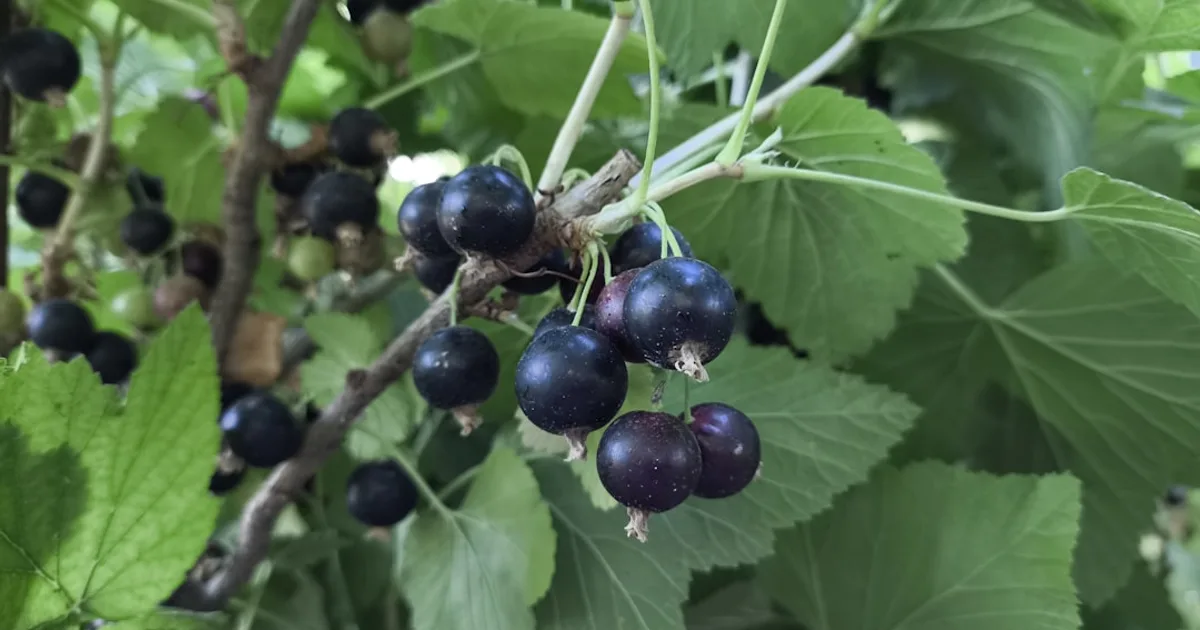
Walk through any decent European grocery store and you’ll find fresh black currants in the produce section alongside raspberries and strawberries. Walk through any American grocery store and you’ll find nothing. That absence is not an accident. The United States spent the better part of a century making sure currants disappeared from American agriculture, and the consequences of that policy linger today even though the policy itself is mostly gone. The result is a market gap that home growers can exploit better than almost any other fruit crop: you can charge $8-15/lb for fresh currants at a farmers market, or keep them for yourself, and either way you’re offering something people cannot find anywhere else.
Why Currants Disappeared From American Stores
The story starts with white pine blister rust (Cronartium ribicola), a fungal pathogen that was accidentally introduced to North America from Europe in the early 1900s on nursery stock. The fungus requires two hosts to complete its life cycle - five-needled white pines (Pinus strobus and related species) and plants in the genus Ribes, which includes currants and gooseberries. When the timber industry recognized the threat to its lumber operations, it successfully lobbied the federal government for a solution. In 1911, the federal government banned cultivation of Ribes species. States followed with their own bans, and for decades, currant and gooseberry growing was simply illegal across most of the country.
The federal ban was lifted in 1966. Most states eventually followed, though not uniformly and not quickly. New York, a major timber state, maintained its black currant ban until 2003. A handful of states still have restrictions on black currant cultivation specifically, or require certain distances from five-needled pines. Check your state’s current department of agriculture regulations before planting black currant - red and white currant are generally unrestricted everywhere now.
The practical result of ninety-plus years of prohibition: no commercial growing infrastructure, no established distribution chains, no consumer familiarity. European countries never went through this. In the UK, black currant cordial (Ribena) is a childhood staple. In France, cassis liqueur is a serious cottage industry. In the US, most people under fifty have never tasted a fresh currant at all. When you grow them, you are not competing with the grocery store. You are the only option.
Black, Red, and White: What You’re Actually Choosing
These are three different growing experiences with different outputs. Get clear on which one fits your goals before you order plants.
| Type | Species | Flavor | Primary Use | Zone | Yield (mature) | Key Varieties |
|---|---|---|---|---|---|---|
| Black | Ribes nigrum | Intense, musky, tart | Jam, cordial, juice | 3-7 | 5-10 lb/plant | Titania, Ben Connan, Ben Sarek |
| Red | R. rubrum | Bright, tart, jewel-like | Jelly, fresh, baking | 3-8 | 5-10 lb/plant | Rovada, Red Lake, Jonkheer van Tets |
| White | R. rubrum (mutation) | Mild, sweet, low acid | Fresh eating, markets | 3-8 | 4-8 lb/plant | White Imperial, Primus, Blanka |
Black currant is the highest-value option on paper - retail prices where available run $10-15/lb because the supply is so thin - but the flavor is polarizing. It is not a gentler version of red currant. It is an entirely different flavor profile: earthy, almost musky, with tannins that hit hard when eaten raw. Most people who love it, love it in cooked or processed form. Most people who encounter it raw without preparation think something is wrong with it. Know your audience before you plant a row of black currants for a farmers market. If you’re making jam and cordial for your own household, black currant is the obvious choice. If you’re selling fresh fruit to people who have never had one, red or white will move faster.
Red currant is the most visually striking. At peak ripeness, the clusters - called strigs - hang from the branches like strings of translucent red glass. They photograph well, they sell on appearance alone, and the flavor is tart enough to be interesting but accessible enough that most people want to try them again. Rovada produces exceptionally long strigs that make harvest faster. Red Lake is older and more forgiving of varied conditions. Jonkheer van Tets ripens early and consistently.
White currant is an albino mutation of red currant - not a separate species, and it grows under identical conditions. The flavor is milder and sweeter, lower in acid, and it’s the one variety that people will actually eat by the handful fresh off the plant. It’s also the variety that turns heads at markets specifically because most people have never seen it and have no idea what it is. That novelty has value if you’re selling. The flavor will not disappoint them once they try it.
All three are self-fruitful. A single plant will fruit without a pollination partner.
The ROI Case
Plants run $12-18 for bare-root stock at a decent nursery. That’s your baseline cost. Year one: the plant establishes. You may get a small handful of fruit, maybe 0.5 lb, and you should leave most of it on the shrub anyway to let the root system develop. Year two: a real harvest starts, typically 1-3 lb depending on variety and conditions. Year three and beyond, a well-managed shrub at full production yields 5-10 lb annually (Penn State Extension, Small Fruit Production, Agronomy Fact Sheet 43, 2021). That production level holds for 15-20 years on properly pruned plants.
At $8-15/lb retail for fresh black currant, or $8-12/lb for red, a single mature shrub’s annual harvest at the low end (5 lb at $8/lb) returns $40. A row of five shrubs returns $200. The plant cost is recouped by mid-year-three at typical yields, and after that every season is profit on a plant that asks for almost nothing.
The jam math is where the numbers get compelling. Take a 5 lb harvest of black or red currant. Add 4 lb of sugar. That’s a standard currant jam ratio, and it produces 8-10 half-pint jars. Currant jam at specialty markets, farm stands, or online retail runs $10-14/jar. Call it $10 to be conservative: 8 jars at $10 each is $80. At $14/jar, you’re at $140. The sugar costs $3-4. Your initial plant cost was $15. By year three, a single productive shrub’s annual jam output exceeds its purchase price in retail value every year, indefinitely.
That’s not a projection. That’s fifth-grade arithmetic applied to a plant that’s already established in your yard.
Cold Hardiness: Where Currants Win Outright
Black and red currants are among the most cold-hardy fruiting plants available for temperate gardens. They are rated to USDA Zone 3, which means they survive -40°F without protection. They bloom late in spring - later than peaches, plums, apricots, and most apple varieties - which means they consistently dodge the late frosts that wipe out other fruit crops. In Zone 4 and 5 climates where a May frost is a real annual risk, currants produce reliably in years when everything else fails.
This is not a minor advantage. A peach tree in Zone 5 is a gamble. You’ll get a full crop maybe four years out of seven, and in the bad years you get nothing at all. A red currant in Zone 5 is a sure thing. Year after year, the strigs ripen whether or not the spring cooperated. For home growers who want predictable returns from a fruit planting, that consistency has real value that’s hard to quantify in a price-per-pound calculation.
They also require winter chill to perform well - 400 to 700 hours below 45°F - which limits them in Zone 8 and warmer. If you’re in a mild-winter climate, these are not your fruit. If you’re in the upper Midwest, New England, the mountain West, or the northern Plains, they are almost certainly the most reliable fruiting shrub you can plant.
Growing Requirements
Soil pH 5.5-7.0, with a preference for the slightly acidic end of that range. Currants tolerate a range of soil types but fail in waterlogged conditions. If your site has drainage problems, plant on a slight mound or amend heavily with compost before planting. Heavy clay that holds standing water will kill established plants slowly through root rot.
Full sun maximizes yield. But currants tolerate 4-6 hours of direct sun better than most fruiting plants, which makes them useful for locations that other fruits can’t occupy - the north side of a building, the shade fringe of a larger tree, a fence line with eastern or western exposure only. In Zone 6 and warmer, afternoon shade actually helps during peak summer heat. Morning sun with afternoon shade reduces heat stress and keeps powdery mildew pressure lower.
Fertilize conservatively. Currants are not heavy feeders, and excessive nitrogen drives the soft, succulent growth that invites mildew and aphids. A balanced fertilizer at 1 lb per 100 square feet in early spring is sufficient for established plants. If your soil tested low in potassium - currants have a higher potassium demand than nitrogen demand - supplement with wood ash or a potassium sulfate product.
Pruning is the most important maintenance task, and skipping it is the most common mistake. Currants produce best on 2-year-old wood. Production declines sharply on wood older than 3 years. The goal is to maintain a shrub with roughly equal numbers of 1-year, 2-year, and 3-year canes - maybe 4-5 of each on a mature plant. Remove all canes older than 3 years at the base in late fall or early spring before bud break. If you skip this for two or three consecutive years, you’ll have a tangled mass of old, unproductive canes and a fraction of the yield a properly managed shrub would give you.
What Goes Wrong
Powdery mildew (Erysiphe grossulariae) is the most common problem, particularly on black currant. It shows as a white powdery coating on new leaves and shoot tips, typically in late spring to early summer. It looks alarming but rarely kills a plant. The reliable solution is variety selection: Titania (black), Ben Connan (black), and Rovada (red) carry documented resistance to the most common mildew strains. Plant these instead of older susceptible varieties and you remove most of the problem before it starts. For susceptible plants or bad outbreaks, a sulfur-based fungicide applied at bud break and repeated every 10-14 days provides reasonable control. Improve airflow through pruning. Avoid overhead irrigation in the evening.
Currant fruit fly (Epochra canadensis) lays eggs inside developing berries. The larvae feed inside the fruit and cause berries to drop prematurely or ripen unevenly. The adult fly is active during bloom and early fruit set. Yellow sticky traps placed near plants during this window help monitor pressure. Spinosad applied when adults are active provides control without significant impact on pollinators if applied in the evening.
Gooseberry sawfly (Nematus ribesii) is the one that gets gardeners’ attention because it works fast. The greenish, black-spotted larvae strip a shrub of leaves in what seems like overnight. They start feeding from the inside of the canopy outward, which is why you can miss the early stages. Check the interior of your shrubs weekly from late May onward. Pick larvae off by hand when populations are small. If you find them late and the plant is being defoliated, Bacillus thuringiensis (Bt) applied to the undersides of leaves controls larvae in the first few instars. Pyrethrin works faster for severe infestations.
White pine blister rust (Cronartium ribicola) remains a real concern if you have five-needled pines within a few hundred feet. Do not plant black currant within 900 feet of Pinus strobus, eastern white pine. The disease does not kill currants directly but spreads from infected Ribes to nearby pines, which is why the regulations existed. Titania carries significant resistance to blister rust and is the recommended variety anywhere pines are present.
Harvest and Storage
Harvest when strigs are uniformly colored and the berries have a slight give when squeezed. Red currants at peak have a glossy, translucent skin. White currants turn a pale gold. Black currants go from bright green to deep, matte black-purple. Taste is the best test: tart enough to make you pucker slightly, with the full berry flavor behind it. Overripe berries are softer and sweeter but lose the sharp brightness that makes currant flavor distinctive.
Pick entire strigs rather than individual berries. It’s much faster and the berries hold better on the strig than stripped. A harvest of 5-10 lb from a mature plant takes about an hour at a comfortable pace.
Fresh currants keep 3-5 days refrigerated on the strig. Strip the berries using a fork to pull strigs through the tines, then freeze on a single layer on a sheet pan before bagging. Frozen currants hold full quality for 12 months and retain their shape for baked goods and sauce.
For jam: currants have some of the highest natural pectin content of any common fruit. You do not need added pectin. A standard ratio is 4 parts currant to 3 parts sugar by weight, cooked to 220°F (105°C) at sea level - subtract 2°F per 1,000 feet of elevation. Process in a water bath canner for 10 minutes for half-pint jars. The result is a firm, intensely flavored jam with a brilliant jewel color that grocery-store jam can’t come close to.
Related crops: Gooseberry, Arugula, Black Currant
Related reading: First Three Years ROI - how to think about perennial investments where year one returns nothing
Growing Currant? Track your harvest value and break-even date in the Garden ROI app.
Get the App