
Mung Bean
Vigna radiata
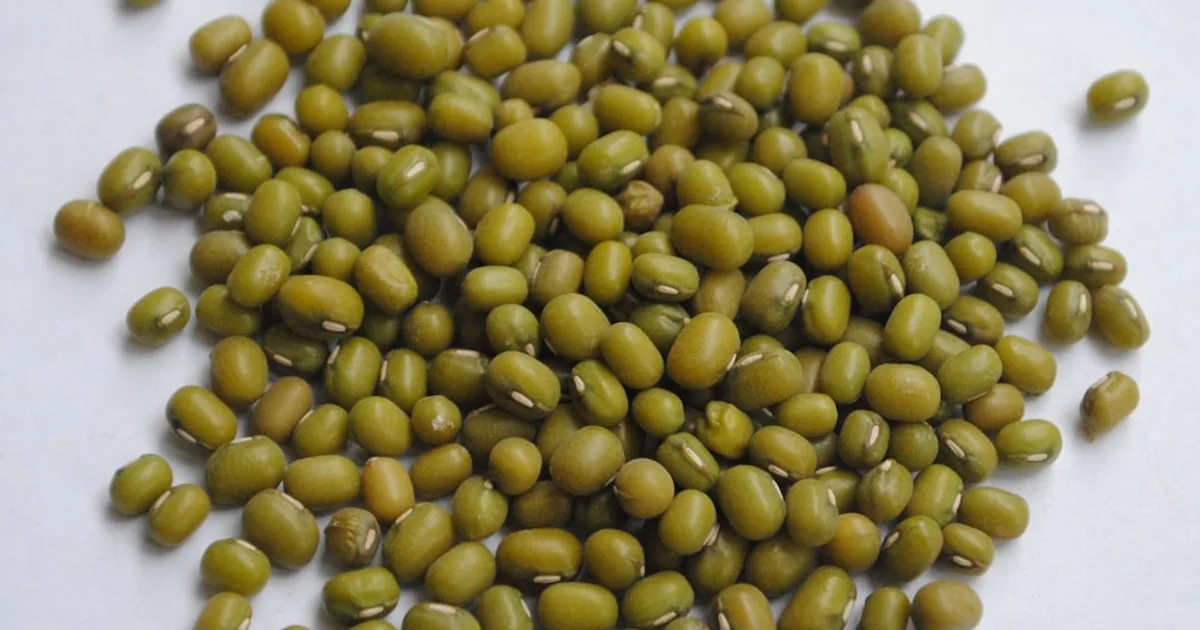
Mung beans (Vigna radiata) are two different crops in the same seed. You can grow them outdoors as a warm-season dry bean - 60 days, full sun, drought-tolerant, nitrogen-fixing, worth growing for the soil as much as the harvest. Or you can skip the garden entirely and sprout them on your kitchen counter in under a week, year-round, with nothing but a jar, water, and a lid. The same bag of dried mung beans works for either use. Most crops give you one return. Mung beans give you at least two.
The outdoor ROI on dried beans is modest. At $1.50-2.50/lb bulk bin pricing (USDA AMS Specialty Crop Market News), growing your own dried mung beans is more about self-sufficiency and soil improvement than replacing expensive grocery items. The sprouting math is a different story.
What it actually is
Vigna radiata is a warm-season annual legume in the family Fabaceae, originating in South Asia and domesticated in India at least 4,500 years ago. It is related to cowpea (Vigna unguiculata) and black-eyed pea, though it is a distinct species. In the US, it is most commonly sold as “mung bean” or “moong”; in Asian cooking traditions it appears as mung dal (hulled and split), whole cooked beans, and bean thread noodles made from mung starch.
Plants grow 18-30 inches tall as a branching bush. Pods are slender, 3-4 inches long, and turn black when mature. Each pod contains 10-15 small, round green or yellow-green seeds. Commercial varieties bred for sprouting include ‘Emerald’ and ‘Oklahoma’; hulled yellow mung beans are the same species but not suitable for sprouting.
Sprouting economics
One pound of dry mung beans costs $1.50-2.50 from bulk bins at natural food stores or $2-4/lb from online suppliers (USDA AMS). One pound of dry beans yields approximately 5 lbs of finished sprouts. Fresh bean sprouts retail at $3-5/lb at natural food retailers and Asian grocery stores - call it $15-25 in retail value from a $2 investment in beans. The equipment is a wide-mouth mason jar and a sprouting lid (mesh screen or ring-and-cheesecloth setup), which runs $2-5 total as a one-time purchase. Space required: a kitchen counter, out of direct sun.
The labor is two rinses per day for 4-5 days. Each rinse takes about 90 seconds. Total active time per batch: roughly 12 minutes spread across a week.
Margins at this scale are real. A $4 bag of mung beans from the bulk section produces two to three batches of sprouts, each worth $15-25 at retail. Even at home, where you’re not selling them, you’re replacing a $3-5 grocery purchase per batch.
Indoor sprouting cycle
The process is straightforward and the same for every batch.
| Day | Action | Notes |
|---|---|---|
| 0 | Soak dry beans 8 hours (or overnight) in cool water | Use 3x the volume of water; beans double in size |
| 1 | Drain, rinse once, prop jar at 45-degree angle to drain | Airflow matters; standing water causes rot |
| 2 | Rinse twice, morning and evening, drain completely each time | Roots emerging, 1/4 inch |
| 3 | Rinse twice; roots 1/2-3/4 inch | Smell should be fresh, not sour |
| 4 | Rinse twice; roots 1-1.5 inches | Harvest window opens |
| 5 | Final rinse and harvest | Do not let roots exceed 2 inches; flavor turns grassy |
Optimal temperature is 65-75°F (USDA FoodData Central sprouting safety guidelines recommend 70°F as the target for home sprouting). Below 60°F, germination slows - a cold basement in winter will push the cycle to 6-7 days. Above 80°F, the risk of bacterial growth increases; keep sprouts in a cooler part of the kitchen.
Light: indirect is fine for the first 4 days. Direct sun turns the sprouts bitter and can heat the jar enough to cause problems. If you want to develop chlorophyll and a slightly greener sprout, move the jar near (but not in) a window on day 4-5.
Rinse any batch that starts smelling sour or fermented - that batch is done. Start fresh. The cause is almost always incomplete drainage. The jar must drain after every rinse.
Nutrition density
Sprouting transforms the nutritional profile. Dry mung beans contain essentially no vitamin C - the USDA FoodData Central database lists raw dried mung beans at 4.8 mg per 100g. Mung bean sprouts at maturity contain 13.2 mg per 100g - vitamin C is generated during germination as the seed mobilizes ascorbic acid for its own growth. Protein content in sprouts runs 3.0g per 100g of finished sprout by weight, with folate at 61 mcg per 100g (USDA FoodData Central, #11043, mung beans, mature seeds sprouted, raw).
The home economics argument here is not just cost. A fresh sprout 4-5 days from a dry seed has more vitamin C than the dry version, is ready to eat with no cooking, and was produced with no refrigeration until the final 24 hours. For anyone interested in year-round fresh food production without a grow light setup or a winter garden, sprouting is one of the few practical options.
Outdoor dry bean growing
Mung beans are a warm-season annual. Direct sow after last frost when soil temperature is at or above 65°F. In most of the continental US, that means May through early July. Germination in 4-7 days at 70°F soil temperature. Sow seeds 1 inch deep, 3-4 inches apart, in rows 18 inches apart. Thin to 6 inches if stand is thick.
The crop tolerates heat and drought better than most legumes. Once established, mung beans handle 90°F+ days without the flower drop you see in beans like fava or pea. Water stress at flowering will reduce pod set, but established plants can go 10-14 days between waterings in average soil without permanent damage. The primary threat is waterlogging - poor drainage leads to root rot and rapid plant loss. If your soil is heavy clay, amend the bed or raise it.
Mung beans fix nitrogen via Bradyrhizobium spp. root nodules. Inoculate with a cowpea or mung bean-specific rhizobium inoculant at planting if you haven’t grown legumes in that bed before. Without the right rhizobia present, the plants grow but don’t fix nitrogen. The inoculant costs $3-5 per season and is available where vegetable seeds are sold.
Yield for home garden conditions: 0.5-1.5 lbs of dried beans per 10-foot row, depending on variety, rainfall, and soil quality (Cornell Vegetable Program yield reference ranges for small legumes). At $1.50-2.50/lb bulk retail pricing, the ROI from outdoor-grown dried mung beans is modest. A 10-foot row returns $0.75-3.75 in retail value of dried beans from a $0.50-1.00 seed investment plus labor. The outdoor value is primarily the nitrogen fixation and the option to use the harvest for sprouting - not the dried bean price itself.
Harvest when 75% of pods have turned tan to black. Pull entire plants and hang them upside down in a warm, dry space for 2 weeks. Pods shatter when fully dry; thresh by beating plants against the inside of a bucket or tub. Winnow to remove chaff.
Storage of dry beans
Properly dried mung beans store 2-5 years in airtight containers kept away from light and heat (USDA National Center for Home Food Preservation guidelines for dry bean storage). Moisture content below 12% is the target - beans dried to cracking-dry between your fingers are close to that range. Storage in glass jars with tight-fitting lids works well; vacuum-sealed bags extend shelf life further.
This makes mung beans an unusually resilient pantry crop. A bag of seeds bought today for sprouting can be stored for years without quality loss. The sprouting use case doesn’t require fresh-season beans - last year’s harvest or last year’s bulk bin purchase sprouts just as well as this year’s. Compare this to most garden crops, which require either fresh use, freezing, or canning. Mung beans require none of that infrastructure to be useful 18 months from now.
If you are buying beans specifically for sprouting, buy green whole mung beans and confirm they are not steam-pasteurized or treated - pasteurized beans will not sprout. Most bulk bin mung beans are viable; packaged “field run” beans sold for soup are usually viable; split or hulled mung beans (yellow moong dal) will not sprout at all.
What goes wrong
Poor germination indoors: Almost always incomplete drainage. The jar must sit at an angle to drain after every rinse. A flat jar on a counter holds pooled water that drowns seeds or promotes rot.
Sour smell by day 2-3: Too warm or not rinsed frequently enough. Rinse more often in hot weather - three times per day above 80°F ambient temperature.
Powdery mildew (Erysiphe polygoni) affects outdoor plants in humid, warm conditions. Adequate spacing (6 inches between plants) and morning irrigation that allows foliage to dry reduce incidence. Sulfur-based fungicides applied preventively when humidity is persistently high provide some protection.
Pod shattering before harvest: Mung bean pods shatter readily when fully dry. Check plants daily once pods start turning tan. Harvest promptly rather than waiting for uniform ripeness across the whole plant.
Whitefly (Bemisia tabaci) can colonize mung beans in warm climates, particularly in the South. Reflective mulch under young plants deters early colonization. Insecticidal soap handles light infestations; heavy infestations in late summer are difficult to reverse.
Related crops: Edamame, Garden Pea, Green Bean
Related reading: Beginner Homestead Crops - crops that build soil and feed you with minimal infrastructure
Growing Mung Bean? Track your harvest value and break-even date in the Garden ROI app.
Get the App